


 by Tom Gurney
Tom Gurney BSc (Hons) is an art history expert with over 20 years experience
Published on June 19, 2020 / Updated on August 8, 2026
Email: tomgurney1@gmail.com / Phone: +44 7429 011000
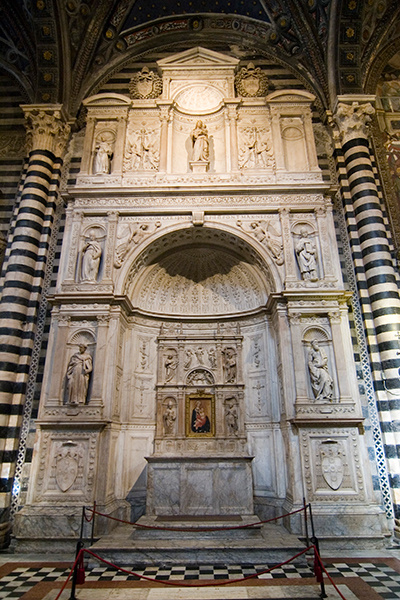
Piccolomini Altarpiece, Siena Cathedral, by Michelangelo
Michelangelo’s presence in Siena Cathedral is easy to miss. It does not announce itself through a single colossal statue or a monument designed entirely by him. Instead, four marble saints occupy niches in the Piccolomini Altarpiece, joining an architectural and sculptural ensemble begun by another master. Saint Peter, Saint Paul, Saint Pius and Saint Augustine stand as individual figures, but their meaning depends on the altar that receives them.[1]
That situation makes the Piccolomini commission unusually revealing. Michelangelo had to carve for predetermined spaces, serve an inherited devotional programme and share authorship with Andrea Bregno’s larger structure. The result challenges the modern habit of extracting a famous artist from every collaboration. These are Michelangelo sculptures, but the Piccolomini Altarpiece is not simply “a Michelangelo.” Its richness lies in the meeting between a young sculptor’s bodily imagination and a Sienese monument with its own family, religious and architectural history.
At a Glance
- Artist focusFour marble saint figures carved by Michelangelo
- MonumentPiccolomini Altarpiece, also called the Piccolomini altar
- LocationSiena Cathedral, Siena
- Date of Michelangelo’s commissionEarly sixteenth century, beginning in 1501
- Michelangelo’s named figuresSaint Peter, Saint Paul, Saint Pius and Saint Augustine, following the Opera del Duomo’s current identification[1]
- Earlier principal artistAndrea Bregno
- Patronal settingThe Piccolomini family and Cardinal Francesco Todeschini Piccolomini, later Pope Pius III
- MediumMarble sculpture within an architectural altar ensemble
- Authorship cautionMichelangelo contributed figures; he did not design or carve the entire altar
- Related but separate siteThe Piccolomini Library elsewhere in the cathedral complex
- Important attribution cautionSome secondary records vary in naming the upper saints[3][4]
- Madonna cautionA proposed connection with the Madonna of Bruges remains disputed in Musea Brugge’s own published material[6][7]
Contents
- An Altar Within Siena Cathedral
- The Piccolomini Ambition
- Andrea Bregno and Shared Authorship
- Four Saints, Not an Entire Monument
- Bodies Designed for Niches
- Saint Peter and Saint Paul
- Saint Pius and Saint Augustine
- What the Ensemble Changes
- An Unfinished Contract, Not Unfinished Statues
- The Madonna of Bruges Question
- Beside Michelangelo’s Other Ecclesiastical Commissions
- How to Look at the Altar
- Siena and Michelangelo’s Geography
- Why the Piccolomini Altarpiece Matters
- Artist Up Close
An Altar Within Siena Cathedral
Siena Cathedral is itself an accumulation of artistic campaigns. The Opera del Duomo presents a building shaped by major sculptors across generations, including Nicola and Giovanni Pisano, Donatello, Michelangelo and Bernini.[1] The Piccolomini altar belongs to this dense environment, where sculpture operates within coloured marble, architecture, liturgy and family commemoration.
The Italian Ministry of Culture likewise places the cathedral and its Piccolomini monuments within a unified historic complex.[2] That broader setting matters, but it can also blur distinct objects. The altar is not the Piccolomini Library, whose frescoed interior and family associations form another celebrated destination within the cathedral. Nor is it the cathedral as a whole. The precise subject here is an altar and Michelangelo’s contribution to its sculptural population.
Originally encountered in sacred use, the figures were not neutral exhibits. Their niches organised a vertical company of saints around a central devotional focus. Prayer, memory and the status of the Piccolomini patron converged in the structure. Michelangelo’s carving had to speak within that already articulated language.
The Piccolomini Ambition
The altar is bound to the Piccolomini family, one of Siena’s most prominent lineages. Cardinal Francesco Todeschini Piccolomini commissioned an imposing monument that carried personal, dynastic and ecclesiastical meaning. His later election as Pope Pius III, although extremely brief, gave the family connection an additional papal resonance.
The family name appears across the cathedral, most famously in the adjacent history of the Piccolomini Library. The Opera’s separate account of that library helps clarify the scale of Piccolomini patronage while also protecting the objects from confusion.[5] The library’s Pinturicchio frescoes, illuminated books and ceremonial programme should not be imported into the altar as though Michelangelo designed them.
For the young sculptor, the commission offered prestige and difficulty. The number of figures envisioned was much larger than the four he eventually delivered. The surviving contribution therefore represents both fulfilment and contraction: a real group of statues made for the monument, and the residue of a more extensive plan that competing commitments prevented him from completing.
Andrea Bregno and Shared Authorship
Andrea Bregno, a leading sculptor and architect of papal Rome, had established the altar’s architectural and sculptural framework. Penn State’s visual-resource metadata preserves both Bregno and Michelangelo in the object’s authorship history, a concise reminder that the monument cannot be assigned to one hand without qualification.[3]
Shared authorship here is not an incidental footnote. The niches determined scale and stance; the existing structure established hierarchy; earlier carving supplied neighbours to which new figures had to respond. Michelangelo’s saints are individual works, but their proportions and presentation arise from those conditions.
This kind of commission was common in Renaissance practice. A later artist might finish, extend or populate a monument whose governing conception belonged to someone else. The artistic problem was not to erase the inheritance. It was to make new work convincing within it. Michelangelo’s physical intensity appears not in opposition to the altar, but through an adjustment to its demands.
Four Saints, Not an Entire Monument
The Opera del Duomo identifies Michelangelo’s figures as Saint Peter, Saint Paul, Saint Pius and Saint Augustine.[1] That institutional list is the soundest basis for naming the group. Secondary guides and metadata can preserve variant labels, particularly for upper figures, which is why a confident account should acknowledge rather than silently combine disagreements.[3][4]
Peter and Paul supply a particularly strong pair. As foundational apostles of the Roman Church, they are frequently juxtaposed. Peter’s identity may be associated with the keys and Paul’s with the sword or book, although the precise condition and visibility of attributes should be judged from the objects rather than filled in from generic iconography. Their pairing gives the altar apostolic authority.
Pius and Augustine add different kinds of ecclesiastical memory. Pius carries special resonance within a monument sponsored by the Piccolomini, a family that produced Popes Pius II and III. Augustine brings the authority of a Church Father and bishop. Together, the four do not make a single narrative. They form a sacred hierarchy whose identities reinforce the altar’s patronal and devotional world.
Bodies Designed for Niches
A niche statue inhabits an architectural limit. It cannot be understood exactly like a freestanding figure placed in open space. The body must remain legible from a principal approach, fill its recess without appearing cramped and sustain attention despite being one element among many.
Michelangelo responds with compact, clearly distributed masses. Drapery does not float independently of anatomy; it records stance, weight and the turn of the torso. Heads and hands carry identity, while the larger silhouette must read across the cathedral interior. The sculptor concentrates rather than disperses action.
This constraint helps explain why the saints may initially look less dramatic than David or the unfinished Saint Matthew. Their task is different. A victorious civic hero can dominate surrounding space. An apostle within an altar must be forceful and obedient at once. Michelangelo’s figures gain distinction through the density with which they occupy assigned places.
Saint Peter and Saint Paul
Peter and Paul embody complementary traditions of ecclesiastical authority. Peter, the apostle associated with Christ’s charge and the keys, represents the foundation of the Church. Paul, converted from persecutor to missionary, represents teaching and expansion. Placed within a Piccolomini monument, their presence links family patronage with universal Christian history.
The pair also lets Michelangelo vary character. Apostolic authority need not produce identical posture or temperament. Differences in head, turn, drapery and attribute allow two saints to belong together without becoming symmetrical copies. Penn State’s record, which focuses specifically on Saint Paul and Saint Peter, supports attention to these lower figures as a coherent part of the ensemble.[3]
Their niches mediate individuality. Each body has its own directional energy, but architectural repetition binds them into the altar. The viewer alternates between recognising two named apostles and seeing the larger order they help construct.
Saint Pius and Saint Augustine
The upper saints are an area where naming requires care. Opera del Duomo’s current English account calls them Saint Pius and Saint Augustine.[1] A secondary Web Gallery of Art entry supplies additional altar history but also illustrates how labels can vary in the literature.[4] The responsible solution is not to conceal that issue or produce an invented consensus. It is to follow the cathedral authority while marking the existence of variants.
Their placement higher in the structure affects their carving and reception. Figures seen from below need forceful silhouettes and gestures that survive distance. Fine surface subtleties become secondary to bodily organisation. What appears reserved in close photographs may have possessed a different clarity within the altar’s vertical sequence.
Pius’s name is especially meaningful in Piccolomini territory. It binds sanctity, papal identity and family memory. Augustine represents learned episcopal authority. Together with Peter and Paul, the figures establish several levels of Church history rather than a random gathering of saints.
What the Ensemble Changes
Looking at one isolated photograph can make a saint appear like a small autonomous sculpture. Looking at the altar restores scale. Architecture divides, ranks and frames. Repeated niches turn individual bodies into a community. The central sacred focus determines why those bodies gather.
This ensemble logic also tempers attribution. Viewers may arrive because Michelangelo’s name is famous, but the altar teaches them to see his contribution among other decisions. Bregno’s structure is not background scenery; it is the system to which the figures respond. The Piccolomini patronal programme is not biography around the art; it is part of what the art was required to do.
Michelangelo’s success becomes more, not less, impressive within that setting. He made figures recognisable as his own while allowing them to maintain the cadence of a monument he inherited.
An Unfinished Contract, Not Unfinished Statues
The commission was not fulfilled to its projected extent, but that does not mean the four surviving figures should be described as though each were merely a rough block. Two forms of incompletion need separation. A programme can remain incomplete because fewer objects were delivered than planned; an individual statue can remain physically unfinished. The Piccolomini story is primarily the first.
Michelangelo’s obligations multiplied rapidly in these years. The David, Florentine painting and sculpture projects, and eventually Julius II’s summons competed for his attention. The contracted group contracted in reality. That professional context helps explain why four figures stand where a larger Michelangelo contribution had once been imagined.
The gap is historically significant. It records how Renaissance commissions could change even when backed by powerful patrons. Yet the figures should not be judged only as remnants of non-performance. They became actual participants in the altar and have sustained its Michelangelo connection for centuries.
The Madonna of Bruges Question
One long-running proposal connects Michelangelo’s Madonna of Bruges with the Piccolomini altar. The idea is attractive: a major Madonna and Child might seem suited to a central niche, and the early date brings the sculpture close to the Sienese commission. But attraction is not proof.
Musea Brugge’s own material preserves the problem unusually clearly. An English visitor-oriented account has repeated a Piccolomini-origin claim, while the museum’s current Dutch object record rejects that theory.[6][7] When sources from the sculpture’s holding institution do not agree, certainty is not responsible.
The altar can therefore mention the hypothesis as part of its interpretive history, but it cannot use the Bruges Madonna as the missing centre of a confident reconstruction. The Madonna has its own provenance, church setting and object history in Bruges. A disputed possible origin should remain precisely that.
Beside Michelangelo’s Other Ecclesiastical Commissions
The Piccolomini saints belong with Michelangelo’s Bologna Angel and Florentine Saint Matthew as evidence of how he worked within religious institutions. The Angel joins an old, multi-author tomb shrine; Saint Matthew is the sole begun figure from an abandoned cathedral cycle; the Siena saints enter a pre-existing altar. None fits the fantasy of the artist creating in isolation.
Their differences are instructive. The angel’s small scale and candlestick define service. Matthew’s over-life-size block makes arrested labour visible. The Piccolomini figures are individually completed contributions to a larger programme that was only partially fulfilled. “Commission sculpture” names a field of distinct problems, not a common look.
A career-wide study of Michelangelo as draftsman and designer helps situate this adaptability within his wider practice.[8] Design meant coordinating a body with purpose, medium and setting, whether or not he controlled the entire environment.
How to Look at the Altar
Begin with the whole. Locate the monument within the cathedral, observe its vertical divisions and find the central devotional axis. Then identify the four saints attributed to Michelangelo. This order prevents fame from reducing the ensemble to scattered signatures.
Next compare how each statue fills its niche. Look at the interval around head and shoulders, the spread of drapery near the base, and the direction of face or gesture. Architectural repetition makes differences easier to detect. Each figure negotiates a similar container without adopting an identical solution.
Finally step back again. Ask what changes when the saints become parts of one altar. Their bodies create a rhythm that is religious, spatial and dynastic. The work’s central lesson lies in that return from individual to ensemble.
Siena and Michelangelo’s Geography
The altar also places Michelangelo within a network of Italian cities. He was formed in Florence, achieved early fame in Rome and contributed to major projects in Bologna and Siena. Renaissance artistic careers did not unfold inside the boundaries later used to organise museums. Patrons, contracts, marble and reputation moved.
Siena was not simply a provincial stop beneath Florentine achievement. Its cathedral possessed one of Italy’s richest sculptural traditions and a fiercely distinctive civic identity.[1][2] For a Florentine sculptor to enter that setting was to join another city’s history, not to export a complete style into an empty space.
The figures preserve this mobility in concentrated form. Their carving belongs to Michelangelo; their niches belong to the Piccolomini altar; their continuing identity belongs to Siena Cathedral. No one geography cancels the others.
Why the Piccolomini Altarpiece Matters
The altar enlarges our understanding of Michelangelo by restricting it. Here he was not the sovereign author of a colossal conception. He was a brilliant contributor completing specified figures for another artist’s architecture and a patron’s sacred design. The commission demanded negotiation as much as invention.
It also makes shared authorship visible. Renaissance monuments often grew over time, and the names now most famous did not monopolise them. Bregno’s framework, Piccolomini ambition, cathedral space and Michelangelo’s saints remain mutually dependent. Separating them may simplify attribution; it impoverishes understanding.
Most importantly, the ensemble gives four relatively small sculptures a collective force. Peter, Paul, Pius and Augustine bind apostolic, papal and learned authority into the family altar. Michelangelo’s figures matter not because they escape the monument, but because they make its hierarchy bodily present.
Artist Up Close
Michelangelo was in his mid-twenties when he accepted the Piccolomini commission, already celebrated for the Roman Pietà and soon absorbed by the David. His Siena saints show a sculptor balancing rising fame with contracted work in several cities. They also reveal something the mythology of solitary genius often loses: he could read another artist’s framework, make strong figures for fixed niches and allow his invention to serve an institution. That ability would remain essential even when the scale of his commissions became architectural.
Frequently Asked Questions
Discussion
What changes when Michelangelo's saints are read as part of a Siena Cathedral altar rather than isolated sculptures?
How much should a page foreground variant labels when the official Cathedral source gives the safest public wording?
Where do you see Michelangelo adapting his sculptural force to an inherited religious setting?
Join the Conversation
Compare the Siena Cathedral setting, Michelangelo's saint figures and the questions raised by ensemble authorship.
References
- Opera Duomo Siena, The Cathedral”:, View source.
- Ministero della Cultura, Cattedrale di Siena e Libreria Piccolomini”:, View source.
- Penn State University Libraries Digital Collections, Piccolomini Altar: St. Paul and St. Peter”:, View source.
- Web Gallery of Art, Piccolomini Altar: St Pius”:, View source.
- Opera Duomo Siena, Piccolomini Library”:, View source.
- Musea Brugge, O.L.V.-kerk Museum”:, View source.
- Musea Brugge, Madonna met Kind”:, View source.
- The Metropolitan Museum of Art, Michelangelo: Divine Draftsman and Designer”:, View source.