by Tom Gurney
Tom Gurney BSc (Hons) is an art history expert with over 20 years experience
Published on June 19, 2020 / Updated on October 17, 2026
Email: tomgurney1@gmail.com / Phone: +44 7429 011000
Looking at Red Bull
Franz Marc’s red bull folds its heavy body into a small, bright space. Its head turns down towards its chest; a short horn curves above a pale face. The broad red-orange flank arches across the right, while a long tail curls at the lower edge. Blue, green, yellow and black shapes surround the animal without describing a realistic field. Marc made Red Bull in 1912. It is a work on paper, and its colour has the direct, concentrated energy of gouache rather than the scale and surface of one of his large oil paintings. [1]
The owning Pushkin Museum in Moscow titles it Красный бычок, with the German original title Roter Stier. It records gouache on paper mounted on cardboard, 337 × 427 mm, about 34 × 43 cm. These facts are important because older online image descriptions sometimes call the same picture oil on canvas. The museum’s direct object record is the better authority for medium and size. “Bull” is a useful English title, though the Russian diminutive suggests a young or small animal; the visible creature is compact and horned, and the work’s title should not be used to invent its exact age. [1]
A resting body with restless colour
The bull appears settled low in the picture, its legs folded beneath its body. Its head drops across the front shoulder, with a dark eye, pale muzzle and curved horn still clear. The torso makes one strong arc from neck to haunch. The tail’s small spiral repeats that movement at the right edge. Marc has kept enough anatomy for the animal to be immediately recognisable, but the enclosing shapes make the body feel pressed into the painted ground. [1]
The red is not a flat fill. It deepens into brown along the neck and underside, burns orange across the main body, then cools with green-blue touches near the back. A pale band on the face and muzzle interrupts the warmer colours. These shifts describe volume even as they free the bull from natural coat colour. Looking from face to flank to tail, the viewer follows both the animal’s form and a movement of colour through it. [1]
Behind the bull, dark rounded zones meet a bright white opening near the top. A saturated blue at left contrasts with the animal’s red; yellow and green areas collect below and to the side. None needs to be labelled as a particular rock, tree or cloud for the picture to work. They are a setting made of colour pressures around a folded body. The animal looks quiet, but its surroundings keep the image active. [1]
This contrast between pose and painted energy is characteristic of the work’s appeal. We might expect a bull to be shown charging or standing ready to fight. Marc chose a curled, inward shape. The tension is not an illustrated action; it lies in the force of the red body and the strong surrounding blues and yellows. The animal has weight without being fixed to a conventional pasture. [1]
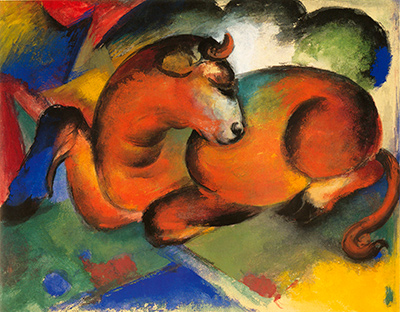
Franz Marc, Red Bull. The reclining bull is held among broad, contrasting patches of colour.
Watch: Franz Marc
Explore Marc’s blue horses, the Blue Rider circle and the move towards abstraction in English-language videos.
Franz Marc, Blue Horses and Der Blaue Reiter
An English-language introduction to Marc’s blue horses, animals, spirituality and the Blue Rider.
Watch on YouTubeThe material matters
Gouache is an opaque water-based paint, and paper behaves differently from a large canvas. In this work, bold zones of colour can be laid down quickly and joined by dark, emphatic contours. The Pushkin Museum lists the sheet as mounted on cardboard. The object’s roughly 34-by-43-centimetre size gives it an intimacy quite unlike Marc’s monumental horse groups. A digital enlargement can hide that difference; the material and dimensions put it back into view. [1]
The museum’s cataloguing also prevents a common confusion with other bull images. Marc made more than one Stier or cattle subject, including oil paintings, studies and woodcuts. Cows, Red, Green, Yellow includes a green bull within a group at the Lenbachhaus, while the Guggenheim’s White Bull [7] is a distinct 1911 oil painting. A 1912 woodcut titled Der Stier exists in multiple impressions. None of those is this small red gouache. The Pushkin accession number Р-12523 and the curling pose identify the specific work. [1] [2] [3]
Red among Marc’s colours
In a December 1910 letter to August Macke, Marc described red through associations with heavy matter, alongside his personal descriptions of blue and yellow. It is tempting to attach that single phrase to the bull’s strength. The picture is more complicated than a code. The red body is made warm and solid by its own curves, while blue, yellow, green and white alter how it appears. The artist’s letter gives context for his thinking about contrasts, but the visible animal and painted relations have to remain the centre of interpretation. [4] [1]
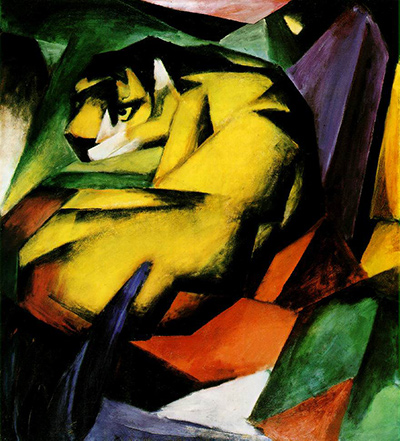
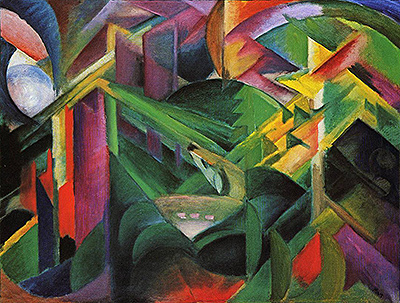
Marc’s other animal pictures of 1912 show how varied that inquiry could be. Tiger puts a crouching predator inside a nearly square field of angular planes. Deer in a Monastery Garden makes a small creature alert within a fractured moonlit setting. The red bull is quieter in action and smaller in material scale. Yet all three bind animal form to surrounding colour and shape instead of merely placing a creature before scenery. Their differences keep “Marc’s animals” from becoming one repeated formula. [5] [6] [1]
In the Pushkin collection
The Pushkin Museum records the work entering its collection in 1965 and names A. A. Tolokonnikov as a former owner. It belongs to the museum’s Western graphic art holdings. This is a concise provenance, and it should remain one: the object record does not support a detailed chain of earlier owners or exhibition claims. What it does establish is the work’s current institutional home, physical medium and date. [1]
The bull rewards a final look as both an animal and a colour structure. Its bowed head, folded legs and curling tail make a compact resting pose. The red body, blue edge and bright yellow ground prevent rest from becoming stillness. Marc compressed considerable visual energy into a sheet that can be held in the mind almost as one curving form. The museum’s precise cataloguing lets us appreciate that form as the particular gouache it is. [1]
Artwork Directory
This source-checked selection contains 192 identified works and print designs from the current Franz Marc research set. It is a curated selection, not a complete catalogue raisonné. Some works link to their article here; others link to a collection record. Unresolved identifications are omitted.
Discussion
The bull rests while its red body and the surrounding colour remain active.
Reader Insights
Observation
Which curve makes the resting weight of the body clearest?
Comparison
How does this animal occupy its small sheet differently from a large canvas?
Interpretation
Does the red feel like a surface colour or part of the scene’s structure?
Join the Conversation
Which detail changed the way you saw this work? Share a close observation or a comparison with another Marc picture.
References
- Pushkin State Museum of Fine Arts, Красный бычок / Roter Stier, Р-12523. View source.
- Lenbachhaus, Kühe, rot, grün, gelb. View source.
- MoMA, Steer / Stier woodcut. View source.
- Marc to Macke, 12 December 1910, German correspondence. View source.
- Lenbachhaus, Tiger. View source.
- Lenbachhaus, Deer in a Monastery Garden. View source.
- White Bull. View source.
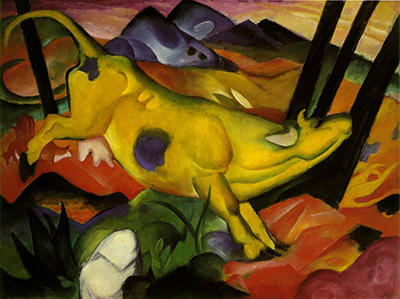
- Related artwork image, Yellow Cow: Photograph by Dr. Alexey Yakovlev; resized without crop or colour change, CC BY-SA 2.0.
- Splash image: Franz Marc, Red Bull, 1912. Pushkin State Museum of Fine Arts, Moscow. Public-domain file on Wikimedia Commons.