by Tom Gurney
Tom Gurney BSc (Hons) is an art history expert with over 20 years experience
Published on June 19, 2020 / Updated on October 17, 2026
Email: tomgurney1@gmail.com / Phone: +44 7429 011000
Looking at The Little Monkey
A small grey monkey sits within an exuberant forest of green, orange and red. The creature is easy to miss at first because branches and broad tropical forms crowd around it. Franz Marc painted The Little Monkey (Das Äffchen) in 1912. The Lenbachhaus describes how rapidly his art changed from the restrained naturalism of horse and deer studies around 1910 to the experimental colour and “magic forest” of this scene. The monkey is recognisable, but its environment sets the painting’s rhythm. [1]
Watch: Franz Marc
Explore Marc’s blue horses, the Blue Rider circle and the move towards abstraction in English-language videos.
Franz Marc, Blue Horses and Der Blaue Reiter
An English-language introduction to Marc’s blue horses, animals, spirituality and the Blue Rider.
Watch on YouTubeA creature inside colour
The oil canvas measures 70.4 × 100 cm and is catalogued as G 14664. Marc placed the monkey near the centre, partly framed by diagonals of branch and foliage. Its cool grey body contrasts with warmer orange forms and darker greens. The surrounding plants are not a detailed botanical record. They give the animal a dense, invented world whose lines and colour are as active as the creature itself. [1]
The museum notes a “Marc” signature at the lower left and another on the reverse with Sindelsdorf. It received the work as a 1965 gift from the Bernhard and Elly Koehler Foundation. Those details identify this particular canvas among Marc’s other monkey pictures, including the separate Monkey Frieze. The similarity of animal subjects should not flatten differences in size, date, arrangement or collection. [1]
In a recent exhibition essay, the Lenbachhaus sets Marc’s animal images in the history of imperial-era zoos and popular imagery. That context complicates any claim that this painting simply shows an untouched natural paradise. The museum’s reading invites attention to how an exotic animal was known and pictured in Marc’s time. The picture itself keeps the little creature and theatrical forest in tension. [2]
Look for the monkey’s curved arms and pale face, then follow the bright branches away from it. Marc gives an animal a place to inhabit while making that place a vivid construction of paint.
Artwork Directory
This source-checked selection contains 192 identified works and print designs from the current Franz Marc research set. It is a curated selection, not a complete catalogue raisonné. Some works link to their article here; others link to a collection record. Unresolved identifications are omitted.
Discussion
The little grey monkey is partly concealed by bright tropical growth.
Reader Insights
Observation
Where does the monkey emerge from the branches?
Comparison
How does this single animal differ from the group in Monkey Frieze?
Interpretation
How does the surrounding colour shape your attention to the animal?
Join the Conversation
Which detail changed the way you saw this work? Share a close observation or a comparison with another Marc picture.
References
- Lenbachhaus, Das Äffchen. View source.
- Lenbachhaus, The Blue Rider exhibition booklet. View source.
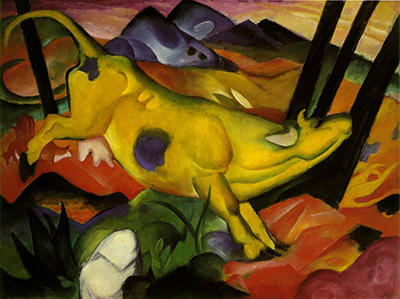
- Related artwork image, Yellow Cow: Photograph by Dr. Alexey Yakovlev; resized without crop or colour change, CC BY-SA 2.0.
- Splash image: Franz Marc, The Little Monkey, 1912, oil on canvas. Lenbachhaus, Munich, G 14664. Image CC0 1.0. Object record.