by Tom Gurney
Tom Gurney BSc (Hons) is an art history expert with over 20 years experience
Published on June 19, 2020 / Updated on October 17, 2026
Email: tomgurney1@gmail.com / Phone: +44 7429 011000
Looking at Little Blue Horse
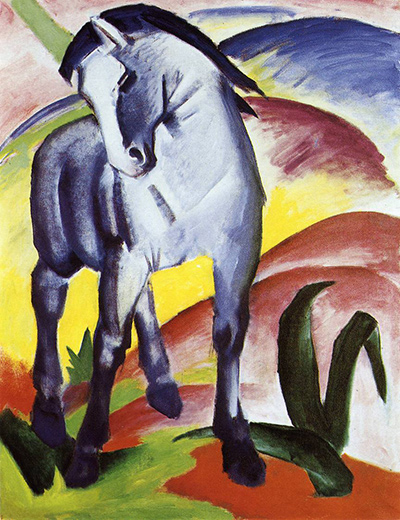
A small blue horse sits in a landscape of warm reds, oranges and greens. The painting is not a miniature version of Blue Horse I: it was made in 1912 as a gift for Walther Macke, the young son of Marc’s friend and fellow artist August Macke. The inscription at the top right names the boy. The Saarlandmuseum calls the work Blaues Pferdchen, Kinderbild—Little Blue Horse, Children’s Picture. That personal dedication gives the painting a specific social setting alongside its brilliant colours. [1]
Watch: Franz Marc
Explore Marc’s blue horses, the Blue Rider circle and the move towards abstraction in English-language videos.
Franz Marc, Blue Horses and Der Blaue Reiter
An English-language introduction to Marc’s blue horses, animals, spirituality and the Blue Rider.
Watch on YouTubeMade for Walther Macke
Marc painted the oil canvas during a visit to the Macke family in Bonn. It measures 58 × 73 cm, a much smaller and more intimate scale than some of his famous horse paintings. Walther had been born in April 1910. The museum reads the gift as a record of friendship between Marc and Macke, who met in 1910 and worked in the circle of Der Blaue Reiter. Calling the picture a “children’s” image should not imply it was casually made; its arrangement of colour and animal form is deliberate. [1]
The horse’s rounded body and youthful proportions give it a different presence from the bowed foal of Blue Horse I. Its blue remains vivid against the red and orange landscape, but the dedication asks us to see an exchange between households as well as a formal experiment. This is a useful case where biography, material facts and looking at the image strengthen one another. [1] [2]
A hidden earlier scene
The Saarlandmuseum describes an X-ray examination that revealed a previous landscape with two deer beneath the visible horse. Turning the radiograph through 180 degrees helped the museum recognise the older composition. Its account relates the different visibility of the two layers to pigments used in each painting. The finding shows that Marc reused the canvas; it does not establish exactly why. A discarded idea or a practical need for canvas are possibilities, not proven motives. [1]
The Saarlandmuseum acquired the picture in 1956 amid political controversy over modern art. Its collection account explains that hostile language about “degenerate art” was still deployed by opponents of such purchases after the war. The painting’s reception is therefore part of a much longer history than its first gift. [1]
Artwork Directory
This source-checked selection contains 192 identified works and print designs from the current Franz Marc research set. It is a curated selection, not a complete catalogue raisonné. Some works link to their article here; others link to a collection record. Unresolved identifications are omitted.
Discussion
Marc made this small blue horse as a gift for Walther Macke.
Reader Insights
Observation
How does the blue body sit among the warm landscape colours?
Comparison
How does its small scale and pose differ from Blue Horse I?
Interpretation
Does knowing it was a gift change what you notice?
Join the Conversation
Which detail changed the way you saw this work? Share a close observation or a comparison with another Marc picture.
References
- Saarlandmuseum/ZDF collection interpretation, Blaues Pferdchen. View source.
- Lenbachhaus, Blue Horse I. View source.
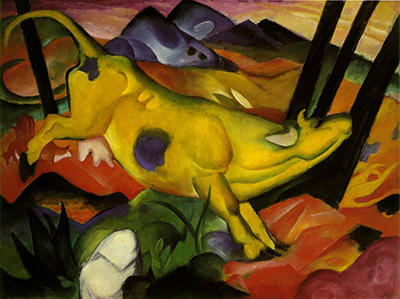
- Related artwork image, Yellow Cow: Photograph by Dr. Alexey Yakovlev; resized without crop or colour change, CC BY-SA 2.0.
- Splash image: Franz Marc, Little Blue Horse, Children’s Picture, 1912, oil on canvas. Saarlandmuseum, Saarbrücken. Object record. Image: Georg-Johann’s photograph via Wikimedia Commons, faithful public-domain reproduction; resized without crop or colour adjustment.