by Tom Gurney
Tom Gurney BSc (Hons) is an art history expert with over 20 years experience
Published on June 19, 2020 / Updated on October 17, 2026
Email: tomgurney1@gmail.com / Phone: +44 7429 011000
Looking at Dreaming Horse
A blue horse curls low within a swirl of angled colour. Its head bends in towards its body while dark arcs and pale shapes press around it. The old English route calls this work Horse Asleep; the Guggenheim Museum-uploaded record names it Dreaming Horse (Träumendes Pferd), dated 1913. The artwork is on paper, not an oil canvas, and the distinction matters to how its layered colour and drawn lines are seen. [1]
Watch: Franz Marc
Explore Marc’s blue horses, the Blue Rider circle and the move towards abstraction in English-language videos.
Franz Marc, Blue Horses and Der Blaue Reiter
An English-language introduction to Marc’s blue horses, animals, spirituality and the Blue Rider.
Watch on YouTubeA horse held by colour
The Guggenheim record describes watercolour, gouache, ink and graphite on paper, 39.6 × 46.8 cm, in its Founding Collection, 44.937. Several materials meet in one small image: watery colour, more opaque painted areas and drawn marks. The horse remains recognisable, but the body is also a group of intersecting blue planes. Pink, red, black and pale green around it make the resting pose feel sheltered and unsettled at once. This is a close look at the image, not a claim to know what the animal dreams. [1]
The picture belongs to Marc's late animal work, when recognisable bodies increasingly met fractured surroundings. Compare the compact sleeping form with The Large Blue Horses of 1911, whose three upright bodies sweep across a wide canvas. Both use blue horses, but they differ in medium, scale, grouping and mood. Dreaming Horse should also be kept separate from other sleeping-horse images in Marc's catalogue; the Guggenheim accession and exact reproduction anchor this one. [1] [2]
The image and the object
The Guggenheim Museum itself uploaded the digital image used here to Wikimedia Commons and dedicated that specific file CC0. This allows a clear high-resolution view of the whole composition. A digital file is still a reproduction of a physical sheet: its smooth screen colour cannot show every change in paper surface or density of pigment. The museum's object details give the size and materials; the picture invites attention to where ink lines and fields of colour meet. [1]
Artwork Directory
This source-checked selection contains 192 identified works and print designs from the current Franz Marc research set. It is a curated selection, not a complete catalogue raisonné. Some works link to their article here; others link to a collection record. Unresolved identifications are omitted.
Discussion
A blue horse curls inward while coloured arcs gather around it.
Reader Insights
Observation
Where does the horse’s head meet its folded body?
Comparison
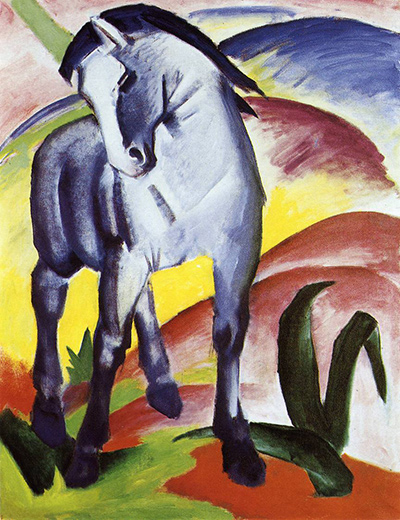
How does this compressed pose differ from Blue Horse I?
Interpretation
Do the surrounding shapes feel protective, pressing or both?
Join the Conversation
Which detail changed the way you saw this work? Share a close observation or a comparison with another Marc picture.
References
- Guggenheim Museum file record, Dreaming Horse. View source.
- Walker Art Center, The Large Blue Horses. View source.
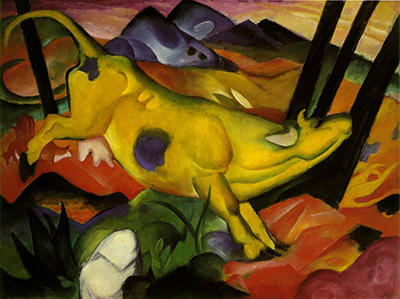
- Related artwork image, Yellow Cow: Photograph by Dr. Alexey Yakovlev; resized without crop or colour change, CC BY-SA 2.0.
- Splash image: Franz Marc, Dreaming Horse, 1913, mixed media on paper. Solomon R. Guggenheim Museum, Founding Collection, 44.937. Image uploaded by the museum under CC0. Image file and rights.