 by Tom Gurney
Tom Gurney BSc (Hons) is an art history expert with over 20 years experience
Published on June 19, 2020 / Updated on October 17, 2026
Email: tomgurney1@gmail.com / Phone: +44 7429 011000
Looking at Animals in a Landscape
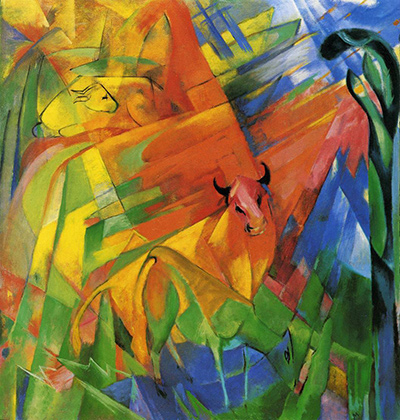
A russet animal's head appears amid a rush of yellow, blue, red and green planes. Other cattle are harder to find: their bodies seem to merge with the land around them. Franz Marc painted Animals in a Landscape in 1914, near the end of his short career. The Detroit Institute of Arts identifies at least three bovine animals, some grazing in the foreground and another lying farther away. The difficulty of separating them from the setting is part of the painting's experience. [1]
Watch: Franz Marc
Explore Marc’s blue horses, the Blue Rider circle and the move towards abstraction in English-language videos.
Franz Marc, Blue Horses and Der Blaue Reiter
An English-language introduction to Marc’s blue horses, animals, spirituality and the Blue Rider.
Watch on YouTubeAnimals and place together
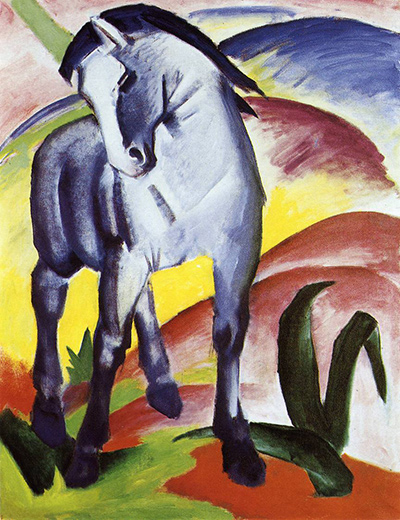
The painting is oil on canvas, Detroit Institute of Arts accession 56.144. The museum describes red, blue and yellow forms bursting from an upper corner and binding the cattle, plants and terrain into one energetic field. Looking closely at the image, horns and muzzles emerge from intersecting shapes, then seem to dissolve back into them. Marc had moved a long way from the clearer animal outlines of Blue Horse I in 1911, yet he had not abandoned recognisable creatures. He made their landscape as active as their bodies. [1] [2]
Colour is important here, but a fixed code for red or blue will not explain why the painting moves as it does. A red-brown bovine head draws attention within a cascade of diagonals, while blue and green shapes carry the eye through the rest of the composition. The DIA relates Marc's colour to his spiritual account of nature. The canvas itself shows how colour and intersecting forms make the animals and their environment difficult to divide. [1]
A documented collection history
Detroit records the painting in Robert H. Tannahill's collection from 1936 to 1956 and his gift to the museum in 1956. Its verso has inscriptions and old exhibition or gallery labels, including a reference to “Cattle in Jungle” and a 1914 cattle picture. Such documentary traces help explain why English names vary without turning every title into a separate object. The museum's current catalogue title and accession provide the clearest identification for this page. [1]
The DIA also records the painting in a 1916 Marc memorial exhibition and in later German and American catalogues. Those appearances place the work in Marc's posthumous reception. Today the painting lets a visitor see a late experiment that still begins with animals. The cattle are present, but finding them means following the whole painted field. [1]
Artwork Directory
This source-checked selection contains 192 identified works and print designs from the current Franz Marc research set. It is a curated selection, not a complete catalogue raisonné. Some works link to their article here; others link to a collection record. Unresolved identifications are omitted.
Discussion
Marc lets cattle emerge from, then disappear into, a field of intersecting colour.
Reader Insights
Observation
Which horn, muzzle or leg helps you find an animal first?
Comparison
How does this crowded 1914 canvas differ from the open meadow in Grazing Horses III?
Interpretation
Where does a colour shape belong to both an animal and its landscape?
Join the Conversation
Which detail changed the way you saw this work? Share a close observation or a comparison with another Marc picture.
References
- Detroit Institute of Arts, Animals in a Landscape. View source.
- Lenbachhaus, Blue Horse I. View source.
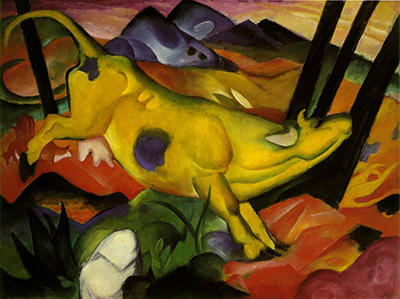
- Related artwork image, Yellow Cow: Photograph by Dr. Alexey Yakovlev; resized without crop or colour change, CC BY-SA 2.0.
- Splash image: Franz Marc, Animals in a Landscape, 1914, oil on canvas, 110.2 × 99.7 cm. Detroit Institute of Arts, Gift of Robert H. Tannahill, 56.144. Exact public-domain faithful reproduction from Wikimedia Commons; DIA object record.