by Tom Gurney
Tom Gurney BSc (Hons) is an art history expert with over 20 years experience
Published on June 19, 2020 / Updated on October 17, 2026
Email: tomgurney1@gmail.com / Phone: +44 7429 011000
Looking at The Bewitched Mill
A white torrent falls through the middle of Franz Marc’s The Bewitched Mill. To the left are houses and a red mill wheel; to the right, trees and small animals emerge from crowded colour. The water joins these two worlds while nearly hiding the passage between them. Marc painted the canvas in 1913 after visiting Merano in the southern Tyrol. The Art Institute of Chicago interprets the “bewitched” title as an expression of the harmony he sensed there between human settlement and the surrounding life of nature. The picture lets us look for that harmony without making the two sides identical. [1]
The work is a tall oil painting, 130.2 × 90.8 cm, now in the Art Institute’s Arthur Jerome Eddy Memorial Collection. Its German title is Die verzauberte Mühle. The shape of the canvas matters: the waterfall can run almost its full height, while the wheel, buildings, plants and animals are pressed together beside it. A wide landscape might have allowed each element its own space. Marc instead made them meet around the force of moving water. [1]
Watch: Franz Marc
Explore Marc’s blue horses, the Blue Rider circle and the move towards abstraction in English-language videos.
Franz Marc, Blue Horses and Der Blaue Reiter
An English-language introduction to Marc’s blue horses, animals, spirituality and the Blue Rider.
Watch on YouTubeFinding the mill and the animals
The mill wheel is visible at the lower left as a large red circle, though it is crossed by pale and dark straight lines. White buildings with small windows rise above it. Their squared forms contrast with the broad white fall just to their right. Marc gives the human-made part of the scene enough detail to be recognised, then lets its edges mingle with the movement of water. The wheel almost touches the stream that would power it; we see a relationship rather than a technical diagram of machinery. [2]
The right side needs slower looking. Rounded green foliage gathers at the top, and below it several shapes suggest animals among the trees. Near the lower right, a yellow head bends toward blue water. Other outlines are partly absorbed by the descending white. Marc had long asked what the world might look like from an animal’s perspective; here the animals are inhabitants of a busy place, not isolated specimens lined up for identification. The visible forms support a reading of animal life, while the picture does not require every patch of colour to resolve into a named species. [1]
The waterfall is the most immediate form. At its top, pale bands curl over a ledge. They widen and drop in long strokes of white, blue and grey, then turn near the bottom into swirling rings. Its repeated curves make a single stream feel like several moments of motion held at once. The water can seem to conceal what lies behind it and to reveal the painting’s structure: every nearby form either cuts across its path or bends with it. [2]
There is no neat boundary dividing “town” from “nature.” Roofs, wheel and windows collect on the left; leaves and creatures gather on the right. Yet the same strong red moves through the mill and the opposite edge, and blue appears in both the buildings and the lower stream. The colours travel across the supposed division. This is one way to understand the Chicago museum’s interpretation of a magical harmony: the painting makes unlike kinds of life share a single rhythm. [1]
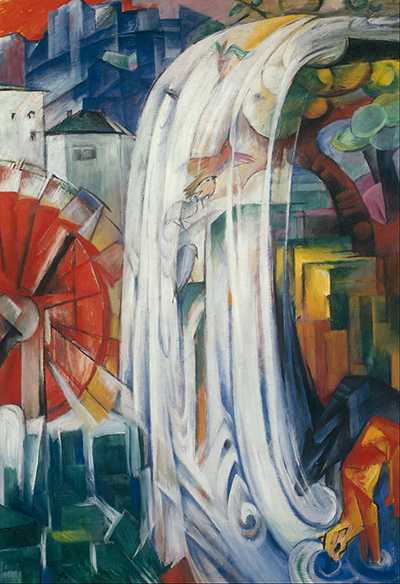
Franz Marc, The Bewitched Mill. The tall composition joins a watermill, animals and a white cascade.
Merano and Marc’s changing landscape
The Art Institute says Marc painted the work after a stay in Merano, the Italian town in the southern Tyrol. That location gives context to the subject, but the canvas should not be treated as a topographic record of a particular mill. Marc makes buildings legible and water unmistakable, then rearranges colour and scale so that the landscape carries a felt relation between settlement and nature. The title invites imagination because the place is concrete enough to recognise and transformed enough to escape a map. [1]
Compare the view with Horse in a Landscape of 1910. In the earlier work, one horse stands at the foreground edge and seems to look across broad bands of land. The Bewitched Mill gives no such stable lookout. The water blocks the centre; animals are distributed within the scene; buildings press near the flow. Marc’s later composition asks us to follow relationships through the whole canvas instead of looking outward with one animal. The two paintings show how far he could move while continuing to explore the meeting of creatures and landscape. [3] [1]
Marc’s colour remains bold, but it does not follow a rigid code in which each patch can be translated into a single emotion. Deep blue weighs down the buildings; white makes the water luminous; the wheel’s red makes human labour hard to ignore. The effect depends on where those colours sit and how they meet. The large white descent could divide the canvas. Through overlapping shapes and repeated tones it also becomes the link between the two sides. [2]
An early American collector
The painting reached Chicago relatively early. The Art Institute’s current provenance says Arthur Jerome Eddy bought it from Marc in 1914. It passed to Eddy’s wife Lucy and son Jerome after his death in 1920; they gave it to the museum in 1931. Some older summaries date Eddy’s purchase to 1913, but the museum’s updated record specifically gives 1914. The distinction matters when the painting’s path is told as a sequence of documented events rather than a general story of transatlantic taste. [1]
Eddy’s collection was already introducing American audiences to the work. The Art Institute’s own catalogue for its 1922 exhibition of Eddy’s paintings and sculpture lists The Bewitched Mill as item 50. A 1933 Chicago exhibition catalogue again lists it, then as a museum work in the Eddy Memorial Collection. These records do not tell us what every visitor thought; they show that the painting had a public American life before it became a familiar image in accounts of Marc. [4] [5]
The Art Institute identifies the work as public domain. That status concerns the painting; image sources still need to be identified precisely when it is reproduced. The institution’s record gives the stable object identity, and its image allows the winding stream, wheel and small animals to be inspected together. The tall canvas rewards that return: look from the houses to the wheel, follow the water down, then find the yellow head at the lower right. The apparent division between human and natural life becomes less secure the longer the forms are followed. [1]
Artwork Directory
This source-checked selection contains 192 identified works and print designs from the current Franz Marc research set. It is a curated selection, not a complete catalogue raisonné. Some works link to their article here; others link to a collection record. Unresolved identifications are omitted.
Discussion
Buildings, water, foliage and animals share an unsettled landscape.
Reader Insights
Observation
Where do you find the mill before the moving colour draws you away?
Comparison
How does this landscape differ from the separate Waterfall painting?
Interpretation
Which detail gives the scene its sense of enchantment?
Join the Conversation
Which detail changed the way you saw this work? Share a close observation or a comparison with another Marc picture.
References
- Art Institute of Chicago, object 1931.522. View source.
- Art Institute of Chicago painting image. View source.
- Museum Folkwang, Pferd in Landschaft. View source.
- Art Institute of Chicago, 1922 Eddy exhibition catalogue. View source.
- Art Institute of Chicago, 1933 Century of Progress catalogue. View source.
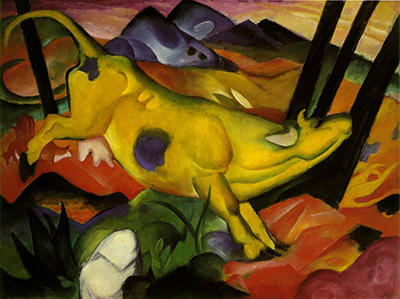
- Related artwork image, Yellow Cow: Photograph by Dr. Alexey Yakovlev; resized without crop or colour change, CC BY-SA 2.0.
- Splash image: Franz Marc, The Bewitched Mill, 1913. Art Institute of Chicago, 1931.522. Public-domain Google Art Project file.