by Tom Gurney
Tom Gurney BSc (Hons) is an art history expert with over 20 years experience
Published on June 19, 2020 / Updated on October 17, 2026
Email: tomgurney1@gmail.com / Phone: +44 7429 011000
Looking at Dog Lying in the Snow
A white dog rests in a quiet field of snow. Its body is curved into the ground, and cool blue shadows make it appear both solid and gently absorbed by winter light. Franz Marc painted Dog Lying in the Snow (Liegender Hund im Schnee) around 1911. The Städel Museum identifies the animal as Russi, Marc’s own white shepherd-cross dog. This is a more personal, stiller scene than the two standing animals in Siberian Dogs in the Snow. [1] [2]
Watch: Franz Marc
Explore Marc’s blue horses, the Blue Rider circle and the move towards abstraction in English-language videos.
Franz Marc, Blue Horses and Der Blaue Reiter
An English-language introduction to Marc’s blue horses, animals, spirituality and the Blue Rider.
Watch on YouTubeSnow, body and colour
The Städel records an oil painting measuring 62.5 × 105 cm, inventory 2085. The long horizontal format lets Russi’s curled shape and the broad ground settle together. White is not a blank area: pale blue and warmer tones differentiate fur, shadow and snow. The museum calls the picture a point of stylistic change away from close naturalistic description towards more deliberate experiments with colour and form. Looking at the dog’s outline and the soft field around it makes that shift visible without making the animal disappear into theory. [1]
Marc often painted resting animals. The pose can invite a viewer to project feelings of safety or sleep, but the painting does not need a sentimental story to be effective. Its calm depends on a precise relationship: the curve of the dog, the blue shadow under its body and the open winter space. Russi remains an individual animal in a setting rather than only an emblem of innocence. [1]
A painting that returned
The Städel bought the work from Marc’s widow Maria in 1919. The Nazi authorities confiscated it from the museum in 1937; the Städel reacquired it in 1961. Its record names the Städel Museum Association as owner. That sequence is crucial to the object’s story and should not be reduced to “in the Städel since 1919.” The museum now lists it on display in its modern-art rooms. [1]
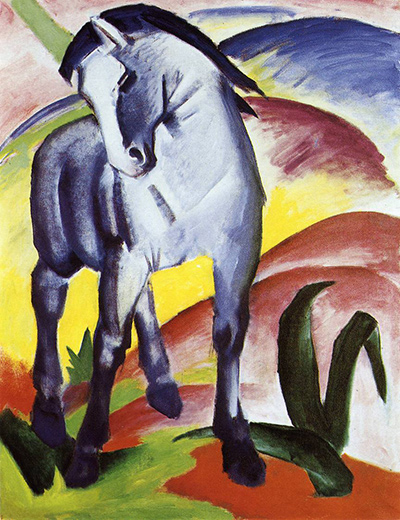
The same artist could make a blue horse monumental, two dogs animated by brushwork, or one white dog nearly motionless in snow. This picture’s small variations of white and blue ask for slower looking. They show how Marc’s experiments with colour grew from careful attention to an animal he knew.
Artwork Directory
This source-checked selection contains 192 identified works and print designs from the current Franz Marc research set. It is a curated selection, not a complete catalogue raisonné. Some works link to their article here; others link to a collection record. Unresolved identifications are omitted.
Discussion
The white dog’s body curls into a field of blue-shadowed snow.
Reader Insights
Observation
Which edge separates the dog from the snow most clearly?
Comparison
How does this still dog differ from Jumping Dog Schlick?
Interpretation
What makes the winter light feel quiet here?
Join the Conversation
Which detail changed the way you saw this work? Share a close observation or a comparison with another Marc picture.
References
- Städel Museum, Dog Lying in the Snow. View source.
- NGA, Siberian Dogs in the Snow. View source.
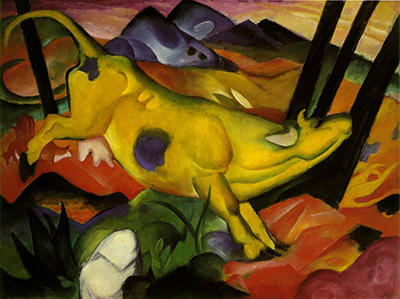
- Related artwork image, Yellow Cow: Photograph by Dr. Alexey Yakovlev; resized without crop or colour change, CC BY-SA 2.0.
- Splash image: Franz Marc, Dog Lying in the Snow, about 1911, oil on canvas. Städel Museum, Frankfurt, 2085. Museum object and image record marks the displayed image Public Domain; resized without crop or colour adjustment.