by Tom Gurney
Tom Gurney BSc (Hons) is an art history expert with over 20 years experience
Published on June 19, 2020 / Updated on October 17, 2026
Email: tomgurney1@gmail.com / Phone: +44 7429 011000
Looking at Blue-Black Fox
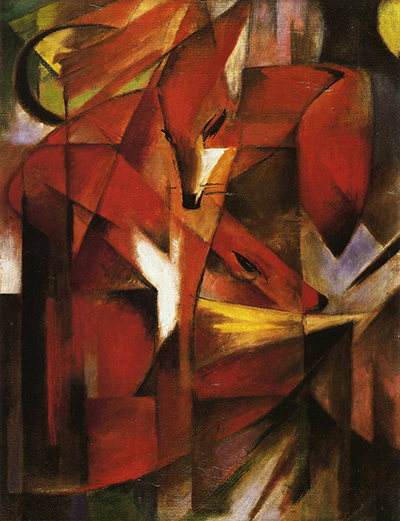
A fox curls into a deep blue and violet-black body while bands of red, yellow and green move around it. The animal is nearly continuous with its setting, yet its crouching outline remains clear. This is Franz Marc’s Fox, also called Blue-Black Fox (Blauschwarzer Fuchs), painted in 1911. It belongs to the Von der Heydt Museum in Wuppertal, inventory G 0686. It is a different painting from Marc’s later, more fractured The Foxes of 1913. [1]
Watch: Franz Marc
Explore Marc’s blue horses, the Blue Rider circle and the move towards abstraction in English-language videos.
Franz Marc, Blue Horses and Der Blaue Reiter
An English-language introduction to Marc’s blue horses, animals, spirituality and the Blue Rider.
Watch on YouTubeThe shape of a resting animal
The museum describes the oil painting as 50 × 63.5 cm. A broad curve runs along the fox’s back and turns towards its head, making the body seem soft despite the sharp colour differences around it. Dark blue and violet absorb part of its form; red, yellow and green areas give the surrounding space a pulse. The fox appears still, but the picture is not visually quiet. Following the curve of the animal helps us see how Marc brings body and landscape into one design. [1]
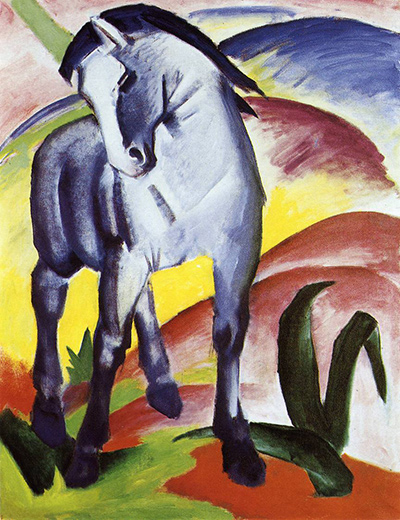
The museum interprets this work as a key step in Marc’s effort to describe an animal beyond its external anatomy. That is a historical reading, not a reason to attach one fixed feeling to every patch of blue. Here the blue-black area gives the fox weight and enclosure; the bright bands make its resting shape legible. The composition can be read alongside Blue Horse I from the same year, where a large blue animal is held by more open curves. Same colour family, different animal, scale and pose. [1] [2]
The Wuppertal museum names August and Eduard von der Heydt among former owners. Its current object title and inventory keep this 1911 single-fox painting distinct from the 1913 two-fox work that passed through Düsseldorf and was restituted in 2021. The similarity of English titles makes those collection details essential. [1] [3]
Spend time with the fox’s silhouette before applying Marc’s colour theory. The curve feels bodily and specific, while its edge almost disappears into the paint around it. That tension is what lets a small, sleeping animal carry the painting.
Artwork Directory
This source-checked selection contains 192 identified works and print designs from the current Franz Marc research set. It is a curated selection, not a complete catalogue raisonné. Some works link to their article here; others link to a collection record. Unresolved identifications are omitted.
Discussion
A dark blue-black fox sits within a landscape of sharply contrasting colour.
Reader Insights
Observation
Where does the fox’s outline separate from the ground?
Comparison
How does this single fox differ from the paired foxes in The Foxes?
Interpretation
What does the blue-black colour contribute before it is given a fixed meaning?
Join the Conversation
Which detail changed the way you saw this work? Share a close observation or a comparison with another Marc picture.
References
- Von der Heydt Museum, Fuchs (Blauschwarzer Fuchs). View source.
- Lenbachhaus, Blue Horse I. View source.
- Christie’s restitution history. View source.
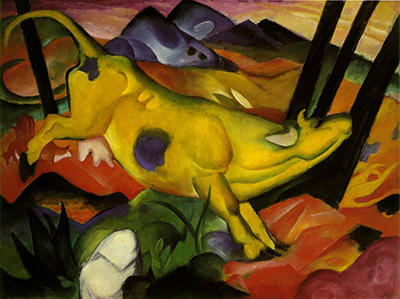
- Related artwork image, Yellow Cow: Photograph by Dr. Alexey Yakovlev; resized without crop or colour change, CC BY-SA 2.0.
- Splash image: Franz Marc, Blue-Black Fox, 1911, oil on canvas, Von der Heydt Museum, Wuppertal, G 0686. Photograph by Derbrauni, CC BY 4.0; resized to 1024 × 803 pixels without crop or colour adjustment. Museum object record.