by Tom Gurney
Tom Gurney BSc (Hons) is an art history expert with over 20 years experience
Published on June 19, 2020 / Updated on October 17, 2026
Email: tomgurney1@gmail.com / Phone: +44 7429 011000
Looking at Cows, Red, Green, Yellow
A yellow cow stretches across the front of Franz Marc’s Cows, Red, Green, Yellow. A red calf bends close behind it, while a broad green bull stands across the back. The three animals are pressed together against a dark field. At the bottom, waves of orange, blue and crimson make a narrow strip of ground. Marc painted this group in 1911, the same year as the better-known Yellow Cow. The two canvases share bright cattle and an interest in colour, but they stage very different encounters. This picture is a compact arrangement of three bodies rather than one animal leaping through a wide landscape. [1]
The Lenbachhaus title lists the colours as red, green and yellow; English word order varies. Its record identifies an oil painting on canvas measuring 62 × 87.5 cm, collection number G 13140. The museum’s essay makes the animals more specific than the general English word “cows” suggests: a yellow cow, a red calf and a green bull. That identification is useful because their sizes and positions shape the composition. The yellow body carries the foreground, the smaller red form turns inward, and the green body spans the back. [1]
Three animals held close
The yellow cow’s head points to the right. Its body opens across most of the lower canvas, with a raised, curling tail to the left. White and green touches model its face and neck, while yellow changes from bright gold to softer, more muted tones across its flank. One leg reaches down towards the coloured foreground. The shape carries movement, but the body remains connected to the two animals behind it. This is not the isolated, airborne cow of the Guggenheim picture. [1] [2]
The red calf leans down over the yellow animal’s head and neck. Its curved back and lowered face make a smaller arch inside the larger group. The green bull behind them is harder to separate at first: its body stretches across the upper right, with a tail curling upward. Their outlines touch and overlap, so the colour differences do much of the work of keeping each animal visible. The painting can briefly look like one complicated creature before the three bodies resolve. [1]
The dark ground makes the animals seem nearer to the viewer. There are no distant hills or trees to pull the eye away. A pale shape at upper right and the coloured bands below keep the field from being empty, but the black backdrop gives the yellow, red and green a common setting. Marc could make a harmonious group without giving the animals natural coat colours. The composition depends on their different positions as much as on their bright hues. [1]

Franz Marc, Cows, Yellow, Red, Green. Three closely grouped cows answer one another through colour and pose.
Watch: Franz Marc
Explore Marc’s blue horses, the Blue Rider circle and the move towards abstraction in English-language videos.
Franz Marc, Blue Horses and Der Blaue Reiter
An English-language introduction to Marc’s blue horses, animals, spirituality and the Blue Rider.
Watch on YouTubeColour as a way to build the group
Marc’s colour choices here are striking because the animals are distinct yet related. Yellow advances at the front, red sits warm and close in the middle, and green stretches across the rear. Blue and violet accents in the lower field help the three strong colours breathe. A narrow orange passage warms the foreground. These relationships make the bodies readable against black, while their shared curves join them into a single rhythm. The colours are not an overlay on a finished drawing; they are part of how the group is made. [1]
In his correspondence with August Macke, Marc gave blue, yellow and red personal associations and described how colours could affect one another. The letter is dated 12 December 1910. It belongs to the context of this 1911 picture, but it is not a chart that gives the green bull or red calf one fixed meaning. Marc’s terms also carried historical gender assumptions. The most useful question for this canvas is what each hue lets us see: foreground and background, young and large bodies, contact and separation. [3] [1]
The Lenbachhaus essay notes Marc’s interest in typified animal forms and the rhythm of several bodies within one composition. It cites a 22 February 1911 letter to Maria in which he distinguished the limitless complexity of nature from the stricter order an artist creates to depict it. This group shows that task clearly. He simplified three animals enough for their colours and curves to hold together without erasing their individual forms. The bull’s long green mass, the calf’s red bend and the cow’s yellow sweep are different elements of one design. [1]
Its relationship to Yellow Cow
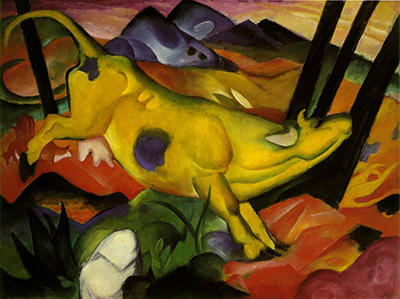
The Guggenheim’s Yellow Cow is another 1911 work, large and wide, with a single cow leaping across a landscape of blue mountains, red and orange ground, and dark tree trunks. The Lenbachhaus places it before this multi-animal version. The shared yellow figure makes comparison tempting, but the jobs of the two pictures differ. In the Guggenheim painting, the cow’s stretched body seems to animate an entire landscape. Here a yellow body helps organize a close grouping, with red and green animals pressed around it and distant scenery removed. [1] [2]
The Lenbachhaus essay recalls that Yellow Cow provoked sharp contemporary reactions at the first Blue Rider exhibition in December 1911, including criticism from Alexander Kanoldt. It also cites more enthusiastic literary responses. Those reactions document how startling the single leaping cow appeared to some early viewers. They are not direct reviews of Cows, Red, Green, Yellow. The later group painting lets Marc continue the same colour inquiry through different bodies and a different format. [1]
This page’s English title can obscure that difference, especially because the colours are often listed in changing order. Looking for the three animals is more reliable than searching for one familiar phrase. The yellow cow at front, red calf at middle and green bull behind are the identifying composition. It is the Lenbachhaus canvas, G 13140, rather than the Guggenheim’s solo cow or another cattle study. [1] [2]
Ownership and the Lenbachhaus
The museum records Alfred and Thekla Hess of Erfurt among the early owners, with acquisition through either Galerie Goltz in Munich or Galerie Der Sturm in Berlin. Its provenance then lists Galerie Ferdinand Möller, Hanna Bekker vom Rath and Galerie Günther Franke before the Lenbachhaus bought the painting from Franke in 1960. The record does not settle which of the two first galleries supplied the work to the Hesses; that uncertainty should remain visible. It also places the painting within the collecting networks through which Marc’s work circulated during and after his lifetime. [1]
The picture rewards a final look from front to back. Follow the cow’s yellow body to its face, find the red calf bending over it, then let the broad green bull appear behind both. Return to the dark space around them and the small coloured waves beneath. Marc made a group that is crowded but legible, bright but strongly structured. Its colours draw us in; its overlapping animals give us a reason to stay. [1]
Artwork Directory
This source-checked selection contains 192 identified works and print designs from the current Franz Marc research set. It is a curated selection, not a complete catalogue raisonné. Some works link to their article here; others link to a collection record. Unresolved identifications are omitted.
Discussion
Three close bodies create a different colour problem from the solitary Yellow Cow.
Reader Insights
Observation
Which contour first separates the calf from the larger animals?
Comparison
How does the group’s stillness differ from Yellow Cow’s leap?
Interpretation
Where does colour join the bodies as much as distinguish them?
Join the Conversation
Which detail changed the way you saw this work? Share a close observation or a comparison with another Marc picture.
References
- Lenbachhaus, Kühe, rot, grün, gelb, object record and Friedel/Hoberg essay. View source.
- Guggenheim, Yellow Cow. View source.
- Marc to Macke, 12 December 1910, German correspondence. View source.
- Related artwork image, Yellow Cow: Photograph by Dr. Alexey Yakovlev; resized without crop or colour change, CC BY-SA 2.0.
- Splash image: Franz Marc, Cows, Red, Green, Yellow, 1911. Lenbachhaus, Munich. Museum image, CC0 1.0.