by Tom Gurney
Tom Gurney BSc (Hons) is an art history expert with over 20 years experience
Published on June 19, 2020 / Updated on October 17, 2026
Email: tomgurney1@gmail.com / Phone: +44 7429 011000
Looking at Broken Forms
Red curls, blue bands, dark wedges and yellow light press against one another in Franz Marc’s Broken Forms. No animal presents itself as the principal subject. The eye follows one large curve, then loses it where another colour interrupts. Marc painted the work in 1914, near the end of the short period in which he moved from recognisable animal scenes toward increasingly independent arrangements of form. The painting belongs to New York’s Solomon R. Guggenheim Museum, whose English title is Broken Forms and whose German title is Zerbrochene Formen. [1] [2]
The canvas is tall. A bright area near the upper centre is surrounded by red, blue and green forms that seem to fold inward and out again. The shapes retain the energy of Marc’s earlier landscapes and animals, but they do not settle into a single creature or scene. The title offers a way to think about them: forms appear joined, interrupted and remade as we look. It does not tell us that a literal object has broken or that the painting illustrates a particular historical event. [1]
Watch: Franz Marc
Explore Marc’s blue horses, the Blue Rider circle and the move towards abstraction in English-language videos.
Franz Marc, Blue Horses and Der Blaue Reiter
An English-language introduction to Marc’s blue horses, animals, spirituality and the Blue Rider.
Watch on YouTubeFollowing the shapes
Begin at the red curved form toward the upper left. Its rounded sections have volume, almost like a body viewed in pieces, but the next blue band cuts across that impression. Near the centre, a dark wedge drops through a lighter yellow region. Other curves open to white or green, sending attention back upward. The painting has no one starting point. Each strong shape leads to an edge that another shape takes over. [1]
The colours are bold enough to keep individual sections distinct even when their outlines meet. Blue may hold a cool arch against a warm red swirl; yellow opens a luminous interval between darker pieces. Marc uses those relations to create tension and continuity at the same time. If the forms simply scattered, the painting would lose its visual pull. Instead the strongest arcs seem to turn around a shared centre while sharp diagonals disturb them. [1]
Near the bottom, smaller red and green curls carry the movement downward. The canvas’s upright format encourages that vertical journey, yet dark diagonals stop it from becoming a smooth fall. A viewer may imagine fragments of familiar things in the coloured fields. The image does not require those guesses to work. Marc allows the paint’s connections, breaks and returns to become the subject. [1]
A late turn in Marc’s painting
In Mandrill of 1913, arcs and vegetation nearly absorb the animal, but a face still anchors what we see. Broken Forms removes that dependable recognition. The painting invites the same close attention to curve, colour and overlap without resolving them into an animal body. Looking from one to the other makes the change tangible without suggesting that Marc had simply lost interest in living forms. [3] [1]
Another 1914 canvas, Fighting Forms, belongs to the Bavarian State Painting Collections. Its large opposing colour masses make conflict unusually explicit. Broken Forms has its own kind of disturbance, generated by interrupted contours and reappearing curls. The similar titles and late date can tempt us to treat the works as twins, but they are separate paintings in separate collections, with different visual structures. [4] [1]
Marc made this work in 1914, the year war began in Europe. It is understandable to experience its ruptured shapes through knowledge of what followed, including Marc’s death in 1916. The title alone is not proof that he painted a prophetic image of war, and the museum’s object identity does not turn its abstract forms into an illustrated battle. The painting can be seen fully as a formal experiment made in a dangerous historical moment. [1]
The Guggenheim’s own verbal-description programme includes a recording devoted to Broken Forms, a useful companion for looking carefully at its colours and spatial relations. The painting’s strongest invitation remains visual: trace one red curl until blue cuts across it, then follow that blue into the yellow opening and on toward the darker lower forms. No final object appears at the end of the route. The act of moving among broken and joined shapes is the encounter Marc made. [2] [1]
Artwork Directory
This source-checked selection contains 192 identified works and print designs from the current Franz Marc research set. It is a curated selection, not a complete catalogue raisonné. Some works link to their article here; others link to a collection record. Unresolved identifications are omitted.
Discussion
This late painting gives the eye no single animal or landscape to hold.
Reader Insights
Observation
Which edge or colour mass anchors your first look?
Comparison
How do these forms carry forward movement seen in Marc’s animal paintings?
Interpretation
Does the title guide your reading, or leave the picture more open?
Join the Conversation
Which detail changed the way you saw this work? Share a close observation or a comparison with another Marc picture.
References
- Guggenheim Museum, Broken Forms, object 50.1240. View source.
- Guggenheim, Marc audio index. View source.
- Pinakothek, Der Mandrill. View source.
- Pinakothek, Kämpfende Formen. View source.
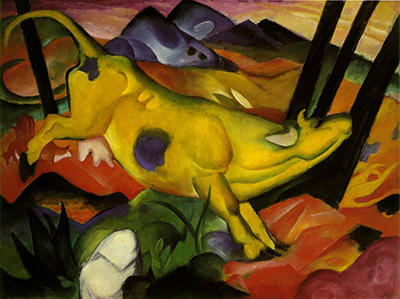
- Related artwork image, Yellow Cow: Photograph by Dr. Alexey Yakovlev; resized without crop or colour change, CC BY-SA 2.0.
- Splash image: Franz Marc, Broken Forms, 1914. Solomon R. Guggenheim Museum, 50.1240. Public-domain art-book reproduction via Wikimedia Commons; resized without crop or colour adjustment.