 by Tom Gurney
Tom Gurney BSc (Hons) is an art history expert with over 20 years experience
Published on June 19, 2020 / Updated on October 17, 2026
Email: tomgurney1@gmail.com / Phone: +44 7429 011000
Explore Marc’s drawings and works on paper
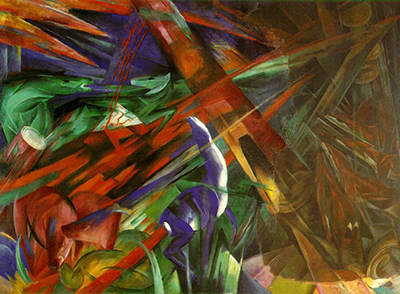
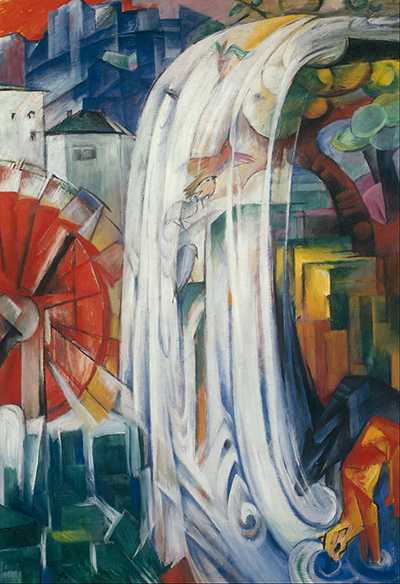
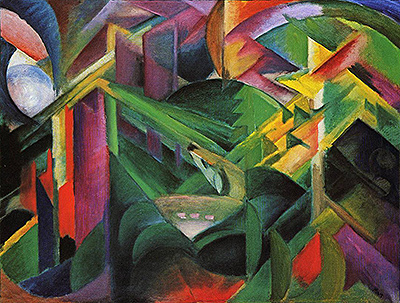
Franz Marc’s horses and deer are familiar as oil paintings, yet some of his most direct ideas survive on small sheets of paper. A drawing could test the placement of a body; a painted postcard could carry an image to a friend; a carved block could turn an animal into a striking print. These are different kinds of objects. Looking at them separately makes Marc’s working process and his exchanges with other artists easier to see. [1] [2]
A sketch is an artwork in its own right
The Franz Marc Museum highlights an early sketch connected with The Tower of Blue Horses. The celebrated large painting has been missing since the Second World War; a surviving work on paper therefore matters enormously as evidence of Marc’s design. It is still a sketch with its own material, scale and history. It should not be labelled as the lost painting or presented as a photograph of it. Nor should every tentative mark be made to carry a definite claim about what the finished canvas looked like. [1]
Drawings can reveal how an artist arrived at a composition, but they do not always move neatly from rough outline to final canvas. A line may study the curve of an animal’s neck or the balance of several bodies on a page. Coloured marks can explore relationships that change later in paint. Marc’s works on paper are valuable partly because we can attend to those decisions without assuming each sheet was made only to serve another work. The object label matters: date, medium and collection tell us whether we are looking at a sketch, a finished small picture, a letter or a print. [2]
The works listed below also include coloured, fully developed images made with gouache, tempera or watercolour on paper or card. Harvard describes Playing Dogs as gouache on tan cardboard; RISD records Two Horses as tempera and gouache on paper; and the Bavarian State Painting Collections identify the Tower of Blue Horses postcard as a painted work on paper. These records explain why such images appear with drawings and other works on paper here, even when their colour is as vivid as a canvas. [3] [4] [5]
Two further examples show how broad this category is. Sotheby’s catalogued Fabulous Beast II (Horse) as tempera on card, while the Franz Marc Museum has described Gazelles as tempera on card. Both are painted images, yet their paper-based supports and small scale make them useful companions to Marc’s other coloured sheets here. [6] [7]
The First Animals is another painted work on paper. The Neue Galerie identifies the 1913 image as gouache and pencil on paper, and the Musée de l’Orangerie exhibited the same composition. Its large blue and small red animals make a fully developed picture; its material still places it with the paper works rather than the oil-painting grid. [8] [9]
Watch: Franz Marc
Explore Marc’s blue horses, the Blue Rider circle and the move towards abstraction in English-language videos.
Franz Marc, Blue Horses and Der Blaue Reiter
An English-language introduction to Marc’s blue horses, animals, spirituality and the Blue Rider.
Watch on YouTubeImages sent through the post
The Lenbachhaus holds illustrated postcards Marc sent to Wassily Kandinsky. Their small size and handwritten setting belong to the history of the images. Zinnobergruß, postmarked 19 April 1913 from Sindelsdorf to Kandinsky in Munich, is catalogued as watercolour, gouache and pencil on a 14 × 9 cm postcard. It is a deliberately made image and a piece of correspondence at once. Its title evokes vermilion, but the material record gives us a firmer starting point than any broad claim about the meaning of a single colour. [10]
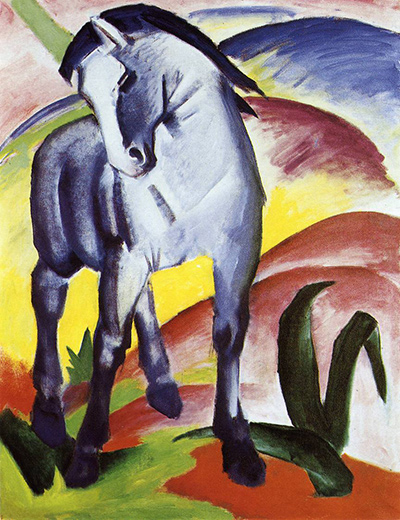
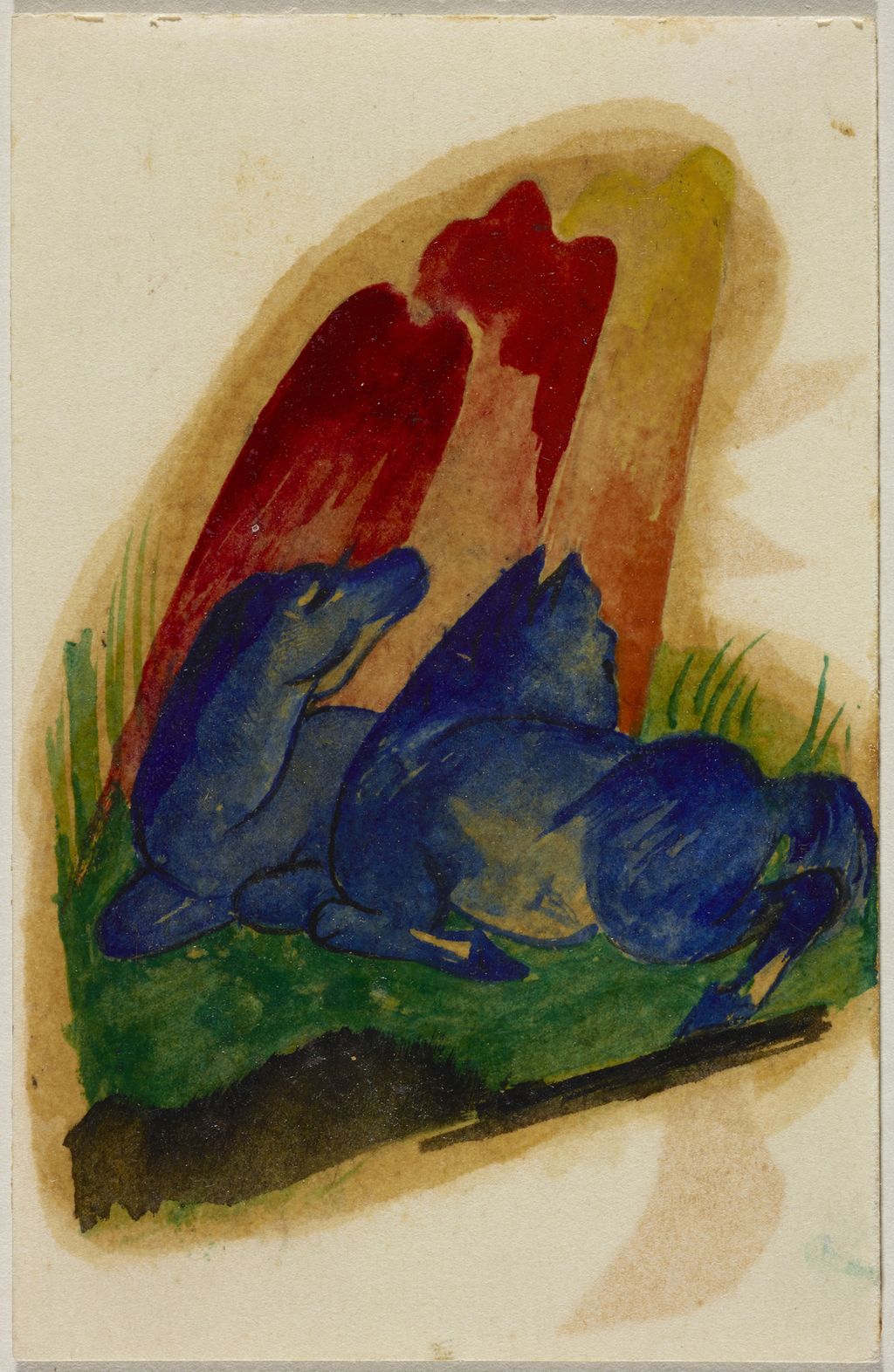
A second postcard, Two Blue Horses before a Red Rock, was sent to Kandinsky from Sindelsdorf on 21 May 1913. At 14 × 9 cm it is a miniature encounter with subjects Marc also explored on larger surfaces. The blue horses and red rock offer a compressed composition, but the postcard is not simply a reduced version of Blue Horse I or Blue Horse II. Those are distinct oil paintings with different dates, poses, settings and collection histories. [11] [12]
These cards show how art circulated within the circle associated with Der Blaue Reiter. Marc and Kandinsky were co-editors and colleagues, and an image could move between them without an exhibition or a dealer. The physical card joins a picture to an address, date and journey. That social life is easy to lose when a tiny image appears online at the same screen size as a large canvas. [10] [11]
From a drawn idea to a printed sheet
Marc also made original prints. A woodcut is made by cutting a design into a block, inking its raised surface and pressing it onto paper. It is not a photographed copy of an oil painting. MoMA identifies Horses Resting of 1911 as Marc’s first woodcut and places his total print production at 46. Its account stresses the choices he made while working with wood, where an animal has to be shaped through areas that will take ink and areas that will stay pale. [13]
A postcard painted in watercolour and gouache, a pencil sketch and an impression from a carved block can all be called works on paper, but they reward different questions. On a postcard, look for how a small composition shares space with correspondence. In a sketch, look at what a mark tests or leaves open. In a woodcut, notice how the act of cutting simplifies an animal into contrasting shapes. The paper object is the evidence; a modern poster reproducing the image is a later product. [2] [13]
Looking closely
Start with a museum’s full object record whenever possible. Ask what the work is made of, how large it is, when it was made and whether it was sent, printed or kept in the studio. Then compare the arrangement of bodies and colours with a related painting without assuming the two are interchangeable. Marc’s paper works preserve particular moments of invention and communication. They add to the paintings rather than merely illustrating them. [1] [2]
Browse works on paper




Artwork Directory
This source-checked selection contains 192 identified works and print designs from the current Franz Marc research set. It is a curated selection, not a complete catalogue raisonné. Some works link to their article here; others link to a collection record. Unresolved identifications are omitted.
Discussion
Marc’s sheets include sketches, postcards and finished works with different purposes.
Reader Insights
Observation
Which drawn line best catches an animal’s pose with little detail?
Comparison
How does a painted postcard differ from a preparatory sketch?
Interpretation
What makes a small sheet feel complete in its own right?
Join the Conversation
Which detail changed the way you saw this work? Share a close observation or a comparison with another Marc picture.
References
- Franz Marc Museum, collection. View source.
- Lenbachhaus, Franz Marc collection. View source.
- Harvard Art Museums, Playing Dogs. View source.
- RISD Museum, Two Horses. View source.
- Bavarian State Painting Collections, Tower of Blue Horses postcard. View source.
- Sotheby’s, Fabulous Beast II. View source.
- Franz Marc Museum, archived collection description of Gazelles. View source.
- Neue Galerie exhibition record. View source.
- Musée de l’Orangerie exhibition dossier. View source.
- Lenbachhaus, Zinnobergruß. View source.
- Lenbachhaus, Two Blue Horses before a Red Rock. View source.
- Lenbachhaus, Blue Horse I. View source.
- MoMA, German Expressionist woodcuts. View source.
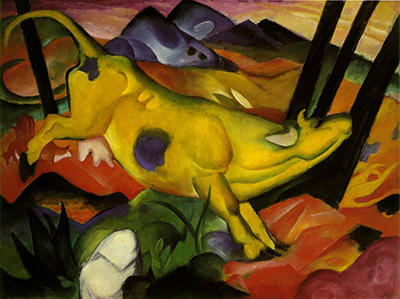
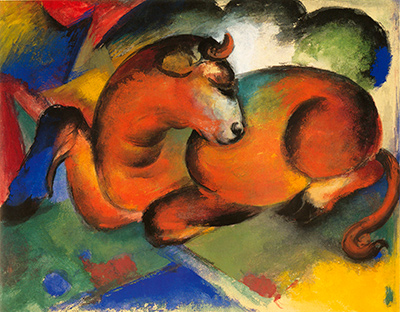
- Related artwork image, Yellow Cow: Photograph by Dr. Alexey Yakovlev; resized without crop or colour change, CC BY-SA 2.0.
- The First Animals grid image: Photograph by Jean-Pierre Dalbéra; resized without crop or colour change, CC BY 2.0.
- Tower of Blue Horses postcard grid image: Bayerische Staatsgemäldesammlungen; resized without crop or colour change, CC BY-SA 4.0. This derivative is shared under the same licence.