 by Tom Gurney
Tom Gurney BSc (Hons) is an art history expert with over 20 years experience
Published on June 19, 2020 / Updated on October 17, 2026
Email: tomgurney1@gmail.com / Phone: +44 7429 011000
How Marc used colour and form
Franz Marc used colour to do more than describe what an animal looked like. A horse could be blue, a cow yellow and a forest divided into red, green and violet planes. Those choices helped him create relationships among bodies, landscape and the viewer’s eye. He also wrote about colour in symbolic terms, but his paintings changed quickly between 1910 and 1914. A sentence from one letter cannot serve as a fixed key for every work. To understand his style, it helps to look at what he said, what later museums have proposed, and what each canvas actually makes visible. [1] [2]
Colour as an experiment
Around 1910–11, Marc became increasingly dissatisfied with local colour: painting snow white or an animal brown simply because it appeared so. The Franz Marc Museum describes how his winter scenes tested contrasting colours and consciously arranged every part of the canvas. Snow could become a bright ground for yellow, blue and violet; its whiteness had a compositional role rather than a duty to imitate weather. The museum’s account quotes his wish to remove chance marks from his painting. This is a useful early stage in the development of the coloured animals, before their hues became the most memorable shorthand for his work. [2]
The museum also describes Marc using a prism to test the optical relation between adjacent colours. He was interested in whether contrasts such as blue and orange or red and green intensified one another or dulled into grey. This practical concern sits beside, rather than beneath, his symbolic language. A yellow dog against blue-white snow works partly because the surfaces make each other visible. The picture need not be read as a sentence whose words are the colour names. [2]
In a letter to August Macke dated 12 December 1910, Marc laid out associations among blue, yellow and red, including masculine and feminine qualities and the force he felt in their combinations. He was explaining a theory to a fellow artist. The letter continues beyond the short phrases most often quoted, describing what happens when colours meet or mix. It shows thought in motion rather than a universal law. The owning Lenbachhaus’s essay on Blue Horse I also dates this discussion to December 1910. [1] [3]
The Franz Marc Museum’s recent essay richly explains the experiments but misdates that particular colour letter in a footnote to November 1911. The dated correspondence and Lenbachhaus record support December 1910 for the famous statement. Keeping the source date straight matters because the paintings changed quickly over these years. A claim about a 1910 working theory should not be silently moved after the 1911 blue-horse canvases. [2] [1]
Imagining an animal’s world
Marc’s interest in animals was also a question of viewpoint. In notes dated by their later editor to probably 1911–12, he wondered how nature might appear in the eye of a horse, deer, eagle or dog. He challenged the habit of putting animals into a landscape composed only for human viewers. That thought experiment does not claim a painter can discover an animal’s exact visual system. It asks him to try to imagine a different centre of experience. [4]
In Horse in a Landscape of 1910, a reddish horse stands near us and looks out over broad land. Blue Horse II of 1911 places a blue horse in a similar rear view, now more centrally and with stronger bands around it. These paintings do not let us see as a horse literally sees. They make the animal our way into a place, displacing the usual human figure who surveys the view. [5] [6]
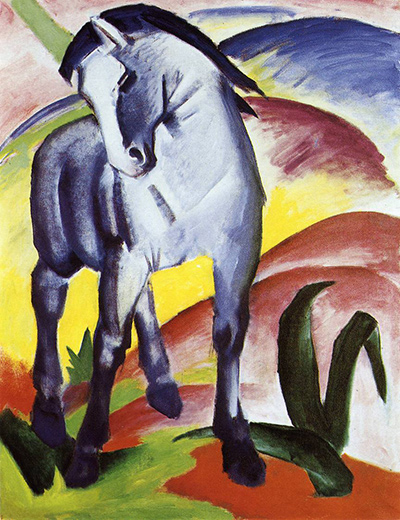
Marc could also give an animal a direct presence. In Blue Horse I, the blue foal bends its head within a landscape of warm and cool curves. Blue marks the animal as a distinct being, while yellow, red and green around it make the body seem both held and challenged by its space. The colour works with posture and scale. A single label such as “blue equals spirituality” cannot explain the whole visual effect. [3]
Watch: Franz Marc
Explore Marc’s blue horses, the Blue Rider circle and the move towards abstraction in English-language videos.
Franz Marc, Blue Horses and Der Blaue Reiter
An English-language introduction to Marc’s blue horses, animals, spirituality and the Blue Rider.
Watch on YouTubeDifferent uses of the same colour
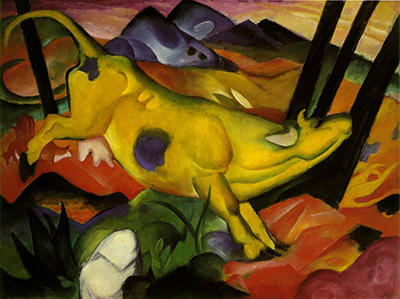
The Stuttgart Little Yellow Horses bring several warm bodies into a compact group beneath a blue arch. The museum relates yellow to the historical feminine principle in Marc’s thought and, just as importantly, explains how the horses’ circular forms echo the sky. In the Guggenheim’s Yellow Cow, one yellow body stretches in a leap. Same dominant animal colour, different movement and relation to space. [7] [8]
Red changes role too. In Large Red Horses, grouped grazing bodies make a broad triangular rhythm. In Three Cats, one red cat anchors a busy three-animal scene. Red is not a mechanical sign of violence in both. It can build mass, direct attention and balance other colours according to the needs of a particular painting. Marc’s 1910 letter is part of the historical context; the actual arrangement on canvas is the primary thing a viewer can inspect. [9] [10]
Follow a colour through several paintings
A useful way to test Marc’s colour ideas is to follow one hue across different subjects. Compare the blue foal in Blue Horse I with the blue land behind the leaping Yellow Cow. In the first picture, blue gives the animal a unified body; in the second, it helps the yellow figure stand forward. The same colour can therefore act as subject in one painting and as a contrasting setting in another. Marc’s letter to Macke describes associations for colours, but the paintings also ask us to notice edges, scale and placement. [1] [3] [8]
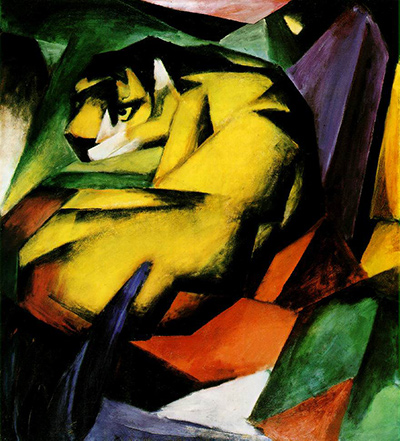
Green offers another route. In Cows Yellow, Red & Green, animal colours press against a dark field; in Tiger, green and yellow planes help conceal as well as frame the crouching cat. Try looking first for the largest patch of colour, then for the smaller marks that interrupt it. That movement from a broad area to its edges often reveals more than attaching a single meaning to a hue. The colour guide explains terms such as contrast and saturation that can help describe what is visible without turning Marc’s pictures into a code. [11]
Colour beyond Marc
Marc worked among artists who also treated colour as something more active than a record of appearances. The pages on Wassily Kandinsky and August Macke offer nearby points of comparison within the Blue Rider circle. Robert Delaunay provides another route into early twentieth-century experiments with colour and form. These links are invitations to compare particular works, not evidence that all four artists used the same theory. Start with a Marc painting, then ask what another artist’s colours do differently: do they build a body, set a rhythm, or make the whole surface feel as if it is moving? The wider Expressionism guide helps place those choices in a larger setting.
From animal form to independent shape
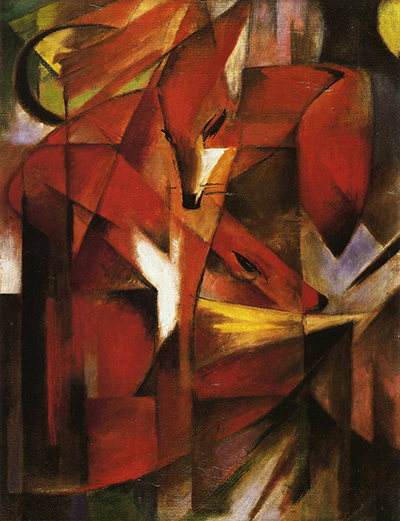
Marc’s painted forms grew more fractured in the years before the war. Tiger of 1912 makes a crouched animal out of large angular blocks. In Mandrill of 1913, a face remains visible amid arcs of vegetation and colour. Birds of 1914 still has three identifiable creatures, but their boundaries nearly merge with a fan of shapes. These works are a useful sequence because each asks us to find an animal in a different way. [11] [12] [13]
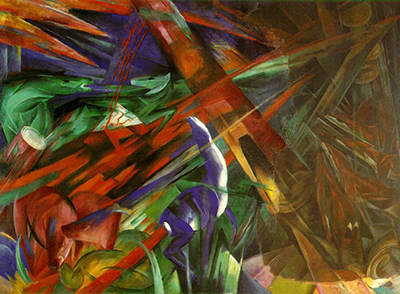
By Fighting Forms and Broken Forms, both dated 1914, colour and shape can act without a clearly pictured creature. That change should not be forced into a simple story of animals disappearing because the war was coming. Marc was exploring how forms could express tension and relation on their own. The two canvases are separate objects in Munich and New York with different structures; one title cannot stand for all his late work. [14] [15]
Colour, then, is one way Marc made a world. His letters show that he thought hard about its symbolic and optical effects; his notes ask whose world a painting might show; the canvases test those questions in very different compositions. Start with a body or a line, follow how its colour meets the rest of the image, and allow the work to answer before applying a theory. [1] [4]
Artwork Directory
This source-checked selection contains 192 identified works and print designs from the current Franz Marc research set. It is a curated selection, not a complete catalogue raisonné. Some works link to their article here; others link to a collection record. Unresolved identifications are omitted.
Discussion
Marc tested how colour could organise a painting as well as describe an animal.
Reader Insights
Observation
Where does a coloured shape repeat or interrupt an animal’s contour?
Comparison
How does the same colour work differently in Blue Horse I and a later composition?
Interpretation
When does a colour letter help you see a painting, and when might it limit you?
Join the Conversation
Which detail changed the way you saw this work? Share a close observation or a comparison with another Marc picture.
References
- Marc’s 12 December 1910 letter to August Macke. View source.
- Franz Marc Museum, colour-theory essay. View source.
- Lenbachhaus, Blaues Pferd I essay. View source.
- Marc, Aufzeichnungen, 1920 posthumous edition. View source.
- Museum Folkwang, Pferd in Landschaft. View source.
- Albertina record crediting Kunstmuseum Bern, Blaues Pferd II. View source.
- Staatsgalerie Stuttgart, Die kleinen gelben Pferde. View source.
- Guggenheim, Yellow Cow. View source.
- Harvard Art Museums, Grazing Horses IV. View source.
- Kunstsammlung Nordrhein-Westfalen, Drei Katzen. View source.
- Lenbachhaus, Tiger. View source.
- Pinakothek, Mandrill. View source.
- Lenbachhaus, Birds. View source.
- Pinakothek, Kämpfende Formen. View source.
- Guggenheim, Broken Forms. View source.
- Related artwork image, Yellow Cow: Photograph by Dr. Alexey Yakovlev; resized without crop or colour change, CC BY-SA 2.0.