 by Tom Gurney
Tom Gurney BSc (Hons) is an art history expert with over 20 years experience
Published on June 19, 2020June 19, 2020 / Updated on July 6, 2026
Email: tomgurney1@gmail.com / Phone: +44 7429 011000
Melancholy by Edvard Munch: Shoreline, Jealousy and the Mood Landscape
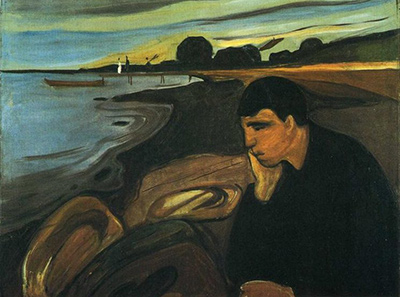
Edvard Munch's Melancholy is one of his great early mood landscapes. A man sits in the foreground near the shore, head lowered and body turned inward. Behind him, on a jetty, three small figures stand near a boat. The physical distance between foreground and background becomes the emotional subject of the painting. [1]
The National Museum of Norway records its Melancholy as probably 1892, oil on canvas, 64 x 96 cm, inventory number NG.M.02813. It is signed lower left with "E. M." and entered the collection through the Charlotte and Christian Mustad bequest, accessioned in 1970. [1]
The museum identifies the landscape as the coastline at Asgardstrand and links the motif to Munch's friend Jappe Nilssen and his unhappy love life around this time. That context matters, but the painting is not only anecdote. Its power lies in how Munch turns shore, stones, figure, jetty and blue-violet atmosphere into a mental state. [1]
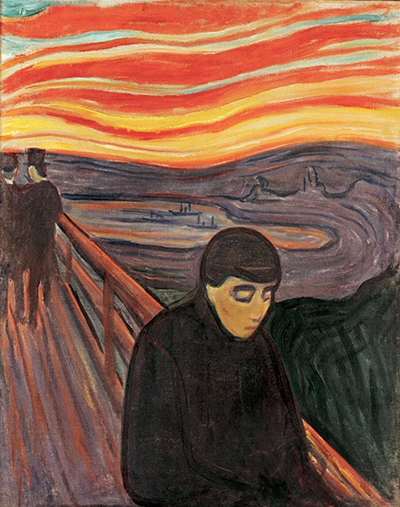
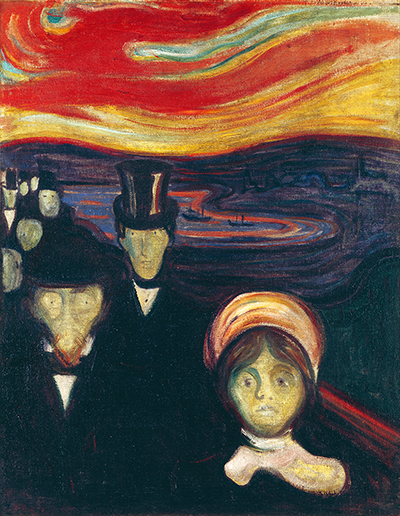
This makes Melancholy a key bridge in the Munch cluster: between the anxiety route of Despair and Anxiety, and the love-and-separation route of Separation and The Kiss. [6]
At a Glance
- Artist:Edvard Munch
- Title:Melancholy
- Date:Probably 1892
- Medium:Oil on canvas
- Dimensions:64 x 96 cm
- Collection:National Museum of Norway
- Inventory no.:NG.M.02813
- Acquisition:Mustad bequest, accessioned 1970
Contents
- Museum Perspective
- Looking Carefully
- Jappe Nilssen and Oda Krohg
- The Shoreline Motif
- Versions and Prints
- The Frieze of Life
- Meaning and Interpretation
- Things You Might Miss
- Timeline
- Comparison Works
Museum Perspective
The National Museum's account is unusually rich. It describes the dark shoreline curving diagonally into the picture, the three figures on the distant jetty, and the foreground man whose head and drooping shoulders stand out against the pale beach. It also stresses the simplified forms and softened blue tones of the summer night. [1]
The catalogue text places the work in a wider artistic context. It links the simplified and stylised forms to Synthetism and notes Munch's exposure to new French art during stays in Paris between 1889 and 1892. This matters because Melancholy is not simply a naturalistic record of a shore scene; it is a constructed mood image. [1]
The museum also places Melancholy within the future Frieze of Life. It says the depictions of melancholy and the kiss were among the first works Munch painted for his series about love and life, and that repeating themes with variations became an important part of his practice. [1]
That museum perspective is essential for this page. Melancholy is not only a picture of sadness. It is an early test case for the method that would define Munch: a personal situation transformed into a repeatable, symbolic visual language. [7]
Looking Carefully
The foreground figure sits low in the composition, pushed toward the edge of the canvas. His head rests on one hand, a classic posture of melancholy. The pose is old in art history, but Munch makes it modern by setting it against an expressive shoreline rather than a studio or allegorical interior. [1]
The background is small but decisive. On the jetty, three figures and a boat appear at a distance. They are not detailed enough to become a narrative scene, yet they are clear enough to give the man's brooding a possible object. The painting lives in the gap between what is seen and what is felt. [1]
The rocks are important too. The National Museum notes that Munch's linked text describes stones looming from the water like mysterious sea inhabitants. In the painting, the boulders echo the shape of the man's head and shoulders, making the landscape seem to share his state. [1]
The colour is restrained compared with the later red-sky anxiety pictures. Blue, violet, dark shoreline and pale beach dominate. The mood is not explosive; it is heavy, inward and held. [6]
Video Guide
This selected video from Courtauld offers useful visual context before the detailed analysis continues.
Jappe Nilssen and Oda Krohg
The National Museum links the motif to the unhappy love affair involving Munch's friend Jappe Nilssen and Oda Krohg, wife of Christian Krohg, at Asgardstrand in the summer of 1891. Munch witnessed the situation and found it artistically compelling as he explored love relationships in both texts and pictures. [1]
That context gives the painting a human starting point, but it should not be allowed to reduce the work to gossip. Munch turns the episode into a structure: foreground isolation, distant couple, shoreline, boat, stones, and mood. [5]
In that sense, Melancholy anticipates later pages such as Separation. Both works transform love and distance into shoreline compositions, where physical space carries emotional pressure. [6]
The Shoreline Motif
The Asgardstrand shoreline becomes one of Munch's great pictorial tools. The National Museum quotes a contemporary comment that Munch sees in "wavy lines," and its catalogue text stresses how sea, sky and landscape create a dynamic of flowing contours. [1]
This shoreline does more than locate the scene. It binds Munch's early love and mood pictures together. The curve of the coast becomes a way of connecting outer landscape to inner condition, and later works return to similar coastal structures in different emotional registers. [7]
That is why Melancholy belongs beside Despair and Sick Mood at Sunset: Despair. The colour differs, but the underlying method is related: shoreline, figure and mood become inseparable. [6]
Versions and Prints
The National Museum records that Munch painted five versions of the Melancholy motif, while also noting uncertainty about their dating and order. It says the National Museum version is assumed to be the second in the series and differs by placing the main figure in the lower right corner, facing out of the frame. [1]
The museum identifies MUNCH's Evening. Melancholy as the earliest version, dated 1891, and notes that it was shown at the National Annual Autumn Exhibition that year under the title Evening. [1]
The motif also entered print. The National Museum lists woodcut and print versions including Evening. Melancholy I from 1896 and Melancholy III from 1902. MUNCH's collection context also matters here because the museum holds one of the world's largest bodies of work by a single artist, making version comparison central to Munch study. This makes the page a natural bridge to the future Munch prints hub. [1] [3] [8]
Version history is not a side note here. It is the point. Munch took a charged emotional arrangement and kept testing it across paintings, drawings and prints. [5]
The Frieze of Life
The National Museum says Melancholy was included in what later became known as The Frieze of Life. It also says the shoreline almost serves as an element binding the series together. [1]
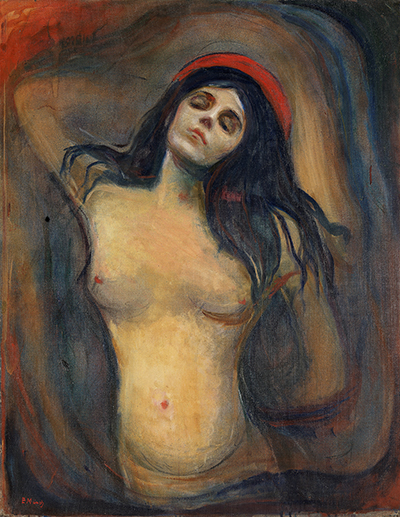
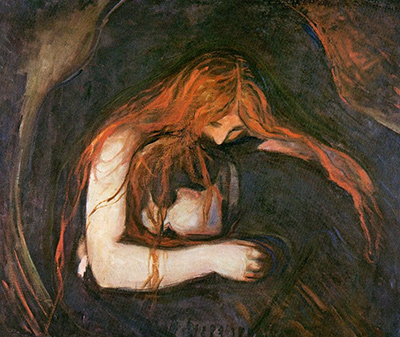
This is why the painting matters for the cluster as a whole. It is one of Munch's early ways of turning love, jealousy and inward suffering into a repeatable visual structure. Later pages on The Kiss, Separation, Vampire, Madonna and Dance of Life all develop related problems. [7]
Seen this way, Melancholy is not only a page about sadness. It is a foundation page for Munch's whole language of love, mood and landscape. [6]
Meaning and Interpretation
The strongest interpretation begins with separation. The foreground man is present, but emotionally cut off from the figures near the boat. His body turns inward while the background holds the social or romantic world from which he feels excluded. [1]
The painting has often been linked to jealousy, and the National Museum catalogue text notes that it has been described as a defining image of that emotion. But the image is broader than jealousy alone. It is about a mood that saturates place. [1]
Munch's linked text, preserved through the museum account and the wider eMunch archive, is important because it shows how he imagined shore, moon, stones, water, figures and boat as emotionally alive. The image is not a passive landscape with a sad person added; it is a landscape seen through feeling. [4]
This is why the painting should not be reduced to biography. Jappe Nilssen matters, Oda Krohg matters, Asgardstrand matters, but Munch's achievement is the transformation of those materials into a symbolic image that could be repeated and reworked. [5]
Things You Might Miss
- The figure is pushed to the edge. The lower-right placement makes his inwardness feel physically marginal. [1]
- The distant figures matter. They give the foreground melancholy a social and romantic focus. [1]
- The stones echo the body. The boulders repeat the shape of the head and shoulders, tying figure to landscape. [1]
- The work is probably the second version. The National Museum distinguishes it from the earliest MUNCH version. [1]
- The title shifted. It was shown in 1892 as Sad Evening. [1]
- The motif became prints. Woodcut and later print versions are part of the motif's life. [8]
Timeline
- 1891 - Munch's earliest Evening. Melancholy version is shown at the National Annual Autumn Exhibition. [1]
- 1892 - The National Museum version is assumed to date from around this year and is shown at Tostrupgarden as Sad Evening. [1]
- 1892 - A related work appears in the Berlin exhibition whose controversy helped bring attention to Munch. [1]
- 1896 - Munch makes the woodcut Evening. Melancholy I. [1]
- 1970 - The painting enters the National Museum collection through the Mustad bequest. [1]
Comparison Works
Compare Melancholy first with Separation. Both works use shorelines, distance and love-related pain, but Separation makes the lost bond visible through hair while Melancholy uses distance, stones and posture. [6]
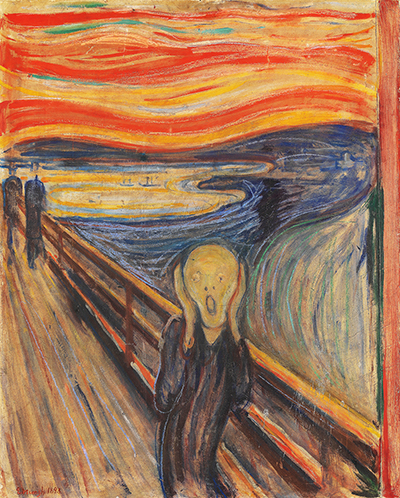
Then compare it with Despair and Sick Mood at Sunset: Despair. These works move from blue-violet inwardness toward the red-sky anxiety route that culminates in The Scream and Anxiety. [5]
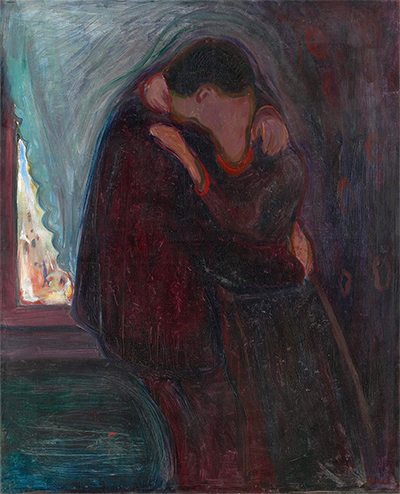
The next comparison is The Kiss, because the National Museum identifies melancholy and the kiss as among the first works Munch painted for the larger love-and-life series. [1]
Finally, compare it with Evening on Karl Johan Street. One is shoreline inwardness, the other modern urban crowd unease, but both turn social distance into psychological image. [7]
FAQs
The National Museum of Norway owns the version discussed here, inventory NG.M.02813. It is probably from 1892 and measures 64 x 96 cm. [1]
The motif has been linked to Munch's friend Jappe Nilssen and his unhappy love life involving Oda Krohg, but the painting transforms that context into a broader mood landscape. [1]
The Asgardstrand shoreline becomes a visual structure for mood. Its curves, stones and water make the landscape feel emotionally active rather than merely descriptive. [1]
Yes. The National Museum records five painted versions of the motif, as well as print versions including Evening. Melancholy I and Melancholy III. [1]
Yes. The National Museum notes that the painting was included in what later became known as The Frieze of Life, Munch's cycle around love, life, anxiety and death. [1]
References
- National Museum of Norway, Edvard Munch, Melancholy, object record and catalogue text, accessed 5 July 2026.
- MUNCH, Edvard Munch, accessed 5 July 2026.
- MUNCH, Our Collection, accessed 5 July 2026.
- eMunch, Edvard Munch's Writings: The English Edition, accessed 5 July 2026.
- Gerd Woll, Edvard Munch: Complete Paintings, London: Thames & Hudson, 2009.
- Patricia G. Berman, ed., Edvard Munch: The Modern Life of the Soul, New York: Museum of Modern Art, 2006.
- Giulia Bartrum, ed., Edvard Munch: Love and Angst, London: British Museum / Thames & Hudson, 2019.
- National Gallery of Art, Edvard Munch Master Prints, Washington, DC, 2010.