 by Tom Gurney
Tom Gurney BSc (Hons) is an art history expert with over 20 years experience
Published on June 19, 2020 / Updated on July 5, 2026
Email: tomgurney1@gmail.com / Phone: +44 7429 011000
Introduction
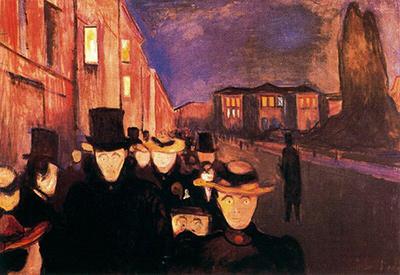
Evening on Karl Johan Street is one of Edvard Munch's most unsettling images of modern city life. Painted in 1892, it shows a crowd moving toward the viewer along Karl Johan Street, the main boulevard of Kristiania, now Oslo. The figures are dressed for respectable public life, yet their pale faces and staring eyes turn the evening promenade into something tense and airless. [1] [3]
The painting matters because it gives Munch a new kind of anxiety image. The Scream and Despair build psychological pressure through landscape and solitary figures. Evening on Karl Johan Street finds pressure in the crowd. It is not an image of isolation away from society, but of isolation inside society. [5]
At a Glance
- Artist: Edvard Munch
- Title: Evening on Karl Johan Street / Evening on Karl Johan
- Date: 1892
- Medium: Oil on canvas
- Dimensions: 84.5 x 121 cm
- Collection: KODE, Bergen, Rasmus Meyer Collection
- Subject: Crowd on Karl Johan Street in Kristiania
- Cluster role: Modern city and crowd route leading toward Anxiety
Why This Painting Matters
Evening on Karl Johan Street is a key bridge between Munch's urban modernity and his later anxiety images. It takes an ordinary city subject - people walking down a main street in the evening - and turns it into a confrontation between the viewer and a mass of faces. [5]
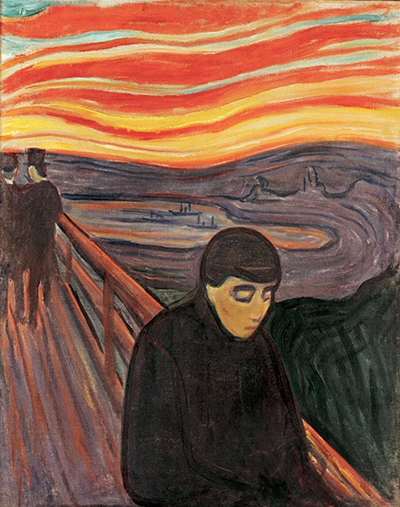
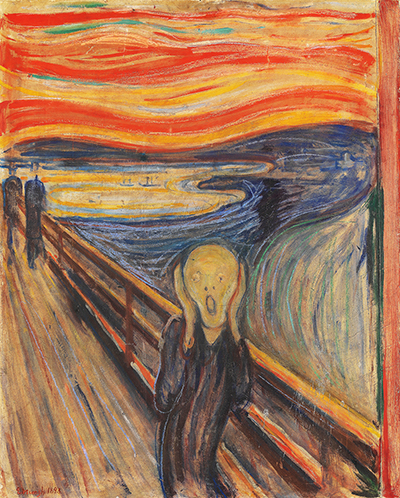
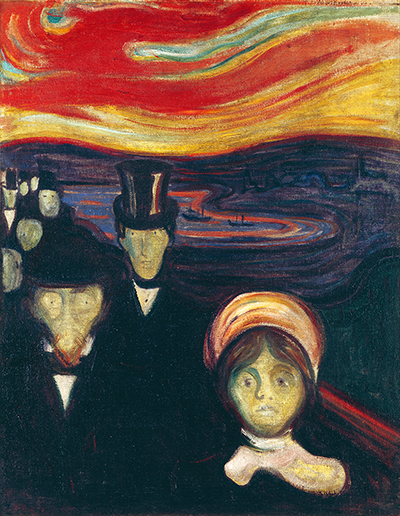
This makes it essential for understanding Anxiety. In Anxiety, Munch brings a frontal crowd into the red-sky landscape associated with The Scream and Despair. Evening on Karl Johan Street supplies the crowd language: mask-like faces, compressed bodies, a social group that feels less like community than pressure. [6]
Museum and Collection Context
The painting is dated 1892 and is held in Bergen in the Rasmus Meyer Collection at KODE. It belongs to the same decisive period in which Munch was moving away from naturalistic street scenes and toward images where colour, composition and figure type make inner pressure visible. [1] [3]
MUNCH's broader artist context is useful here. The museum presents Munch as a modern artist whose work developed across more than sixty years and across several media. Evening on Karl Johan Street sits early in that modern language, close to the emergence of The Frieze of Life. [2]
Looking Carefully
The composition is built as an advance toward the viewer. The crowd comes forward from the left side of the street, compressed by the line of buildings and lit windows. The faces are pale, simplified and frontal. They are recognisable as people, but they also behave like masks. [5]
The diagonal street gives the painting movement, but the mood is not lively. The figures do not feel socially open. Their eyes turn the act of looking into pressure. The viewer is placed in the path of the crowd rather than outside it. [6]
On the right, a solitary dark figure moves away from the group. This figure is often read as an image of the isolated individual, possibly an artist-like self-position, but that interpretation should be handled carefully. What the painting clearly shows is a person moving against the dominant social flow. [4]
The Modern Crowd
Munch's crowd is not a cheerful urban spectacle. It is modern public life made strange. The people are close together, well dressed and socially present, yet the picture makes them feel emotionally remote. [5]
That is the painting's central tension. The crowd is a social form, but not a comforting one. The more the figures approach, the less individual they seem. Munch turns visibility into unease: the faces face us, but they do not welcome us. [6]
From Karl Johan to Anxiety
The link to Anxiety is crucial. Anxiety takes the red-sky setting of The Scream and Despair and joins it to a crowd with mask-like faces. Evening on Karl Johan Street is therefore not merely a separate city scene. It is one half of the visual formula that Anxiety later intensifies. [6]
Seen this way, the Munch anxiety route has two sources. One is the red-sky fjord landscape of Sick Mood at Sunset, Despair and The Scream. The other is the urban crowd of Evening on Karl Johan Street. Anxiety fuses them. [8]
Comparison Works
These comparison routes were checked against the local Edvard Munch sitemap during production. [8]
- Anxiety is the most important comparison. Evening on Karl Johan Street gives Munch a frontal crowd; Anxiety transfers that crowd into a more openly psychological landscape. [6]
- The Scream and Despair offer the second route. They focus on a single figure under emotional pressure, while Evening on Karl Johan Street makes the pressure social and collective. [4]
- Spring Day on Karl Johan Street is an important counterpoint because it treats the same urban setting in a brighter, more naturalistic register. The difference shows how dramatically Munch's city imagery changed around 1892. [3]
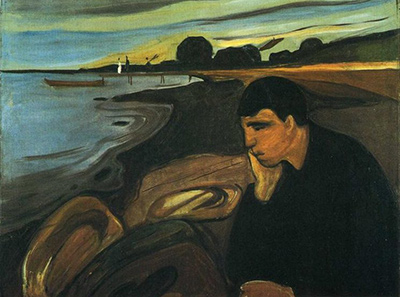
- Melancholy gives the opposite kind of social pressure: not an advancing crowd, but a withdrawn figure near others and yet emotionally alone. [5]
Things You Might Miss
- The crowd is respectable, not chaotic. That makes the unease sharper. [5]
- The faces are frontal and mask-like, which anticipates Anxiety. [6]
- The solitary figure on the right matters because it moves against the crowd. [4]
- The lit windows create urban brightness, but not comfort. [5]
- The painting is not simply a nightmare scene. It is a modern street made psychologically charged. [7]
Interpretation
Evening on Karl Johan Street is a painting about being seen, approached and pressured by modern social life. The crowd is not violent, yet it feels overwhelming. Munch makes normal public behaviour feel uncanny by flattening faces, tightening space and placing the viewer directly in the crowd's path. [5]
The strongest interpretation therefore treats the painting as an image of social anxiety rather than private fantasy alone. It belongs with The Scream and Despair, but it moves the problem into the city. It shows that modern anxiety can come not only from solitude, but from proximity to other people. [6]
Timeline
- 1863: Edvard Munch is born. [2]
- 1892: Munch paints Evening on Karl Johan Street. [1]
- 1893: The Scream develops the red-sky anxiety route into an iconic single figure. [4]
- 1894: Anxiety brings the crowd route into the red-sky landscape. [6]
- 1944: Munch dies after a career of more than sixty years. [2]
FAQs
Munch painted it in 1892. [1]
It is in Bergen, in the Rasmus Meyer Collection at KODE. [1]
It shows Karl Johan Street, the main boulevard of Kristiania, now Oslo. [3]
Anxiety combines the frontal, mask-like crowd type from Evening on Karl Johan Street with the red-sky landscape route of The Scream and Despair. [6]
The lone figure is often interpreted in relation to Munch's own position outside the crowd, but the safer reading is visual: it is a solitary figure moving against the social flow. [4]
References
- KODE / Rasmus Meyer Collection, Evening on Karl Johan Street object context, accessed 5 July 2026.
- MUNCH, "Edvard Munch (1863-1944)," official artist page, accessed 5 July 2026.
- Gerd Woll, Edvard Munch: Complete Paintings, London: Thames & Hudson, 2009.
- Reinhold Heller, Edvard Munch: The Scream, London: Allen Lane, 1973.
- Patricia G. Berman, ed., Edvard Munch: The Modern Life of the Soul, Museum of Modern Art, 2006.
- Arne Eggum, Edvard Munch: The Frieze of Life, 1993.
- eMunch, Edvard Munch's Writings: The English Edition, accessed 5 July 2026.
- TheHistoryOfArt.org, Edvard Munch sitemap and local internal-link validation, checked 5 July 2026.