



 by Tom Gurney
Tom Gurney BSc (Hons) is an art history expert with over 20 years experience
Published on June 19, 2020 / Updated on November 2, 2026
Email: tomgurney1@gmail.com / Phone: +44 7429 011000
Skiffs: Introduction
A yellow paddle cuts across green water, and a narrow wooden bow runs out through the lower edge of the canvas. Gustave Caillebotte’s Skiffs brings a canoe so close that looking becomes an encounter with its progress. Behind it, two smaller boats stretch the scene into the distance; at the right, a fragment of another boat suggests someone already passing beyond our view. [1]
The subject is an outing on the Yerres, the river beside the Caillebotte family’s country property. The men propel their light craft with double-bladed paddles. Their repeated white shirts and straw hats make a sequence across the water, while the paint breaks their reflections into fleeting patches of yellow, blue and green. This conjunction of a firmly organised composition and a visibly restless surface gives the painting its particular energy. [2]
At a Glance
- ArtistGustave Caillebotte
- Date1877
- MediumOil on canvas
- Dimensions88.9 × 116.2 cm
- CollectionNational Gallery of Art, Washington
- Accession1985.64.6
- CreditCollection of Mr. and Mrs. Paul Mellon [1]
- Historical catalogueBerhaut 1994, no. 87 [3]
This work across Gustave Caillebotte’s career
Contents
- Summer on the Yerres
- A river crossed by diagonals
- The blade, the bow and the painted wake
- Green water and yellow light
- A view that seems to continue beyond the canvas
- Boating pictures at the 1879 exhibition
- Related boats, different pictures
- From the artist’s family to Washington
- Annotated details
Summer on the Yerres
The setting belongs to an important period in Caillebotte’s painting. At the family estate in Yerres he explored the park, kitchen garden and adjoining river, finding subjects in cultivation as well as recreation. The Musée des impressionnismes Giverny places these works within a landscape shaped by the family’s use of the property: winding garden paths, planted beds, productive ground and water used for swimming and boating. Nature here was close to home and closely connected with what people did there. [2]
That relationship helps explain the unusual balance of figures and landscape in Skiffs. The water occupies most of the canvas, yet the people organise the experience of it. Their boats establish distances; their paddles supply angles; their pale clothing gives the eye a set of bright points to follow. The river is both an expanse of shifting colour and a place crossed by bodies. The distant greenery becomes legible as a bank because the smallest paddler provides a measure of scale against it.
The craft were known in French as périssoires. Giverny’s teaching dossier describes them as long wooden canoes driven by a double paddle and explains the association of their name with périr, to perish: these light, unstable boats could readily capsize. The term gives a useful corrective to the apparent ease of the excursion. Keeping a narrow hull moving also demands balance, even when the participant’s posture looks relaxed. [2]
At the same time, this is recreation made possible by leisure. The Getty Museum’s Painting Men exhibition text interprets Caillebotte’s boating pictures within the growth of sporting culture in France. Its curators connect such activities with contemporary ideals of male companionship, health, strength and discipline, while placing his freedom to pursue painting and sport within his privileged circumstances. That social reading gives substance to the outing without requiring the men to stand for a single message. [5]
The painting keeps the activity specific. There is no crowd of spectators or visible prize, and no incident announces a winner. The conspicuous action is the repeated handling of paddles. Instead of narrating a decisive sporting event, Caillebotte makes an ordinary passage down the river substantial enough to command a large canvas.
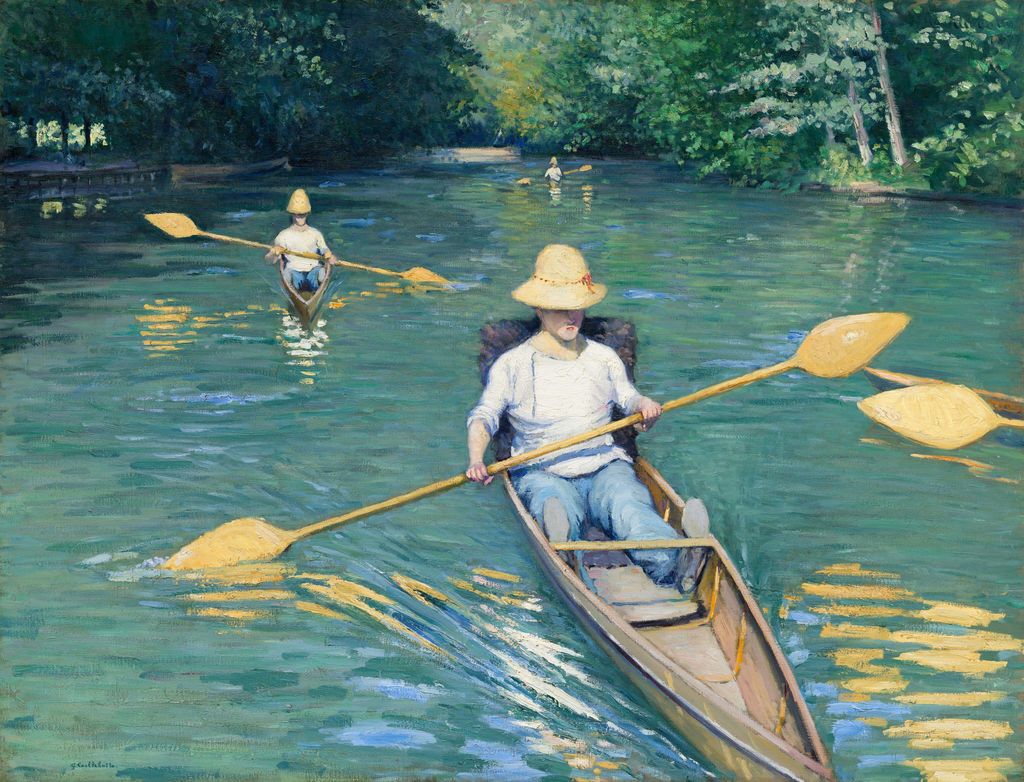
Skiffs,1877; National Gallery of Art,Washington. Collection of Mr. and Mrs. Paul Mellon. Image source. Public domain. Resized only; source appearance preserved.
A river crossed by diagonals
Start with the nearest canoe. Its bow points down and towards the right, meeting the bottom edge before the boat can be seen complete. The right-hand side of the hull makes an especially clear slant, while its pale interior opens towards us. We can look along the narrow space containing the paddler’s extended legs, the crosspiece and the boards. The boat projects into the foreground with a force that the dark trees at the back can scarcely contain.
The paddle supplies a second, crossing direction. Its shaft stretches from the lower left to the upper right across the man’s body. One broad blade is close to the water at the left; the other is lifted against the green expanse to the right. Across this strong diagonal, the shoulders and hands hold an irregular horizontal. The body mediates between the length of the boat and the sweep of the paddle. It is the working centre of an arrangement that otherwise seems liable to slide beyond the frame.
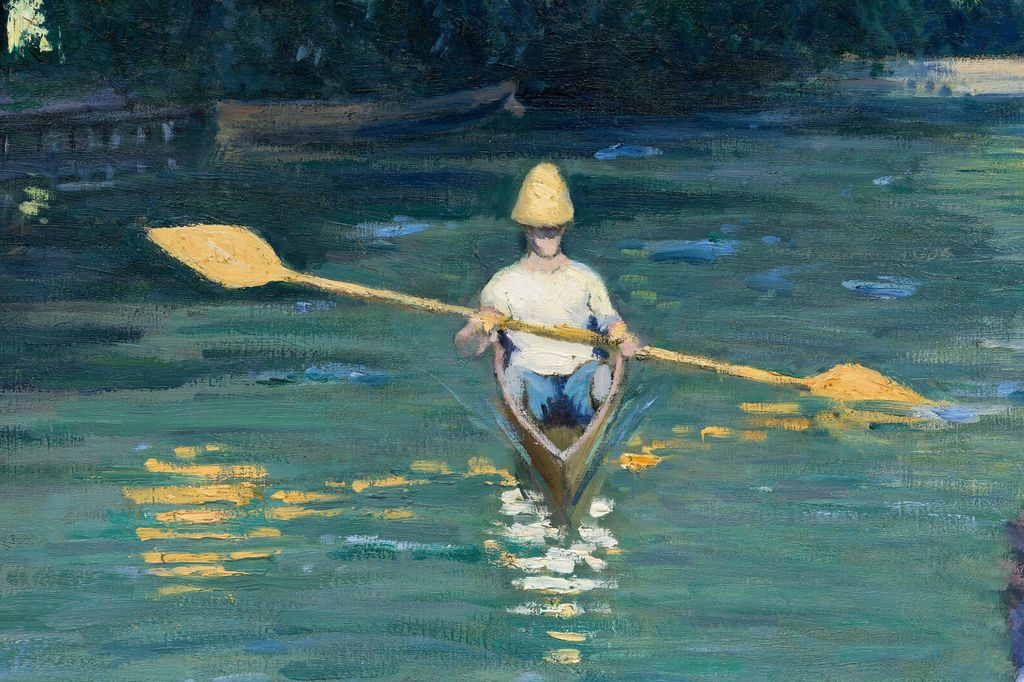
The next canoe occupies the left half of the picture. Its paddler is smaller, and his paddle slopes the other way. Farther back, the third figure sits just to the right of centre. Following these people from foreground to distance sends the eye right, left and right again. Their boats do not form a stately line up the middle of the river. Each changes our direction slightly, making the space feel traversed rather than simply laid out.
Scale is as important as position. The nearest straw hat is a broad, weighty shape, with a brim wide enough to cast a shadow across the face. The middle hat rises to a more pointed crown. The farthest hat can be registered with a small touch. Repetition gives the figures a family resemblance; their drastic reduction in size makes the distance palpable. A reader can recognise the same activity at three scales almost at once.
The fourth boat complicates that sequence. At the right edge, a small wedge of hull and a large blade enter the picture without their occupant. The fragment makes us imagine a neighbouring paddler beyond the painted field. It also prevents the closest man from becoming an isolated portrait. There is traffic around him, continuing outside the limits that Caillebotte has chosen.
The eye therefore has two jobs. It follows the deep route towards the small distant figure, but it also scans sideways for the larger forms that the frame interrupts. These movements do not settle into one comfortable perspective. The painting gives enough information to establish a navigable river and then makes the act of looking as mobile as its subject.
Annotated Details from Skiffs
The numbered points identify visible features discussed in this article. Return from each detail to the whole composition. Skiffs,1877; National Gallery of Art,Washington. Collection of Mr. and Mrs. Paul Mellon. Image source. Public domain. Resized only; source appearance preserved.
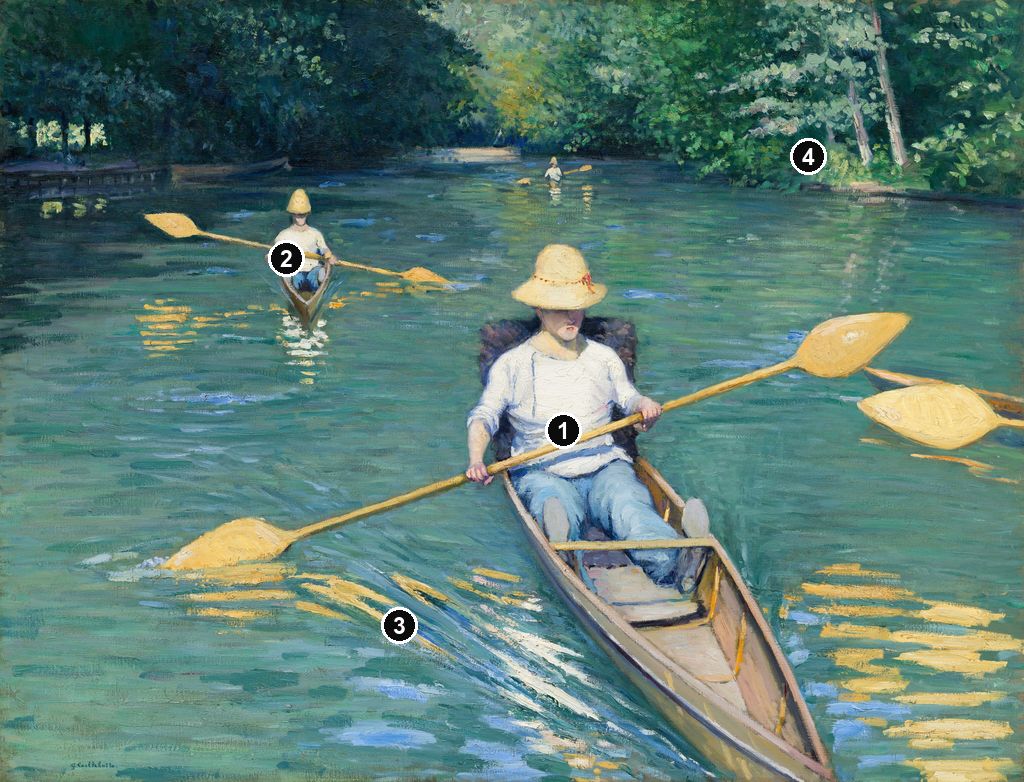
Details from SKIFFS
Compare the cropped details with the complete images above. Notice how their colours, shapes and positions contribute to the larger compositions.
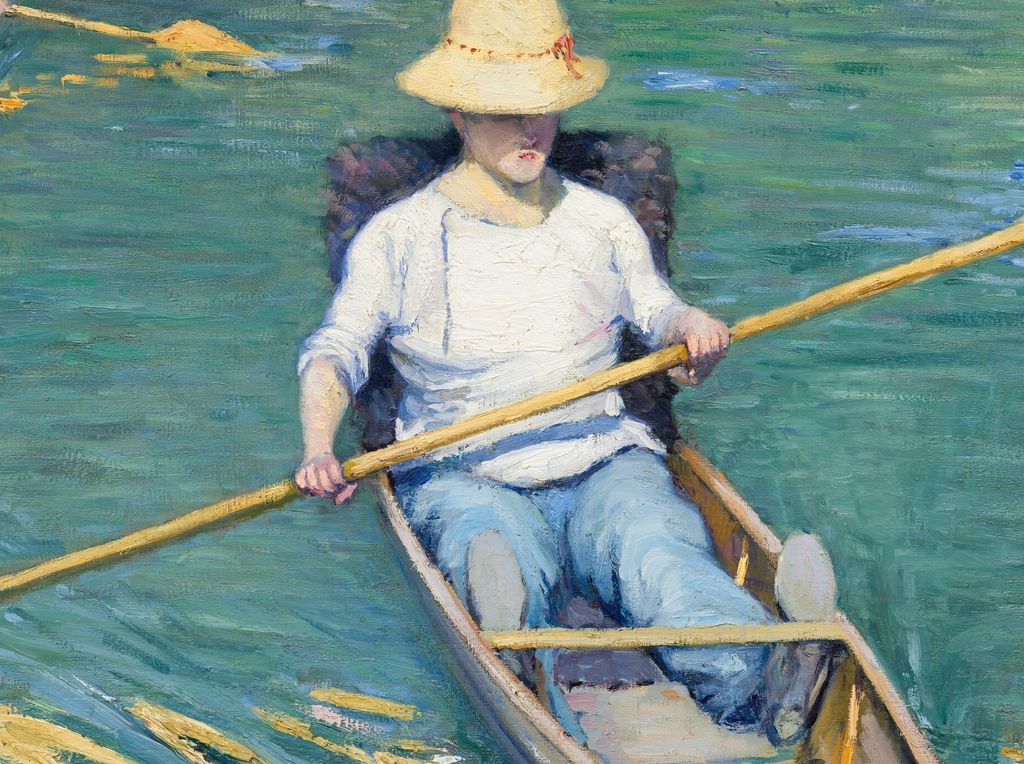
A double-bladed paddle across the body
The nearer paddler holds a long shaft with a blade at each end. Its diagonal crosses the body and reaches into the water beyond the narrow boat.
A second paddler in the distance
The next skiff is smaller and more completely visible. Figure, hull and paddle repeat the nearer arrangement at a different scale.
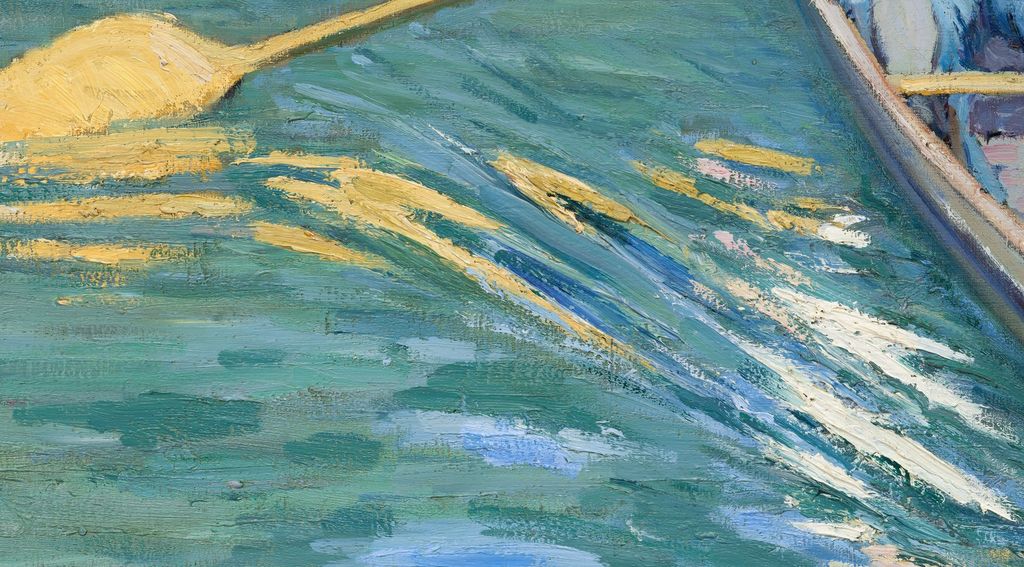
The wake beside the nearest boat
Pale, yellow and blue strokes trail beside the nearest hull. They interrupt the darker green surface and make the boat’s movement visible.
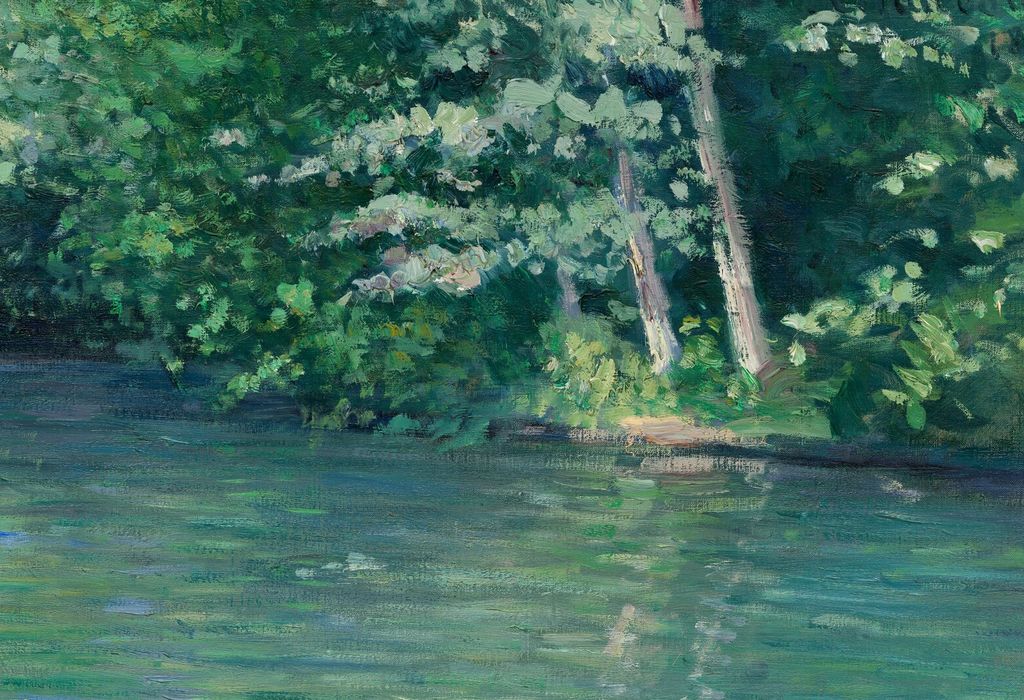
Trees and an opening of water
Dense leaves frame the far stretch of river. The pale trunk and its broken reflection establish a vertical against the open horizontal surface below.
The blade, the bow and the painted wake
The double paddle matters to the action. Both blades belong to one shaft held freely across the paddler’s lap; there is no pair of oars secured to the sides of the canoe. The nearer man faces along his boat’s direction of travel. Calling the scene a generic image of rowing would obscure the physical relation that Caillebotte makes so clear: hands steer a long implement whose two ends work alternately beside a very narrow hull. [2]
Look at the difference between the nearest blades. The raised one has a warm, almost self-contained silhouette. The low one touches the region where the river’s surface breaks into disturbed marks. Beneath and beside it, the yellow of the paddle comes apart in the water. The shape that is solid in the air becomes discontinuous in reflection, so the same colour tells us about an object and its changing surroundings.
The bow produces a related disturbance. Along its left side, long streaks of white and blue sweep down towards the edge of the picture. Some yellow touches are caught among them. These slanting strokes differ from the shorter, more nearly horizontal marks that spread across the quieter water. Through that change of direction alone, the river registers the boat’s passage. Movement becomes visible in the relationship between one group of marks and another.
The hull itself remains readable through a few decisive boundaries. A pale rim encloses the interior; warm brown planes distinguish its sides; the pointed form narrows beyond the bottom edge. Its solidity does not depend on a uniformly smooth finish. Indeed, the visible roughness of the surrounding water makes those comparatively continuous edges more effective. Each element supplies what the other lacks: the canoe gives the moving water a stable shape to break against, and the water gives the canoe a sense of motion.
The paddler’s clothes work in the same way. Broad white areas establish the shirt, but blue and violet strokes fold it around the torso and gather under the arms. The trousers change from pale blue to much darker accents between the legs. His hands are small, concentrated patches at the points where the shaft is gripped. Attention moves from the large, luminous shirt to the precise contacts that make the sporting action possible.
His face is comparatively withheld. Hat, shadow and a few light and dark touches allow us to recognise it, but they offer little basis for reading an individual mood. The picture gives us a body occupied in an activity before it gives us a personality. The obscured face also keeps the broad hat, white shirt and diagonal paddle available as shapes within the whole composition.
Watch: Gustave Caillebotte
Explore a museum overview and two discussions of Paris Street; Rainy Day. This shared selection offers wider context for the artist’s work.
"Who Is Gustave Caillebotte?" - HD version
An introduction to Caillebotte from the Kimbell Art Museum.
Watch on YouTubeGreen water and yellow light
Green is the encompassing colour, but it changes character from place to place. Near the upper left, blue-green shadows gather under the trees. Across the middle, lighter strokes move towards turquoise and grey. In the foreground, pale blues appear among warmer greens, while dark patches interrupt the surface. The water cannot be reduced to one local colour because it receives the varied light and shade of its surroundings.
The yellows create a second system within that green field. Hats, shafts and blades recur from foreground to background. Their reflections are more scattered: short strokes beneath the middle paddler, broader broken bands beside the nearest boat, tiny glints beneath the farthest figure. Solid yellow objects and loose yellow marks repeatedly call to each other across the surface.
These reflections also complicate the construction of depth. Their short, horizontal touches lie visibly across the canvas even while the boats pull us into it. The broadest yellow patches near the bottom can be enjoyed as paint before they resolve into reflections. Then the hull beside them re-establishes the river’s space. Caillebotte allows these two experiences to coexist: looking through the painting into distance and looking at its worked surface.
The trees form an uneven, dark enclosure. On the right, pale trunks interrupt the mass of foliage, and light catches scattered leaves. On the left, the vegetation is denser, with a low bank running along the water. Towards the centre, the river opens into a lighter recess. There is very little open sky to provide relief. Most of the light has to be understood through what it touches: shirts, hats, paddles, leaves and water.
This is one reason the white clothing is so effective. The shirts have a brightness that the setting seldom matches in a continuous area. They draw the people forward without needing exaggerated gestures. At the same time, the blue and violet shadows in the nearest shirt connect it with the cooler colours around it. The figure belongs to the painted atmosphere even as he stands out against it.
A view that seems to continue beyond the canvas
The spectator looks down enough to see inside the nearest canoe. Yet the view is not so steep that the river becomes a flat map. The paddler’s torso rises in front of us, the bow projects towards us, and the far bank remains visible above his head. That intermediate height gives the encounter an unsettled immediacy: we are close to the water, but see more of the boat than another seated paddler might easily see.
The National Gallery’s interpretation connects the composition with photography and tentatively with Japanese prints. Those comparisons concern its framing and viewpoint; they do not establish a particular source photograph or print. [1] The Musée d’Orsay’s Painting Men presentation similarly emphasises Caillebotte’s immersive framing as an aspect of his modernity. [6]
The comparison is useful because the frame seems to catch an activity that exceeds it. The cut-off bow brings the nearest boat into the spectator’s space, while the partial boat at the side implies an adjacent event. Neither cut feels like a decorative border enclosing a finished arrangement. They give the composition the provisional character of a selected view, even though the repeated figures and opposing paddles create a strong underlying order.
Giverny’s dossier takes the sequence of paddlers as an anticipation of a cinematic effect. [2] That is a suggestive analogy for the experience of looking. The three figures can seem like successive appearances of a similar action, each at a different distance. They remain separate people within one painted scene, however; the image gains its sense of unfolding time from our movement between them.
Boating pictures at the 1879 exhibition
Skiffs was shown at the fourth Impressionist exhibition in Paris in 1879, as catalogue number 10, Périssoires. [3] Berhaut places it within a substantial group of Yerres boating subjects made in 1877 and 1878 and records seven boating works in Caillebotte’s contribution to that exhibition. Their formats and media varied, making river recreation a sustained artistic enquiry rather than a single excursion into landscape. [3]
Seeing Skiffs as part of that group changes its emphasis. The men occupy themselves with a practical action that can be compared across different pictures: pulling, balancing, looking and moving through water. The Getty curators interpret the group’s athletic bodies and sporting clothes as central to its treatment of masculinity, including the possibilities of admiration and desire that those bodies offered viewers. [5]
In this canvas the sporting clothes also do compositional work. The nearest man’s rolled sleeves uncover his forearms at the very points where the diagonal shaft is held. His light trousers allow the extended position of his legs to remain legible inside the narrow boat. Dress makes a physical arrangement visible. The leisure subject gains weight through the careful attention paid to how the body occupies and operates the craft.
Giverny’s dossier reports a severe critical reception for the boating series in 1879. [2] The works gave ordinary river recreation the scale and prominence of ambitious exhibition pictures. In Skiffs, the forceful foreground and broken surface make that ambition visible even when the subject itself is an apparently uneventful outing.
Related boats, different pictures
Several Caillebotte paintings bear closely related French titles, so the Washington composition needs to be distinguished from its neighbours. In Berhaut’s 1994 catalogue it is number 87. The Milwaukee Périssoires sur l’Yerres, another horizontal painting dated 1877, is number 86; the tall Rennes canvas dated 1878 is number 120 and belongs to a decorative group with fishing and bathing subjects. They are separate works, not alternative locations or dates for this picture. [3]
The difference in format is especially revealing. The horizontal Washington canvas can spread the paddles across the water while allowing the nearest hull to escape downwards. A tall decorative panel has a different relation to a wall and a different balance between vertical reach and lateral movement. Grouping all these works under an English title such as Skiffs would conceal choices that shaped the individual pictures.
Another useful comparison is Rower in a Top Hat, also known as Boating Party. Galina Olmsted discusses that canvas alongside Canotiers, a different boating composition explored in drawings and drypoint. She identifies a developing interest in placing the viewer within a moving boat. The drypoints belong to Canotiers; the shared enquiry is how a boat can establish a viewer’s position. [7]
The comparison sharpens the question of where we stand. Skiffs makes us feel the approach of another craft through its enlarged foreground and obstructing paddle. The boat nearly fills the space immediately in front of us, yet we see it from outside. Across the boating paintings, the river offered Caillebotte ways of testing the spectator’s position as well as depicting an enjoyable activity.
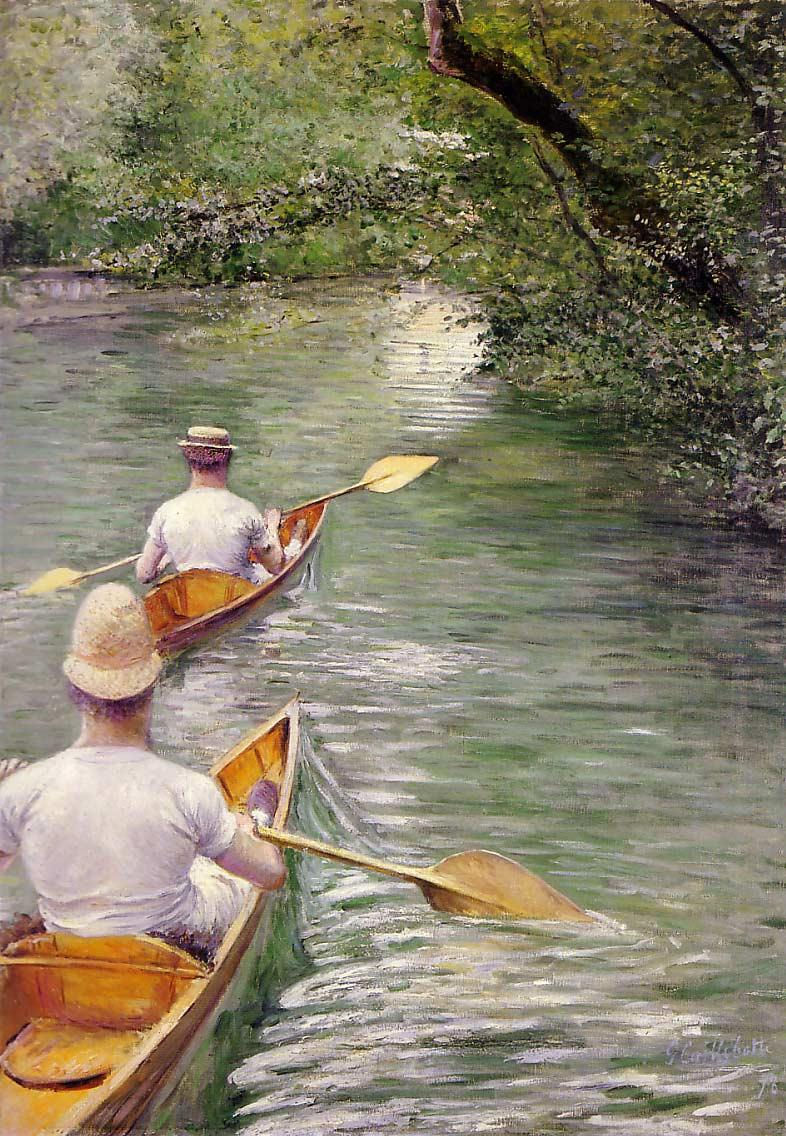
Skiffs on the Yerres,1878; Rennes. Separate vertical composition,Berhaut120. Image source. Public domain. Whole suppliedimage retained; resizedonly.
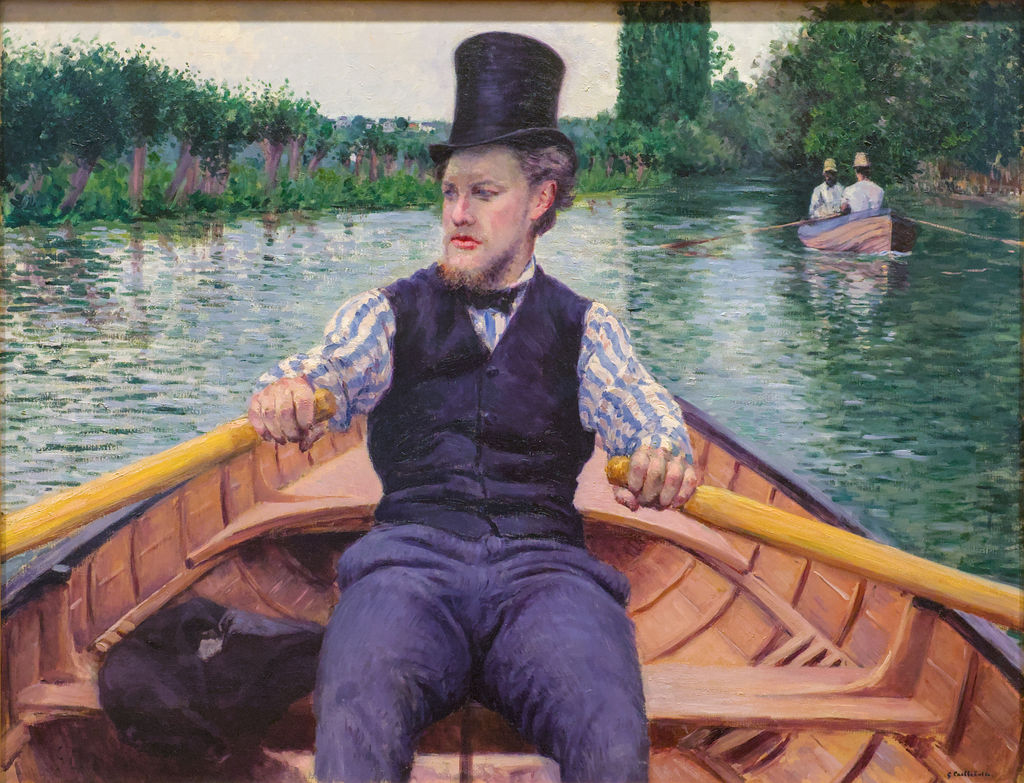
Rower in a Top Hat (Boating Party),about1877–78; Musée d’Orsay. Own work. Image source. Public domain. Resized only; source appearance preserved.
From the artist’s family to Washington
The National Gallery records that the picture passed from Caillebotte’s family to Wildenstein & Co. in 1966 and was sold that year to Mr. and Mrs. Paul Mellon. They gave it to the museum in 1985. [1] Its present collection history is therefore separate from the histories of the similarly titled Milwaukee and Rennes works.
The museum’s inscriptions record distinguishes the dated upper-right signature from a lower-left name probably added by another hand in imitation of an atelier stamp. [1] That small distinction rewards a look towards the edges, just as the incomplete boats do. The margins contain evidence about the painting as an object as well as clues to its visual construction.
The strongest return, however, is to the patch of water where the nearest paddle meets it. There the ordered shape of an implement begins to dissolve into yellow marks, while longer blue and white strokes run beside the bow. The scene’s larger contrasts meet at this local point: solid wood and liquid reflection, a controlled bodily action and the river’s disturbance, a sharply selected view and movement that carries on beyond it.
Catalogue and documented works
This directory brings together 578 entries in the revised 1994 catalogue, 11 further documented records and three groups of study descriptions. It is a directory of records, not a total of authenticated individual works. Albums, print states and surviving decorative panels are grouped. English labels retain the French titles as searchable aliases; dates are supplied only where checked. Numbered entries link to the relevant article or the historical catalogue. Pastels appear under the Drawing filter; original prints remain searchable under All media.
Frequently Asked Questions
They are périssoires, narrow wooden canoes propelled with double-bladed paddles. The French name refers to their instability and tendency to capsize. [2]
No. Washington’s horizontal picture is Berhaut no. 87, dated 1877. Rennes owns the separate vertical composition no. 120, dated 1878. Milwaukee’s related 1877 canvas is no. 86. [3]
The museum’s photographic comparison is interpretive; it identifies no particular source photograph. [1]
The National Gallery of Art, Washington, Collection of Mr. and Mrs. Paul Mellon. [1]
Discussion
Look again at the images and ideas explored in Skiffs. These editorial prompts invite your observations.
Reader Insights
Oars, bows and wakes make several different diagonals across the water.
The close boat and the distant riverbank offer contrasting measures of space.
Which marks make the water seem most active?
Join the Conversation
Share a detail, comparison or question about Skiffs below.
References
- National Gallery of Art, Skiffs, 1877, accession 1985.64.6. Collection record, image, interpretive text, provenance, 1879 exhibition entry and inscriptions. View source.
- Musée des impressionnismes Giverny, Caillebotte, peintre et jardinier: Dossier pédagogique (2016), PDF pp. 4–7, especially the analysis of Périssoires sur l’Yerres, p. 7. View source. (in French).
- Marie Berhaut, with Sophie Pietri, Gustave Caillebotte: Catalogue raisonné des peintures et pastels (1994), nos. 83, 86–87 and 118–120, pp. 103, 105 and 118–119; public reader supplied by the Wildenstein Plattner Institute. View source. (in French).
- Marie Berhaut with Sophie Pietri; Wildenstein Plattner Institute, Gustave Caillebotte Catalogue raisonné des peintures et pastels, 1994. View source. (in French).
- J. Paul Getty Museum, Gustave Caillebotte: Painting Men—Gallery Text (2025), PDF pp. 1 and 6, introductory and sporting-culture texts. View source. (in en/es).
- Musée d’Orsay, Paul Perrin, Scott Allan and Gloria Groom, Caillebotte: Painting Men (2024), institutional exhibition presentation, discussion of immersive framing. View source. (in en/fr).
- Galina Olmsted, Making and Exhibiting Modernism: Gustave Caillebotte in Paris, New York, and Brussels (PhD dissertation, University of Delaware, 2019), printed pp. 151–153, PDF pp. 178–180, on Canotiers, drypoint and A Boating Party. View source.
- Art Institute of Chicago, Caillebotte Paintings and Drawings at the Art Institute of Chicago, 2015. View source.
- Petit Palais / Paris Musées, Portrait de Paul Hugot, original print, PPG2319, current. View source. (in French).
- Paul Perrin, Musée d’Orsay, Transcription de l’entretien commissaire Caillebotte, 2024. View source. (in French).
- Cleveland Museum of Art, Caillebotte collection records: 2020.260, 2009.157 and 2020.105, current. View source.
- Splash image, Skiffs, 1877.


