



Le Pont de l’Europe, 1876. Buy Art Prints Now
from Amazon

* As an Amazon Associate I earn from qualifying purchases.


by
Tom Gurney BSc (Hons) is an art history expert with over 20 years experience
Published on June 19, 2020 / Updated on November 2, 2026
Email: tomgurney1@gmail.com / Phone: +44 7429 011000

Le Pont de l’Europe: Introduction

An enormous iron lattice recedes towards a sunlit Parisian street. A man in a top hat and a woman approach along the pavement; another man rests against the railing, looking towards the railway below. Nearer us, a dog moves into the scene. In Le Pont de l’Europe, Gustave Caillebotte gives a modern bridge the commanding presence of a monument, while keeping the life around it ordinary and unresolved. Painted in 1876, the large oil on canvas belongs to the Association des Amis du Petit Palais in Geneva. [1]

The painting measures about 125 × 180 cm. Its generous width lets Caillebotte set two kinds of movement against each other: the slow approach of pedestrians and the abrupt rush of the ironwork towards the foreground. The bridge’s shadows repeat its structure across the ground, so that even the open pavement participates in its geometry. Marie Berhaut’s catalogue records the inscription “G. Caillebotte / Paris 1876” and identifies this canvas as the work exhibited under number 2 at the third Impressionist exhibition in 1877. [2]

That exhibition context matters. The Geneva picture was one of six paintings Caillebotte presented, and its railway setting brought it into conversation with Monet’s views of the Gare Saint-Lazare. It also belongs to the group of ambitious street scenes through which Caillebotte explored how a person experiences the changing city: walking, passing strangers, turning to look and finding that a piece of urban engineering can dominate the field of vision. [3]

At a Glance

  • ArtistGustave Caillebotte.
  • Date1876.
  • MediumOil on canvas.
  • DimensionsAbout 125 × 180 cm.
  • CollectionAssociation des Amis du Petit Palais, Geneva, accession 111. [1]
  • Catalogue identificationBerhaut 1994, no. 49.
  • First exhibitionThird Impressionist exhibition, Paris, 1877, no. 2. [2]

This work across Gustave Caillebotte’s career

Contents

  1. Entering the picture
  2. A bridge over the railway
  3. Pedestrians, clothing and uncertain encounters
  4. The dog and the moving viewer
  5. How a passing moment was constructed
  6. Light held within firm edges
  7. Shown alongside Monet in 1877
  8. A second view of the bridge
  9. Later ways of seeing the painting
  10. Annotated details

Entering the picture

The bridge seems to start outside the canvas. At the upper and right edges, the girders are cut off before we can see their full extent. Their nearest intersections are so large that the distant buildings appear delicate by comparison. As the metalwork diminishes into the background, its repeated openings become smaller and more closely packed. The eye follows them almost automatically, travelling down the pavement towards the approaching couple.

Yet Caillebotte leaves a broad area of ground between those figures and us. The couple has not reached the foreground. The dog occupies part of that interval, facing into the painting rather than towards the spectator. Its body supplies a direction we can follow. We seem to have arrived behind it, on the same strip of pavement, while the couple approaches from the opposite direction.

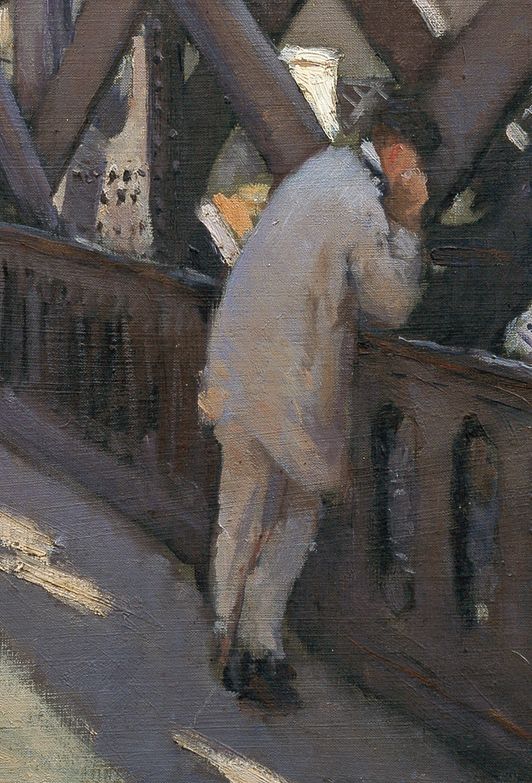
The man at the railing introduces a pause into this traffic. His body leans diagonally, his elbows supported by the parapet, his head turned towards the open spaces between the girders. Compared with the walkers, he is absorbed in something outside our immediate view. The picture allows us to see the act of looking more clearly than the object of his attention.

These different orientations keep the composition active. We can follow the dog, meet the couple, or turn with the leaning man towards the railway. Each movement belongs to the same pavement, yet each directs attention elsewhere. Nothing has happened that requires a story with a beginning and end. The interest lies in the moment when several ordinary activities occupy one place.

The apparent ease of that encounter rests on a highly organised design. In his foreword to Jean Chardeau’s book on Caillebotte’s drawings, Kirk Varnedoe understood such scenes as combinations of modern subjects and traditional construction: calculated spaces and separately studied figures. [5]
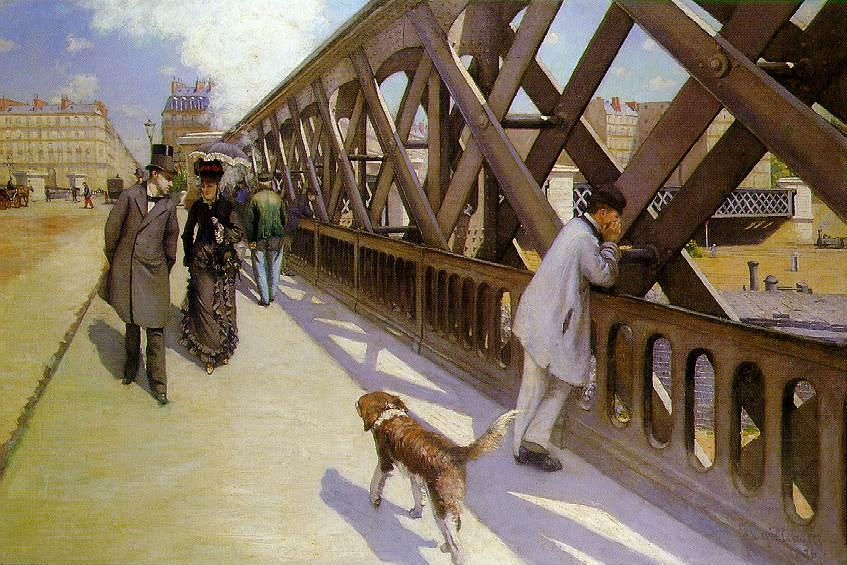
Le Pont de l’Europe,1876; finishedGeneva painting, with foregrounddog.

A bridge over the railway

The Pont de l’Europe crossed the railway approaches to the Gare Saint-Lazare. Berhaut dates the construction of the new bridge to 1865–1868, making it a recent addition to Paris when Caillebotte painted it. Her account identifies the street at the left as the rue de Vienne, descending from the place de l’Europe, with buildings of the rue de Saint-Pétersbourg beyond. On the right, glimpses through the metalwork connect the scene to the rue de Londres and another arm of the bridge. [2]

Those coordinates explain an initially puzzling feature: this is a bridge picture in which the crossing itself is difficult to grasp as a whole. There is no distant, complete view of a structure spanning a void. Caillebotte places us upon it. The pavement feels continuous with an ordinary street, while the girders expose the exceptional engineering that supports the route. The railway lies beneath and beside this everyday passage.

Steam rising beyond the ironwork provides a sign of the traffic below. It also changes the picture’s balance. The metal lattice is hard, repeated and weighty; the pale plume has an irregular outline and seems capable of dispersing. One part of the image gives the city a permanent framework, while another registers activity that lasts only a moment.

The distant blocks make another comparison possible. Their pale façades and rows of windows offer the regularity of the surrounding residential city. Against them, the bridge has a more emphatic rhythm: enormous diagonal members, riveted junctions and an abrupt alternation of solid metal and open sky. Caillebotte gives the infrastructure at least as much visual authority as the buildings it serves.

This was part of a broader transformation of the subjects available to painting. Berhaut places the work within Caillebotte’s interest in contemporary Paris and its recent industrial achievements. A station approach and its iron bridge could sustain the attention once reserved for a celebrated historic building. Their importance here comes from their place in modern experience, made visible through the scale and placement of the structure. [2]

Pedestrians, clothing and uncertain encounters

The approaching man’s top hat and long coat distinguish him from the man leaning at the railing in a cap and lighter working clothes. The woman’s dark, carefully shaped dress gives her figure a different outline again. Their clothes make social distinctions visible before their faces become individually legible. At the same time, the pavement brings them within a few steps of one another.

The painting does not turn that proximity into a clear exchange. The leaning man looks away; the couple moves forward; the dog follows its own course. The top-hatted man turns his head, but the exact direction and meaning of that glance remain open. A viewer can notice the possibility of attention crossing between the figures without converting it into a definite conversation, attraction or confrontation.

The Musée d’Orsay’s Caillebotte: Painting Men presentation, curated by Paul Perrin, Scott Allan and Gloria Groom, offers a useful broader frame. It places workers, passers-by and men observing the city among the figures through which Caillebotte renewed the painting of contemporary life. Its interest in masculinity encourages attention to clothing, posture and the occupation of public space. That framework helps us look closely at the contrast between walking and leaning here; it does not establish an individual’s biography from a painted gesture. [1]

The top-hatted pedestrian has traditionally been identified as Caillebotte himself. Berhaut presents that identification confidently and connects him to a separate painted study of the walker. For the finished picture, however, it is better treated as a longstanding identification than as a securely documented sitting. Berhaut’s proposed identity for the woman is itself qualified. Her identity remains uncertain, limiting attempts to build a biographical episode around the pair. [2]

The possibility of self-representation remains interesting even with that qualification. A painter might place a likeness of himself within the city he observes, making him both a maker of the view and one of its passing inhabitants. But the composition works without resolving that possibility. The pedestrian’s position, turning head and dark silhouette remain significant whether we recognise a portrait or see an anonymous Parisian.

Likewise, the leaning figure need not stand for an entire social class. His clothes and stance mark a contrast with the well-dressed walker, but he also has a direct compositional role. His pale back interrupts the dark lattice, and his bent body makes the railing feel usable, a place where someone can stop. The grand structure becomes part of lived space through the simple act of resting against it.

The dog and the moving viewer

The dog is close enough to anchor the foreground, yet small enough to leave the pavement open around it. Its diagonal passage cuts across the more insistent recession of the bridge. It introduces a body whose movement does not have the measured uprightness of the pedestrians. Against the long rigid members of the ironwork, its legs, tail and uneven coat create a mobile, irregular shape.

Art historian Galina Olmsted, discussing Michael Marrinan’s reading of the painting, explains the dog as a sign that the composition addresses a viewer in motion. We are poised to cross the boundary of the frame rather than remain at a fixed observation point. That is an interpretation of the picture’s effect, and a persuasive one: the animal faces away from us, occupying the route ahead as if it has entered the scene a moment earlier. [3]

The open ground matters to that effect. It gives the viewer room to imagine another step. The approaching couple, the figure moving away beside the ironwork and the dog distribute bodies along the pavement without making it impassable. Caillebotte lets us feel the adjustments that walking among others entails: looking ahead, registering someone at the side and judging how soon our paths may meet.

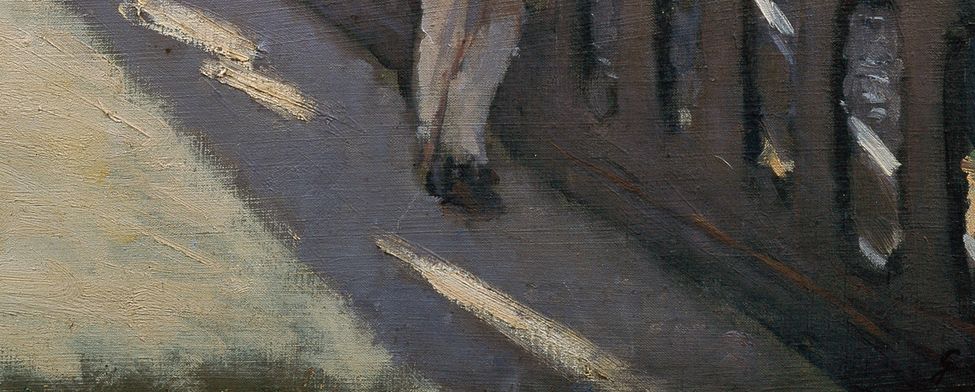
The shadows complicate this freedom. Large diagonal bands cross the pavement, echoing the bridge above. They divide the apparently empty foreground into alternating areas of light and shade. Our imagined route passes through a structure we can see both overhead and underfoot. The bridge shapes movement even where there is no physical barrier.

This helps explain why the composition can feel convincing and unsettled at once. Its repeated lines give us a powerful sense of depth, but they also insist upon the surface of the canvas. Looking down the pavement, we are drawn into distance; looking at the ironwork, we encounter a pattern of crossing diagonals. The image continually shifts between a place to enter and an arrangement to inspect.

Watch: Gustave Caillebotte

Explore a museum overview and two discussions of Paris Street; Rainy Day. This shared selection offers wider context for the artist’s work.

How a passing moment was constructed

The surviving studies recorded by Berhaut show how many different problems the finished painting brought together. Her catalogue groups three overall oil sketches and three partial studies with the Geneva canvas. The smallest overall sketch, no. 43, establishes the perspective and rhythm of the metal superstructure while leaving the two principal pedestrians largely absent. Other studies bring the figures and setting closer to the final arrangement. [2]

The partial studies are especially revealing. One isolates the top-hatted walker, whose posture is reversed in relation to the finished picture. Another concentrates on the foreground ironwork, leaving the railway and distant buildings more loosely indicated. A further study includes the man at the railing in his eventual position. The painter could work through a figure, a structural junction and a view beyond it as related but distinct tasks. [2]

Olmsted connects this preparation with the perspective drawings made using a straight-edge. She describes the final street scenes as assembled spaces, their architectural components producing an ordered yet uneasy result. Her analysis helps account for the sense that the painting can accommodate more than a single, effortlessly unified glance. It should not be mistaken for a claim that the visible bridge is an unedited record of one optical instant. [3]

Varnedoe also suggested possible optical or photographic assistance in making small perspective studies. This remains a hypothesis. His central point concerns the productive relationship between traditional preparation and modern experience. [5]

A later family story adds another element to the work’s history. As Olmsted explains, Berhaut first published the recollection in 1951 that Caillebotte had an enclosed vehicle constructed so that he could paint in different weather. Olmsted allows that such a vehicle might have served the making of preliminary studies. The story does not establish that the large finished Geneva canvas was painted entirely on the bridge. Its status as later family recollection is part of the evidence. [3]

These stages of preparation alter how we see the apparent encounter. The man’s glance, the dog’s path and the bridge’s recession do not have to have occurred together before the painter’s eyes. Their force lies in the coherent experience Caillebotte creates from observed and studied elements. The painting makes the city feel immediate through an arrangement that took time to achieve.
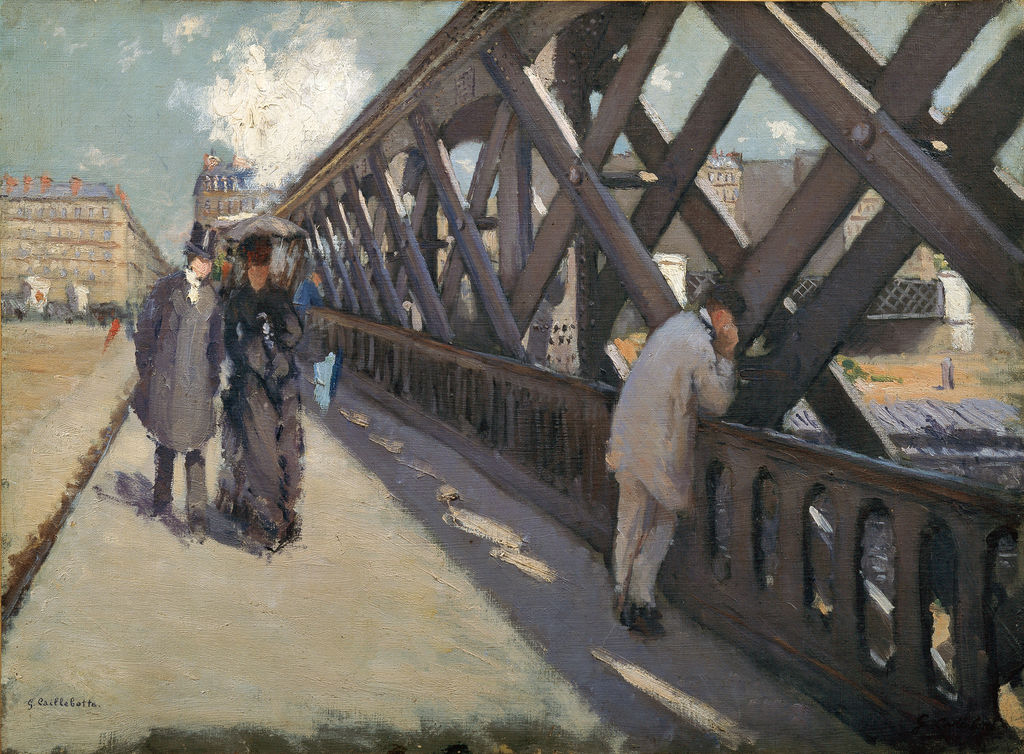
Oil study for Le Pont de l’Europe,1876; a separate preparatory composition without theforegrounddog.
Oil study for Le Pont de l’Europe,1876; a separate preparatory composition without theforegrounddog. ordrupgaard.dk. Image source. Public domain. Resized only; source appearance preserved.
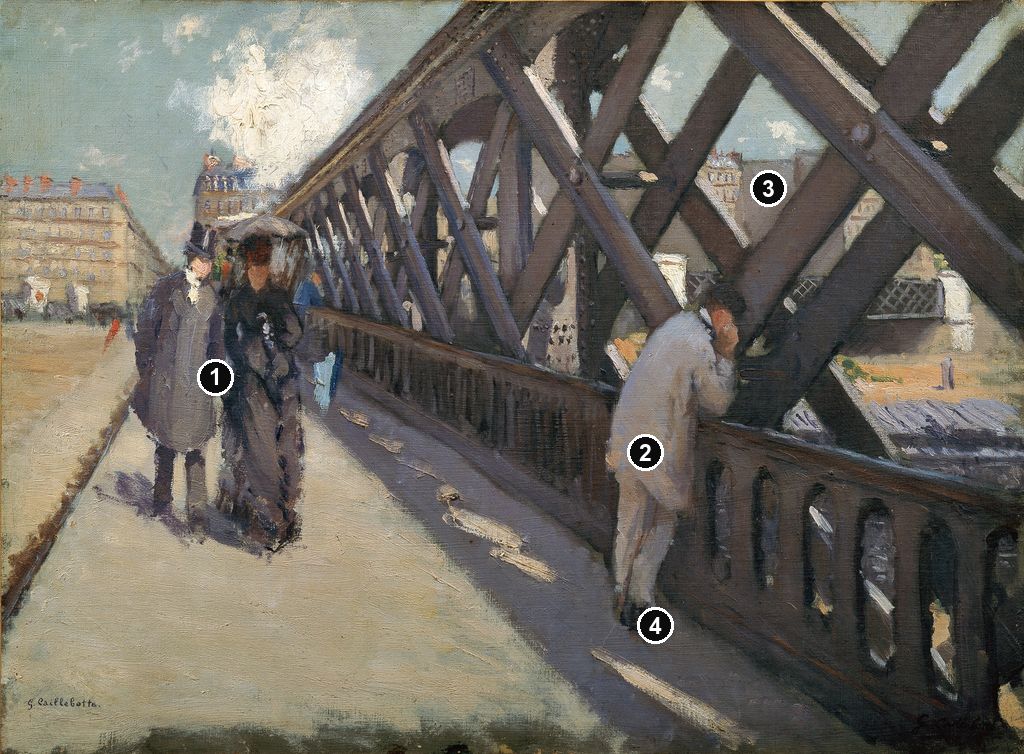
Annotated Details from the separate oil study for Le Pont de l’Europe

The numbered points identify visible features discussed in this article. Return from each detail to the whole composition. Oil study for Le Pont de l’Europe,1876; a separate preparatory composition without theforegrounddog. ordrupgaard.dk. Image source. Public domain. Resized only; source appearance preserved.

Annotated details from the separate oil study for Le Pont de l’Europe by Gustave Caillebotte

Details from THE SEPARATE OIL STUDY FOR LE PONT DE L’EUROPE

These details belong to the oil study, not the finished Geneva painting. Compare its simplified construction with the finished work discussed above.

1

The walking pair in the oil study

A man and a woman walk together beneath a parasol. Their dark clothes gather into a compact group beside the wide pavement.
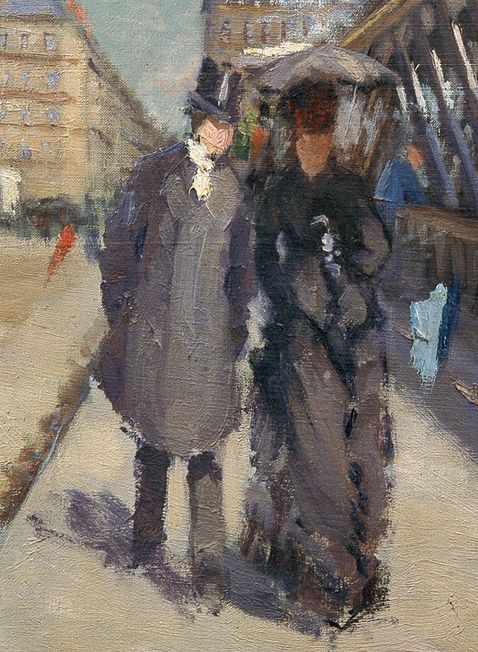
The walking pair in the oil study detail from the separate oil study for Le Pont de l’Europe by Gustave Caillebotte
2

The man leaning over the rail

A figure in pale clothes bends towards the railing. His angled back and lowered head draw attention away from the walking pair and towards the space beyond the bridge.
The man leaning over the rail detail from the separate oil study for Le Pont de l’Europe by Gustave Caillebotte
3

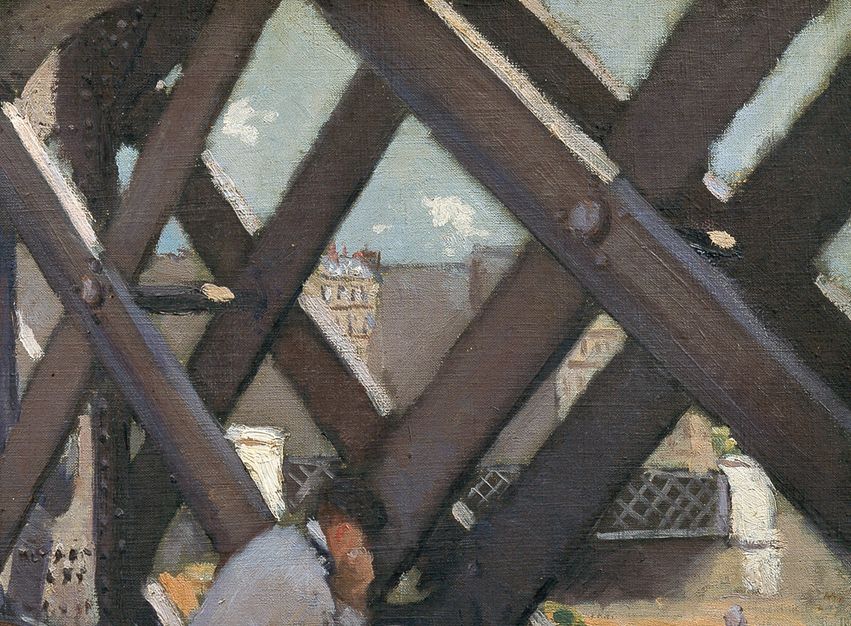
Crossing iron girders

Broad diagonal girders repeat along the bridge. Their dark intersecting shapes divide glimpses of buildings and sky.
Crossing iron girders detail from the separate oil study for Le Pont de l’Europe by Gustave Caillebotte
4

Light and shadow across the pavement

Long pale and darker shapes cut across the pavement. Their diagonals echo the bridge structure and open the foreground around the figures.
Light and shadow across the pavement detail from the separate oil study for Le Pont de l’Europe by Gustave Caillebotte

Light held within firm edges

Lynn Kellmanson Matheny’s National Gallery of Art brochure draws attention to the painting’s controlled handling. She notes that the sharp definition of the girders and railing extends to the figures and shadows, while the steam, clouds and dog’s fur allow looser brushwork. This distinction gives material variety to a tightly organised scene. [6]

Look at how the light travels across the bridge. Some edges catch a pale highlight; other planes sink into blue-grey shade. The same member can therefore read as a dark diagonal and as a substantial object with thickness. The openings between the girders disclose fragments of sky and distant architecture, so that the construction never becomes a completely closed wall.

Below, the railing has a smaller rhythm of repeated openings. These recede towards the distance alongside the more dramatic lattice above. Their two scales help make the bridge appear both monumental and physically close. The leaning man belongs to the smaller scale of the parapet, while the towering members behind him continue beyond the frame.

The sunlit pavement provides relief from this density. Its broad pale surface allows the scattered bodies and their shadows to remain distinct. Small warm notes in the dog and the distant buildings prevent the cool iron from determining the entire colour of the picture. Brightness does not dissolve the structure; it makes its divisions more legible.

Shown alongside Monet in 1877

At the third Impressionist exhibition, held at 6 rue Le Peletier, Caillebotte appeared as both painter and organiser. Berhaut records his part in obtaining the premises and arranging the pictures with Renoir, Pissarro and Monet. His six exhibited works included Le Pont de l’Europe, Paris Street, Rainy Day and House Painters. [2]

Olmsted reconstructs the installation as a setting in which Caillebotte’s major urban pictures appeared alongside Monet’s Gare Saint-Lazare paintings in the fourth gallery. The association let visitors compare views of the same railway district from different positions and through different kinds of paint. Caillebotte’s bridge presented the place as a route occupied by pedestrians, dominated by the hard geometry of its construction. Monet’s station paintings gave smoke, atmosphere and railway activity greater prominence. [3]

Berhaut makes a similar distinction between Caillebotte’s attention to recent urban developments and Monet’s interest in optical changes produced by steam. The comparison does not separate structure and atmosphere absolutely: there is steam in Caillebotte’s picture, just as Monet’s station views require architecture. What changes is the distribution of emphasis. Seen together, the paintings expanded the possibilities of a common modern subject. [2]

Olmsted argues that the installation also answered doubts about Caillebotte’s place within Impressionism. His more finished surfaces could distinguish him sharply from colleagues whose brushwork remained conspicuous. A thematic pairing with Monet allowed that difference to become part of a shared investigation of contemporary Paris. Her further argument that Caillebotte helped prompt Monet’s railway project is a reconstruction of their artistic relationship, rather than a documented agreement between the two painters. [3]

The street paintings also figure in Olmsted’s account of Caillebotte’s response to criticism of his earlier perspectives. She proposes a progression from House Painters through the Geneva bridge to Paris Street, Rainy Day, increasing in scale and spatial ambition. The dates establish the bridge painting’s place before the 1877 exhibition; the exact sequence of production and the motive of answering critics remain her interpretation. [3]

The painting’s apparent realism can conceal a question running through this critical history: why does such a precisely organised view feel strange? Varnedoe later used the drawings to defend the originality of Caillebotte’s constructed spaces. Their tension between organisation and unstable sensation is also something we can experience directly. [5]
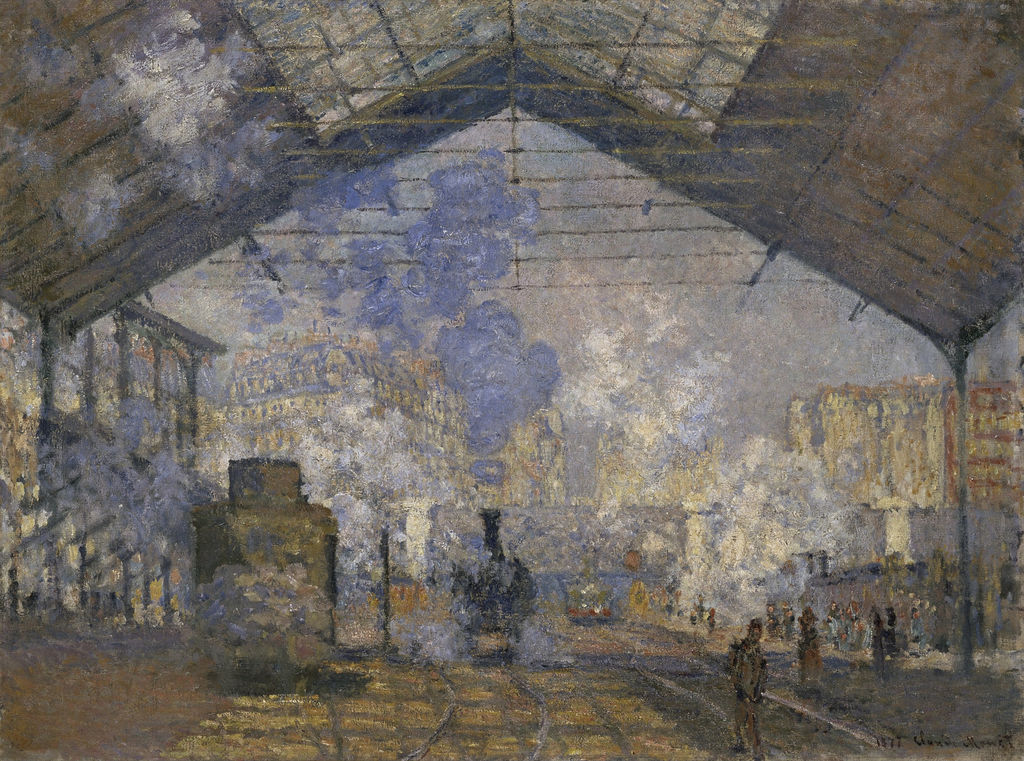
Claude Monet, The Saint-Lazare Station,1877; comparison with railway subjects shown in1877.
Claude Monet, The Saint-Lazare Station,1877; comparison with railway subjects shown in1877. wAHOCsl09dhUPw at Google Cultural Institute maximum zoom level. Image source. Public domain. Resized only; source appearance preserved.

A second view of the bridge

Caillebotte returned to the subject in the painting now known as On the Pont de l’Europe, in the Kimbell Art Museum. The two canvases are easily confused because both show men beside the same iron structure. The Geneva work, dated 1876 and catalogued by Berhaut as no. 49, is the wide pedestrian scene with the foreground dog. The Kimbell composition, made around 1876–1877, is no. 51 and takes a much closer, more restricted view of the lattice and the men beside it. [1] [2]

In the Geneva painting the bridge leads our gaze into distance; in the Kimbell picture it occupies the width of the image as a formidable screen. Olmsted describes the latter’s space as comparatively shallow, its geometry corresponding closely to the structural divisions of the bridge. The comparison shows how much depends on the painter’s chosen position. A few steps and a different framing can transform the same subject from a street one can imagine walking along into a field of metal and interrupted views. [3]

The Kimbell canvas was not included in the 1877 exhibition. Olmsted proposes that its shallower space did not serve the same exhibition strategy as the Geneva picture, but the reason for its omission is not securely known. What is certain is that the bridge scene encountered by the 1877 audience was the Geneva composition. [3]

Later ways of seeing the painting

Berhaut’s catalogue traces the Geneva canvas from a gift by Caillebotte to Eugène Lamy, through Lamy’s daughter Blanche, Mme Drouilly, to a Paris sale in 1956. It records Oscar Ghez’s acquisition and the painting’s entry into Geneva’s Petit Palais in 1968. The later Musée d’Orsay caption identifies the collection as the Association des Amis du Petit Palais, Geneva, accession 111. [2] [1]

The work has also acquired different contexts through exhibitions. Berhaut records its inclusion in the 1894 retrospective and in the Houston and New York Caillebotte exhibition of 1976–1977. It appeared in the Paris and Tokyo Le Japonisme exhibition of 1988. Such a context encouraged comparison between the bridge motif and Japanese art, although exhibition history alone cannot identify a particular print as Caillebotte’s source. [2]

Photography supplies another way into the picture. The SCHIRN’s 2012 exhibition texts interpreted Caillebotte’s unusual viewpoints, framing and interest in movement as a distinctive response to modern visual experience. Their comparisons with both nineteenth-century photography and later photographic experimentation concern relationships between ways of seeing. They do not prove that he traced a photograph for Le Pont de l’Europe. [7]

The 2024 Painting Men presentation brought the work into a different conversation, centred on bodies, social roles and masculine experience. Together, these approaches explain why so much can be found in a seemingly uneventful stretch of pavement: an engineered view, a pattern of social differences, a setting for observation and a carefully constructed experience of movement. The painting sustains those readings because its people remain particular in their actions while their encounters stay open. [1]

Catalogue and documented works

This directory brings together 578 entries in the revised 1994 catalogue, 11 further documented records and three groups of study descriptions. It is a directory of records, not a total of authenticated individual works. Albums, print states and surviving decorative panels are grouped. English labels retain the French titles as searchable aliases; dates are supplied only where checked. Numbered entries link to the relevant article or the historical catalogue. Pastels appear under the Drawing filter; original prints remain searchable under All media.

592 records

NameDateMedium
14 July on the Rue Lepic (Berhaut 155)Oil painting
A Balcony, Boulevard Haussmann (Berhaut 146)Oil painting
A Balcony, Boulevard Haussmann (Berhaut 148)1880Oil painting
A Field at Villers (Berhaut 169)Pastel
A Garden at Trouville (Berhaut 232)Oil painting
A Garden, Yerres (Berhaut 74)Oil painting
A House at Petit Gennevilliers (Berhaut 208)Oil painting
A Path at Yerres (Berhaut 543)Oil painting
A Road in Naples (Berhaut 6)Oil painting
A Skiff on the Yerres (Berhaut 88)Oil painting
A Soldier (Berhaut 185)Oil painting
A Stack of Sheaves (Berhaut 546)Oil painting
A Street in Yerres (Berhaut 65)Oil painting
A Traffic Island, Boulevard Haussmann (Berhaut 153)Oil painting
A Villa at Trouville (Berhaut 226)Oil painting
After Luncheon (Berhaut 2)Oil painting
An Uphill Path (Berhaut 158)Oil painting
Angler in a Boat (Berhaut 386)Oil painting
Angler Lifting His Line (Berhaut 323)Oil painting
Anglers on the Banks of the Yerres (Berhaut 117)Oil painting
Anglers on the Seine (Berhaut 387)Oil painting
Angling (Berhaut 118)Oil painting
Apple Trees by the Sea, Trouville (Berhaut 173)Oil painting
Apple Trees in Blossom, Hillside at Colombes (Berhaut 265)Oil painting
Apple Trees in Blossom, Petit Gennevilliers (Berhaut 444)Oil painting
Apples (Berhaut 395)Oil painting
Argenteuil Bridge (Berhaut 478)Oil painting
Argenteuil Bridge and the Seine (Berhaut 334)Oil painting
Argenteuil, the Fairground (Berhaut 264)Oil painting
Arm of the Seine, Autumnal Mood (Berhaut 414)1890Oil painting
Azalea (Berhaut 564)Oil painting
Banana Plant, Garden at Petit Gennevilliers (Berhaut 258)Oil painting
Bank of the Seine at Argenteuil (Berhaut 388)Oil painting
Bank of the Seine at Petit Gennevilliers (Berhaut 441)Oil painting
Bank of the Seine at Petit Gennevilliers (Berhaut 476)Oil painting
Bank of the Seine at Petit Gennevilliers in Winter (Berhaut 477)Oil painting
Bank of the Seine near Argenteuil (Berhaut 378)Oil painting
Bank of the Seine near Argenteuil (Berhaut 411)Oil painting
Bank of the Seine, Argenteuil (Berhaut 412)Oil painting
Banks of the Seine at Sunset (Berhaut 429)Oil painting
Banks of the Yerres (Berhaut 125)Oil painting
Bather Preparing to Dive (Berhaut 119A)Drawing
Bather Preparing to Dive, Banks of the Yerres (Berhaut 121)Oil painting
Bathers, Banks of the Yerres (Berhaut 119)Oil painting
Bezons Bridge Seen from the Tip of Île Marande (Berhaut 377)Oil painting
Blue Irises, Garden at Petit Gennevilliers (Berhaut 447)Oil painting
Boat at Anchor on the Seine, Argenteuil (Berhaut 422)Oil painting
Boat Moored on the Seine (Berhaut 421)Oil painting
Boat Moored on the Seine at Argenteuil (Berhaut 278)Oil painting
Boat Moored on the Seine at Argenteuil (Berhaut 348)Oil painting
Boat near the Bank, Autumn Effect (Berhaut 280)Oil painting
Boater Bringing in His Skiff, Banks of the Yerres (Berhaut 123)Oil painting
Boater Fishing on the Yerres (Berhaut 85)Pastel
Boaters Rowing (Berhaut 83A)Drawing
Boaters Rowing on the Yerres (Berhaut 83)Oil painting
Boaters’ Luncheon on the Banks of the Yerres — historical attribution questioned (Berhaut 1)Oil painting
Boathouse near Port-Marly (Berhaut 28)Oil painting
Boats and Shed on the Banks of the Seine (Berhaut 433)1891Oil painting
Boats at Anchor on the Seine (Berhaut 437)Oil painting
Boats Moored on the Seine at Argenteuil (Berhaut 439)Oil painting
Boats near the Landing Stage (Berhaut 274)Oil painting
Boats on the Seine at Argenteuil (Berhaut 409)Oil painting
Boats on the Seine at Argenteuil (Berhaut 438)Oil painting
Boats on the Seine at Argenteuil (Berhaut 474)Oil painting
Boulevard des Italiens (Berhaut 144)Oil painting
Boulevard Haussmann, Effect of Snow (Berhaut 179)Oil painting
Boulevard Haussmann, Effect of Snow (Berhaut 180)Oil painting
Bouquet of China Asters, Nasturtiums and Sunflowers in a Vase (Berhaut 358)Oil painting
Bouquet of Daisies in a Vase (Berhaut 359)Oil painting
Bouquet of Roses in a Crystal Vase (Berhaut 253)Oil painting
Cactus Dahlias in a Vase (Berhaut 456)Oil painting
Caillebotte’s House Seen from the Seine, Petit Gennevilliers, or The Landing Stage (Berhaut 389)Oil painting
Cakes (Berhaut 197)Oil painting
Camille Daurelle in the Park at Yerres (Berhaut 70)Pastel
Canal Bank near Naples (Berhaut 7)Oil painting
Cattleya and Anthurium (Berhaut 494)Oil painting
Cattleya and Red-Flowered Plants (Berhaut 496)Oil painting
Cherry-Bay Horse in the Stable (Berhaut 517)Oil painting
China Asters in a Vase (Berhaut 241)Oil painting
Chrysanthemum Bed, Garden at Petit Gennevilliers (Berhaut 489)Oil painting
Chrysanthemums in a Vase (Berhaut 485)Oil painting
Chrysanthemums in a Vase (Berhaut 486)Oil painting
Château beside the Seine, Argenteuil (Berhaut 423)Oil painting
Cliff in Normandy (Berhaut 177)Oil painting
Cliff in Normandy (Berhaut 178)Oil painting
Coastal Cliff, Normandy (Berhaut 315)Oil painting
Coastal Landscape, Trouville (Berhaut 224)Oil painting
Corner of a Park, Yerres (Berhaut 38)Oil painting
Covered Path in Normandy (Berhaut 191)Oil painting
Cows in a Meadow (Berhaut 317)Oil painting
Cows in a Meadow by the Sea (Berhaut 316)Oil painting
Dahlias in a Vase (Berhaut 200)Oil painting
Dahlias in a Vase (Berhaut 482)Oil painting
Dahlias, Garden at Petit Gennevilliers (Berhaut 461)Oil painting
Dahlias, Garden at Petit Gennevilliers (Berhaut 462)1893Oil painting
Daisies (Berhaut 451)Oil painting
Daisy Flowerbed (Parterre de marguerites), four surviving panelsc. 1892–1893Oil on canvas
Dark-Bay Horse in the Stable (Berhaut 518)Oil painting
Duck (Canard d’Inde) (Berhaut 13)Oil painting
Edge of the Pond, Yerres Park (Berhaut 23)Oil painting
Enclosure with Fruit Trees in a Landscape (Berhaut 209)Oil painting
Factories at Argenteuil (Berhaut 390)Oil painting
Farmyard (Berhaut 545)Oil painting
Field by the Sea, Trouville (Berhaut 220)Oil painting
Fields, Gennevilliers Plain, Study in Yellow and Green (Berhaut 268)Oil painting
Fields, Gennevilliers Plain, Study in Yellow and Pink (Berhaut 291)Oil painting
Floor Scrapers studies — source-bounded groupDrawing study group
Flower Bed, Garden at Petit Gennevilliers (Berhaut 203)Oil painting
Flower Bed, Garden at Petit Gennevilliers (Berhaut 300)Oil painting
Foliage (Berhaut 450)Oil painting
Four Vases of Chrysanthemums (Berhaut 484)Oil painting
Fruit Displayed on a Stand (Berhaut 193)about 1881–82Oil painting
Full-Length Portrait of Pierre Rabot (Berhaut 464)Oil painting
Further House Painters studies — source-bounded groupDrawing study group
Garden and House, Petit Gennevilliers (Berhaut 342)Oil painting
Garden in Trouville (Berhaut 233)c. 1882Oil painting
Garden Path and Dahlia Beds, Petit Gennevilliers (Berhaut 420)Oil painting
Garlic Cloves and Knife on a Table (Berhaut 556)Oil painting
Gennevilliers Plain, Yellow Fields (Berhaut 293)1884Oil painting
Gladioli (Berhaut 503)Oil painting
Gladioli (Berhaut 505)Oil painting
Hare (Berhaut 250)Oil painting
Hare and Thrushes (Berhaut 249)Oil painting
Head of a Man (Berhaut 141)Oil painting
Head of a Woman (Berhaut 393)Oil painting
Hens and a Duck (Berhaut 547)Oil painting
Hors d’Œuvre (Berhaut 198)Oil painting
Horse-Chestnuts in Blossom (Berhaut 295)Oil painting
Horses in a Stable (Berhaut 18)Oil painting
House and Garden in Normandy (Berhaut 231)Oil painting
House in the Normandy Countryside (Berhaut 163)Oil painting
Houses and Gardens, Yerres (Berhaut 66)Oil painting
Houses at Argenteuil (Berhaut 262)Oil painting
Houses in the Gennevilliers Countryside (Berhaut 331)Oil painting
Houses on the Coastal Cliff (Berhaut 168)Oil painting
Hyacinth Bed, Garden at Petit Gennevilliers (Berhaut 419)Oil painting
In a Boat on the Seine (Berhaut 134)Oil painting
In a Café (Berhaut 142)Oil painting
Interior, Woman at the Window (Berhaut 140)1880Oil painting
Interior, Woman Reading (Berhaut 139)Oil painting
Irises and Gladioli, Garden at Petit Gennevilliers (Berhaut 446)Oil painting
Kitchen Garden, Yerres (Berhaut 78)Pastel
Landscape (Berhaut 541)Oil painting
Landscape (Berhaut 542)Oil painting
Landscape at Argenteuil (Berhaut 401)Oil painting
Landscape in Normandy (Berhaut 318)Oil painting
Landscape in Normandy, Apple Tree in a Wooded Valley (Berhaut 174)Oil painting
Landscape in Normandy, Apple Trees in a Wooded Valley (Berhaut 175)Oil painting
Landscape near Trouville (Berhaut 189)Oil painting
Landscape near Yerres (Berhaut 128)Pastel
Landscape under Snow (Berhaut 20)Oil painting
Landscape with a Hotel and Restaurant (Berhaut 330)Oil painting
Landscape with a Railway Line (Berhaut 5)Oil painting
Landscape with a River (Berhaut 379)Oil painting
Landscape with a River (Berhaut 380)Oil painting
Landscape with a Row of Poplars, Petit Gennevilliers (Berhaut 374)Oil painting
Landscape with Haystacks (Berhaut 544)Oil painting
Landscape with Haystacks (Berhaut 91)Pastel
Landscape with Houses, Petit Gennevilliers (Berhaut 372)Oil painting
Landscape with Poplars, Petit Gennevilliers (Berhaut 373)Oil painting
Landscape with Straw Stacks (Berhaut 19)Oil painting
Landscape, Gennevilliers (Berhaut 410)Oil painting
Landscape, Petit Gennevilliers (Berhaut 398)Oil painting
Laundry Drying on the Banks of the Seine (Berhaut 368)c. 1892Oil painting
Laundry Drying on the Banks of the Seine, Petit Gennevilliers (Berhaut 367)Oil painting
Laundry Drying, Petit Gennevilliers (Berhaut 369)Oil painting
Laundry Drying, Petit Gennevilliers (Berhaut 370)1888Oil painting
Le Pont de l’Europe (Berhaut 49)1876Oil painting
Le Pont de l’Europe (Berhaut 51)1876–77Oil painting
Le Pont de l’Europe, Oil Sketch (Berhaut 43)Oil painting
Le Pont de l’Europe, Oil Sketch (Berhaut 44)Oil painting
Le Pont de l’Europe, Oil Sketch (Berhaut 45)Oil painting
Le Pont de l’Europe, Oil Sketch (Berhaut 50)Oil painting
Le Pont de l’Europe, Partial Study (Berhaut 46)Oil painting
Le Pont de l’Europe, Partial Study (Berhaut 47)Oil painting
Le Pont de l’Europe, Partial Study (Berhaut 48)Oil painting
Lilacs and Peonies in Two Vases (Berhaut 255)Oil painting
Lilacs in a Vase (Berhaut 256)Oil painting
Lilacs in a White Vase (Berhaut 11)Oil painting
Little Girl on a Balcony (Berhaut 151)Oil painting
Luncheon (Berhaut 37)1876Oil painting
Madame Boissière Knitting (Berhaut 67)Oil painting
Madame Boissière Knitting, original drypoint1877Drypoint
Madame Renoir in the Garden at Petit Gennevilliers (Berhaut 418)Oil painting
Man and Woman beneath an Umbrella (Berhaut 55)Oil painting
Man and Woman beneath an Umbrella (Berhaut 55A)Drawing
Man at His Bath (Berhaut 286)1884Oil painting
Man before a Mirror (Berhaut 142A)Drawing
Man Drying His Leg (Berhaut 285)about 1884Oil painting
Man in a Top Hat Seated near a Window (Berhaut 137)Oil painting
Man on a Balcony (Berhaut 145)Oil painting
Man on a Balcony, Boulevard Haussmann (Berhaut 149)1880Oil painting
Meadow at Yerres (Berhaut 24)Oil painting
Meadow by the Sea, Normandy (Berhaut 314)Oil painting
Meadow, Yerres (Berhaut 127)Pastel
Melon and a Dish of Figs (Berhaut 238)Oil painting
Nasturtiums (Berhaut 452)Oil painting
Nasturtiums (Berhaut 453)Oil painting
Normandy Coast (Berhaut 312)Oil painting
Normandy Coast (Berhaut 313)Oil painting
Nude on a Couch (Berhaut 201)about 1880 (current);1881–82 sequence 1994Oil painting
Nude Woman Lying on a Couch (Berhaut 8)Pastel
Oarsmen (Canotiers), original drypoint1877Drypoint
Oarsmen on the Yerres (Berhaut 84)Pastel
On the Bench (Berhaut 460)Oil painting
Orchard and Corner of a House, Petit Gennevilliers (Berhaut 329)Oil painting
Orchard in Normandy (Berhaut 171)Pastel
Orchard with Apple Trees in Blossom, Colombes (Berhaut 266)Oil painting
Orchard, Trees in Blossom, Petit Gennevilliers (Berhaut 325)Oil painting
Orchids (Berhaut 490)Oil painting
Orchids (Berhaut 497)Oil painting
Orchids (Berhaut 498)Oil painting
Orchids (Berhaut 499)Oil painting
Orchids in a Vase (Berhaut 483)Oil painting
Orchids in the Greenhouse at Petit Gennevilliers (Berhaut 492)Oil painting
Orchids: Cattleya and Anthurium (Berhaut 493)Oil painting
Painter beneath His Parasol (Berhaut 115)Oil painting
Parc Monceau (Berhaut 102)Oil painting
Parc Monceau (Berhaut 64)Oil painting
Paris Square in Snowy Weather (Berhaut 362)Oil painting
Paris Street Seen from Above (Berhaut 143)Oil painting
Paris Street, Rainy Day (Berhaut 57)1877Oil painting
Paris Street, Rainy Day studies — source-bounded groupDrawing study group
Paris Street, Rainy Day, Oil Sketch (Berhaut 56)Oil painting
Paris Street, Rainy Day, Partial Study (Berhaut 54)Oil painting
Paris under Snow (Berhaut 351)Oil painting
Park under Snow, Paris (Berhaut 365)Oil painting
Path at the Edge of a Wood (Berhaut 192)Oil painting
Path at the Villa des Fleurs, Trouville (Berhaut 270)Oil painting
Path at the Villa des Fleurs, Trouville (Berhaut 271)Oil painting
Path in Normandy (Berhaut 234)Oil painting
Path in the Park, Yerres (Berhaut 512)Oil painting
Path in the Park, Yerres (Berhaut 521)Oil painting
Paul Hugot (Berhaut 111A)Drypoint
Peaches and Apricots (Berhaut 554)Oil painting
Peaches, Apples and Grapes (Berhaut 555)Oil painting
Penstemons in Flower (Berhaut 502)Oil painting
Penstemons in Flower (Berhaut 504)Oil painting
Petit Gennevilliers near the Embankment (Berhaut 397)Oil painting
Pheasants and Woodcocks on a Marble Table (Berhaut 282)Oil painting
Pink Dahlia (Berhaut 454)Oil painting
Place Saint-Augustin in Misty Weather (Berhaut 103)Oil painting
Place Saint-Georges (Berhaut 156)Oil painting
Place Vintimille (Berhaut 101)Oil painting
Plaster Head of a Woman (Berhaut 552)Oil painting
Plaster Medallion (Berhaut 553)Oil painting
Poplars on the Argenteuil Embankment at Petit Gennevilliers (Berhaut 400)Oil painting
Poppies (Berhaut 565)Oil painting
Portrait of a Man (Berhaut 106)Oil painting
Portrait of a Man (Berhaut 138)1880Oil painting
Portrait of a Man (Berhaut 184)Oil painting
Portrait of a Man (Berhaut 353)Oil painting
Portrait of a Schoolboy (Berhaut 131)Oil painting
Portrait of a Seated Woman Reading (Berhaut 392)Oil painting
Portrait of a Woman in a Feathered Hat (Berhaut 288)Oil painting
Portrait of a Young Woman (Berhaut 63)Oil painting
Portrait of a Young Woman in an Interior (Berhaut 59)Oil painting
Portrait of A. Cassabois (Berhaut 61)Oil painting
Portrait of Blanche Lamy in a Straw Hat (Berhaut 459)Oil painting
Portrait of Blanche Lamy Reading (Berhaut 458)Oil painting
Portrait of Bérenger (Berhaut 16)Oil painting
Portrait of Camille Daurelle (Berhaut 69)Pastel
Portrait of E.-J. Fontaine, Bookseller (Berhaut 319)Oil painting
Portrait of Eugène Daufresne Reading (Berhaut 109)Oil painting
Portrait of Eugène Lamy (Berhaut 403)Oil painting
Portrait of Eugène Lamy, Bust Length (Berhaut 394)Oil painting
Portrait of Henri Cordier (Berhaut 251)1883Oil painting
Portrait of Jean Daurelle (Berhaut 352)Oil painting
Portrait of Jules Dubois (Berhaut 320)Oil painting
Portrait of Jules Froyez (Berhaut 130)Oil painting
Portrait of Jules Froyez (Berhaut 181)Oil painting
Portrait of Jules Richemond (Berhaut 129)Oil painting
Portrait of M. R. (Berhaut 60)Oil painting
Portrait of Madame Charles Caillebotte (Berhaut 112)Oil painting
Portrait of Madame Martial Caillebotte (Berhaut 58)Oil painting
Portrait of Madame Renoir (Berhaut 391)Oil painting
Portrait of Madame X (Berhaut 110)Pastel
Portrait of Marie Caillebotte (Berhaut 113)Oil painting
Portrait of Maurice Hugot as a Child (Berhaut 321)Oil painting
Portrait of Paul Hugot (Berhaut 111)Oil painting
Portrait of Pierre Rabot (Berhaut 435)Oil painting
Portrait of Richard Gallo (Berhaut 107)Oil painting
Portrait of Richard Gallo (Berhaut 182)Oil painting
Portrait of Zoé Caillebotte (Berhaut 68)Oil painting
Portraits in an Interior (Berhaut 62)Oil painting
Portraits in the Countryside (Berhaut 40)1876Oil painting
Père Magloire Lying in a Wood (Berhaut 308)Oil painting
Père Magloire on the Road from Saint-Clair to Étretat (Berhaut 306)Oil painting
Père Magloire on the Road from Saint-Clair to Étretat (Berhaut 307)Oil painting
Red Cactus Dahlias (Berhaut 457)Oil painting
Red Horse-Chestnuts, Argenteuil (Berhaut 261)Oil painting
Red Mullet (Berhaut 237)Oil painting
Red Roses in a Vase (Berhaut 252)Oil painting
Regattas at Argenteuil (Berhaut 475)Oil painting
Regattas at Sea, Villerville (Berhaut 311)Oil painting
Rib of Beef (Berhaut 245)Oil painting
Richard Gallo and His Dog Dick at Petit Gennevilliers (Berhaut 305)Oil painting
Riverbank in Morning Mist (Berhaut 31)Oil painting
Road from Honfleur to Trouville (Berhaut 190)Oil painting
Road in Normandy (Berhaut 172)Pastel
Rooftops of the Hôtel des Roches Noires, Trouville (Berhaut 222)Oil painting
Rooftops under Snow (Berhaut 349)Oil painting
Rooftops under Snow (Berhaut 96)1878Oil painting
Rooftops under Snow, Paris (Berhaut 95)Oil painting
Rose and Blue Forget-Me-Nots in a Vase (Berhaut 558)Oil painting
Rosebush and Mauve Irises, Garden at Petit Gennevilliers (Berhaut 448)Oil painting
Roses (Berhaut 449)Oil painting
Rouen Cathedral (Berhaut 560)Oil painting
Rower in a Top Hat (Berhaut 122)about 1877–78Oil painting
Rue du Mont-Cenis, Montmartre (Berhaut 157)Oil painting
Rue Halévy, Seen from a Balcony (Berhaut 99)Oil painting
Rue Halévy, Seen from the Sixth Floor (Berhaut 100)1878Oil painting
Sailboat on the Seine, Argenteuil (Berhaut 469)Oil painting
Sailboats at Anchor, Argenteuil (Berhaut 407)Oil painting
Sailboats at Argenteuil Bridge (Berhaut 218)Oil painting
Sailboats at Sea (Berhaut 219)Oil painting
Sailboats Moored on the Seine at Argenteuil (Berhaut 272)Oil painting
Sailboats Moored on the Seine at Argenteuil (Berhaut 273)Oil painting
Sailboats on the Seine at Argenteuil (Berhaut 347)Oil painting
Sailboats on the Seine at Argenteuil (Berhaut 408)Oil painting
Sailboats on the Seine at Argenteuil (Berhaut 471)Oil painting
Sailboats on the Seine at Argenteuil (Berhaut 473)Oil painting
Sailboats on the Seine, Argenteuil (Berhaut 213)Oil painting
Sailboats, Study of Sails, Argenteuil (Berhaut 472)Oil painting
Sailing Boat on the Seine (Berhaut 468)Oil painting
Sailing Boat on the Seine at Argenteuil (Berhaut 470)1893Oil painting
Sailing Boat on the Yerres (Berhaut 124)Oil painting
Sailing Boats at Argenteuil (Berhaut 214)about 1888 (owner);1882 in 1994sequenceOil painting
Sea View, Villers (Berhaut 165)Oil painting
Seascape, Regattas at Villers (Berhaut 167)Oil painting
Seaside Villas in Normandy (Berhaut 164)Oil painting
Self-Portrait (Berhaut 26)Oil painting
Self-Portrait (Berhaut 404)Oil painting
Self-Portrait (Berhaut 436)about 1892 (current owner);about 1889 (Joconde)Oil painting
Self-Portrait at the Easel (Berhaut 132)Oil painting
Self-Portrait in a Summer Hat (Berhaut 509)Oil painting
Shed in the Garden at Petit Gennevilliers (Berhaut 205)Oil painting
Ships in a Harbour Basin, Le Havre (Berhaut 135)Oil painting
Ships in a Harbour Basin, Le Havre (Berhaut 136)Oil painting
Silver-Leaved Begonias and Lady’s-Slipper Orchids (Berhaut 501)Oil painting
SketchbookJune 1883–September 1887Graphite, watercolor and gray wash in a bound sketchbook
Skiffs on the Yerres (Berhaut 120)Oil painting
Skiffs on the Yerres (Berhaut 86)Oil painting
Skiffs on the Yerres (Berhaut 87)1877Oil painting
Small House among the Trees (Berhaut 341)Oil painting
Smaller Arm of the Seine near Argenteuil (Berhaut 413)Oil painting
Snowy Weather in Paris (Berhaut 94)Oil painting
Soldiers in a Wood, Yerres (Berhaut 510)Oil painting
Still Life with a Platter of Spiny Lobster (Berhaut 196)Oil painting
Still Life with a Vase of Lilacs (Berhaut 254)Oil painting
Still Life with Lobster (Berhaut 284)Oil painting
Still Life with Oysters (Berhaut 195)about 1881–82Oil painting
Still Life: Basket of Fruit and Vase of Flowers (Berhaut 15)Oil painting
Still Life: Calf’s Head and Ox Tongue (Berhaut 244)Oil painting
Still Life: Chickens and Game on Display (Berhaut 242)Oil painting
Still Life: Fruit, Pot and Pipe (Berhaut 14)Oil painting
Still Life: Glasses, Carafes and Fruit Dishes (Berhaut 133)Oil painting
Still Life: Jar and Jug (Berhaut 557)Oil painting
Still Life: Jug, Apples and Grapes (Berhaut 12)Oil painting
Stream through Woodland (Berhaut 357)Oil painting
Street Study, Paris (Berhaut 159)Oil painting
Studies for Paris Street, Rainy Day (Berhaut 55B)Drawing
Studies for Paris Street, Rainy Day: Man under an Umbrella and Man Lighting His Pipe (Berhaut 55D)Drawing
Studies for The Floor Scrapers (Berhaut 33A)Drawing
Studies for The Floor Scrapers: Two Studies of Hands and a Kneeling Man (Berhaut 33B)Drawing
Studio Interior with a Stove (Berhaut 10)Oil painting
Study for Le Pont de l’Europe: Man Leaning on the Railingc. 1876Pencil on paper
Study for Le Pont de l’Europe: Man Walking, Seen from Behindc. 1876Pencil on paper
Study for Luncheon: René Caillebotte at Tablec. 1876Charcoal on paper
Study for Luncheon: René Caillebotte at Tablec. 1876Pencil and charcoal on paper
Study for Paris Street, Rainy Day1877Graphite with erasing and touches of charcoal on laid paper
Study for Paris Street, Rainy Day: The Cobblestones (Berhaut 559)Oil painting
Study for The Floor Scrapers: Man Seated Facing Forward1875Conté crayon and graphite on paper
Study for The House Painters (Berhaut 52A)Drawing
Study for The House Painters (Berhaut 52B)Drawing
Study for The House Painters: Man at the Top of a Ladder (Berhaut 52C)Drawing
Study of a Man with His Hands in His Pockets1893Black chalk on laid paper
Study of Sky (Berhaut 533)Oil painting
Study of Sky (Berhaut 534)Oil painting
Study of Sky (Berhaut 535)Oil painting
Study of Sky (Berhaut 536)Oil painting
Sunflowers on the Banks of the Seine (Berhaut 336)about 1885–86Oil painting
Sunflowers, Garden at Petit Gennevilliers (Berhaut 335)Oil painting
Team of Horses Pulling a Heavy Cart (Berhaut 160)Oil painting
The Argenteuil Basin (Berhaut 216)Oil painting
The Artist’s House at Petit Gennevilliers (Berhaut 206)1882Oil painting
The Aviary, Yerres (Berhaut 515)Oil painting
The Bank at Petit Gennevilliers (Berhaut 304)Oil painting
The Bank at Petit Gennevilliers and the Seine (Berhaut 406)Oil painting
The Bank at Petit Gennevilliers and the Seine (Berhaut 440)Oil painting
The Banks of the Seine (Berhaut 432)1891Oil painting
The Bezique Game (Berhaut 183)1880 (owner);about 1881 (2024show)Oil painting
The Billiard Table (Berhaut 27)Oil painting
The Boulevard Seen from Above (Berhaut 154)Oil painting
The Brie Plain (Berhaut 532)Oil painting
The Cabbages (Berhaut 338)Oil painting
The Calf and the Goat (Berhaut 126)Oil painting
The Card Game (Berhaut 41)Pastel
The Coast in Normandy (Berhaut 176)Oil painting
The Coast in Normandy (Berhaut 225)Oil painting
The Coast in Normandy (Berhaut 561)Oil painting
The Dog Charlotte (Berhaut 339)Oil painting
The Dog Paul (Berhaut 340)Oil painting
The Embankment and Poplars, Petit Gennevilliers (Berhaut 399)Oil painting
The Embankment at Petit Gennevilliers in Winter (Berhaut 396)Oil painting
The Floor Scrapers (Berhaut 33)Oil painting
The Floor Scrapers (Berhaut 34)1875Oil painting
The Floor Scrapers (Berhaut 35)Oil painting
The Flowering Rosebush (Berhaut 301)Oil painting
The Game of Hot Cockles (Berhaut 187)Oil painting
The Garden at Petit Gennevilliers (Berhaut 257)Oil painting
The Garden at Petit Gennevilliers (Berhaut 402)Oil painting
The Garden at Petit Gennevilliers (Berhaut 463)Oil painting
The Garden at Petit Gennevilliers (Berhaut 508)Oil painting
The Garden at Petit Gennevilliers in Winter (Berhaut 506)Oil painting
The Garden at Petit Gennevilliers in Winter (Berhaut 507)Oil painting
The Garden at Petit Gennevilliers, Pink Roofs (Berhaut 405)Oil painting
The Garden at Petit Gennevilliers, Sunlight Effect (Berhaut 298)Oil painting
The Garden at Yerres (Berhaut 39)Oil painting
The Garden Entrance, Petit Gennevilliers (Berhaut 346)Oil painting
The Garden Path (Berhaut 343)Oil painting
The Garden Path at Petit Gennevilliers (Berhaut 344)Oil painting
The Garden Path, Petit Gennevilliers (Berhaut 296)Oil painting
The Garden Pavilion (Casin), Yerres (Berhaut 511)Oil painting
The Garden Pavilion (Casin), Yerres (Berhaut 513)Oil painting
The Gardener (Berhaut 79)Oil painting
The Gardeners (Berhaut 80)1877 (catalogue sequence)Oil painting
The Greenhouse (Berhaut 520)Oil painting
The Hillside at Colombes (Berhaut 290)1884Oil painting
The House among the Trees (Berhaut 170)Oil painting
The House Painters (Berhaut 53)1877Oil painting
The House Painters, Oil Sketch (Berhaut 52)Oil painting
The Kitchen Garden Wall, Yerres (Berhaut 75)Oil painting
The Kitchen Garden Wall, Yerres (Berhaut 76)Pastel
The Kitchen Garden, Petit Gennevilliers (Berhaut 207)Oil painting
The Kitchen Garden, Yerres (Berhaut 81)Oil painting
The Lawn in the Park, Yerres (Berhaut 525)Oil painting
The Lawn in Yerres Park at Sunset (Berhaut 526)Oil painting
The Lawn in Yerres Park at Sunset (Berhaut 527)Oil painting
The Lawn in Yerres Park at Sunset (Berhaut 528)Oil painting
The Lawn in Yerres Park at Sunset (Berhaut 529)Oil painting
The Lawn in Yerres Park at Sunset (Berhaut 530)Oil painting
The Luxembourg Garden in Autumn (Berhaut 42)Oil painting
The Man with Gil Blas (Berhaut 152)Oil painting
The Market Square (Berhaut 263)Oil painting
The Marly Machine (Berhaut 30)Oil painting
The Medici Venus (Berhaut 551)Oil painting
The Old Chapter House at Meaux (Berhaut 548)Oil painting
The Orange Trees (Berhaut 114)1878Oil painting
The Orchard (Berhaut 212)Oil painting
The Ornamental Farm, Yerres (Berhaut 514)Oil painting
The Ornamental Farm, Yerres (Berhaut 516)Oil painting
The Painter Morot in His Studio (Berhaut 17)Oil painting
The Park at Yerres (Berhaut 73)1877Oil painting
The Park at Yerres, Study of Flowers (Berhaut 77)Oil painting
The Park of the Caillebotte Property at Yerres (Berhaut 25)Oil painting
The Path (Berhaut 562)Oil painting
The Path at the Villa des Fleurs, Trouville (Berhaut 235)Oil painting
The Piano Lesson (Berhaut 186)Oil painting
The Pink Villa, Trouville (Berhaut 310)Oil painting
The Pit Sawyers (Berhaut 332)Oil painting
The Plain of Gennevilliers Seen from the Argenteuil Hills (Berhaut 376)Oil painting
The Plain of Gennevilliers, Group of Poplars (Berhaut 269)Oil painting
The Plain of Gennevilliers, Yellow Field (Berhaut 292)Oil painting
The Plain of Gennevilliers, Yellow Fields (Berhaut 289)1884Oil painting
The Plate of Peaches (Berhaut 239)Oil painting
The Pontoon at Argenteuil (Berhaut 276)Oil painting
The Promenade at Argenteuil (Berhaut 259)Oil painting
The Promenade at Argenteuil (Berhaut 260)Oil painting
The Promenade at Argenteuil (Berhaut 294)Oil painting
The Pépinière Barracks (Berhaut 104)Oil painting
The Quay at Petit Gennevilliers (Berhaut 210)Oil painting
The Red Boat (Berhaut 275)Oil painting
The Riverbank and Argenteuil Bridge (Berhaut 215)Oil painting
The Roses, Garden at Petit Gennevilliers (Berhaut 345)Oil painting
The Sea Seen from Villerville (Berhaut 221)Oil painting
The Seine and the Railway Bridge at Argenteuil (Berhaut 333)Oil painting
The Seine and the Tip of Île Marande (Berhaut 417)Oil painting
The Seine at Argenteuil (Berhaut 217)Oil painting
The Seine at Argenteuil (Berhaut 442)Oil painting
The Seine at Argenteuil, Moored Boats (Berhaut 277)Oil painting
The Seine at Argenteuil, Moored Boats (Berhaut 279)Oil painting
The Seine at Port-Marly (Berhaut 29)Oil painting
The Seine at Porte-Joie (Berhaut 434)Oil painting
The Seine at the Pointe d’Épinay (Berhaut 375)Oil painting
The Seine Downstream from Argenteuil (Berhaut 428)Oil painting
The Seine in Misty Weather (Berhaut 425)Oil painting
The Siesta (Berhaut 90)Pastel
The Smaller Arm of the Seine (Berhaut 431)Oil painting
The Smaller Arm of the Seine at Argenteuil (Berhaut 302)Oil painting
The Smaller Arm of the Seine at Argenteuil (Berhaut 354)Oil painting
The Smaller Arm of the Seine at Argenteuil (Berhaut 381)Oil painting
The Smaller Arm of the Seine at Argenteuil (Berhaut 466)Oil painting
The Smaller Arm of the Seine at Argenteuil, Overcast Weather (Berhaut 465)Oil painting
The Smaller Arm of the Seine at Argenteuil, Sunlight Effect (Berhaut 303)Oil painting
The Smaller Arm of the Seine Downstream from Petit Gennevilliers (Berhaut 427)Oil painting
The Smaller Arm of the Seine in Autumn (Berhaut 416)Oil painting
The Smaller Arm of the Seine near Argenteuil (Berhaut 356)Oil painting
The Smaller Arm of the Seine near Argenteuil (Berhaut 415)Oil painting
The Smaller Arm of the Seine, Argenteuil (Berhaut 355)Oil painting
The Smaller Arm of the Seine, Argenteuil (Berhaut 424)Oil painting
The Smaller Arm of the Seine, Fog Effect (Berhaut 426)Oil painting
The Soulins Bridge, Brunoy (Berhaut 539)Oil painting
The Stable, Yerres (Berhaut 519)Oil painting
The Still-Life Painter (Berhaut 108)Oil painting
The Sunflowers, Garden at Petit Gennevilliers (Berhaut 337)Oil painting
The Swimmer (Bathers), Berhaut 891877Pastel on paper
The Thatched Cottage at Trouville (Berhaut 230)Oil painting
The Thatched Cottage, Trouville (Berhaut 229)Oil painting
The Touques Valley, Trouville (Berhaut 188)Oil painting
The Woman with a Rose (Berhaut 287)Oil painting
The Wood, Yerres (Berhaut 540)Oil painting
The Yellow Yacht (Berhaut 467)Oil painting
The Yerres (Berhaut 537)Oil painting
The Yerres Valley (Berhaut 92)Pastel
The Yerres, Effect of Rain (Berhaut 21)1875Oil painting
Theodore Robinson Painting beneath a Parasol beside a River (Berhaut 116)Oil painting
Three Anglers in a Boat (Berhaut 385)Oil painting
Three Partridges on a Table (Berhaut 283)Oil painting
Tree beside a Path (Berhaut 211)Oil painting
Tree beside a Road (Berhaut 299)Oil painting
Tree in Blossom (Berhaut 204)Oil painting
Tree-Lined Avenue (Berhaut 563)Oil painting
Trees in Blossom on the Hillside at Colombes (Berhaut 326)Oil painting
Trees in Blossom, Petit Gennevilliers (Berhaut 324)Oil painting
Trees in Blossom, Petit Gennevilliers (Berhaut 327)Oil painting
Trees in Blossom, Petit Gennevilliers (Berhaut 328)Oil painting
Trouville Beach Seen from the Corniche (Berhaut 227)Oil painting
Trouville, the Beach and Villas (Berhaut 228)Oil painting
Two Dahlias (Berhaut 455)Oil painting
Two Hanging Pheasants (Berhaut 247)Oil painting
Two Men beneath an Umbrella (Berhaut 55C)Drawing
Two Pheasants on a Marble Table (Berhaut 281)Oil painting
Two Wild Ducks (Berhaut 246)Oil painting
Two Young Partridges (Berhaut 194)Oil painting
Urban Landscape under Snow (Berhaut 363)Oil painting
Urban Landscape under Snow (Berhaut 93)Oil painting
Vase of Flowers before a Window (Berhaut 150)Oil painting
Vase of Gladioli (Berhaut 361)Oil painting
Veal on a Market Stall (Berhaut 243)Oil painting
Venus at Her Bath (Berhaut 550)Oil painting
View of Paris in Sunlight (Berhaut 105)Oil painting
View of Rooftops under Snow (Berhaut 350)Oil painting
View of Rooftops, Paris (Berhaut 97)Oil painting
View of Rooftops, Paris (Berhaut 98)Oil painting
View of the Artist’s Garden and the Yerres Valley (Berhaut 82)Oil painting
View of the Seine towards Bezons Bridge (Berhaut 443)Oil painting
View through a Balcony (Berhaut 147)Oil painting
Village Gate (Berhaut 549)Oil painting
Village in the Gennevilliers Countryside (Berhaut 371)Oil painting
Villas at Trouville (Berhaut 223)Oil painting
Villas at Trouville (Berhaut 309)1884Oil painting
Villas at Villers-sur-Mer (Berhaut 162)Oil painting
Villers-sur-Mer (Berhaut 161)Oil painting
Walker by the Sea (Berhaut 322)Oil painting
Wallflowers (Berhaut 199)Oil painting
Washhouse on the Banks of the Yerres (Berhaut 22)Oil painting
Washhouses on the Seine, Drying Laundry (Berhaut 366)Oil painting
Water Lilies on the Pond (Berhaut 538)Oil painting
White and Pink Flowers, Anthuriums (Berhaut 500)Oil painting
White and Yellow Chrysanthemums (Berhaut 487)Oil painting
White and Yellow Chrysanthemums, Garden at Petit Gennevilliers (Berhaut 488)about 1893Oil painting
White-Flowered Orchids (Berhaut 495)Oil painting
Willow on the Banks of the Seine (Berhaut 430)Oil painting
Willows (Berhaut 480)Oil painting
Willows on the Banks of the Yerres (Berhaut 3)Oil painting
Winter Landscape (Berhaut 364)Oil painting
Woman at Her Toilette (Berhaut 9)Oil painting
Woman on the Banks of the Seine (Berhaut 479)Oil painting
Woman Seated beneath a Tree (Berhaut 4)Oil painting
Woman Seated on a Sofa with Red Flowers (Berhaut 202)Oil painting
Woman Seated on the Grass, Yerres (Berhaut 524)Oil painting
Woman with a Parasol, Yerres (Berhaut 523)Oil painting
Woodcocks (Berhaut 248)Oil painting
Woodland (Berhaut 297)Oil painting
Woodland near the Sea (Berhaut 166)Oil painting
Woodland Path in Normandy (Berhaut 236)Oil painting
Woodland, Petit Gennevilliers (Berhaut 481)Oil painting
Yellow and Red Roses in a Crystal Vase (Berhaut 360)Oil painting
Yellow Field, Gennevilliers (Berhaut 267)Oil painting
Yellow Irises (Berhaut 445)Oil painting
Yellow Orchids (Berhaut 491)Oil painting
Yellow Roses in a Vase (Berhaut 240)Oil painting
Yerres, the Lawn in the Park at Sunset (Berhaut 531)Oil painting
Young Boy at the Foot of a Tree, Yerres (Berhaut 522)Oil painting
Young Man at His Window (Berhaut 32)1876Oil painting
Young Man in a Straw Hat (Berhaut 72)Pastel
Young Man Playing the Piano (Berhaut 36)1876Oil painting
Zoé Caillebotte in the Garden, Yerres (Berhaut 71)Pastel
Île Marande and the Smaller Arm of the Seine (Berhaut 382)Oil painting
Île Marande and the Smaller Arm of the Seine (Berhaut 383)Oil painting
Île Marande and the Smaller Arm of the Seine (Berhaut 384)Oil painting

Frequently Asked Questions

Where is Le Pont de l’Europe?

The finished 1876 painting is in the collection of the Association des Amis du Petit Palais in Geneva, accession 111. The collection identification does not establish its present display arrangements. [1]

Is the man in the top hat Caillebotte?

He has traditionally been identified as the artist. Berhaut connects him with a separate painted study, but the identification should not be treated as a fully documented sitter record. The woman’s identity is also uncertain. [2]

Is this the same painting as On the Pont de l’Europe?

They are separate compositions. The Geneva painting includes the approaching couple and a foreground dog; the Kimbell painting takes a closer view of men beside the bridge’s iron lattice. They are Berhaut nos. 49 and 51 respectively. [1] [2]

Why is the dog important?

It occupies the route ahead of the viewer and helps make the scene feel like somewhere we are entering. Olmsted, discussing Marrinan’s interpretation, connects it with the painting’s address to a moving spectator. [3]

Discussion

Look again at the images and ideas explored in Le Pont de l’Europe. These editorial prompts invite your observations.

Reader Insights

Editorial prompt · Close Looking

The bridge’s diagonals compete with the paths of the pedestrians.

Editorial prompt · Comparison

The dog gives the foreground a pace distinct from the people at the railing.

Editorial prompt · Context

Which direction do you imagine moving through this picture?

Join the Conversation

Share a detail, comparison or question about Le Pont de l’Europe below.

References

  1. Musée d’Orsay; Paul Perrin, Scott Allan and Gloria Groom. Caillebotte: Painting Men (2024), curatorial presentation and displayed captions for Le Pont de l’Europe, Geneva, accession 111, and the Kimbell composition. View source. (in en/fr).
  2. Marie Berhaut, with Sophie Pietri. Gustave Caillebotte: Catalogue raisonné des peintures et pastels (1994), nos. 43–49 and 51, especially no. 49, p. 85; biographical account of the 1877 exhibition and discussion of Paris views, pp. 33–34. Public digital edition, Wildenstein Plattner Institute. View source. (in French).
  3. Galina Olmsted. Making and Exhibiting Modernism: Gustave Caillebotte in Paris, New York, and Brussels (PhD dissertation, University of Delaware, 2019), pp. 98–112, especially pp. 100–108 and notes 189–191. View source.
  4. Marie Berhaut with Sophie Pietri; Wildenstein Plattner Institute, Gustave Caillebotte Catalogue raisonné des peintures et pastels, 1994. View source. (in French).
  5. Kirk Varnedoe. “Les dessins de Gustave Caillebotte,” foreword to Jean Chardeau, Les dessins de Caillebotte (1989), publisher’s excerpt, foreword p. 7, PDF page 9 (counting the cover). View source. (in French).
  6. Lynn Kellmanson Matheny, National Gallery of Art. Gustave Caillebotte: The Painter’s Eye (2015), exhibition brochure, pp. 4–5, discussion and reproduction of The Pont de l’Europe, fig. 4. View source.
  7. SCHIRN Kunsthalle Frankfurt. Gustave Caillebotte: Ein Impressionist und die Fotografie (2012), German exhibition wall texts, pp. 1 and 3–5, on framing, modern Paris and movement. View source. (in German).
  8. Art Institute of Chicago, Caillebotte Paintings and Drawings at the Art Institute of Chicago, 2015. View source.
  9. Petit Palais / Paris Musées, Portrait de Paul Hugot, original print, PPG2319, current. View source. (in French).
  10. Paul Perrin, Musée d’Orsay, Transcription de l’entretien commissaire Caillebotte, 2024. View source. (in French).
  11. Cleveland Museum of Art, Caillebotte collection records: 2020.260, 2009.157 and 2020.105, current. View source.
  12. Splash image, Le Pont de l’Europe, 1876.