by Tom Gurney
Tom Gurney BSc (Hons) is an art history expert with over 20 years experience
Published on June 19, 2020 / Updated on November 18, 2026
Email: tomgurney1@gmail.com / Phone: +44 7429 011000
Bust of Camilla Barbadori
A veil drops from either side of Camilla Barbadori’s face and spreads over her shoulders in long, nearly straight folds. A narrow opening at the throat makes the contours of the chin and neck stand out. Gian Lorenzo Bernini carved the marble in 1619 for the family of Cardinal Maffeo Barberini, Barbadori’s son and the future Pope Urban VIII. She had died in 1609. The portrait was intended for the Barberini chapel at Sant’Andrea della Valle in Rome. It is now held by the Statens Museum for Kunst in Copenhagen, where it is catalogued as DEP44. [1][2][3]
At a Glance
- Date1619
- Location or statusStatens Museum for Kunst, Copenhagen
- WorkPosthumous marble portrait made for the Barberini family
The work in Bernini’s career
Bust of Camilla Barbadori
1619The Rape of Proserpina
1621–22Apollo and Daphne
1622–25David
1623–24A portrait of Maffeo Barberini’s mother
The commission came early in the relationship between Maffeo and the young sculptor. Bernini was twenty when he made the bust, and Maffeo was still a cardinal. An account entry of April 1619 records payment of fifty scudi to Gian Lorenzo and provides evidence of his early ability to take commissions and receive payment in his own name. Irving Lavin connects the date with evidence about Bernini’s entry into the marble workers’ guild. The payment is especially valuable because later dates had been proposed on stylistic grounds before the account was brought to bear on the sculpture. [2][3]
The family intended the likeness of Camilla for the chapel alongside a portrait of her husband, Antonio Barberini, Maffeo’s father. A payment for Antonio’s bust followed in February 1620. Bringing the two portraits into the same chapel related the cardinal’s family history to a place of burial and remembrance. Both portraits were posthumous. Camilla’s widow’s dress, as described by Lavin, gives a visible indication of her place in that family history. Its form also provides Bernini with the means to mark the face out clearly in the confined space of a niche. [2][3]
The companion portrait of Antonio is known through the records and Fedeli’s relief. Lavin reads the relief as evidence of a much less regular fall to Antonio’s cloak. Camilla’s veil descends on both sides of the head, with the dress opening between them. A visitor who saw the busts together would have encountered two different ways of defining the shoulders: through long parallel edges on Camilla and through broken folds on Antonio. The relief gives a basis for that comparison, though its shallow carving cannot recover the depth or lighting of the lost marble. [3]
Shape and shadow in the veil
The fabric rises above Camilla’s forehead and dips in the middle, forming a pointed edge. Further down, the sides separate from the face. The shadow is particularly pronounced near the throat, where the cloth projects forward and leaves space between the neck and the inner edge of the veil. The opening frames a much narrower form than the spread of the shoulders suggests. It also changes as the viewer moves. In a frontal view the two sides read together, while an oblique view makes the nearer edge stand clear against the far side of the face. [1][2][3]
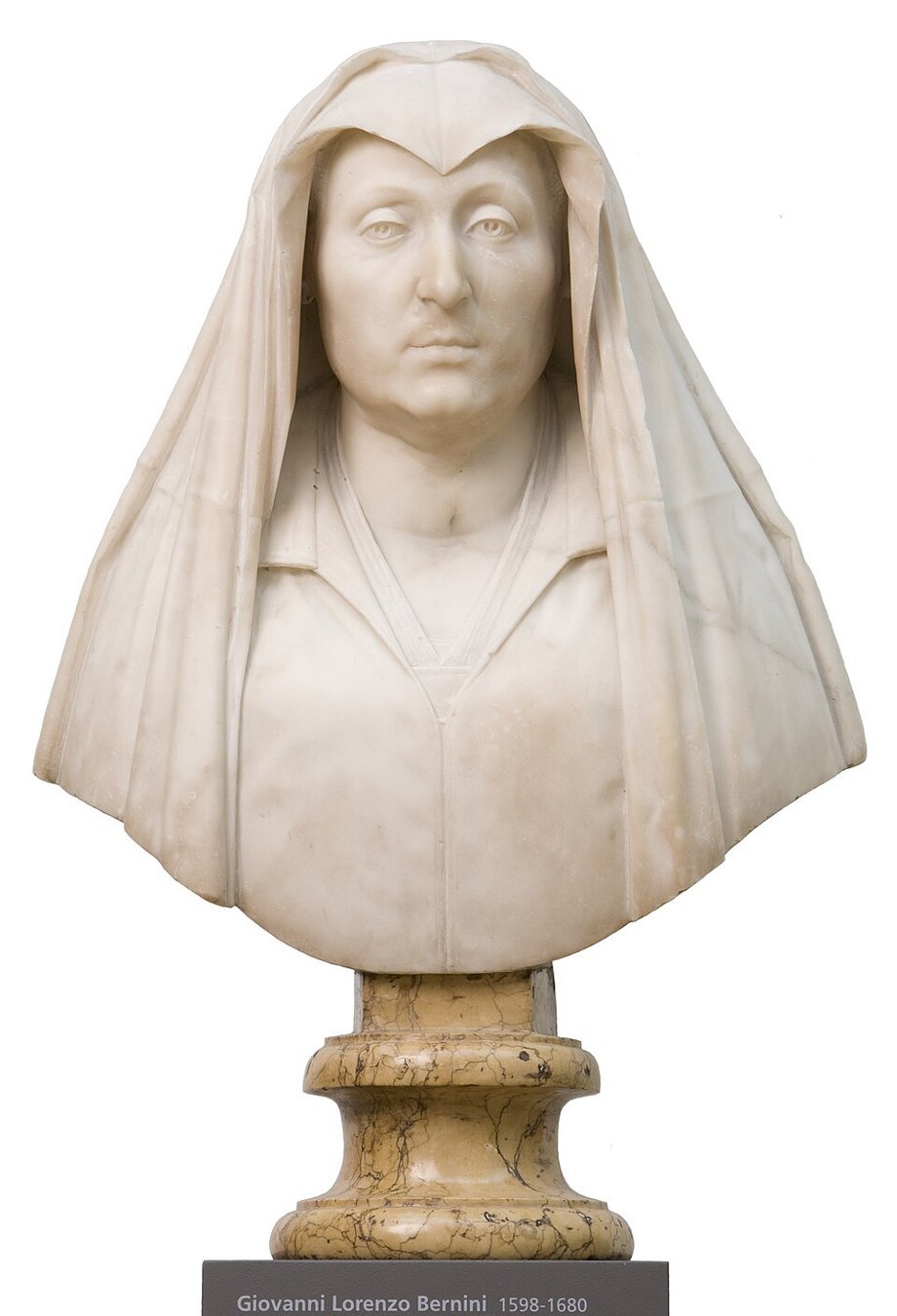
The main folds in the veil are broad and vertically inclined. Their surfaces are smooth, with the ridges divided by shallow changes in direction. The join between the outer drapery and the clothing beneath it is concentrated near the centre of the torso. Two short diagonal edges lead to the front opening. Lower down, the lines resolve into large planes, and the bottom of the bust lies in a rounded curve above the support. These forms explain how the figure can have a strongly symmetrical outline while offering several different depths across its face and chest. [2][3]
The eyes are cut more deeply than the broad surfaces of the cheek. The Copenhagen museum draws attention to the grooves around the pupils, which take up shadows even when the face is well lit. A viewer can make out the direction of the gaze before distinguishing the eyelids or the full shape of the eyes. The long slope of the nose and the slight projection of the upper lip give the centre of the face a further set of small divisions. The steady frontal pose gives that detailed carving a consistent place within the shape of the veil. [2][3]
Lavin describes the polish and clear contours as features of Bernini’s work around 1619. He compares their precision with the surfaces of the group showing Aeneas and his family fleeing Troy, paid for later that year. The size and purposes of the two sculptures differ markedly. In Camilla’s portrait a few planar folds control the outline, and very small cuts in the face direct attention at close range. The portrait offers a way to follow those decisions in a work where the figure’s stillness makes every change of contour easy to see. [3]
Why the date of the marble once appeared to be 1628
In his early monograph on Bernini, Stanislao Fraschetti assigned the portraits of Camilla and Antonio to 1628. He cited an inventory entry recording both busts and also transcribed a record for two yellow-marble supports. The research behind the current dating separates those notices from the earlier payments for the carving. The 1628 entry describes the pair in the family collection, while the following year’s payment documents work on their supports. That change in the way the records are read makes Camilla’s bust a work from the end of Bernini’s apprenticeship rather than from the period of his large papal commissions at St Peter’s. [5][6]
Lavin reads the April 1619 payment in the context of Maffeo Barberini’s other dealings with the workshop. The fifty scudi for Camilla’s likeness also settled outstanding work Gian Lorenzo had carried out jointly with Pietro for the cardinal. Lavin connects that wording with the carved cherubs for the chapel. The entry names him as a sculptor and records money going to him directly. It gives a better indication of his growing independence than it does of the exact date on which he entered the guild. The family’s other commissions show that working in his own name could coexist with continuing collaboration with Pietro. [6]
What changed in the chapel passage
The Italian heritage catalogue describes the monument still visible in Sant’Andrea della Valle. Camilla’s profile in porphyry sits in a moulded elliptical frame above the inscription. Below the inscribed panel is a shell ornament and a winged skull. The features give the visitor a vertical sequence from the likeness to the lettering and then to the emblem of death. The marble bust, with broad slopes of cloth beneath a frontal face, occupies its space differently. In porphyry the profile presents a clear line for the forehead, nose and chin while the setting establishes where the viewer should read the dedication. The pale sculpture now in Copenhagen and the dark relief in Rome preserve different presentations of the same person. [7]
The heritage entry attributes the relief to Tommaso Fedeli, an attribution supported by the account transcribed by Marilyn Aronberg Lavin. It records seventy-five scudi on 30 July 1627 for the low-relief porphyry likeness of Camilla, on the basis of Bernini’s valuation. That wording identifies Fedeli’s labour and a separate role for Bernini. The church’s guide usefully describes where the reliefs are set, beneath the arch on the right, and identifies the surrounding statues of saints. It gives a different sculptor’s name for the reliefs. In this case the payment and the heritage catalogue provide the more specific evidence for the identity of the carver. [7][8][9]
Two Barberini portraits moved into collections
The French catalogue of the Louvre provides another example of a Barberini family likeness that survived in a collection. Its bust of Maria Duglioli Barberini is catalogued under Giuliano Finelli and Bernini and dated before 1627. In place of Camilla’s broad veil, Maria’s portrait gives considerable space to the dress and its small, sharply articulated ornaments. Both works preserve a woman’s likeness within the wider family collection. Their resemblance as commemorative portraits allows a comparison of how the veil or dress establishes the scale of the head. The Louvre’s account of the artists and ownership belongs to Maria’s bust. It supplies a separate example when tracing Camilla’s passage from a chapel setting into a palace collection and eventually into a museum. [6][10]
From chapel bust to collection portrait
The busts of Camilla and Antonio appear together in Cardinal Francesco Barberini’s inventory of 4 December 1628. A payment in March 1629 records yellow marble supports for the pair. Lavin took the addition of bases as evidence that the portraits had first been installed in recesses, where freestanding supports were unnecessary. A recess would restrict the angles from which the marble could be seen and direct light towards it from the opening. The added supports gave the portraits a means of standing in a room as objects in the family collection. [3][4]
Tommaso Fedeli made porphyry relief versions, recorded in 1627. The reliefs were installed with commemorative inscriptions in 1629 in the passage by the Barberini chapel. A profile of the clothing modelled in low relief has to register largely through the contours and shallower shadows on its surface. On Bernini’s bust the veil and the side of the face can be seen at different depths, and light can reach behind parts of the drapery. The chapel versions preserved the subjects within the memorial scheme as the marbles took on a different kind of display. [3][4]
The dates of these interventions describe three separate commissions. The payment for Camilla’s white marble fixes its making in 1619. The payment to Fedeli identifies a second sculptor and a different kind of stone for the chapel likeness. The later payment for the supports relates to the display of the original busts. Taken together, these entries explain why elements associated with the portrait can bear dates a decade apart. They also show Bernini’s involvement in appraising Fedeli’s relief, as recorded in the payment Lavin published. [3][4]
The Statens Museum for Kunst records the acquisition of Camilla’s portrait in 1929. Its collection text gives the marble as seventy-seven centimetres high, fifty-four and a half wide and twenty-six deep. That shallow depth relative to the width helps account for the strength of the frontal view. The longer fall of the veil and the sharp edge beside the face are especially apparent from the side. In Copenhagen, where the whole profile can be examined, the viewer can see how the portrait relates the frontal clarity of a chapel likeness to the changing shadows of a sculpture in the round. [1][2]
Discussion
The veil drops in long folds on either side of Camilla Barbadori’s face.
Reader Insights
Where does the fabric direct your attention within the marble?
What would a paired portrait have added to the family chapel?
How does the portrait’s history change the way you interpret its present museum setting?
Join the Conversation
Share a detail, comparison or question about Bust of Camilla Barbadori by Gian Lorenzo Bernini below.
References
- Statens Museum for Kunst. Buste af Camilla Barbadori (død 1609). Moder til Pave Urban VIII Barberini. SMK Open collection record DEP44. View source
- Statens Museum for Kunst. Bust of Camilla Barbadori (dead 1609). Mother of Pope Urban VIII Barberini. Museum collection text hosted on Google Arts & Culture. View source
- Lavin, Irving. Five New Youthful Sculptures by Gianlorenzo Bernini and a Revised Chronology of His Early Works. Reprinted in Visible Spirit, 2007. See discussion of the pair and document 17. View source
- Pierguidi, Stefano. I busti degli avi nelle collezioni seicentesche dei Barberini. Research on family portraits and the Barberini inventories. View source
- Stanislao Fraschetti. Il Bernini, la sua vita, la sua opera, il suo tempo. Earlier dating and transcription on the yellow-marble supports.
- Irving Lavin. Five New Youthful Sculptures by Gianlorenzo Bernini, original publication. The payment of 1619 and the workshop context.
- Ministero della Cultura. Camilla Barbadori’s funerary monument, record 1200705803A. Structure, material and attribution of the chapel monument.
- Marilyn Aronberg Lavin. Seventeenth-Century Barberini Documents and Inventories of Art, vol. 1. Account entry for Fedeli’s porphyry work.
- Sant’Andrea della Valle. Cappella Barberini. Description of the chapel, statues and location of the reliefs.
- Musée du Louvre. Maria Duglioli Barberini. French catalogue of the separate bust, RFR 66.