by Tom Gurney
Tom Gurney BSc (Hons) is an art history expert with over 20 years experience
Published on June 19, 2020 / Updated on November 18, 2026
Email: tomgurney1@gmail.com / Phone: +44 7429 011000
A Faun Teased by Children
A faun climbs a fig tree, two children hinder him among the branches, and a third loses his seat on a lioness reaching for grapes. In Bacchanal: A Faun Teased by Children, several figures reach for fruit in the same narrow space. The marble was made in Rome around 1616–17 and is now in the Metropolitan Museum of Art. The Met credits Gian Lorenzo and Pietro Bernini, whose workshop was responsible for a number of sculptures of woodland creatures and figures from ancient mythology. The piece was documented among Gian Lorenzo’s possessions after his death. Its design and carving have prompted debate about the contributions of father and son. [1][2]
At a Glance
- Datec. 1616–17
- Location or statusMetropolitan Museum of Art, New York
- WorkMarble group by Gian Lorenzo and Pietro Bernini
The work in Bernini’s career
A Faun Teased by Children
c. 1616–17The Rape of Proserpina
1621–22Apollo and Daphne
1622–25David
1623–24The climb up the fig tree
The faun’s body stretches up the middle of the sculpture. He puts his legs around the tree and reaches above his head. The branch he grasps has broken under the force of his movement. A child near his head pulls at his hair, and another sticks out his tongue. Their interlinked arms occupy the path he wants to take. The struggle over the fruit is expressed through shifting points of support. The trunk holds the faun’s lower body while his arm pulls against the branch, and the children put their weight and their grips to use across the narrow space above. [1]
The figures at ground level take part in another attempt to reach fruit. The lioness rears up towards hanging grapes and dislodges a child. A lizard appears near the roots. Seen from a distance, the lioness’s rise answers the faun’s much larger upward movement. Seen close to, the lizard draws attention back to the foot of the tree and to a different scale of life. The cloak draped over a low branch is a lion’s skin. Its relaxed shape gives the viewer a second version of the animal, arranged by gravity after being put aside. The living lioness below stretches upward and makes the contrast visible through her effort. [1]
Fig branches and grapevines occupy the same trunk. A visitor can trace the fruit over the sculpture and find several places where it comes within reach, even though nobody has an easy time securing it. The fig tree gives the faun something substantial to climb. The grapes can hang where the lioness can reach them from below. This distribution lets the carvers set a large action high in the marble and repeat part of it near the base without having to divide the sculpture into separate scenes. Each incident has its own direction, and the trunk keeps the movements in relation to one another. [1]
Viewing a narrow block of marble
The Met records a height of 132.4 centimetres and a depth of 47.9 centimetres. Those dimensions help explain the first impression of a tall composition with relatively narrow sides. From a broad face the figures can be followed up the tree. A side view brings passages into alignment that are distinct from the front and discloses the expressions of the children. The back also repays a look, according to the museum. The work rewards a viewer who steps back to follow the main action and then moves around it to see how the children’s faces and the smaller incidents fit into the design. [1]
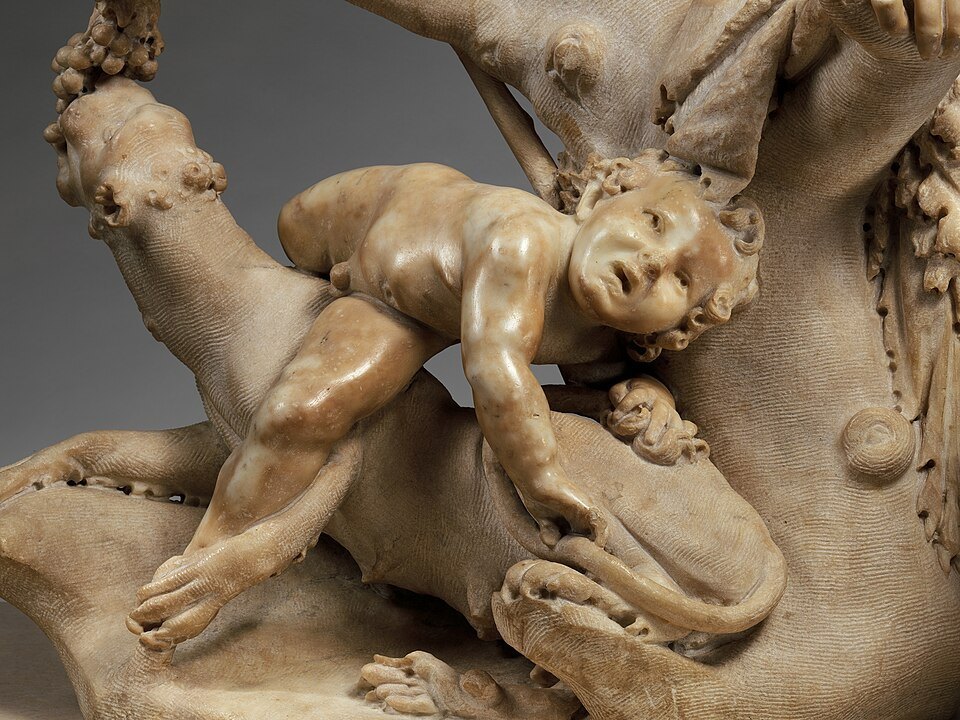
Some of the spaces between the figures are cut through the marble. An opening makes a limb or branch readable by giving it a distinct silhouette, and it allows light to pick out edges at different depths. Elsewhere a shadow is made by a recess that does not go through. The drilled depressions in the vine and in parts of the lioness give those areas a more broken surface than the faun’s skin. Marks on the bark repeat over the trunk, establishing a material and direction against which the contours of the body can be seen. The effects depend on the shape given to each surface and on how light reaches it. [1][2]
The break in the branch makes an especially telling passage to examine. The sculptors had to give the impression of wood that had yielded, while retaining the stone needed to support the surrounding forms. Nearby openings and overlaps let the eye separate the branch from the faun’s arm. Other connections become evident as the viewer moves to the side and the apparent distance between them changes. These shifts are part of the account of the climb. The same narrow block provides the surfaces that show exertion and the open spaces that make the exertion visible. [1]
The Bernini workshop and its patrons
Pietro Bernini was an established sculptor with a Roman workshop where Gian Lorenzo received his early training. The Met’s Spring and Autumn, represented by Flora and Priapus, help place the Bacchanal among other works of that period. Accounts for those two figures name Pietro and place their execution in 1616. The Met’s acquisition bulletin sees Gian Lorenzo’s assistance in the carving and particularly associates him with the modelling of Priapus’s face and fruit. The documents identify who was responsible to the patron on that commission. The museum’s interpretation of the surfaces addresses the further question of what the trained son might have contributed. [1][3]
Bacchic subjects had an established place in Roman collections. Collectors knew antique sculpture and sarcophagi featuring the followers of Bacchus, as well as recent interpretations such as Annibale Carracci’s fresco of Bacchus and Ariadne at the Palazzo Farnese. Gardens associated with villas offered a setting for the more unruly inhabitants of those stories. The fallen and climbing figures in this marble also invite close attention to details of behaviour drawn from daily life, such as the child’s grip and the animal reaching for something above its head. An interest in ancient figures could thus coexist with an interest in how bodies respond when their balance is disturbed. [1]
The museum’s terms make a formal comparison possible as well. Their figures rise from a tapering support and the attributes of the seasons are kept close to the bodies. In the Bacchanal the figures distribute their weight around a tree, which can support an arm or leg at nearly any point along its length. Fruit which identifies a season in the terms becomes the object of a chase in the larger group. [1][3]
Fruit, animals and children in Bacchic sculpture
A Roman sarcophagus lid at the Louvre gives a sense of the range of action children could have in antique scenes of the grape harvest. One cuts a bunch from the vine with a sickle, another carries a basket and others tread grapes. The Louvre’s catalogue identifies drill work in the leaves and fruit and incisions around the contours. The relief uses the length of the lid to spread out the stages of the harvest. In the Bernini group the fruit is distributed vertically, drawing the faun and animal upward while the children cling or fall. Ancient marble gives a precedent for making the fruit and foliage conspicuous. The Louvre lid is a comparison for the motif and its treatment in stone, with no established connection to the Bernini workshop. [5][6]
The small figure losing his balance also bears comparison with the Putto on a Dolphin in Berlin. The Bode Museum traces that composition to a probable ancient model in the Borghese collection and describes the change made in the newer version. The dolphin twists to bite the child’s right calf. The animal in the New York group rears to reach something above it, leaving its rider to cope with the sudden change of position. The shared interest is in the child’s reaction to an animal with a movement of its own. The comparison involves two different relationships between bodies carved in close contact, and it gives a concrete reason to connect the children with experiments in sculpture from Gian Lorenzo’s early years. [5][7]
The marble on the Bernini staircase
Marilyn Aronberg Lavin follows the evidence for the marble in the Bernini household. She identifies a notice by the visiting Swedish architect Nicodemus Tessin the Younger and cites the 1706 estate inventory, which places the work on the principal staircase of the house in Via della Mercede. She also reproduces a drawing by Étienne Parrocel, made from the left side in the eighteenth century, which identifies the sculpture as being at the Bernini house. The record and drawing give different kinds of evidence for its later display. The inventory identifies where people encountered the sculpture as they moved through the house. The Louvre’s record for Parrocel’s drawing transcribes his annotation locating the group in the Bernini home. Parrocel used black chalk, pen and brown wash to bring the figures into view on paper. The side view he selected gives the animal and its rider a prominent place beneath the larger contest in the branches. [5][9]
Its subsequent ownership is harder to follow. The Fondazione Zeri catalogue records the auction appearances in Paris in May 1972 and London in March 1973. It also lists Palazzo Cardelli as a previous location. Lavin challenges the identification behind that part of the history, arguing that the Cardelli marble cited by the early Bernini scholar Stanislao Fraschetti was a work by Francesco Grassia. The catalogue and Lavin’s article therefore support different readings of the supposed Roman link. The location at the Bernini house and the two sale appearances are useful anchors while the intervening ownership remains uncertain. [5][8]
The surface and the story
Lavin describes the stone as white Carrara marble and attributes its yellowish cast to wax and fatty material applied to the surface. Its colour today therefore has a history distinct from the work of separating hair, grapes and bark with tools. She also records the weight, about 240 kilograms. An object that substantial can still look precarious because of where the sculptors left open spaces. Seen from the side, the high bent knee of the faun and the curl of the branch above him leave gaps through which the viewer can follow the grip and the pull. The apparent instability belongs to the action of the figures within a compact block. [5]
Lavin also proposes that the fig tree might carry part of the story. In the Garden of Taste in Giambattista Marino’s L’Adone, a group of strange trees has features that change from wood into human form and back into vine and fruit. She reads the faun’s close embrace of the trunk in relation to that passage and the tradition of woodland spirits inhabiting trees. The poem appeared in print in 1623, several years after the date generally assigned to the marble. Lavin discusses earlier circulation of portions of the poem as a possible connection. The visual resemblance supports a reading of the faun as embracing a tree with a life of its own, while his exact intention and the sculptors’ knowledge of the verses remain open. [5]
Recognition and attribution
The inventory taken after Gian Lorenzo’s death places a group matching the marble in his house. The modern history of the attribution shows how far the style could be open to another reading. The sculpture was connected with Giambologna around its reappearance on the market in the 1970s. The tall composition, in which forms curve and cross as they rise, helps explain the association with late Renaissance sculpture. The Met acquired the piece in 1976. Olga Raggio subsequently made the case for Gian Lorenzo’s authorship while recognising the importance of Pietro’s example to the composition. [1][4]
The Met compares the faun’s strongly formed body with Gian Lorenzo’s early Saint Sebastian. It also connects the children to figure types present in Pietro’s relief for the Cappella Paolina at Santa Maria Maggiore and compares their expressions to the young Gian Lorenzo’s Putto with a Dolphin. Those are comparisons with documented or accepted works that help account for the different qualities of the marble. The father’s and son’s training and work were so closely connected that a shared feature cannot by itself identify whose tools cut it. The museum’s joint credit recognises the workshop context while leaving room for disagreement about the division of labour. The linked figures, uneven textures and sharply directed gestures can still be read together as decisions made for a single block. [1][2]
Discussion
The fig tree gives the climbing figures a shared space and a strong vertical direction.
Reader Insights
Which child’s action is easiest to follow from the front?
How does the lioness extend the group’s action downwards?
What kinds of evidence can support a joint workshop credit?
Join the Conversation
Share a detail, comparison or question about Faun Teased by Children by Gian Lorenzo and Pietro Bernini below.
References
- Metropolitan Museum of Art. Bacchanal: A Faun Teased by Children. Collection record 1976.92, dimensions, provenance and attribution discussion. View source
- Dickerson, C. D. III, Anthony Sigel and Ian Wardropper. Bernini: Sculpting in Clay. Metropolitan Museum of Art, 2012. Essay on early work and fig. 3. View source
- Metropolitan Museum of Art. Recent Acquisitions: A Selection, 1990–1991. Entry for the Flora and Priapus terms, 1990.53.1–2. View source
- Lavin, Irving. “Bernini giovane”, reprinted in Visible Spirit. Discusses the group in the Bernini collection and cites Olga Raggio’s original attribution study. View source
- Lavin, Marilyn Aronberg. “A Faun in Love: The Bernini Sculpture in the Metropolitan Museum of Art”. Artibus et Historiae 78 (2018), pp. 297–323.
- Musée du Louvre. Sarcophage d’enfant. Ma 1553. French collection catalogue.
- Staatliche Museen zu Berlin, Skulpturensammlung. Putto auf einem Delphin. German collection catalogue.
- Fondazione Federico Zeri. Fauno molestato da cupidi. Italian photo archive catalogue.
- Musée du Louvre. Homme taquiné par deux amours, avec une lionne mangeant du raisin…, Étienne Parrocel. RF 3729, 34. French drawings catalogue.