 by Tom Gurney
Tom Gurney BSc (Hons) is an art history expert with over 20 years experience
Published on June 19, 2020 / Updated on November 18, 2026
Email: tomgurney1@gmail.com / Phone: +44 7429 011000
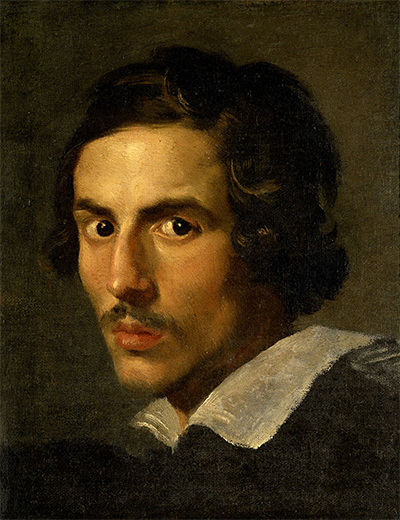
Self-Portrait as a Young Man
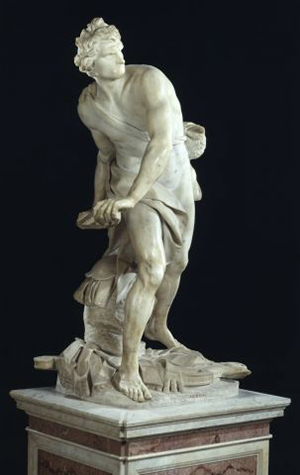
Gian Lorenzo Bernini’s young self-portrait holds the viewer with a concentrated gaze. The hair and moustache are recognisable features, but the expression is carried just as much by the way light meets shadow around the eyes. The Galleria Borghese dates the painting to about 1623, when Bernini was around twenty-five. That places it close to his marble David, whose face early accounts associate with his own. The comparison gives us two ways to see how Bernini studied an expression. One belongs to the close space of an oil painting, and the other sits at the far end of a gesture that runs through a body poised to throw a stone. [1][2]
At a Glance
- Datec. 1623
- Location or statusGalleria Borghese, Rome
- WorkPainted self-portrait
The work in Bernini’s career
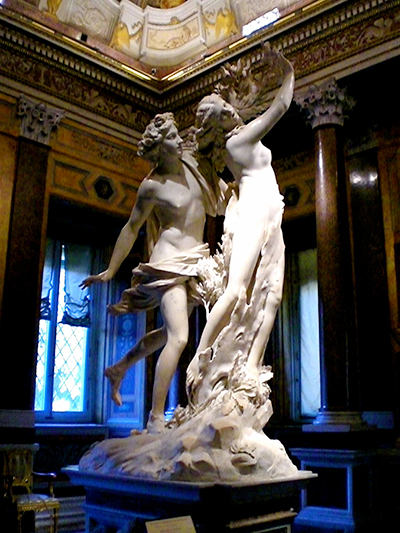
Apollo and Daphne
1622–25Self-Portrait as a Young Man
c. 1623David
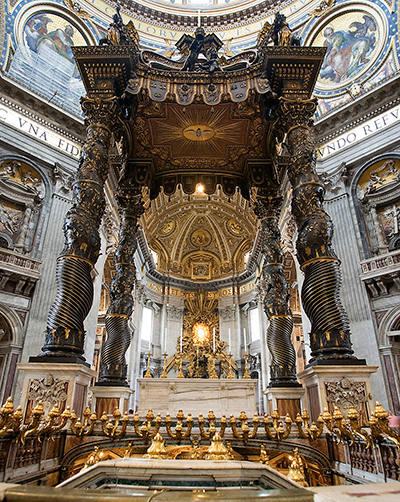
1623–24St Peter’s Baldachin
1624–33How the face takes shape
The picture measures 39 by 31 centimetres. It is oil on canvas laid down on panel. Most of the descriptive work is concentrated in the head. The collar and shoulders are indicated more rapidly, and the greenish ground gives them little depth to occupy. Starting at the collar, the eye reaches the face before it has much opportunity to go anywhere else. The painting gives the viewer enough of the clothing to understand the head’s position, then leaves the strongest distinctions of colour for the features. [1]
The Borghese catalogue describes an approach built from touches of colour rather than a strongly drawn outline. It relates the painting to work done a macchia, where quickly placed areas of tone and colour establish the forms. The shape of the cheek depends on how a lighter patch meets its shadow. The eyes occupy small areas within the face but carry much of the effect because the transitions elsewhere are broad enough to leave them clear. The solidity comes from the arrangement of these surfaces, something Bernini could explore in paint without the changing daylight that would fall on a sculpture. [1]
There is a useful difference between the volume of the face and the speed visible elsewhere. If the collar and shoulder were given the same density of information as the eyes, the lower part of the image would ask for more attention. Bernini gives the face a relatively large share of the canvas and uses more abbreviated marks to describe what surrounds it. The handling creates an impression of proximity without needing furniture, a room or a professional attribute to explain who the sitter is. The degree of finish itself determines what seems close. [1]
The self-portrait and the marble David
The Galleria compares the tense gaze with the marble David, which it dates to 1623–24. In his biography of Bernini, Filippo Baldinucci relates that Cardinal Maffeo Barberini held a mirror while the sculptor studied his own features for David’s face. The story concerns the making of the sculpture. The proposed relationship between the painting and the marble comes from their apparent proximity in date and from comparison of their expressions. The catalogue treats the possibility that the painted face was a study of expression as an interpretation of those connections. [1][2]
The two works make different demands on the same concentration. David’s clenched mouth and focused eyes belong to a figure that has already twisted to prepare for the throw. A viewer can follow the tension from the stance through the shoulders and then to the face. In the painting a turn of the head is nearly the whole available action. The gaze gathers the kind of energy that the sculpture can spread across arms, hands and legs. Looking at the painting in this context helps explain why a slight change around the eyes can carry so much of a portrait. [1][2]
The projects also have different documentary histories. The David began as a commission for Cardinal Montalto and was taken over by Scipione Borghese. The self-portrait’s presence in the gallery traces to a much later purchase. The shared museum setting gives an opportunity to compare them, while the records supply independent evidence of how each reached the collection. [1][2]
The young sculptor in Ottavio Leoni’s print
Ottavio Leoni’s portrait of Bernini bears the date 1622. The Metropolitan Museum records its impression as a combination of engraving and etching and gives the plate size as 14.5 by 11.4 centimetres. The paper is larger than the plate, which can be seen from the separate dimensions in the catalogue. Princeton records another impression from a plate with the same dimensions, on a differently sized sheet. The separate surviving impressions show how a likeness could pass between collections and still be checked against the design of the print. That is a different kind of evidence from the appearance of a single painting acquired under another artist’s name two centuries later. [5][6]
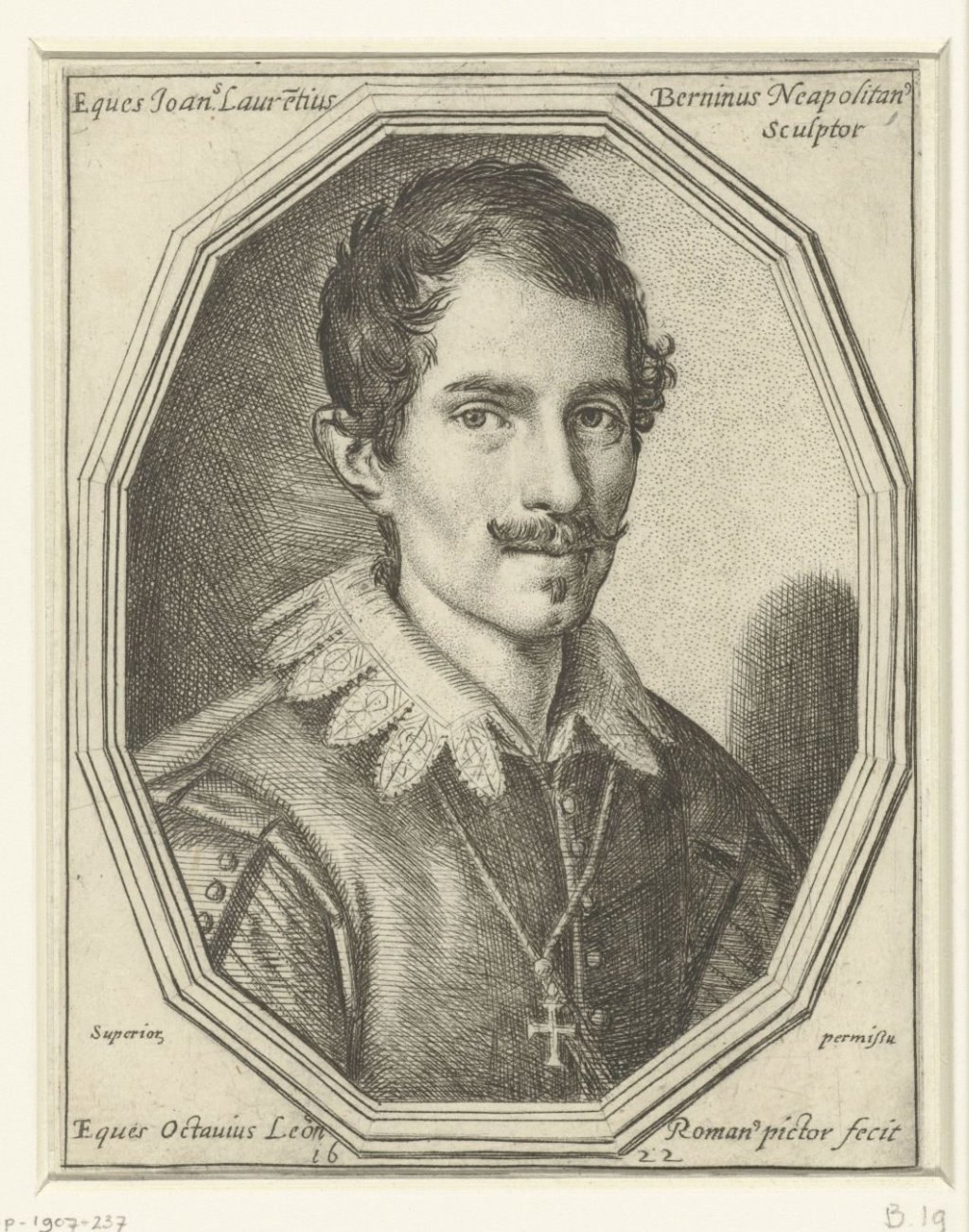
The Louvre’s French catalogue describes its impression as a portrait of Bernini the sculptor. In the print, the head is surrounded by a many-sided border, and lettering identifies the sitter and the maker. The small marks that describe the face accumulate within that contained format. Bernini’s self-portrait gives the viewer much less explicit information about who is represented. Its pale collar, contrasting paint and distinct hairline do the work of making the person recognisable. Comparison with the named print makes the wavy hair and small tuft beneath the lip pertinent to the identification, while the dark field and the broader colour of the painting give them a different emphasis. [6][7][8]
From a drawing to an impression
The Princeton catalogue places the print among Leoni’s engravings made after his portrait drawings. Irving Lavin reproduces a chalk portrait of Bernini by Leoni, also dated 1622, from the Biblioteca Marucelliana in Florence. The library sheet is drawn in red and black chalk and heightened with white. Its surfaces can be built up by changing the pressure or density of the chalk. The print arranges dark ink marks on light paper, and its enclosing border gives the image a form that can be repeated across impressions. Bernini’s oil portrait offers the light of the cheek as a patch of colour in its own right. These objects give three ways of describing the same young sculptor within a few years, each with a different way of producing light and a different kind of evidence for identification. [5][6][8][9]
The possibility that Bernini looked in a mirror when making the self-portrait can be distinguished from the story that records the use of a mirror for David. Leoni’s drawing and print supply an outside likeness with a definite year. They can strengthen an identification of the painted head even when they cannot establish the circumstances in which it was painted. A shared trait such as the moustache helps only when it is considered alongside the turn of the eyes, the shape of the face and the other likenesses that can be securely identified. An approximate date of 1623 for the oil remains a judgement of the painting in relation to that group. [6][8][9]
The comparison also helps account for the viewing distance each work invites. In a print little larger than a hand, it takes an attentive look at close range to see the fine marks describing the eye and the edge of the beard. In the oil, contrasts on a larger scale carry the expression before individual touches of paint can be discerned. The head occupies a substantial share of the painted surface although the work itself remains small. That balance makes the expression legible at more than one distance, from an initial encounter with the gaze to a close view of how it was painted. [5][6][8]
Why the attribution and date are approximate
The Italian state acquired the painting in 1919 from the collection of Alvise De Ruggieri. It came in as a work by Andrea Sacchi. Pietro D’Achiardi had proposed Bernini in 1908, and Corrado Ricci accepted that attribution when the work entered the gallery. The catalogue traces the continuing acceptance of Bernini’s authorship and discusses how Luigi Grassi arrived at a date around 1623 using comparisons and the apparent age of the sitter. The date is an estimate based on the appearance of the work and the group of works with which scholars have compared it. [1]
The gallery also notes an engraved portrait of Bernini circulating around 1622. Its shorter hair differs from the painted image, but the wavy texture, moustache and small tuft below the lip give points of comparison. An engraved likeness helps test the broad appearance of the individual without making the two pictures equivalent. The painting has colour and a range of light across the face, while the print describes the features by marks on the surface of the paper. The two media give different weight to the features they share. [1]
The gallery records restoration campaigns in 1936, 1963 and 2009. The catalogue’s description of the support also matters when comparing the portrait with other works. The image is painted on canvas, although the canvas now lies on a rigid panel. Light and the scale of reproduction can both make a photographic view look smoother than the painted surface. The museum’s account of distinct touches of colour gives a specific feature to look for in a close view, particularly where a lighter area along the cheek meets the surrounding shadow. [1]
Other faces in the Borghese collection
The Self-portrait at a Mature Age, inventory 545, is another painting and the gallery places it around 1635–40. The shoulders and upper body play a larger role in its composition. Its size, 53 by 43 centimetres, also gives the figure more room in relation to its surroundings. The Portrait of a Young Boy, inventory 555, has a similarly restrained background and puts much of its detail into the face. The museum leaves the boy’s identity open. The separate inventory numbers make it possible to connect general observations about Bernini’s approach to the right canvas, while the comparisons reveal how a turn, glance or strip of light could change the effect of a simple arrangement. [1][3][4]
The young self-portrait’s own frame is much larger than the painted area. The gallery records it as a seventeenth-century frame with a black outer shape and gilded inner decoration. The scale of the canvas is easier to appreciate once the frame and panel are understood as separate measurements. Within the small painted surface, the most decisive distances are from the eyes to the edges of the face, and from the face to the quickly sketched shoulders below. [1]
Discussion
The young artist’s eyes pull attention from the loosely painted clothing.
Reader Insights
How much of the expression comes from the contrast around the eyes?
Which feature would you compare with the face of David?
What changes in the older self-portraits when the sitter turns his body?
Join the Conversation
Share a detail, comparison or question about Self-portrait as a Young Man by Gian Lorenzo Bernini below.
References
- Puddu, Pier Ludovico. Self-portrait as a Young Man. Galleria Borghese, inv. 554. View source
- Galleria Borghese. David, inv. LXXVII. Includes the account of the mirror attributed to Baldinucci. View source
- Galleria Borghese. Self-portrait at a Mature Age, inv. 545. View source
- Galleria Borghese. Portrait of a Young Boy, inv. 555. View source
- Metropolitan Museum of Art. Portrait of Gian Lorenzo Bernini. Ottavio Leoni, 1622, 28.57.39. Process and plate and paper dimensions.
- Princeton University Art Museum. Gian Lorenzo Bernini. Ottavio Leoni, 1622, 2017-57. Another impression and an account of Leoni’s practice.
- Musée du Louvre. J.L. Berninus, sculpteur. French catalogue of Leoni’s print.
- Puddu, Pier Ludovico. Autoritratto in età giovanile. Galleria Borghese, inv. 554. Italian entry and Leoni comparison.
- Lavin, Irving. High and Low Before Their Time: Bernini and the Art of Social Satire, fig. 14. Leoni’s chalk portrait in the Biblioteca Marucelliana.