 by Tom Gurney
Tom Gurney BSc (Hons) is an art history expert with over 20 years experience
Published on August 21, 2026 / Updated on October 23, 2026
Email: tomgurney1@gmail.com / Phone: +44 7429 011000
About Malcesine on Lake Garda
Gustav Klimt painted Malcesine on Lake Garda (Malcesine am Gardasee) in 1913, during his only extended summer devoted to landscapes outside Austria. The oil on canvas measured 110 × 110 centimetres. A historical archive record transcribes Gustav Klimt at the lower right, although the original can no longer be checked: its whereabouts have been unknown since the end of the Second World War.[1][2]
That last distinction is essential. Many older books and image records say the painting burned with works from the Lederer collection at Schloss Immendorf in May 1945. Current specialist research does not list Malcesine among the canvases whose transfer to the castle and destruction there can be verified. It is missing, not securely proved destroyed.[1][3]
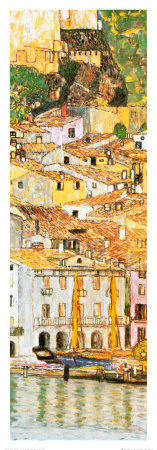
What can still be studied is a transmitted image. Photographs and printed reproductions preserve Klimt's square view of the lakeside town: houses descend in steps beneath the battlements of the Castello Scaligero; façades and roofs gather into a bright architectural field; broken reflections carry their colours into the water. The best-known 1931 portfolio impression is itself a separate print on paper, not the missing oil.[1][4]
At a Glance
- ArtistGustav Klimt
- Governing titleMalcesine am Gardasee
- English titleMalcesine on Lake Garda
- Date1913
- MediumOil on canvas
- Dimensions110 × 110 centimetres
- SignatureHistorically recorded as Gustav Klimt, lower right; not available for present inspection
- SubjectMalcesine, its lakeside buildings and Scaliger castle on Lake Garda
- First documented collectorVictor Zuckerkandl
- Later ownersBerta Zuckerkandl; subsequently the Lederer family
- Last secure statusIn the Lederer collection before Nazi control of that collection
- Current statusWhereabouts unknown since 1945; delivery to and destruction at Immendorf have not been verified
- AccessNo original is publicly accessible; Leopold Museum object 33307 is a 1931 reproduction and was not displayed when checked on 10 August 2026[1][3][4][5][6]
One Canvas, Several Forms of Evidence
The German and English titles name one painting. No second version is created by translating Malcesine am Gardasee as Malcesine on Lake Garda, nor does the surviving print constitute another painted state. The object completed in 1913 was a square oil; the later sheets and digital images are records made after it.[1][2][4]
This difference governs every close description. A museum can examine the support, paint surface and condition of a surviving canvas. That is impossible here. No published technical report identifies Malcesine's ground, pigments, underdrawing, varnish or sequence of application. Apparent dabs, contours and changes of colour can be discussed as features visible in historical images, but not as laboratory findings.
The same caution applies to the reported signature. The Sterling and Francine Clark Art Institute's library record, derived from its collection of study photographs and clippings, gives the inscription and original dimensions. It also repeats the older belief that the work burned at Immendorf.[2] The physical data remain useful historical documentation; the loss narrative has been superseded by more discriminating research. A source can preserve one accurate strand without governing every later conclusion.
The 1931 reproduction makes the distinction unusually concrete. Leopold Museum object 33307 is titled Malcesine on Lake Garda, page 7 of Max Eisler's Gustav Klimt. Eine Nachlese. It is a print on paper measuring 48.2 × 45.8 centimetres, produced thirteen years after Klimt's death. The sheet belongs to the ARGE Collection as a permanent loan to the Leopold Museum and was marked not displayed on 10 August 2026.[4]
Those measurements describe the printed sheet, not a smaller version of the oil. Its publication date does not redraft the canvas in 1931. Most importantly, its survival does not answer whether the original survived the war. It lets viewers encounter a mediated composition while leaving material questions open.
The Town as a Stepped Structure
In the transmitted image, Malcesine does not spread gently along the shore. Buildings climb and descend in compact tiers. Cubic houses overlap; reddish shingle roofs make short diagonals; pale, yellow, blue and warm-toned façades break the settlement into neighbouring blocks. Differently coloured windows and balconies puncture that mass.[1]
The arrangement is recognisable as a town, yet it also behaves like a constructed field. A roof can serve as the top edge of one coloured unit and the base of another. Small changes in height replace a broad, recessionary street. Instead of leading the eye through an open foreground towards a distant centre, Klimt stacks architecture almost from the water upward.
This is not evidence that Malcesine itself lacked streets or depth. The painting selects an aspect of the lakeside settlement and compresses it into the square. Its visual logic depends less on a complete topographic inventory than on the intervals among wall, roof, opening, tree and water.
The compactness is intensified by the limited sky. There is no large atmospheric zone above the town to reduce the buildings into distant scenery. Architecture and vegetation occupy nearly the entire upper part of the square, while water receives the lower register. The shore operates as a meeting line between relatively stable constructed forms and their mobile reflections.
The grouping also makes scale difficult to judge from an isolated reproduction. The known 110-centimetre support was large enough for balconies, windows and roof edges to register as deliberate details. On a small screen, those details may collapse into pattern. The historical dimensions restore an important fact: this was a substantial square painting, not an intimate travel sketch.
Castello Scaligero as an Anchor
The battlements of the Castello Scaligero identify Malcesine decisively. They rise within the building cluster rather than hovering as a remote monument. The castle's crenellated upper edge provides one of the composition's clearest repeated rhythms, while its greater mass steadies the more varied houses below.[1]
Klimt did not paint an architectural elevation. The castle is caught within the same process of compression that affects the town. Its walls, openings and battlements matter as visible forms and as geographic evidence, but they do not supply a complete account of the building's history or plan.
The castle also prevents the image from becoming a generic Mediterranean fantasy. Colour may be intense and the surfaces may appear highly organised, yet the distinctive fortification holds the work to a named place. Recognition and transformation operate together: Malcesine is identifiable precisely while being reorganised into a close-packed square.
That balance separates the work from a universal theory that Klimt simply made every landscape “flat.” Depth has not disappeared. Houses stand above and behind one another, the castle rises, and water reflects a shoreline. What changes is the relative force of recession. Overlap, tiering and colour contrasts often matter more than a continuous path into the distance.
Windows, Balconies and Roofs
The current Klimt Database singles out the variety of windows and balconies, the reddish roofs and the polychrome façades.[1] These elements keep the town from becoming one undifferentiated block. Openings appear as dark or coloured accents; balconies project slightly; roof planes change direction as the buildings step down.
Together they establish an irregular beat. The eye moves laterally from one interruption to the next, then upward towards the castle or downward towards the lake. No single doorway or street has to bear the entire burden of spatial entry. Many small architectural differences animate the field.
Colour reinforces that motion. Neighbouring façades do not merge into a uniform stone tone. Their contrasts make the town appear sunlit and crowded, while darker openings and vegetation prevent brightness from dissolving the structures. Yet the surviving reproductions cannot certify the precise hue, saturation or present state of any passage on the original.
It would therefore be misleading to offer an exact pigment list or diagnose fading from differences among digital files. Printed plates, photographs and screens mediate colour differently. What remains secure is the compositional relationship reported by scholarship: varied colours make the buildings vivid above, then fragment further in the reflection below.[1]
The Water Changes the Architecture
The lower portion is not a neutral blue base. Reflections take the colours of the shore and loosen them into smaller, less stable marks. The Klimt Database describes an abstract, multicoloured flicker on the water surface.[1] That language identifies a transformation rather than a separate non-representational picture.
Above the shoreline, façades retain edges, roofs and openings. Below it, related colours appear without the same architectural obligations. Vertical correspondence remains possible, but the lake interrupts exact continuity. The viewer recognises reflection while following a surface rhythm of its own.
This difference gives the composition an internal before-and-after. The town's forms are compressed but still built; their counterparts in the water are broken and mobile. The castle and houses supply weight, while the lake tests how little structure is required for their presence to persist.
The effect should not be confused with evidence about paint texture. Historical images can show shorter marks and changing colour units, but they cannot establish the height of impasto or the precise layering of wet and dry paint. “Flicker” describes the reflected pattern seen through reproduction, not a conservation measurement.
Nor does reflection need a fixed symbolic code. It may intensify the midsummer atmosphere identified by the specialist source, but it does not automatically signify memory, instability or a private relationship. The strongest reading stays with the pictured event: solid-seeming buildings meet moving water, and their colours cross that boundary in altered form.
Three Landscapes from Lake Garda
Klimt's 1913 stay produced three known landscapes: Malcesine on Lake Garda, Church in Cassone on Lake Garda and Italian Garden Landscape. Current specialist research describes them as his only landscapes made outside Austria.[1][7]
The group contains two architectural views and one garden. Church in Cassone survives in a private collection and centres the village church among cypresses and clustered houses. Italian Garden Landscape survives in the Kamm Collection at Kunsthaus Zug and turns towards dense southern vegetation. Malcesine is the missing town-and-castle composition.[1]
Their relationship is useful only if the objects stay separate. Cassone's provenance, restitution history and surviving surface do not belong to Malcesine. The garden's exhibition in Prague in 1914 does not prove that either architectural canvas was there. Indeed, the Klimt Database states that the two architecture paintings were not presented until the large 1928 retrospective.[1]
That delayed presentation is part of Malcesine's documentary history. In 1928, Moriz Nähr photographed the painting in connection with the commemorative exhibition. Three years later the Eisler portfolio reproduced it. Those images help establish what the oil looked like before its disappearance, but neither amounts to a modern technical examination.[3]
Egon Schiele later praised the Lake Garda pictures as Klimt's most important landscapes.[1] That retrospective judgement demonstrates how early the group acquired special standing. It need not become a ranking imposed on every viewer, and it does not resolve the fate of the lost canvas.
Where Klimt Stayed: Two Accounts
The broad chronology is secure. From the end of July until 10 September 1913, Klimt spent his summer on Lake Garda, at times accompanied by members of the Flöge and Klimt families and Josef Eibl. Postcards locate members of the party in Tremosine and Klimt in Malcesine at the end of the stay.[1]
The exact working base is less settled. One section of the Klimt Database says the party stayed at the Albergo Morandi in Tremosine on the western shore, which afforded views across the lake towards Malcesine and Cassone. Its close reading of Malcesine also says Klimt is assumed to have been near Villa Gruber—now the Hotel Bellevue San Lorenzo—at Dosso Ferri on the Val di Sogno peninsula to obtain the depicted perspective.[1]
The Comune di Malcesine gives the Villa Gruber tradition greater certainty. Its current cultural-history account places Klimt there from late July to 11 September and says he used a telescope from a room in the villa for Malcesine and Cassone.[8]
These accounts are not best reconciled by selecting whichever offers the most picturesque studio story. They document a real Lake Garda stay, western-shore and Malcesine-area evidence, and a continuing debate about where particular motifs were observed. Klimt and his companions could move around the lake; a postcard or lodging reference does not prove that a canvas was painted entirely from one room.
The responsible conclusion is graded. A distant or elevated view and some form of optical aid are plausible in current scholarship. No surviving telescope, measured lens, room coordinate or working photograph reconstructs the exact setup for this canvas.
Telescope, Binoculars and the Finished Square
The Klimt Database discusses binoculars and a “motif finder” in relation to the two Lake Garda architectural views.[1] The local account prefers a telescope.[8] All three terms concern how a distant scene might have been selected, magnified or bounded. None proves a mechanical transfer of the town to the canvas.
An optical aid could help make small architectural differences visible across water. It may also help explain why the houses feel close and why deep distance is compressed. Yet a lens does not decide which roofs to emphasise, how much water to include, or how the reflection should break into colour.
The square itself is a sequence of choices. Klimt positioned the castle within the upper cluster, made the town descend towards the lake and allotted the reflection a substantial lower zone. Even if observation began through an instrument, the finished order cannot be reduced to equipment.
There is also no documented preparatory drawing or certified working photograph for Malcesine. The absence of one in current records does not prove that none ever existed. Interpretation must begin with the known oil, documentary photographs, postcards and specialist analysis rather than inventing an intermediate design process.
The 1928 Retrospective and the 1931 Portfolio
The current specialist chronology says the two Lake Garda architecture paintings were not publicly presented until the large Klimt retrospective of 1928.[1] That is a very different history from Italian Garden Landscape, which had appeared in Prague in 1914. It also prevents the familiar 1913 image from being treated as though it immediately entered a well-documented exhibition circuit.
Moriz Nähr photographed Malcesine in connection with the 1928 retrospective.[3] His documentation is especially valuable because the canvas was then still in private hands and available for direct photography. The image belongs to the painting's evidence trail, but it is not a working photograph used by Klimt in 1913. Its purpose and date place it firmly in the work's later exhibition and reproductive history.
Max Eisler's 1931 Nachlese then carried the composition into a published portfolio.[1][4] Publication widened access while introducing another material transformation: oil on canvas became a printed image on paper, scaled to a different sheet. The portfolio preserved relationships among castle, houses, shore and reflection, but it could not preserve the painting's exact surface or guarantee colour equivalence.
Together the 1928 photograph and 1931 print form a bridge between the missing original and present viewers. They also define a limit. They show that the oil existed and was photographable before the war; they do not document where it went after the Lederer collection fell under Nazi control.
Victor and Paula Zuckerkandl
Victor and Paula Zuckerkandl assembled a collection combining older Austrian art, East Asian objects and modern works. Victor acquired several Klimt landscapes, including Flowering Poppies, Roses beneath Trees, the avenue to Schloss Kammer, Church in Cassone, Malcesine and later Attersee views.[5]
The precise purchase date and terms for Malcesine are not published in the available record. The painting was, however, in Victor's collection and moved with the remaining Klimt canvases to the family's villa in Berlin-Grunewald. Early-1920s interior photographs document landscape paintings in the villa's stairwell.[5]
Victor's ownership matters beyond a collector's name. It placed the two Lake Garda architecture pictures together within a group chosen by someone closely connected to Vienna's modern-art networks. Yet the page does not need to reconstruct the entire Zuckerkandl family or Purkersdorf Sanatorium. The object-specific point is that Malcesine had a documented private home before it passed to another branch of the family.
Victor and Paula died within months of each other in 1927. Their childless estate was divided among relatives; the 1928 auction of portions of the collection included no Klimt painting.[5] A federal provenance decision supplies the next exact step: Berta Zuckerkandl received Malcesine and transferred it to the Lederer family in the early 1930s.[6]
The record says “transferred” or “passed on,” not whether the transaction was a sale, gift or another arrangement. No price or contract is retained here. Those missing terms should remain missing.
From Berta Zuckerkandl to the Lederer Collection
Berta Zuckerkandl was a critic, writer and advocate for Klimt, but the federal decision notes that she was not generally known as a collector of his paintings. Malcesine came to her through the division of Victor and Paula's estate rather than through a newly documented commission or gallery purchase.[6]
Her transfer in the early 1930s brought the canvas into the collection of August and Serena Lederer, Klimt's most extensive patrons. Specialist records list Malcesine among their landscapes alongside Golden Apple Tree, Farm Garden with Crucifix, Garden Path with Hens and other major works.[3][9]
August died in 1936. The collection remained with Serena and their children. After the Anschluss in March 1938, the family's Vienna apartment was looted by the Gestapo, drawings were confiscated, and in March 1939 the collection was removed and the apartment sealed.[3]
This persecution history is secure. Malcesine's later wartime path is not. The distinction matters morally as well as methodologically: uncertainty about a canvas's wartime movements does not weaken the documented dispossession of its owners, while documented persecution does not authorise an invented transport record.
The 1943 Klimt commemorative exhibition at the former Secession displayed works under Nazi control from the Lederer collection. Current research describes it as their last public presentation before many were sent to Immendorf.[3] If Malcesine's exact catalogue position is not independently established, it should not be assigned a number or hanging place simply because it belonged to the collection.
Immendorf: Destroyed or Missing?
Schloss Immendorf in Lower Austria served as a wartime art depot. Numerous Klimt works stored there were destroyed when the castle burned in May 1945. The Faculty Paintings, Friends II, Wally, Golden Apple Tree, Farm Garden with Crucifix and Garden Path with Hens belong to the documented loss group.[3]
For decades, Malcesine was often added to that list. The Clark library record, older catalogues and many reproduction captions say it had been moved to Immendorf and burned there.[2] Repetition made that version appear settled.
The present Klimt Database draws a sharper line. It states that rescue and storage at Immendorf could not be verified for Malcesine, From the Realm of Death, Portrait of Charlotte Pulitzer and Gastein. These works have instead been considered lost since 1945.[3]
“Missing” does not mean “known to survive.” More than eighty years without a secure sighting is a grave absence. Nor does the revised classification prove theft, secret removal or a hidden private collection. It identifies a gap between what happened to many Lederer works and what the surviving transport/depot evidence can establish for this particular painting.
The fire's exact circumstances also remain incompletely documented. Later accounts frequently blame retreating SS units for deliberate ignition, while current institutional research notes unresolved details and allegations of plundering. Malcesine's page does not need to solve the entire Immendorf event. Its narrower conclusion is enough: the canvas cannot be declared burned there when its arrival is unverified.
What Can Be Seen Today
There is no verified current owner, city, physical condition or public display for the oil. A visitor cannot presently be directed to Malcesine's original in a museum. Claims that it belongs to an unnamed private collector would go beyond the evidence.
The 1931 print at the Leopold Museum offers a documented surrogate, but it was not on display when the collection record was checked on 10 August 2026.[4] Digital images make the composition widely recognisable while concealing how far they may be removed from the canvas through photography, printing, scanning and colour correction.
That mediated access need not make close looking futile. It changes the questions. Viewers can examine the stepped arrangement of houses, the castle's anchoring role and the transition from façade to reflection. They cannot assess the present surface, confirm the signature firsthand or decide the original's fate from the image alone.
Malcesine therefore matters as both a painting and an evidence problem. Its reproduced composition demonstrates how Klimt transformed a real lakeside town into a dense relation of architecture, colour and water. Its ownership history places that achievement inside Jewish patronage, Nazi persecution and wartime dispersal. Its unresolved status shows why “lost” and “destroyed” are not interchangeable, even when the distinction frustrates a tidy ending.
Frequently Asked Questions
References
- Gustav Klimt Database, “Expressive Blaze of Colors,” especially “Monuments for Lake Garda”; exact title/date and missing status, Lake Garda chronology, three-painting group, architecture, castle, windows, balconies, reflections, viewpoint and 1928 exhibition evidence. View source. Accessed 10 August 2026.
- Sterling and Francine Clark Art Institute Library, “Malcesine on Lake Garda,” study photograph/clipping record; historical medium, dimensions, lower-right inscription and former Lederer repository, retained with its older Immendorf-loss classification explicitly superseded by current specialist research. View source. Accessed 10 August 2026.
- Gustav Klimt Database, “Posthumous Fame and Legend,” especially “Immendorf Castle” and “The Lederer Family Collection”; Moriz Nähr's 1928 documentation, Lederer persecution, 1943 exhibition, verified Immendorf losses and the unverified transfer/storage of Malcesine. View source. Accessed 10 August 2026.
- Leopold Museum, “Malcesine on Lake Garda, Page 7 — Gustav Klimt. Eine Nachlese,” object 33307; 1931 print identity, paper medium, 48.2 × 45.8-centimetre dimensions, publication, permanent-loan credit and dated not-displayed status. View source. Accessed 10 August 2026.
- Gustav Klimt Database, “The Zuckerkandl Family”; Victor and Paula Zuckerkandl's collection, Malcesine ownership, Berlin villa context, 1927 estate division and related landscape holdings. View source. Accessed 10 August 2026.
- Austrian Federal Advisory Board, decision LM 1359; Berta Zuckerkandl's receipt of Malcesine after Victor and Paula's deaths and transfer to the Lederer family in the early 1930s. View source. Accessed 10 August 2026.
- Gustav Klimt Database, “Italy”; 1913 Lake Garda travel, three non-Austrian landscapes and current status of Malcesine. View source. Accessed 10 August 2026.
- Comune di Malcesine, “Malcesine e Gustav Klimt — Estate 1913”; current local Villa Gruber, Val di Sogno, travel-date and telescope account, used as an attributed local position alongside the specialist uncertainty. View source. Accessed 10 August 2026.
- Gustav Klimt Database, “The Lederer Family”; Malcesine in the Lederer collection, Nazi persecution and its present missing-since-1945 classification. View source. Accessed 10 August 2026.
Discussion
Malcesine on Lake Garda rewards close attention to source context, object identity and careful reproduction boundaries.