by Tom Gurney
Tom Gurney BSc (Hons) is an art history expert with over 20 years experience
Published on June 19, 2020 / Updated on October 14, 2023
Email: tomgurney1@gmail.com / Phone: +44 7429 011000
Jo, the Beautiful Irishwoman: Introduction
Joanna Hiffernan lifts a lock of red hair and studies her reflection in a small mirror. The fingers that raise the hair are partly lost among the strands. The other hand holds the mirror low and steady. Gustave Courbet gives us her face from the side and turns the glass towards her, so we see what she is doing while her view of herself stays private. The painting illustrated here is the version in Nationalmuseum, Stockholm. The museum calls it Jo, the Beautiful Irish Girl. It is an oil on canvas measuring 54 by 65 centimetres, signed and dated 1866, and entered the collection as a gift from Nationalmusei Vänner in 1926. Its inventory number is NM 2543. [1]
Courbet painted four versions of this arrangement. The bend of Hiffernan’s head, the two hands and the oval mirror make them immediately recognisable as a group, even when the colour of her hair or the handling of the blouse changes. The distinction between canvases matters. Stockholm owns the painting that stayed with Courbet until his death, while the version now at the Metropolitan Museum of Art is the one the Nelson-Atkins catalogue favours as the first. Both bear the date 1866. Their early histories give us different kinds of evidence about how the picture was made, sold and remembered. [1] [2] [3]
At a Glance
- DateStockholm version signed 1866
- MediumOil on canvas
- CollectionNationalmuseum, NM 2543
Contents
- The gesture in the Stockholm painting
- Joanna Hiffernan in London and Trouville
- Whistler’s mirror
- Four canvases and their differences
- How the Kansas City version was made
- The painting Courbet kept
- How photographs and catalogues tell the versions apart
The gesture in the Stockholm painting
The mirror is at the left, close to the edge of the painting. One hand angles it up from the table, and Jo’s gaze runs down towards it. Her other hand comes up between the mirror and her face. Its fingers gather a section of hair and lift it clear of the mass on her shoulder. The movement makes a little opening in the hair through which the ground shows. We can follow the raised strands back to her head, then down through the heavier waves that hang over her clothes. The longer we look, the more the gesture seems to be about feeling the hair as much as seeing it. [1]
The red is brightest where light travels along a curve. Darker brown separates one group of waves from another, and the tips break up at the edges of the silhouette. Against the muted greenish background the hair has a warm outline, but around the face the contrast is reversed. The darkest locks give way to the pale cheek, and a shadow along the eye makes Hiffernan’s downward glance legible. Courbet holds the face and hair together at the temple, where the outline becomes hard to follow. The two passages ask for different speeds of looking. The face can be taken in almost at once, while the hair keeps leading the eye from one turn to the next. [1]
Look below her chin to see how little of the blouse it takes to establish a change in texture. The pale fabric has a fine open edge at the neck, and the white cuff echoes the small highlights around the face. Large parts of the blouse disappear behind the hair and dark outer garment. The interruptions are what make the lace feel delicate. There is space for the hands, the face and the mirror inside the tight crop, and only a strip of table to establish where she is sitting. A few loose strands spill across the pale surface. Without the furniture and distractions of a furnished room, the white at her wrist draws us back to the fingers doing the work. [1]
The mirror was a familiar way of introducing a woman’s private routine into a picture. Nationalmuseum connects it with sensuality, vanity and the passing of beauty. Nicole R. Myers, writing for the Nelson-Atkins, places the subject in the longer tradition of the toilette, the acts of dressing and grooming often pictured in prints. Courbet had already used a hand mirror in his Woman with a Mirror of 1860, where a slipping garment exposes the sitter’s breast. Jo’s clothing changes the emphasis. The blouse keeps the chest covered while the undone hair and angled mirror give the impression of an intimate moment. The painted mirror tells us where her attention lies, while the title tells us whom the public is invited to admire. [1] [2]
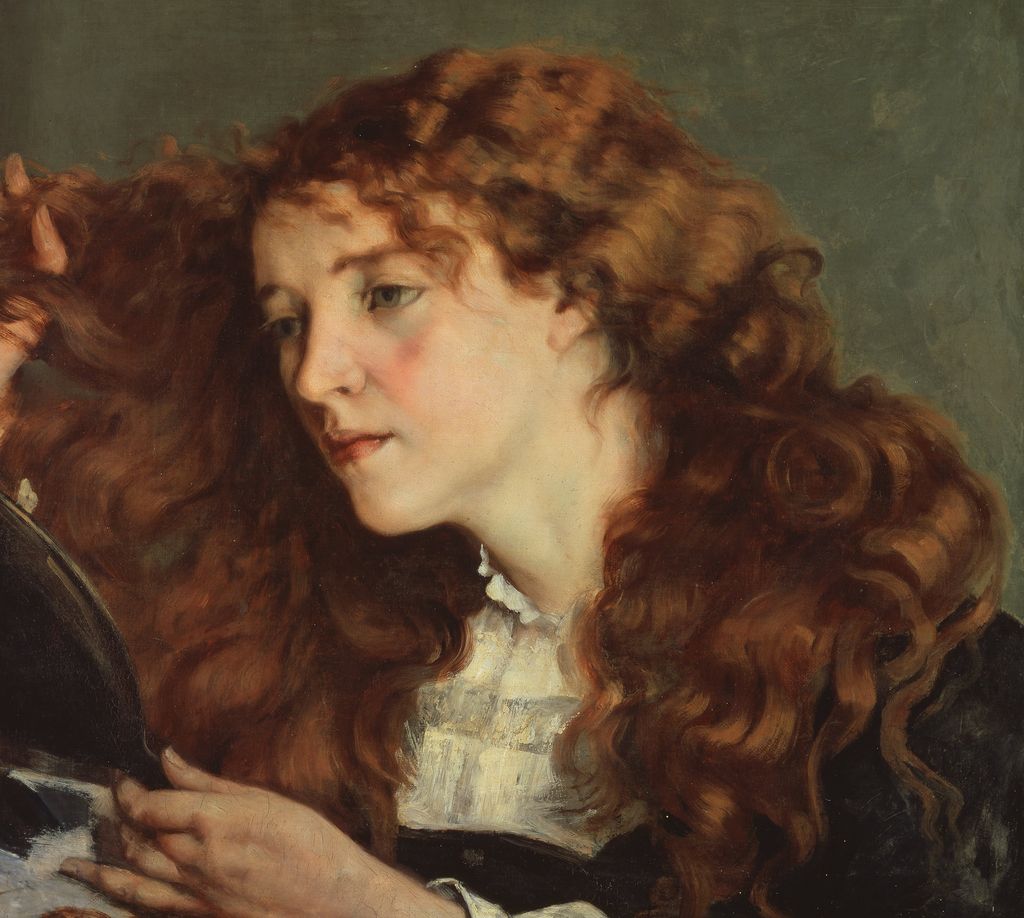
Detail of Jo, the Beautiful Irishwoman, Stockholm NM 2543. Shown here, hair, hand and mirror. Image source. Public domain. Cropped and resized from the source image.
Joanna Hiffernan in London and Trouville
Hiffernan was baptised in Limerick and moved with her family to London. The National Gallery of Art and the Royal Academy’s research dates her life to 1839–1886. She met James McNeill Whistler in 1860 and became his principal model in the early part of that decade. Their personal partnership included responsibilities that a finished painting seldom makes visible. She helped manage the studio and its finances, and in 1866 Whistler gave her power of attorney and named her his sole heir. The surviving record makes it possible to follow Hiffernan’s working life across studio arrangements, pictures and family ties. [4]
Whistler and Hiffernan were in Trouville on the Normandy coast in the autumn of 1865, when Courbet was working there. Courbet told his patron Alfred Bruyas that he had begun the portrait of a striking red-haired woman. The Metropolitan Museum links the report to the beginnings of its canvas and gives that work the date range 1865–66. Myers also discusses a separate, smaller portrait of Hiffernan, dated 1865, in which her hair falls over one shoulder. It may have been a study for the larger composition. The start of a portrait at Trouville, the date inscribed on a finished canvas and the making of subsequent versions are distinct events. Hiffernan’s presence in Normandy establishes the setting for the sittings associated with the project and leaves the circumstances of individual repetitions open. [2] [3] [4]
Hiffernan’s relationship with Whistler is documented as both personal and professional. Accounts of an affair with Courbet vary. A text in the Stockholm record calls her Courbet’s mistress, while the Met describes a possible relationship. The evidence for her modelling and their friendship is clearer. In February 1877 Courbet wrote to Whistler, remembered their time together in Trouville and recalled Jo amusing them. He added that he still had her portrait and intended to keep it. The letter connects the painting he retained to his memories of both people. [1] [2] [3] [5]
Whistler’s mirror
Whistler had already painted Hiffernan with a mirror in Symphony in White, No. 2: The Little White Girl of 1864, now at Tate Britain. It was shown at the Royal Academy in 1865 under the shorter title The Little White Girl. She stands at a mantelpiece, her arm running along its ledge, and a Japanese fan and touches of blossom interrupt the white of her dress. Her reflected profile appears in the glass above the mantel. The angle of the mirror lets a viewer see a second aspect of her face at the same time as the figure in the room. [6]
Courbet moves the glass down to the level of the hand. Its oval has the size of an ordinary object she can turn, while Whistler’s wall mirror is large enough to create a second space within the picture. In Whistler, the whites of the dress and mantel connect the figure to the interior. In Courbet, the pale blouse is squeezed between hair, skin and the dark garment. Hiffernan’s pose helps set the limits of each picture. The mantel gives her somewhere to lean and opens the arrangement vertically. The lifted lock folds attention inwards until the small space between the hand and cheek can hold a whole scene. [1] [6]
Four canvases and their differences
Stockholm. The dated signature on NM 2543 sits at the lower left. Myers describes the painting as less finely detailed than the Met version and proposes that it served as the model for the two other variants. One of Nationalmuseum’s catalogue texts instead calls it the original. The attribution of priority depends on the reconstruction one follows. The Stockholm painting’s presence in Courbet’s estate is a separate, documented part of its history. Its date and its early ownership establish its importance even though a date shared by two paintings leaves their relative order open. [1] [2]
New York. The Metropolitan Museum’s Jo, La Belle Irlandaise, 29.100.63, measures 55.9 by 66 centimetres and entered through the Havemeyer bequest in 1929. The Met catalogues it as 1865–66, and Myers, following a sequence proposed by Sarah Faunce, identifies it as the leading candidate for the first rendition. Look at the fine wisps around the hairline and the careful detailing of the lace and buttons. They give the face and garment more finely drawn edges than in Stockholm. The two faces share the slightly contracted brow and downturned mouth that Myers reads as signs of concentration. Those details survive even when the treatment of the hair and cloth changes. [2] [3]
Kansas City. The Nelson-Atkins Museum of Art dates Jo, the Irish Woman, 32-30, to about 1866–68. It measures 54.3 by 63.5 centimetres and is signed at the lower left. Here the raised hand, blouse and hair are handled in broader touches, and Myers reads the expression as calmer than in the Stockholm and Met canvases. The painter Paul-Désiré Trouillebert had collected this version from Courbet’s studio by September 1868. The signed surface and the positions of the tendrils at the lower left also identify it in an installation photograph of the 1882 Courbet retrospective in Paris. [2] [7]
Australian private collection. The fourth oil on canvas is reproduced as figure 3 in the Nelson-Atkins catalogue, which identifies it as a work dated 1866, measuring 54 by 63.8 centimetres, in a private collection in Australia. The same dark oval anchors the left edge, but the mass of hair over her shoulder reads in broader, softer waves than in Stockholm, where several curls loop tightly before they fall. The dark band below the white blouse and the pale cuff stand out against the broad sweep of hair and forearm. Myers groups this painting with the similarly sized Kansas City work as another version developed from the Stockholm composition. The available evidence leaves the relative order of those two narrower paintings open. [2] [7]
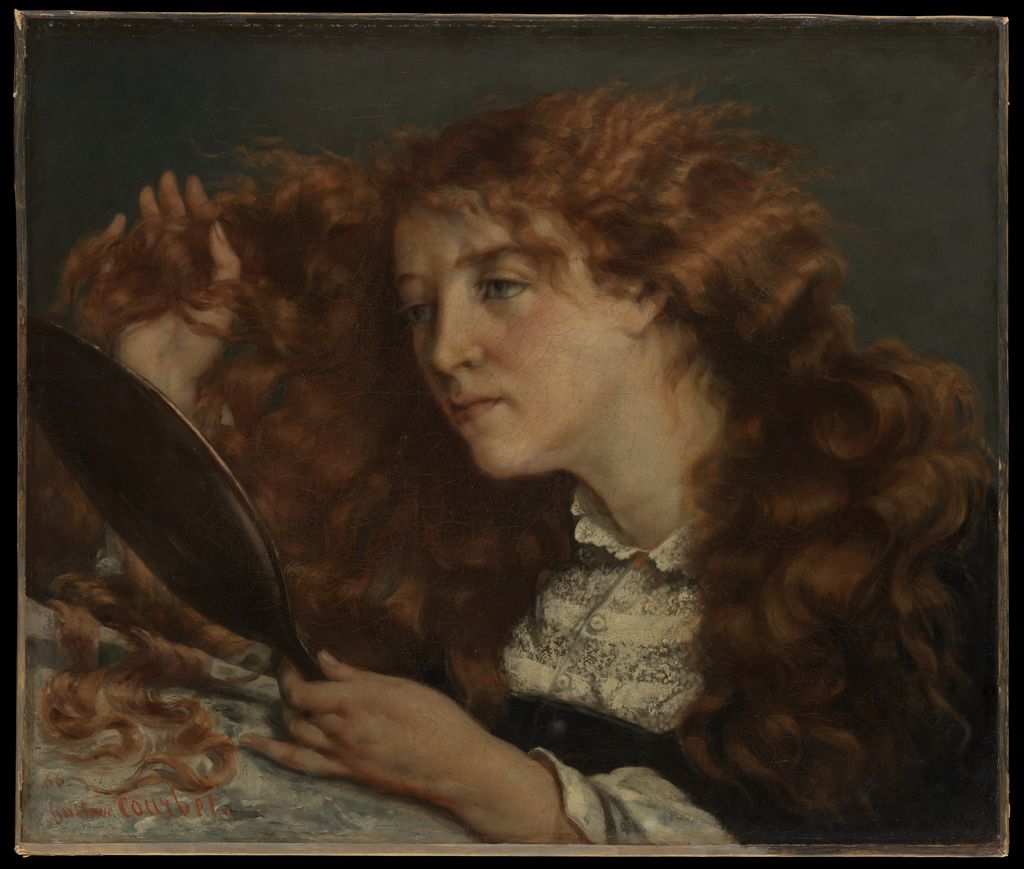
Gustave Courbet, Jo, La Belle Irlandaise. The Metropolitan Museum of Art version. Image source. CC0 / Public domain. Resized from the complete source image.
How the Kansas City version was made
Examination of the Kansas City painting gives a rare view of how Courbet worked through a pose he had already painted. Conservator Mary Schafer found no underdrawing with infrared reflectography and microscopic examination. Instead, several features, including the outline of the face and parts of the eyelid and lips, appear to have been marked with lines incised into a wet reddish-brown preparatory layer. The layer also does work at the surface. Part of the raised palm was left as exposed brown preparation, and Courbet painted strands of hair directly over it. Something that reads at normal viewing distance as a lock sliding across skin depends on how little separate paint he needed to establish the hand. [8]
The blouse shows another use of the same layer. Courbet scraped through some of its light grey underpaint with a palette knife so that the warmer preparation showed at the tops of the canvas threads. Light stippling suggests the openings of lace. In the hair he laid dark and medium browns in broad strokes, then grouped short curves to make the swell of the curls. Where the hair and background overlap, wet paint meets wet paint. The examination helps account for the speed of the brushwork in this particular version. New York’s lace looks finer by comparison, and Stockholm’s hair breaks into a more distinct pattern of individual curls. [1] [2] [3] [8]
Kansas City also shows why it matters when a comparison was made. A tear had damaged the face and adjacent hair before the painting entered the museum in 1932, and an old cleaning had stripped away some of the transitions in the flesh and hair. In the treatment completed in 2015, Schafer used the original paint that remained, the photograph from the 1882 exhibition and images of the other variants to guide the retouching. That old photograph could serve two purposes. The signature and hair at the lower edge identify the canvas, and the record of the rest of the composition helps clarify passages changed by earlier damage. [2] [7] [8]
The painting Courbet kept
Courbet’s independent exhibition of 1867 listed a version of the subject as La Jo, femme d’Irlande, no. 91, with Trouville and the date 1866 in the entry. Myers proposes that the canvas was the one in Stockholm. [2]
The intimate scale is striking beside Woman with a Parrot, Courbet’s much larger Salon painting of 1866. The reclining body and extended arm in that painting show how differently he could use a pale figure and loose hair when working at exhibition scale. [2]
The later trail of the Stockholm version is clearer. Hubert Debrousse bought it at Courbet’s estate sale in 1881 and lent it to the posthumous retrospective the following year. It appeared in the supplement as no. 162, while the Kansas City painting had its own listing as no. 51. The estate sale had listed the Stockholm canvas under a Dutch title even though its description fits Jo. At the retrospective the two numbers and the photograph help separate two pictures with nearly the same subject and sometimes misleading names. [1] [2] [7]
In 2022 the National Gallery of Art showed the Stockholm, Kansas City and New York versions in The Woman in White: Joanna Hiffernan and James McNeill Whistler. Seeing them together put Courbet’s repeated pose alongside the variety of roles Hiffernan took on with Whistler. The picture he kept still draws the eye to the same small interval between the mirror and the lock of hair. The hand is poised long enough for us to recognise a familiar act. What Jo can see in the glass remains hers. [1] [4] [9]
How photographs and catalogues tell the versions apart
A printed catalogue can establish that a picture with a given title was shown, while leaving open which version the entry means. The Nelson-Atkins catalogue describes just such a problem at Courbet’s 1882 retrospective. A photograph of the installation by Eugène Cheron supplies an independent clue. In the museum’s reading, the disposition of the locks at the lower left and the signature identify the work hanging there as the Kansas City canvas. These are small features, yet they give an older photograph the capacity to answer a question a name in the catalogue could not settle. [10]
The Stockholm work came into the same exhibition later. It appears in the supplement with a different lender, Hubert Debrousse. The order in which the two works joined the show is evidence about their nineteenth-century display. It tells us nothing directly about the order in which Courbet painted them. The distinction is worth holding onto when a sale or exhibition history is used to identify a painting that repeats another work’s principal pose. [10]
A modern exhibition can ask a different question with one of the same canvases. The National Gallery of Art placed the Met’s version in an exhibition about Hiffernan and her work with Whistler. The checklist includes Wapping and all three of Whistler’s white symphonies. In that setting the portrait can be read beside the different tasks Hiffernan performed as a model and collaborator. Courbet concentrates her attention on the mirror. Whistler gives her a role in different arrangements of costume, other figures and surroundings. Taken together they allow the viewer to ask how much of the apparent intimacy of any one picture depends on the painter’s choice of setting. [9] [11]
Courbet artworks directory
Browse the paintings covered in this guide. Dates identify the specific versions discussed.
Discussion
Look again at the images and ideas explored in Jo, the Beautiful Irishwoman. These editorial prompts invite your observations.
Reader Insights
How do the mirror and Jo’s hands direct your gaze?
Which details help distinguish the versions?
What evidence could establish the order in which the versions were painted?
Join the Conversation
Share a detail, comparison or question about Jo, the Beautiful Irishwoman below.
References
- Nationalmuseum, Jo, the Beautiful Irish Girl, NM 2543, collection record and reproduction. View source.
- Nicole R. Myers, The Nelson-Atkins Museum of Art, Gustave Courbet, Jo, the Irish Woman, ca. 1866–68, catalogue essay in French Paintings and Pastels, 1600–1945, 2021. View source.
- The Metropolitan Museum of Art, Jo, La Belle Irlandaise, 29.100.63, collection record and reproduction. View source.
- National Gallery of Art, First Exhibition to Explore the Collaborative Partnership of James McNeill Whistler and Joanna Hiffernan, exhibition and biographical notes. View source.
- Gustave Courbet, letter to James McNeill Whistler, 14 February 1877, Glasgow University Library, MS Whistler C196. English translation in Petra ten-Doesschate Chu, ed., Letters of Gustave Courbet, 1992, letter 77-9, p. 601, excerpted in the Nelson-Atkins catalogue. View source.
- University of Glasgow, The Paintings of James McNeill Whistler, Symphony in White, No. 2: The Little White Girl, YMSM 052, Tate N03418. View source.
- Glynnis Napier Stevenson, The Nelson-Atkins Museum of Art, Gustave Courbet, Jo, the Irish Woman, ca. 1866–68, provenance and exhibition documentation, 2021. View source.
- Mary Schafer, The Nelson-Atkins Museum of Art, Gustave Courbet, Jo, the Irish Woman, ca. 1866–68, technical entry, 2021. View source.
- National Gallery of Art, The Woman in White: Joanna Hiffernan and James McNeill Whistler, 2022 exhibition checklist, nos. 48–50. View source.
- Nicole R. Myers, Nelson-Atkins Museum of Art, Jo, the Irish Woman, discussion of the 1882 photograph and catalogue supplement. View source.
- National Gallery of Art, The Woman in White: Joanna Hiffernan and James McNeill Whistler, exhibition overview and selected works. View source.