by Tom Gurney
Tom Gurney BSc (Hons) is an art history expert with over 20 years experience
Published on June 19, 2020 / Updated on October 14, 2023
Email: tomgurney1@gmail.com / Phone: +44 7429 011000
Woman with a Parrot: Introduction
A parrot opens its wings over a woman’s upturned hand. Her head has fallen back, and her loose hair spreads across the sheet and over the side of the bed. Most of her weight rests low in the picture, while the raised arm carries her attention, and ours, into the darkness above. Gustave Courbet painted this small exchange on a canvas almost two metres wide. When Woman with a Parrot appeared at the Paris Salon of 1866, critics could agree on what she was doing and still disagree about almost everything else, from the character of the pose to the kind of painter Courbet had become. [1]
The painting is an oil on canvas measuring 129.5 by 195.6 centimetres, signed and dated at the lower left. It belongs to the Metropolitan Museum of Art in New York, where it entered the collection through the 1929 bequest of Louisine Havemeyer, and carries the accession number 29.100.57. The French title in the Salon catalogue, La Femme au perroquet, names the woman through her companion. The space between the woman’s fingers and the tips of its wings is a small part of the canvas, but the position of her body makes sense once we reach it. [1] [2] [3]
At a Glance
- Date1866
- MediumOil on canvas
- CollectionThe Metropolitan Museum of Art, 29.100.57
Contents
- A hand for the bird
- From rejection to the Salon wall
- Zola, Du Camp and the Goncourts
- A sale that fell through
- Courbet’s parrot and Manet’s
A hand for the bird
The body has a broad base in the folds of the sheet. One knee rises and turns away, while the nearer leg stretches diagonally towards the right. The hand resting on her thigh presses gently into the lit surface and gives us a measure of how little effort that arm is making. The other arm bends sharply, wrist tipped back and fingers spread so the bird can balance. From the shoulder to the fingertips the light narrows as the arm rises, until it catches the bright underside of the parrot. The bird’s spread wings interrupt the sweep of the forearm. Above them, the canopy cuts off much of the light. The green and yellow under the bird’s body are brighter for that darkness. [1]
Courbet describes how the pose feels through what it does to the head and hair. A few strands cling to the forehead. Heavier locks collect beside the cheek before spreading into thinner curls across the white sheet. At the mouth, a glimpse of teeth gives the face an expression even from this awkward angle. These details, which the Met’s curator Alison Hokanson singles out, make the head seem suspended for a moment at the edge of its support. Seen alongside the raised hand, the hair gives the scene two quite different kinds of motion. One follows gravity down across the bedding. The other depends on the woman holding still for the bird. [1]
The sheet is almost as pale as the body in places, but Courbet models the two differently. The folds have abrupt creases and cool shadows where the cloth gathers. On the abdomen and the thighs, smaller gradations of colour give the skin volume, with warmth in the light and deeper tones where the forms turn. The pale figure draws the eye across the width of the painting, then the cloth catches it in shorter, less predictable movements. At lower right, a pale waistband loops over dark fabric. The Met identifies the garment as her skirt. Its position below the bed lets a piece of recognisably modern clothing enter the scene from the edge. [1]
The bird has a perch of its own at the right, a narrow upright with several projecting bars and a cup at the top. It is easy to miss against the dark pattern behind it. Once seen, it makes the rest of the arrangement easier to read. The perch and the hand sit towards opposite ends of the canvas, with the length of the woman between them. A spiral column and a canopy are also discernible in the shadows. Courbet gives the background enough substance to suggest a furnished setting, then concentrates the light where skin, cloth and feathers meet. [1] [2]
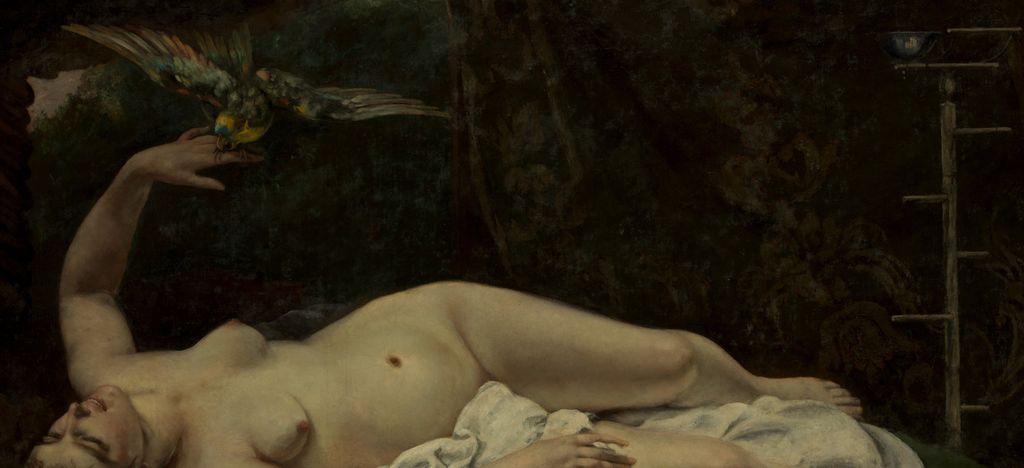
Detail of Woman with a Parrot, Met 29.100.57. Shown here, raised hand, bird and perch. Image source. CC0 / Public domain. Cropped and resized from the source image.
From rejection to the Salon wall
Two years earlier, the 1864 jury had rejected a different Courbet nude, Venus and Psyche, on grounds of indecency. The Met’s scholarly catalogue discusses the earlier composition under the title Le Réveil (The Awakening) and relates the reclining figure and canopy to the 1866 painting. In the earlier work, a seated nude shares the setting with a woman lying down. For Woman with a Parrot, Courbet gave the reclining figure an activity of her own. The new picture retains the breadth and some of the furniture of the earlier arrangement. The lifted arm and the bird concentrate its action above a single body. [2] [4]
In January 1866 Courbet wrote to his friend and patron Alfred Bruyas that he had two paintings to finish for the coming Salon. One was a picture of roe deer, and the other was a female nude, which the Met catalogue identifies with Woman with a Parrot. The official Salon livret lists the canvas as no. 463 and the roe deer painting immediately after it as no. 464. They were exhibited at the Palais des Champs-Élysées. The Met’s French interpretation places Courbet’s second attempt in the context of the success of paintings of Venus at the Paris Salons of the 1860s. His polished handling and expansive format let him work within a recognised tradition, while the plain title and the skirt at the foot of the bed give the viewer the circumstances of a woman in the present. [2] [3] [4] [5]
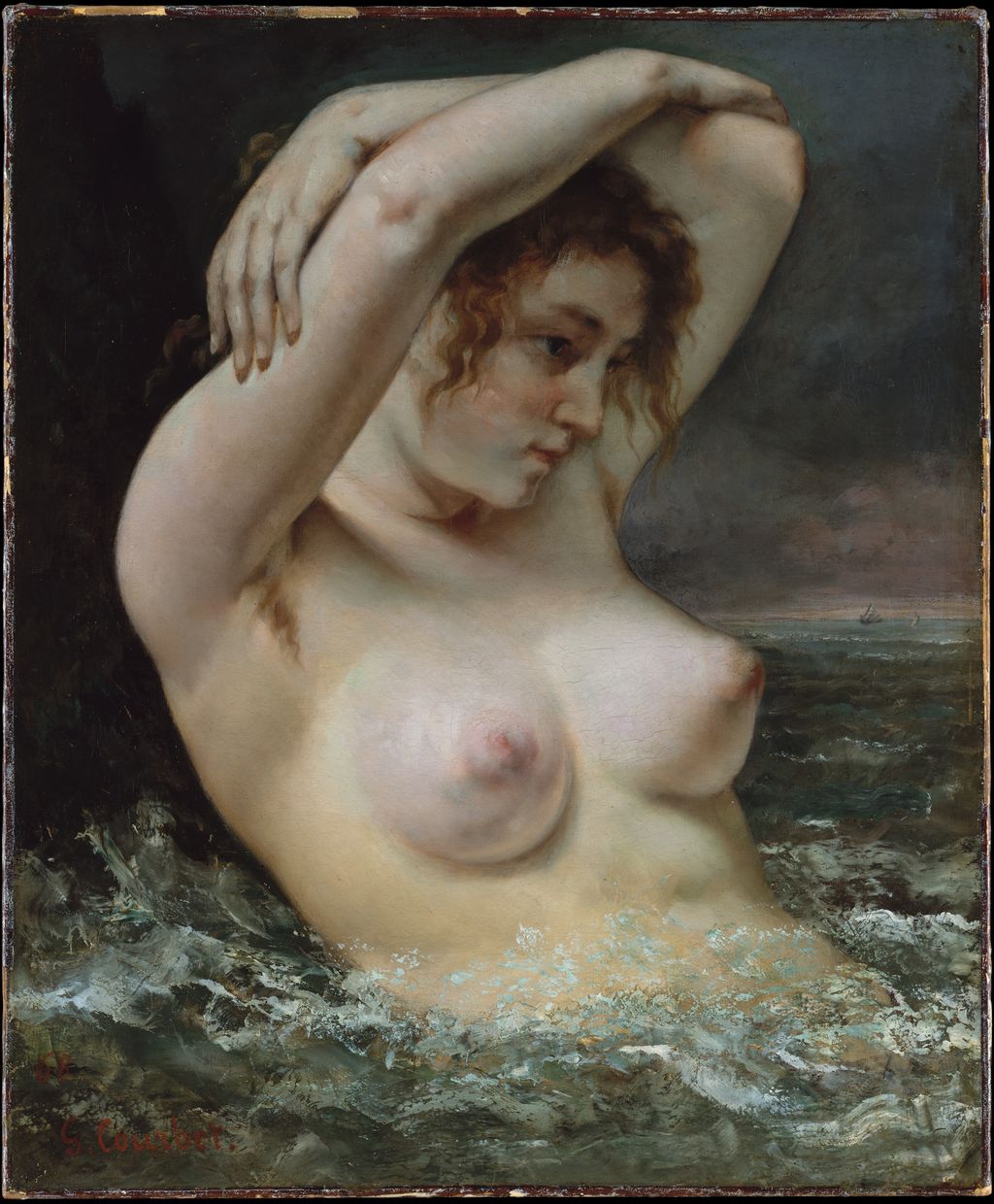
The Woman in the Waves, Met 29.100.62. Image source. CC0 / Public domain. Resized from the complete source image.
Zola, Du Camp and the Goncourts
Writing on 15 May 1866, Émile Zola began with the people he saw gathering around Courbet’s pictures. Some visitors who had previously been harsh about the artist were now calling his work charming. Zola acknowledged the finish and clarity of Woman with a Parrot, but the audience’s approval made him suspect that Courbet had softened what was most distinctive in his painting. He asked readers to recall The Bathers and A Burial at Ornans, works he admired for the very force that had once made them objects of ridicule. The Met’s scholarly catalogue records that the academic painters Alexandre Cabanel and Paul Baudry welcomed the smoother handling as a departure from Courbet’s earlier realism. Zola and the painters could agree about the change in finish while giving it opposite values. [2] [6]
Maxime Du Camp, writing in the Revue des Deux Mondes, objected to precisely the details that give the scene its physical particularity. He likened the hair to rosewood shavings, called the shadows on the body chocolate-coloured and took the discarded garment for a crinoline petticoat whose presence he found suggestive. He even mocked the title by pretending that Courbet was setting his picture up as a counterpart to Raphael’s Madonna of the Chair. But Du Camp praised the parrot’s colour and movement. For a reviewer who doubted whether Courbet could rise above what he saw as skilled copying, the animal in the middle of this contentious arrangement was a passage he could admire on its own. [7]
Courbet showed the canvas again in his independent exhibition of 1867. That September, the Goncourts recorded their response in a journal entry. They compared the woman’s body to an eighteenth-century academy study, finding it just as far from the truth of a nude. The date matters. This was a response to Courbet’s own exhibition the following year, whereas Zola and Du Camp wrote about the Salon itself. Zola used the public’s change of heart to ask what it valued in an artist. The Goncourts measured what they saw against Courbet’s standing as a painter of nature. Their comparison makes a sharp counterpoint to Du Camp’s objections. The same body could strike one viewer as excessively literal and another as far too conventional. [2] [6] [7] [8]
A sale that fell through
The Count of Nieuwerkerke saw the canvas in the studio before Courbet had completed it. The painter understood that the state might acquire it, and a dispute followed when the purchase failed to go through. The Institut Courbet records that a figure of 10,000 francs had apparently been discussed and that Nieuwerkerke ultimately offered 6,000, which Courbet refused. The artist’s independent exhibition gave him a second setting in which to present a painting he still counted among his successes. The Salon jury’s acceptance, the critics’ responses and the failure of the government purchase were three different measures of the picture’s standing. [1] [2] [9]
Courbet’s parrot and Manet’s
The Met also owns Édouard Manet’s Young Lady in 1866, accession 89.21.3, which has circulated under the title Woman with a Parrot. Manet’s tall canvas shows Victorine Meurent standing in a pale pink gown. Her grey parrot remains on a perch, and she looks out towards us. Courbet’s horizontal canvas draws attention from the face to the hand and wings, while Manet sets the bird to one side of a figure who meets the viewer’s gaze. Both pictures date to 1866, but Manet showed his at his independent exhibition of 1867 and at the official Salon in 1868. [1] [10] [11]
The Met’s French text presents the suggestion that Manet answered Courbet as one interpretation. Mona Hadler, writing in the Metropolitan Museum Journal, cites the critic Chaumelin’s quip that Manet had borrowed Courbet’s parrot and set it beside a woman in pink. Hadler also observes that Manet was already showing his work privately to friends while Courbet’s was on the Salon wall. The public exhibition dates explain when the comparison could gain a wider audience. They leave open when each painter first knew what the other was doing. The two paintings make the distinction clear in their own terms. Manet’s bird occupies a separate stand, while Courbet’s tips forward over the fingers that support it. If the parrot were back on its perch, the woman’s upturned hand would lose its immediate purpose. As painted, she lies at ease across most of the canvas and holds a few inches of it in suspense. [1] [4] [10] [12]
Courbet artworks directory
Browse the paintings covered in this guide. Dates identify the specific versions discussed.
Discussion
Look again at the images and ideas explored in Woman with a Parrot. These editorial prompts invite your observations.
Reader Insights
How does the bird change the movement of the reclining pose?
Where does Courbet place the brightest colours?
What can the Salon record and the critics each establish?
Join the Conversation
Share a detail, comparison or question about Woman with a Parrot below.
References
- The Metropolitan Museum of Art, Gustave Courbet, Woman with a Parrot, collection record and audio transcript, 29.100.57. View source.
- Charles Sterling and Margaretta Salinger, French Paintings II: XIX Century, The Metropolitan Museum of Art, 1966, p. 124, entry for 29.100.57. View source.
- Musée d’Orsay, Base Salons, La femme au perroquet, catalogue entry for the Salon of 1866. View source.
- The Metropolitan Museum of Art, La Femme au perroquet, French collection interpretation, 29.100.57. View source.
- Paris Salon, Explication des ouvrages de peinture… exposés au Palais des Champs-Élysées le 1er mai 1866, nos. 463–464, livret transcribed by Ludwig-Maximilians-Universität München. View source.
- Émile Zola, Les chutes, 15 May 1866, reproduced in Mon Salon, Charpentier and Fasquelle, 1893, pp. 309–316. View source.
- Maxime Du Camp, Le Salon de 1866, section III, Revue des Deux Mondes, 2nd series, vol. 63, 1866, pp. 687–719. View source.
- Edmond and Jules de Goncourt, Journal des Goncourt, vol. III, Charpentier, 1888, p. 164, entry for 18 September 1867. View source.
- Institut Gustave Courbet, Acheter Courbet, exhibition catalogue, entry for the drypoint after La Femme au perroquet and discussion of the proposed sale. View source.
- The Metropolitan Museum of Art, Édouard Manet, Young Lady in 1866, collection record, 89.21.3. View source.
- Juliet Wilson-Bareau, Manet, Monet, and the Gare Saint-Lazare, National Gallery of Art, 1998, p. 194, checklist no. 15. View source.
- Mona Hadler, “Manet’s Woman with a Parrot of 1866,” Metropolitan Museum Journal 7, 1973, pp. 120–121. View source.