



 by Tom Gurney
Tom Gurney BSc (Hons) is an art history expert with over 20 years experience
Published on June 19, 2020 / Updated on October 16, 2026
Email: tomgurney1@gmail.com / Phone: +44 7429 011000
Alpine Scene and Doré's Mountain Forest
Alpine Scene shows Gustave Doré turning a mountain forest into a vertical drama of trees, light and scale. Tall trunks rise like pillars, the foreground falls into shadow and a small figure stands near the opening where the landscape drops away toward distant water and sky.
The painting does not need a biblical or literary subject to feel theatrical. The terrain itself carries the force. Doré builds drama through a passage from dark forest floor to bright distance, with the viewer held between roots, trunks, rocks and open air.
The Art Institute of Chicago gives the work a strong object record. AIC identifies Alpine Scene as an 1865 oil on canvas by Doré, measuring 195.5 by 130 cm, with reference number 1967.588. The work is held in the museum's Painting and Sculpture of Europe department and entered the collection as a gift of Julius H. Weitzner, Inc.[1]
At a Glance
- TitleAlpine Scene
- ArtistGustave Doré
- Date and medium1865, oil on canvas [1]
- Museum recordArt Institute of Chicago, 1967.588 [1]
- Recorded size195.5 x 130 cm [1]
- Page roleMountain painting anchor linked to Paintings, The Scottish Highlands and An Alpine Valley
Contents
- Doré and Mountain Landscape
- What Doré Shows
- The Alpine and Scottish Landscape Family
- Place in Doré's Work
- Why Alpine Scene Still Matters
Doré and Mountain Landscape
Musée d'Orsay places mountain landscape near the centre of Doré's non-illustration career. Its Doré exhibition account describes him as a draughtsman, caricaturist, illustrator, watercolourist, painter and sculptor, and notes that he made landscapes during frequent trips through mountain regions including Savoie, the Vosges, Switzerland and Scotland.[3]
That context matters for Alpine Scene. Doré is still best known for images of the Bible, Dante, Milton, Don Quixote and London, but the museum record shows that landscape was not a decorative afterthought. Mountains, forests, storms, dusk and ravines gave him another way to build awe.
Alpine Scene predates the better-known Scotland paintings of the 1870s. It is dated 1865, the same decade in which Doré's fame as an illustrator was accelerating through Dante and the Bible. The painting helps readers see two careers unfolding at once: the public career of the illustrated book and the painterly career of large atmospheric landscapes.
The AIC record also gives the page a firmer footing than many legacy landscape pages. It supplies a museum collection, accession reference, medium, dimensions and rights context. That lets the public article talk about mood and design without relying on vague claims about Doré's reputation or speculative exhibition history.
What Doré Shows
The painting is organized around height. Trees dominate the composition, rising from the forest floor until their trunks nearly become architecture. They frame the distant opening at the centre, where the eye moves from shadow into pale sky and far water or valley.
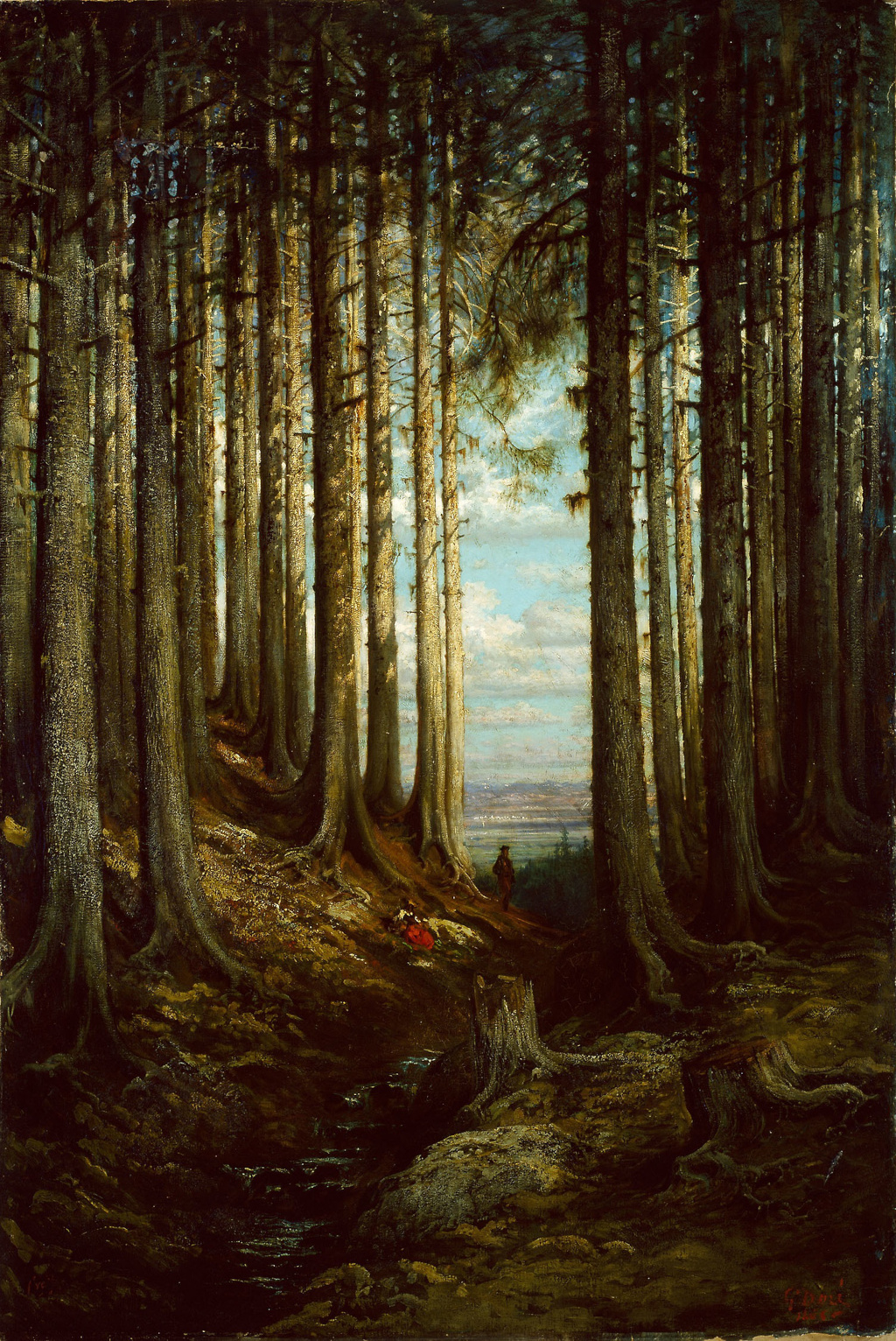
The small figure near that opening gives the landscape its measure. Doré often uses this contrast: human scale against forces that feel much larger. In Bible illustrations, that force might be divine light, flood or wilderness. In London: A Pilgrimage, it might be the pressure of the modern city. In Alpine Scene, it is the forest itself.
The color is also important. The local detail image shows dark greens, blue-shadowed trunks, touches of gold and a cool clearing beyond the trees. The foreground stream, rocks and roots make the space feel physically uneven. The viewer is not looking at a simple mountain postcard; the painting feels like a passage through a dense, damp, elevated world.
The date gives the painting extra weight. In 1865 Doré was still building the illustrated-book reputation that would soon make his Bible images famous, yet Alpine Scene already shows him thinking in the scale and texture of oil painting.
That early date also makes the painting useful for readers moving through Doré's work chronologically. It appears before the later Scottish travel paintings and long before some of the late religious and visionary canvases. The page can therefore show Doré's landscape interests forming while his book-illustration career was still gathering momentum.
The Alpine and Scottish Landscape Family
Alpine Scene works well beside the Scotland pages because all three landscapes use scale differently. The Scottish Highlands emphasizes open breadth: mountains, cloud, water and a small foreground presence. A Souvenir from Scotland concentrates on low light and remembered atmosphere. Alpine Scene moves inward, into a forested mountain space where the trees become the dominant vertical force.
Together, these pages protect the paintings hub from feeling like a loose list. They form a landscape family. That family is important because it shows Doré working outside narrative illustration while still using the visual instincts that made his illustrations powerful: scale, contrast, darkness, distance and theatrical composition.
The next closest active page is An Alpine Valley with Trees and Boulders. The National Gallery of Art records that work as a 1876 watercolour, gouache, black chalk, pen and ink over graphite.[4] One page is oil on canvas; the other is a mixed-media Alpine landscape. Both belong in the mountain route, with medium labels kept precise.
Place in Doré's Work
Alpine Scene belongs first under Paintings. The painting strengthens that hub because it has a museum object record, a clear date, a clear medium, dimensions and a public-domain image lead from AIC.[1]
It also belongs near The Scottish Highlands, A Souvenir from Scotland and A Canyon, because the site now has enough material to make landscape a visible non-Bible corridor.
Illustrations and Engravings remain useful only as broader career context. Alpine Scene is not a print-process page or an illustrated-book page. Its connection to the series-led architecture is that it shows Doré's imagination moving across media.
In practical navigation, the page is best treated as a landscape anchor rather than a minor isolated artwork. It gives the paintings hub a museum-backed mountain scene and gives the landscape row a vertical forest image to contrast with the open Scottish views and valley pages.
Why Alpine Scene Still Matters
Alpine Scene matters because it gives Doré's landscape pages a source-backed mountain painting anchor. The Bible remains central to his public reputation, and London gives Doré a major urban British route. Alpine Scene widens the painterly side of the site, showing that Doré could find spectacle in terrain, trees and light as well as in scripture or literature.
It also helps correct a narrow reading of Doré as only an illustrator. The Art Institute of Chicago object record, Orsay's landscape framing and the related National Gallery of Art and Scotland materials all point in the same direction: Doré's landscapes are part of the real structure of his career.
For readers, the painting offers one of the clearest visual transitions from illustration to landscape. The scene is quiet, but the design is dramatic. A small figure, an immense forest and a distant opening are enough to create the feeling that Doré kept seeking in many forms: the human imagination facing a world larger than itself.
Related Pages
Use these pages to follow Doré through mountain landscape, Scotland and the paintings route.

An Alpine Valley
A mixed-media companion in the mountain route.

The Scottish Highlands
The Scotland landscape anchor.

A Souvenir from Scotland
A sunset and memory support page.

Paintings
The hub for Doré's painted work.
FAQ
Discussion
How does Doré make a forested mountain scene feel theatrical without a narrative subject?
Reader Insights
The tall trunks turn the forest into a kind of natural architecture.
The small human presence measures the forest without taking visual control.
The distant light pulls the eye out of the dense foreground and into a wider landscape.
Join the Conversation
Share your reading of Alpine Scene below.
References
- Art Institute of Chicago, Alpine Scene, accessed 27 July 2026.
- Art Institute of Chicago, Gustave Doré collection route, accessed 27 July 2026.
- Musée d'Orsay, Gustave Doré (1832-1883): Master of Imagination, accessed 27 July 2026.
- National Gallery of Art, Gustave Doré, accessed 27 July 2026.
- Toledo Museum of Art, The Scottish Highlands, accessed 27 July 2026.


