 by Tom Gurney
Tom Gurney BSc (Hons) is an art history expert with over 20 years experience
Published on June 19, 2020 / Updated on October 16, 2026
Email: tomgurney1@gmail.com / Phone: +44 7429 011000
Bluebeard and Doré's Fairy-Tale Danger
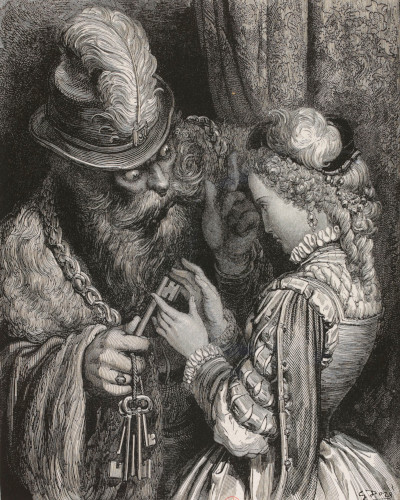
Bluebeard shows Gustave Doré turning a fairy tale into a scene of ceremony, wealth and danger. The subject comes from Charles Perrault's La Barbe bleue, one of the stories Doré illustrated for nineteenth-century Hetzel editions of Perrault's tales.
It belongs with Little Red Riding Hood in the fairy-tale corridor of Doré's work, but its atmosphere is different. Little Red Riding Hood begins with danger in the forest. Bluebeard begins with danger inside the house.
The image most closely belongs to the key-handover moment: Bluebeard gives his wife the keys to his house while forbidding her to open one room. Utpictura18 identifies the plate as Barbe bleue confie à sa femme les clefs de sa maison, from Les Contes de Perrault, drawn by Doré and published by Hetzel in 1867. The record describes it as a wood engraving and links it to Perrault's La Barbe bleue from Contes de ma mère l'Oye.[4]
At a Glance
- SeriesPerrault / Les Contes de Perrault fairy-tale route
- Image noticeUtpictura18: Barbe bleue confie à sa femme les clefs de sa maison [4]
- Publication routeHetzel / BnF / Gallica Perrault-Doré records [2][3]
- Medium noteWood engraving recorded in the Perrault image set [4]
- Companion pageLittle Red Riding Hood and the Fairy Tales / Perrault corridor
Contents
- The Perrault Series
- What Doré Shows
- The Key, Wealth and Fear
- Drawing and Wood Engraving
- Place in Doré's Work
- Why the Image Still Matters
The Perrault Series
Doré's Perrault illustrations are important because they show how his imagination worked at a smaller scale. The Bible gave him creation, flood, angels and prophetic terror. Dante and Milton gave him epic descent and cosmic rebellion. London gave him modern crowds and poverty. Perrault gave him stories that depend on short scenes, memorable objects and sudden changes of mood.
The Bibliothèque nationale de France describes the Perrault-Doré publication as an exceptional Hetzel edition, and BnF Éditions points back to an original 1862 edition preserved in the rare-books collection. The BnF catalogue and Utpictura18 records used for this page document the 1867 Hetzel image set. Together, those sources support a careful public framing: Bluebeard belongs to Doré's Perrault project in the 1860s, with the 1867 plate records providing the clearest object-level source.[1][2][5]
Bluebeard also helps explain why Doré's work is strongest when read by series, not only by isolated titles. A single Bluebeard image is striking, but the sequence is richer. Doré follows the story through key moments: the giving of the keys, the display of wealth, the frantic wait for rescue and the violent end.
What Doré Shows
The key-handover scene is built around two figures and an object. Bluebeard stands richly dressed, dominant and theatrical. His wife appears elegant but vulnerable, caught in the moment when permission and prohibition arrive together. The keys make the picture work. They are ordinary domestic objects, but in this story they carry the force of command, curiosity, transgression and proof.
Doré's composition does not need visible blood to feel threatening. The danger lies in the formality of the exchange. Bluebeard is not shown as a monster bursting into action. He appears as a wealthy husband setting the conditions of the household. That restraint is part of the unease. The image understands that the tale's horror begins before the forbidden room is opened.
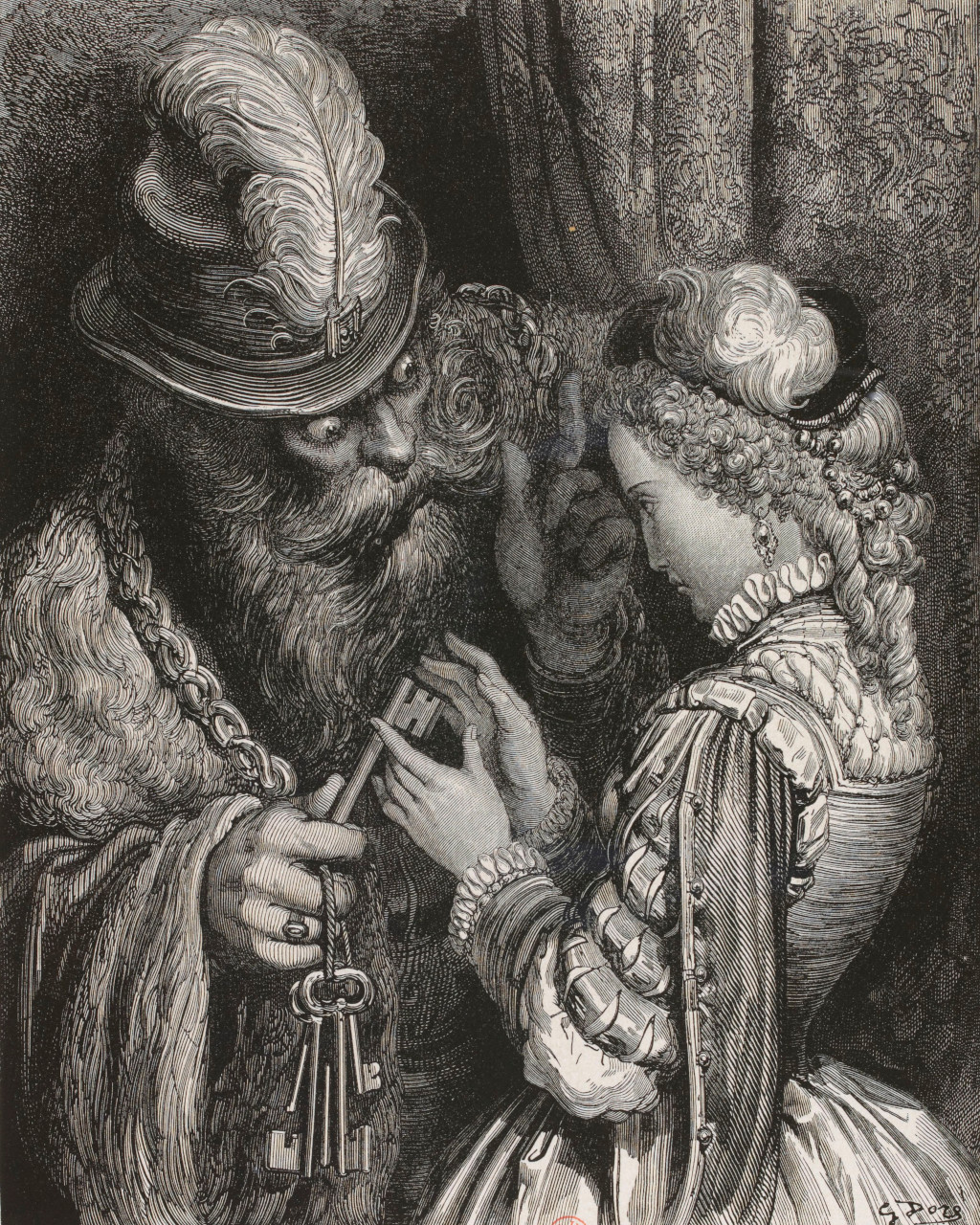
The costume and setting matter as much as the gesture. Doré gives Bluebeard the outward signs of status: fine clothes, decorative surfaces, controlled posture and theatrical confidence. The wife's attention is pulled toward the keys, and the viewer knows that one of them will become the tale's central test. The scene is therefore both elegant and poisoned.
The Key, Wealth and Fear
Françoise Bombard's Utpictura18 essay on objects in Perrault and Doré is especially useful for this page. It treats the Bluebeard key as the starting point for the movement from prohibition to discovery and then to threatened death. The essay also notes how Doré places the key within a network of lines and gazes, so that the object becomes the focus of curiosity and temptation.[7]
The same essay helps with Bluebeard's wealth. In the treasures plate, Doré surrounds the scene with costly objects, reflective surfaces and dense graphic detail. That matters for the key-handover image too, because Bluebeard's power is not only physical. It is social and material. He owns the house, controls the rooms, displays the riches and defines what may or may not be seen.[5][7]
Perrault's story depends on that contradiction. Bluebeard offers access and forbids access at the same time. Doré gives the contradiction a visible form: a husband presenting keys while creating the one rule that will endanger his wife. The image turns domestic property into suspense.
Drawing and Wood Engraving
Utpictura18 records the key-handover plate as a wood engraving, and the BnF catalogue describes the Perrault illustration set as black-and-white prints. That production context links Bluebeard directly to Doré's broader work in illustrated books.[2][4]
Doré's designs often depended on collaboration with professional engravers who translated drawing into reproducible printed tone. In Bluebeard, that translation matters because the mood depends on contrasts: dark clothing against lighter passages, ornamental line against open space, faces and hands set inside a dense social interior.
The page therefore belongs with Engravings as well as Illustrations. Bluebeard is not only a fairy-tale subject. It is a printed image, made to circulate in a book, and its authority comes from the way Doré's visual drama survives the pressure of black-and-white reproduction.
Place in Doré's Work
Bluebeard completes the first strong Perrault pair in the current Doré baseline. It belongs beside Little Red Riding Hood in the Fairy Tales / Perrault section of the Illustrations hub, with both pages linking back to the Engravings hub for production-medium context.
The page also supports the site's series-led Doré navigation. Bible remains the central series route, but Doré's work also needs visible pathways through London, Perrault, Dante and Milton, Don Quixote, La Fontaine and the Crusades where the evidence supports them. Bluebeard is useful because it makes the Perrault route concrete rather than abstract.
For readers, the page offers a different way into Doré. Someone who arrives through fairy tales may not first think of The Creation of Light, The Deluge or The Fall of the Rebel Angels. Bluebeard introduces Doré as an artist of narrative pressure across many kinds of books.
Why the Image Still Matters
Bluebeard remains memorable because Doré turns a small domestic exchange into a scene of dread. The picture is not loud. It does not need to show the forbidden chamber or the later rescue to make the story feel dangerous. It concentrates the tale into a handoff, a warning and a key.
That concentration is Doré's achievement. He makes the viewer understand that the danger has already entered the house. The richest room, the finest costume and the most controlled gesture all point toward violence that is still hidden.
Within Doré's wider body of work, Bluebeard proves that the fairy-tale pages are not light leftovers beside the Bible and epic literature. They are another series in which Doré tests suspense, theatricality and the visual power of printed line. The page deserves to stand as the Perrault companion to Little Red Riding Hood and as one of Doré's clearest examples of narrative danger carried by an object.
Related Pages
Use these pages to follow Doré's Perrault, fairy-tale and literary illustration routes.
Little Red Riding Hood
Perrault danger in the forest.
Illustrations
The series hub for Doré's illustrated books.
Engravings
The print process behind Doré's books.
The Hare and the Frogs
Fable and animal-story corridor.
FAQ
Discussion
How does Doré make a formal domestic exchange feel threatening?
Reader Insights
Start with the keys: the whole story turns on a small object held in plain sight.
Look at how wealth, costume and controlled posture make the house feel dangerous.
Pair the page with Little Red Riding Hood to compare forest danger with domestic danger.
Join the Conversation
Share your reading of Doré's Bluebeard below.
References
- Bibliothèque nationale de France, Les Contes de Perrault, illustrés par Gustave Doré, accessed 27 July 2026.
- BnF Catalogue général, [Illustrations de Les Contes de Perrault], accessed 27 July 2026.
- Gallica, Les contes de Perrault / dessins par Gustave Doré, accessed 27 July 2026.
- Utpictura18, Barbe bleue confie à sa femme les clefs de sa maison, accessed 27 July 2026.
- Utpictura18, Les trésors de Barbe bleue, accessed 27 July 2026.
- Utpictura18, Les deux frères au secours de la femme de Barbe bleue, accessed 27 July 2026.
- Françoise Bombard, Utpictura18, Les objets dans les Contes de Perrault et dans les illustrations de Gustave Doré, accessed 27 July 2026.
- BnF Éditions, Perrault. Contes illustrés par Doré, accessed 27 July 2026.