


 by Tom Gurney
Tom Gurney BSc (Hons) is an art history expert with over 20 years experience
Published on June 19, 2020 / Updated on October 16, 2026
Email: tomgurney1@gmail.com / Phone: +44 7429 011000
The Children's Crusade in 1212 and Doré's Crusades Series
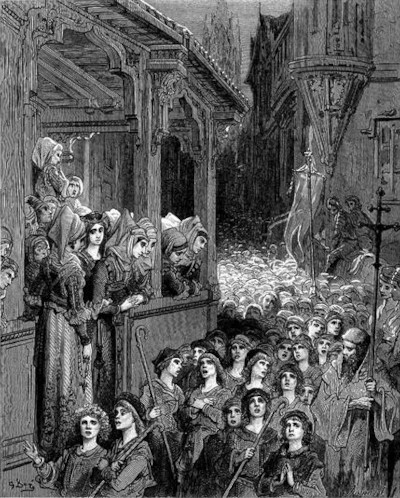
The Children's Crusade in 1212 belongs to Gustave Doré's Crusades illustrations, the historical-religious series he made for Joseph-François Michaud's Histoire des croisades. The image shows a dense movement of young crusaders through a narrow town street. Faces press together in the crowd, banners and crosses rise above them, and women look down from a balcony as the procession passes.
The Library of Congress records the related image under the French title La croisade des enfants. Its catalogue summary describes a crowd of young men marching in a street while women watch from a balcony. The same record notes that the image is an engraving by Doré and was illustrated in Michaud's Histoire des croisades, p. 300.[1]
Inside Doré's work, this is a Crusades-series image first. It is not a Bible illustration, though its subject is religious history and its mood belongs near Doré's wider religious imagination. Its closest companions are A Celestial Light, The Crusaders' War Machinery, The Battle of Nicaea in 1097, The Road to Jerusalem and The Crusaders Massacre the Inhabitants of Caesarea.
At a Glance
- TitleThe Children's Crusade in 1212
- ArtistGustave Doré
- French titleLa croisade des enfants [1]
- SeriesMichaud's Histoire des croisades
- Source anchorLibrary of Congress and BnF records [1][2]
- Page roleCrusades procession and crowd image
Contents
- The Crusades Series
- What Doré Shows
- History and Legend
- Beside the Other Crusades Pages
- Doré and the Printed Page
- Place among Doré's Works
- Why the Image Still Matters
The Crusades Series
Doré's Crusades illustrations need to be read as nineteenth-century historical illustration, not as direct medieval documentation. Michaud's Histoire des croisades was a major nineteenth-century historical text, and the 1877 illustrated edition turned that history into a sequence of large dramatic images.
The BnF catalogue is useful because it confirms the structure of the edition: two folio volumes, 100 large compositions by Doré and engraving work by several named engravers.[2] That places The Children's Crusade in 1212 inside a large printed project rather than leaving it as an isolated image.
The Poitiers scholarly article gives a strong interpretive frame for the series. It describes the 1877 Doré-illustrated edition as a historical work with a strong visual and narrative dimension, one in which images heighten drama, organize crowds and turn the Crusades into a visual story for modern readers.[3]
What Doré Shows
The composition is packed from foreground to distance. Figures fill the lower part of the image, with faces turned upward and forward. Some hold crosses or banners. The procession narrows as it moves deeper into the street, so the crowd appears to continue beyond the visible foreground.
Architecture makes the space feel tight. Tall buildings, projecting wooden structures and shadowed passages press down on the crowd. The balcony at the left is especially important because it gives the image a second level of spectatorship. The women there are not marching with the procession; they watch it, making the viewer more aware of the event as a public spectacle.
The image also depends on age and scale. The title asks the viewer to think about children, youth and religious enthusiasm. LOC's summary uses the phrase "young men," which is a useful reminder that the historical category is not simple. The so-called Children's Crusade has long been surrounded by legend, and the medieval term often associated with the movement can include young people and socially marginal participants rather than only small children.
Doré's image leans into the pathos of the story. The crowd looks hopeful and exposed at the same time. The crosses and standards suggest sacred purpose, while the narrow streets and packed faces make the movement feel vulnerable. The drama is not a charge into battle. It is a departure.
History and Legend
The Children's Crusade of 1212 is one of the more uncertain episodes in Crusades memory. Modern summaries usually describe popular movements associated with a French youth, Stephen of Cloyes, and a German youth, Nicholas of Cologne. The stories describe large groups setting out with hopes of reaching the Holy Land, but the exact composition, routes and outcomes are debated.[4]
That uncertainty shapes the article's tone. Doré was illustrating Michaud's nineteenth-century history, not making a modern archival reconstruction of 1212. His image reflects how the episode could be imagined in the nineteenth century: a crowd of young believers, stirred by faith, entering public view and moving toward an impossible goal.
This does not make the image less useful. It makes it more revealing. The picture shows the Children's Crusade as memory, legend and moral spectacle. Doré gives form to the story's emotional pressure: the youthfulness of the marchers, the religious signs they carry, the attention of onlookers and the shadow of failure that later readers bring to the scene.
Beside the Other Crusades Pages
The Children's Crusade in 1212 is a natural companion to A Celestial Light. Both images are tied to Michaud's Crusades world, but they work differently. A Celestial Light shows aftermath: bodies, darkness, a dove and a sacred sign above death. The Children's Crusade shows a beginning: movement, youth, street architecture and public witness.
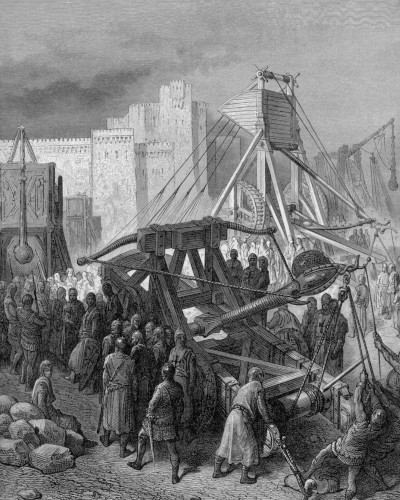
The Crusaders' War Machinery belongs nearby because it represents another side of the same series: not procession or vision, but the practical apparatus of siege warfare. The Battle of Nicaea in 1097 and The Road to Jerusalem extend the family into campaign, journey and sacred geography.
Together, these pages make the Crusades material visible as a real Doré corridor. The Bible remains central to Doré's religious reputation, but the Crusades pages show him applying similar skills to historical-religious narrative: crowds, light, architecture, violence, movement and belief.
Doré and the Printed Page
The Children's Crusade in 1212 also belongs with Engravings. LOC identifies the image as an engraving by Doré, while BnF records the 1877 Histoire des croisades as a large illustrated publication with multiple engravers.[1][2] That production chain matters because Doré's designs reached readers through printed reproduction.
The image's drama depends on engraved density. The crowd contains many faces, but the scene remains readable because the architectural lines, banners and balcony arrange the motion. In a printed book, this kind of organization is essential. The viewer has to understand both the mass of people and the direction of the procession at a glance.
This is why the work is best understood as an illustrated-book image rather than a painting. It is known through engraving and later reproductions. Its power belongs to Doré's print culture: a large historical series moving through books, libraries, collections and modern digital records.
Place among Doré's Works
The Children's Crusade in 1212 belongs first under Illustrations, where the Crusades can sit beside Bible, London, Dante, Milton, Perrault, La Fontaine and Don Quixote as one of Doré's named series. It also belongs under Engravings, where the printed-image process can be explained.
Bible links need a light touch. The subject is religious, but not biblical. The strongest Bible adjacency is visual and structural: Doré's handling of crowds, faith, procession, light and vulnerability. The page can sit near The Creation of Light or The Vision of Death as broader religious-image context without blurring the series boundary.
Placed this way, the page protects a useful Crusades anchor while keeping Doré's larger series structure legible. It gives readers a path from one image to the wider Michaud project, and from there to Doré's broader career in book illustration.
Why the Image Still Matters
The Children's Crusade in 1212 matters because it gives Doré one of his clearest Crusades anchors. The image is sourceable through LOC and the wider 1877 Michaud-Doré publication route, it has a working local image, and it helps turn the Crusades pages from scattered artwork entries into a visible series.
It also rewards careful writing. The historical episode is uncertain and often legendary, so the public article is strongest when it avoids pretending to settle it. Doré's value is visual: he shows the crowd, the architecture, the religious signs and the charged moment of departure.
For readers, the image offers a different Doré from the Bible flagships and dark visions. It is still dramatic, still dense and still religiously charged, but the force comes from a crowd of young people moving through a city. The story has not yet become battlefield tragedy. It is still, for one suspended moment, a procession of belief.
Related Pages
Use these pages to follow Doré through Crusades illustration, religious vision and engraved spectacle.

A Celestial Light
A Crusades image of aftermath and sacred light.
The Crusaders' War Machinery
Siege engineering and war spectacle.

The Battle of Nicaea in 1097
Campaign and battle within the Crusades family.

The Road to Jerusalem
Journey, procession and sacred geography.
FAQ
Discussion
How does Doré make a procession feel both hopeful and vulnerable?
Reader Insights
The compressed figures turn belief into a visible public movement.
The watching women create a second level of witness inside the image.
The narrow architecture makes the procession feel enclosed and exposed.
Join the Conversation
Share your reading of The Children's Crusade in 1212 below.
References
- Library of Congress, La croisade des enfants, accessed 27 July 2026.
- Bibliothèque nationale de France, Histoire des croisades, accessed 27 July 2026.
- Margot Renard, Université de Poitiers, Le siège et l'assaut dans l'Histoire des Croisades de Joseph-François Michaud illustrée par Gustave Doré (1877), accessed 27 July 2026.
- World History Encyclopedia, Children's Crusade, accessed 27 July 2026.
- WikiArt, The Children's Crusade in 1212, 1877 - Gustave Dore, accessed 27 July 2026.


