


 by Tom Gurney
Tom Gurney BSc (Hons) is an art history expert with over 20 years experience
Published on June 19, 2020 / Updated on October 16, 2026
Email: tomgurney1@gmail.com / Phone: +44 7429 011000
The Crusaders' War Machinery and Doré's Siege Imagination
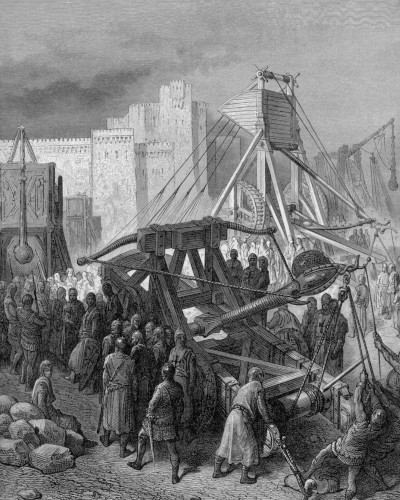
The Crusaders' War Machinery belongs to Gustave Doré's Crusades illustrations, the historical series connected with Joseph-François Michaud's Histoire des croisades. Instead of showing a charge, martyrdom or procession, the image concentrates on preparation. A large siege machine fills the foreground, soldiers gather around it, and a fortified city rises behind them.
The Metropolitan Museum of Art records an exact related object under the title The Crusaders' War Machinery, from History of the Crusades. The Met identifies it as a wood engraving, after Doré, engraved by Albert Doms and connected with Michaud as author. The print was published by George Barrie in Philadelphia and is dated after 1880 in the museum record. Its plate measures 29.6 by 23.2 cm, with a sheet size of 38 by 28 cm.[1]
Other public records often date Doré's design to 1877 and place it in the Bibliothèque des Croisades series.[5][6] That difference is useful rather than confusing: the work can be explained as a Doré Crusades design known through later wood-engraved publication. The subject is military technology, but the deeper interest is visual organization: how Doré turns siege equipment, labour and anticipation into historical drama.
At a Glance
- TitleThe Crusaders' War Machinery
- ArtistAfter Gustave Doré
- EngraverAlbert Doms [1]
- SeriesMichaud's Histoire des croisades
- MediumWood engraving [1]
- Date noteMet: after 1880; common series date: 1877
- Page roleCrusades siege-technology image
Contents
- The Crusades Series
- What Doré Shows
- Siege, Technology and Spectacle
- Beside the Other Crusades Pages
- Doré, Doms and the Printed Image
- Place among Doré's Works
- Why the Image Still Matters
The Crusades Series
Doré's Crusades images are nineteenth-century historical illustrations. They are not neutral medieval documents, and they are not simply generic battle pictures. They belong to a printed interpretation of Michaud's history, where the Crusades became a sequence of dramatic scenes for modern readers.
The BnF catalogue confirms the scale of the 1877 edition: two folio volumes of Histoire des croisades, illustrated with 100 large compositions by Doré and engraved by several named printmakers.[2] That publication setting matters because The Crusaders' War Machinery is not simply an image of a machine. It is one part of a large visual argument about war, faith, expedition and spectacle.
The Poitiers scholarly article is useful for tone. It describes Doré's Crusades illustrations as a late-career project that transformed historical narrative into strong visual scenes. It also stresses the importance of siege, assault, spectacle, violence and dramatic framing in Doré's treatment of Michaud's text.[3]
The Crusaders' War Machinery fits that pattern exactly. It pauses before impact. The machine is being prepared, the soldiers are assembled, and the fortified target waits in the background. Doré makes the technical apparatus of war feel as dramatic as battle itself.
What Doré Shows
The image is dominated by a siege engine. Its frame, ropes, wheels and angled beams create a dense structure in the foreground. Around it, soldiers work, gather, pull or watch. The machine is not a small accessory. It is the centre of the composition, almost a temporary architecture built in front of the city walls.
The fortified city gives the image its direction. Towers and walls rise behind the machine, making the viewer understand why the apparatus matters. The scene is organized around the problem of distance and resistance: how an army approaches a defended place, and how technology becomes part of that approach.
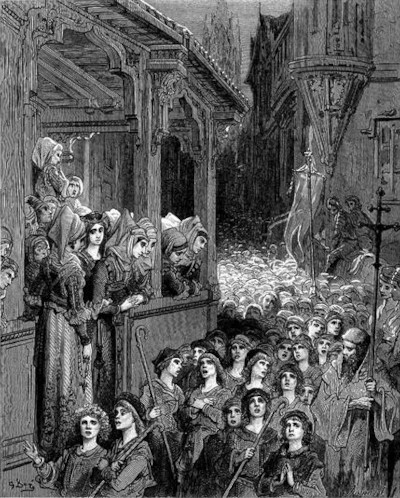
Doré also fills the scene with labour. The soldiers are not heroic single combatants. They form a working crowd, handling ropes, standing near the frame, moving around the equipment and waiting for the next stage of the assault. This gives the image a different rhythm from The Children's Crusade in 1212. There, a crowd moves through a town as a religious procession. Here, a crowd gathers around military preparation.
The image is strongest when described without over-certifying the machine. The broad idea of a catapult may be familiar, but the public description is better kept careful: siege engine, war machine, throwing apparatus, ropes, beams and frame. The visual point is clear even when the exact engineering term needs specialist confirmation.
Siege, Technology and Spectacle
This image adds an important kind of subject to the Doré section. Many Doré pages are built around spiritual vision, literary drama or landscape. The Crusaders' War Machinery is about material force: timber, rope, wheels, weight, coordination and the attempt to break a fortified position.
That does not make it dry. Doré turns the machine into spectacle. The viewer sees not only an object but a whole system of action: the walls in the background, the soldiers in the foreground, the vertical frame, the diagonal ropes and the implied violence that will follow. The image is all preparation and pressure.
The subject also helps explain why the Crusades family deserves its own path in Doré's work. The series is not just battle and piety. It includes crowds, departures, siege equipment, massacres, roads, miraculous or religious signs and the geography of expedition. War machinery gives the family its practical, technical edge.
Beside the Other Crusades Pages
The closest companion is The Children's Crusade in 1212 because the two images show different forms of collective movement. The Children's Crusade gathers a crowd around youthful religious enthusiasm. The Crusaders' War Machinery gathers a crowd around military labour.
A Celestial Light is another important companion, but for contrast. It shows aftermath and sacred illumination over death. War Machinery shows the stage before violence, where a machine and a fortified target imply the coming assault. The Battle of Nicaea in 1097 and The Road to Jerusalem extend the family into named campaign and journey subjects, while The Crusaders Massacre the Inhabitants of Caesarea requires careful writing around violence and historical imagination.
Together, these pages let readers understand Doré's Crusades work as a series rather than a set of disconnected dramatic images. The Bible remains central to Doré's religious reputation, but the Crusades pages show him applying similar compositional powers to historical-religious narrative.
Doré, Doms and the Printed Image
The Met record is especially valuable because it names Albert Doms as engraver.[1] Doré's design supplied the scene's structure, but the published image reached readers through wood engraving. The engraved surface had to carry timber, masonry, rope, crowd and distance in black and white.
That makes the page a natural link to Engravings. The image depends on the very thing that made Doré's book illustrations travel: a design that could be translated into a printed page without losing density or drama. The siege machine's beams and ropes are also a good demonstration of what engraving could do. Line becomes structure; tone becomes atmosphere; repeated marks make both machine and city legible.
This collaborative print chain is part of the work's value. It is best understood as an illustrated-book image after Doré, not as a painting. Michaud's text, Doré's design, Doms's engraving and George Barrie's publication history all belong to its object record.
Place among Doré's Works
The Crusaders' War Machinery belongs first under Illustrations and Engravings. It sits in the Crusades group beside A Celestial Light, The Children's Crusade in 1212, The Battle of Nicaea in 1097, The Road to Jerusalem and The Crusaders Massacre the Inhabitants of Caesarea.
Bible links need a light touch. This is a religious-history image, not a Bible illustration. Its strongest connection to the Bible material is visual: Doré's use of crowds, architecture, pressure, darkness and anticipation. Those shared tools matter, but the publication series remains distinct.
Placed this way, the image becomes a useful Crusades anchor: the siege-technology or military-preparation subject in a family that also includes procession, battlefield, journey, sacred light and violence.
Why The Crusaders' War Machinery Still Matters
The Crusaders' War Machinery matters because it gives Doré a practical military subject inside the Crusades corridor. It is not only about kings, saints, battles or visions. It is about the machinery of siege and the coordinated human labour around it.
The image also has a strong preservation case. The active URL is canonical, the local image works, and the Met supplies exact object metadata. Careful writing can remove loose technical claims while keeping the subject's usefulness.
For readers, the image makes Doré's historical imagination feel concrete. A city wall, a machine, ropes, soldiers and waiting air become the drama. The assault has not yet happened, but Doré makes preparation itself feel momentous.
Related Pages
Use these pages to follow Doré through Crusades illustration, religious vision and engraved spectacle.
The Children's Crusade in 1212
Procession, faith and public movement.

A Celestial Light
Aftermath and sacred light in the Crusades family.

The Battle of Nicaea in 1097
Campaign and battlefield spectacle.

The Road to Jerusalem
Journey, procession and sacred geography.
FAQ
Discussion
How does Doré make a machine feel as dramatic as a battle?
Reader Insights
The wooden frame becomes the centre of the scene, almost like a temporary building before the walls.
The surrounding soldiers make war feel coordinated, physical and collective.
The city in the background turns preparation into suspense.
Join the Conversation
Share your reading of The Crusaders' War Machinery below.
References
- Metropolitan Museum of Art, The Crusaders' War Machinery, from History of the Crusades, accessed 27 July 2026.
- Bibliothèque nationale de France, Histoire des croisades, accessed 27 July 2026.
- Margot Renard, Université de Poitiers, Le siège et l'assaut dans l'Histoire des Croisades de Joseph-François Michaud illustrée par Gustave Doré (1877), accessed 27 July 2026.
- Wikimedia Commons, Gustave Doré - The Crusaders War Machinery, accessed 27 July 2026.
- WikiArt, The Crusaders' War Machinery, 1877 - Gustave Dore, accessed 27 July 2026.
- Artchive, The Crusaders' War Machinery (1877) by Gustave Dore, accessed 27 July 2026.


