 by Tom Gurney
Tom Gurney BSc (Hons) is an art history expert with over 20 years experience
Published on June 19, 2020 / Updated on November 20, 2026
Email: tomgurney1@gmail.com / Phone: +44 7429 011000
Young Woman Reading The Pillow Book
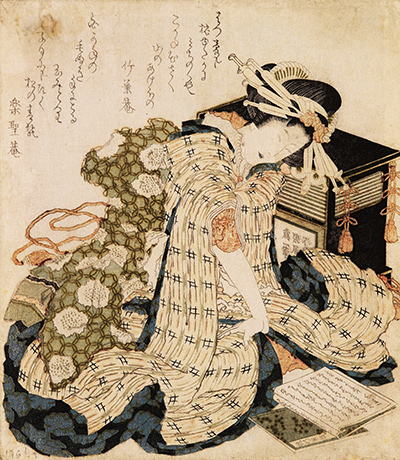
Katsushika Hokusai’s Young Woman Reading The Pillow Book brings a reader, an open volume and several kinds of writing together on a single printed sheet. The young woman lowers her head towards the bottom right, where a pale page sits against the dark edge of her robe. Behind her is a square box with a black lid and hanging cords. Before the words on the page can be made out, the angle of her head and the direction of her sleeve have already brought the book to attention. The Museum of Fine Arts of Bilbao dates its impression, catalogued as Woman Reading, to 1822. The Sumida Hokusai Museum dates its own to about 1822 and identifies the title on the pictured book as Makura no Sōshi, or The Pillow Book. [1] [2] [3]
At a Glance
- ArtistKatsushika Hokusai
- Date1822 (Bilbao)
- MediumColour woodblock print
- SeriesLiterary surimono
Contents
Following the reader’s gaze
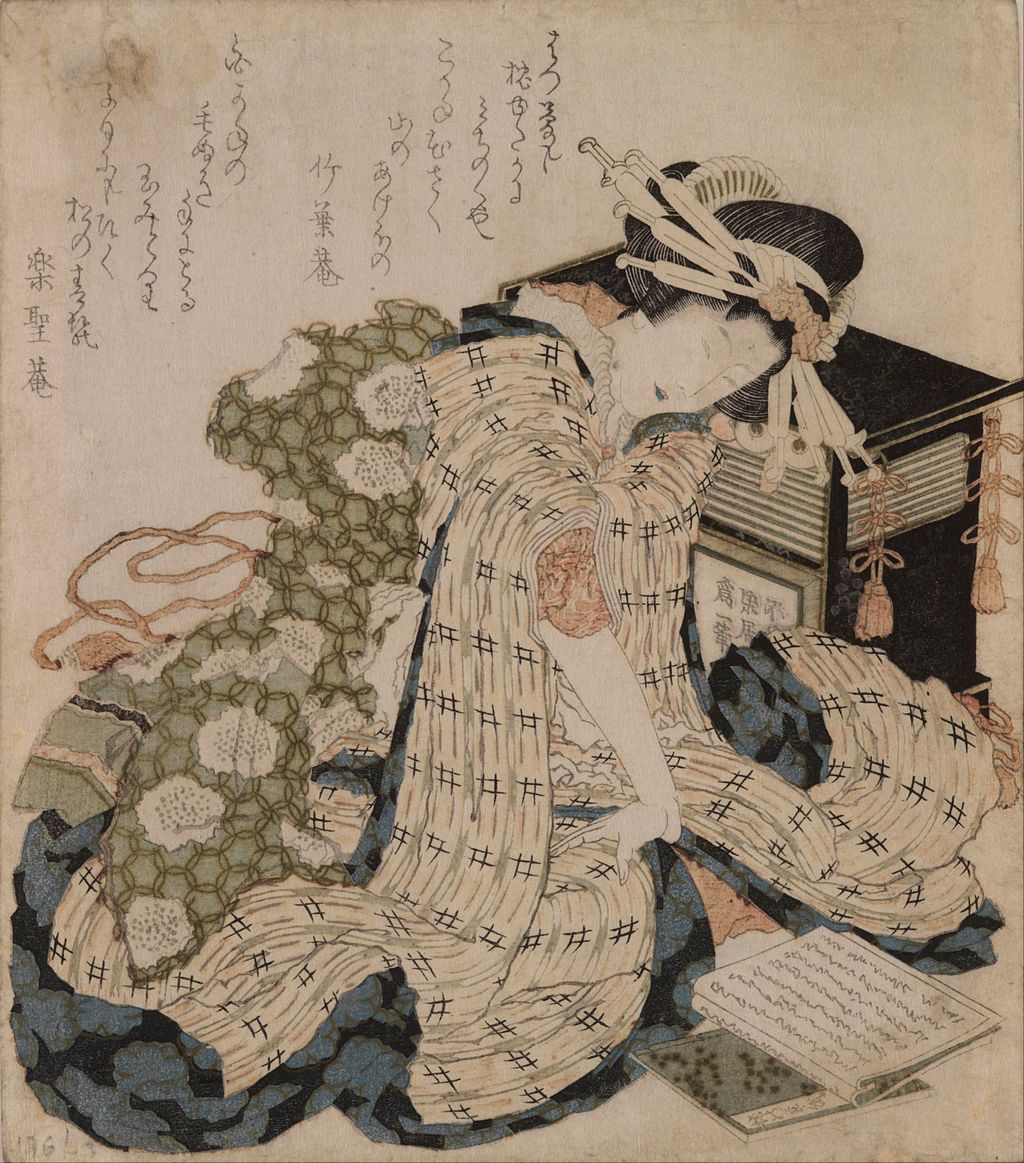
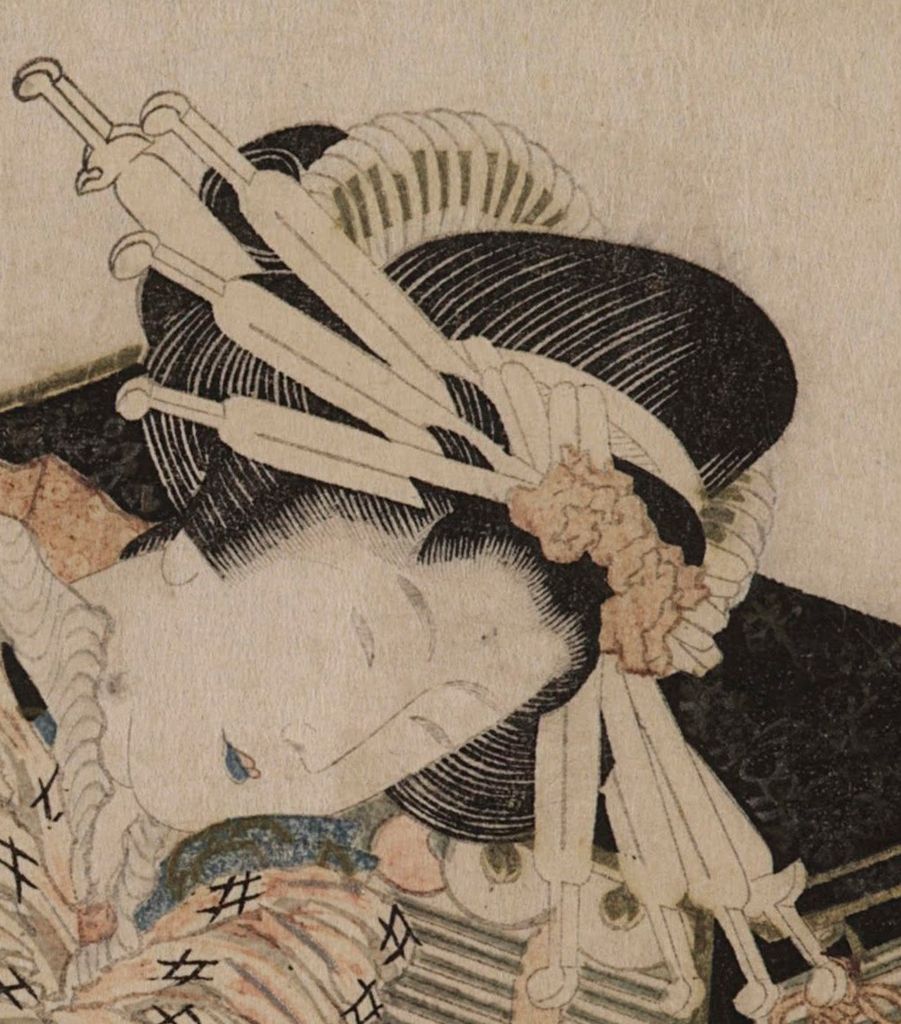
The young woman’s face seems to hover in an opening between the hair, the furniture and the printed fabric. The folds of the clothing occupy most of the sheet, but the profile is drawn with a few thin lines. Under the dark mass of the coiffure, pale hair ornaments make a fan of long shafts. Several extend down past the ear towards the shoulder. They echo the turn of the head and start a downward movement that continues through the clothing. The narrow shapes of the ornaments are especially clear where they cross dark hair or the black surface behind. [1] [2]
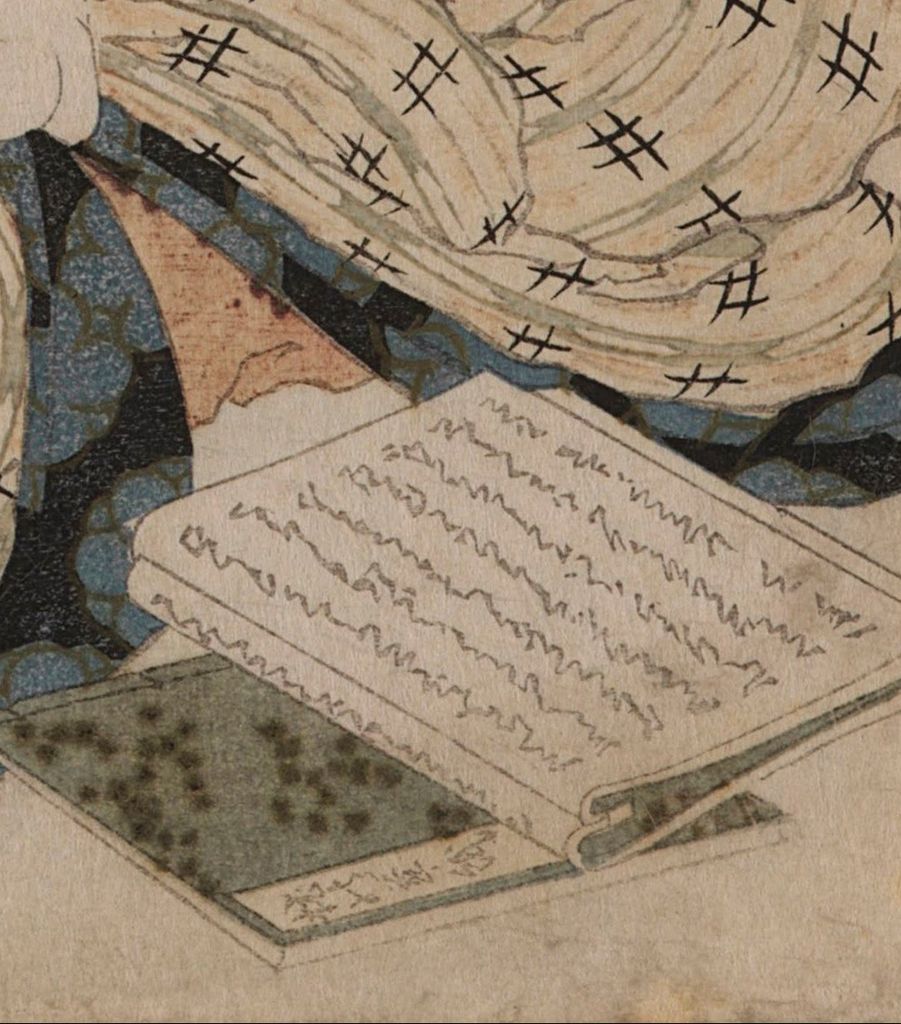
The book is far enough from her face for the eye to travel through much of the picture between the two. One light forearm emerges from a striped sleeve. The hand bends down, following the fall of the cloth. At lower right, the regular edges of the book pick up that diagonal and make a small corner of the image feel sharply ordered. The open page is covered in repeated lines of writing, set at a slant to the print itself. Hokusai gives the reader a broad field of textiles and only a small area of page, then uses pose and geometry to make that small area matter. [1] [2]
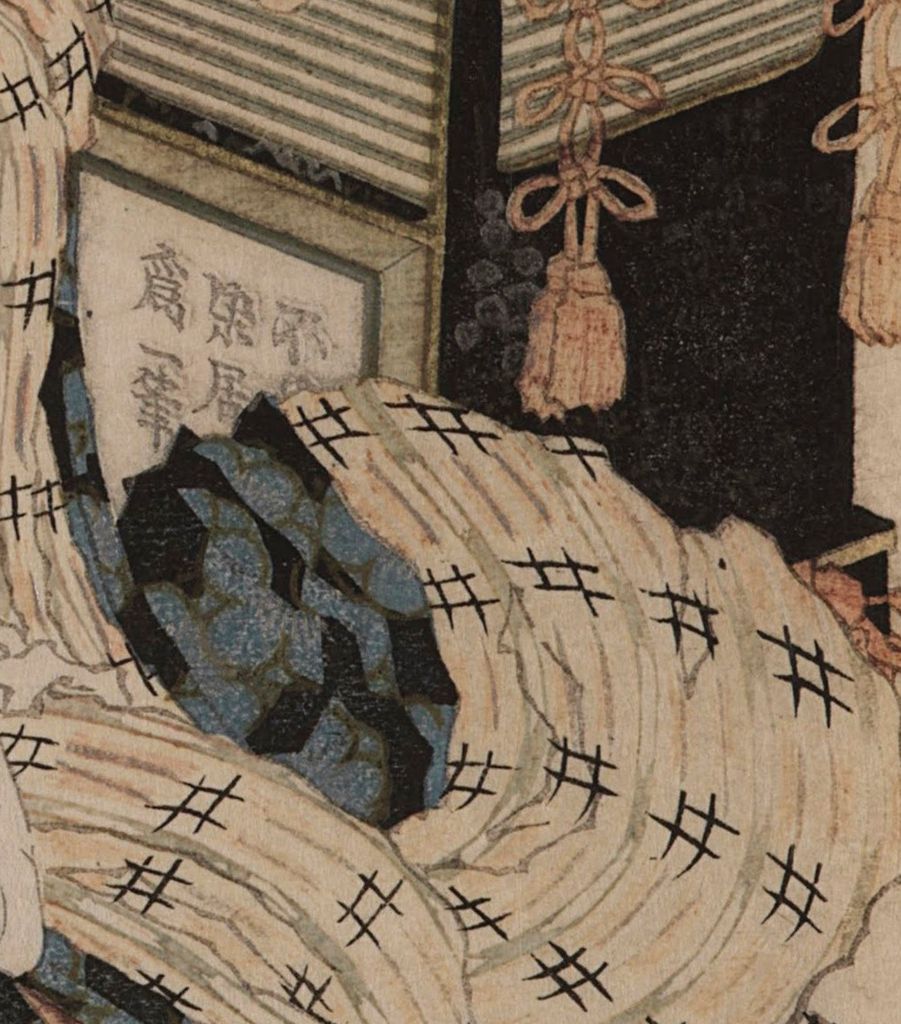
Behind her, the long horizontal lines of the box keep their spacing. Their regularity offers something to compare with the stripes across the sleeve. Near the shoulder the stripes make a tight bend; higher on the right, they are carried into a pale sweep of cloth. At the left, a fine looping cord hangs over open paper. Another group of cords falls beside the black box. These lines are much thinner than the wide sleeve hems, but all contribute to the movement around the still figure. The box and book hold their angles while the cords and sleeves turn. [1] [2]
How the patterns describe the figure
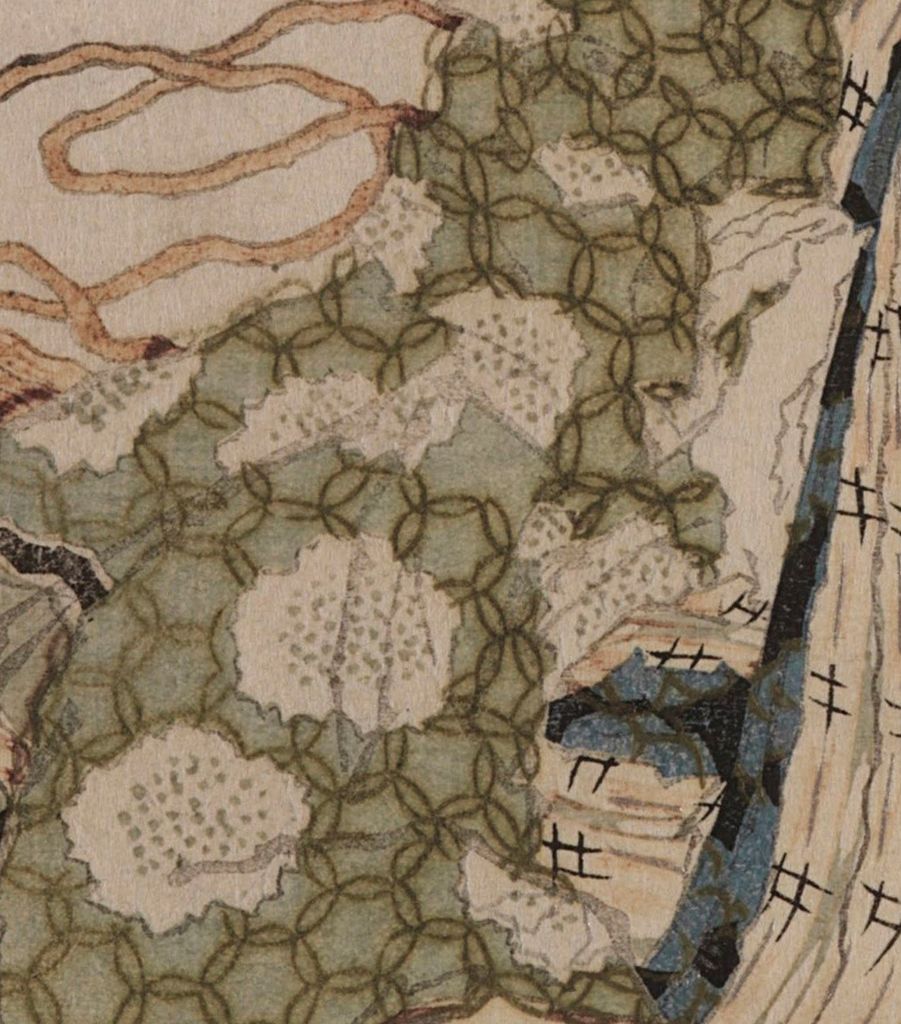
A dark patterned cloth spreads out at the lower left and around the foot of the print. Above it, a patch of repeating blossoms and interlocking lines gathers behind the shoulder. Between these areas, the prominent pale garment is covered by long stripes and small crossing marks. Follow the stripes as they round the shoulder or bend sharply near the lower edge. Their changing direction shows how one fold passes in front of another. The broad, pale passages also preserve a sense of the garment’s weight when the underlying shape of the figure is largely concealed. [1] [2]
Each fabric makes a different demand on the eye. The large floral forms on the darker cloth can be recognised from a distance. The network of smaller marks at the left invites a closer look, while the stripes carry the gaze quickly along the sleeve. Where two patterns meet, a dark border or a slight shift in the direction of the lines often separates them. Hokusai could use both the repeated motif and its interruption to show volume. The turn of a fold becomes particularly clear where a stripe disappears under another layer of cloth. [1] [2]
The Sumida Hokusai Museum identifies the long-sleeved formal garment as a furisode. Its exhibition text reads the sitter as a young woman perhaps moving from service as an attendant towards the position of a courtesan. The museum connects her reading with the education expected of women in the highest ranks of the profession. The print makes that reading plausible through a combination of dress and literary activity. It gives no personal name for the woman. The activity is quiet and concentrated, despite the amount of space and attention Hokusai gives to the dress. [2]
A book from the Heian court in an Edo print
The enlarged detail published by Sumida lets the viewer distinguish the writing on the open page from the title slip. The slip identifies The Pillow Book, the collection associated with Sei Shōnagon, a woman of the Heian court. Its contents range from lists of things grouped under a single heading to recollections of court life and observations of natural or social details. The variety matters here. A book of closely observed gestures, appearances and customs is a particularly apt object in a print that asks for close attention to a gesture and a set of clothes. The woman looking at the book belongs to Hokusai’s Edo-period scene. Sei Shōnagon belongs to the history of the text she is reading. [2] [4]
The old work could have been encountered in many forms by Hokusai’s contemporaries. Kitamura Kigin’s Shunshoshō, a commentary on The Pillow Book, survives in an early Edo printed edition held by the National Archives of Japan. The National Institute of Japanese Literature records subsequent editions and holdings across multiple collections. The history of the commentary shows how readers in the Edo period could encounter an old court text through intervening generations of editors and publishers. The small title slip in Hokusai’s design supports the identification of the work. Identifying the precise edition would require more information about the printed volume he depicts. [2] [5] [6]
The Sumida museum placed its impression at the beginning of The Courtly Hokusai, an exhibition about the ways people in Edo pictured the Heian court. In that context the sheet shows one means by which the past took on a place in contemporary life. Hokusai gives the old text a present-day reader, along with the furnishings, clothes and posture that frame her attention. Compare that use of writing with Cuckoo and Azaleas, where an older poem appears alongside the bird and flowers. Here the older text has a material form within the picture. The reader’s body and position give us a way to look towards it. [2] [7]
Poetry and the printed sheet
The writing above and to the left of the woman sits on the background of the print, apart from the pages at lower right. Its upright columns pull upwards while the face, sleeves and book draw attention down. Some columns are short and others extend farther along the left edge. A viewer who begins with the written field can reach the figure by following the low points of those columns, where the printed characters give way to patterned cloth. The difference in the scale and angle of the two kinds of writing makes it possible to recognise them as separate pictorial elements. [1] [2]
Sumida’s catalogue describes its sheet, which measures 21.3 by 18.6 centimetres, as a surimono. These prints were often commissioned and circulated privately among poets and their associates. The Rijksmuseum describes the combination of verse and image as central to the form and includes Hokusai among the designers who supplied pictures for literary circles. The small scale of the Sumida sheet suits that kind of close attention. The loops in the hanging cords, narrow stripes of the textiles and lettering on the volume all come into view when the print can be examined from nearby. This use of printed marks belongs alongside the many other possibilities of ukiyo-e woodblock printing, from single sheets to illustrated books. [2] [3] [8]
Comparing Bilbao and Sumida
The Bilbao museum has used different titles for the image. Its exhibition Japanese Art calls it Courtier sleeping. The museum’s object deposit under Woman Reading labels it a colour wood engraving and traces it to the collection of José Palacio, donated by María de Arechavaleta in 1953. The tilt of the head helps explain why a description might place the emphasis on repose. The Sumida reproduction offers a detail from which to read the scene, since the open pages and their title slip give the angle of the head a visible object. [1] [2] [9]
The museum photographs also make it possible to follow the same shapes through different colour balances. The black lid, profile, striped fabrics and spread of the book sit in the same places. Red accents in the Sumida photograph are more apparent, particularly among the stripes and cords. Bilbao’s published image registers the broad mass of cloth more softly, with the dark hem and black lid holding much of the contrast. Both photographs preserve the relation between the small, light face and the spread of the figure. Any claim about printing sequence or the original intensity of a particular colour would need evidence from the physical objects. [1] [2]
Look once more at the book after following the rise and fall of the sleeves. Its pages are small, but they fix the direction of nearly everything the young woman does. Hokusai makes sure we can first recognise a person absorbed in reading, then gives us enough detail to ask what has caught her attention and how it reached her. [1] [2]
Image comparison
Where this work sits in Hokusai’s career
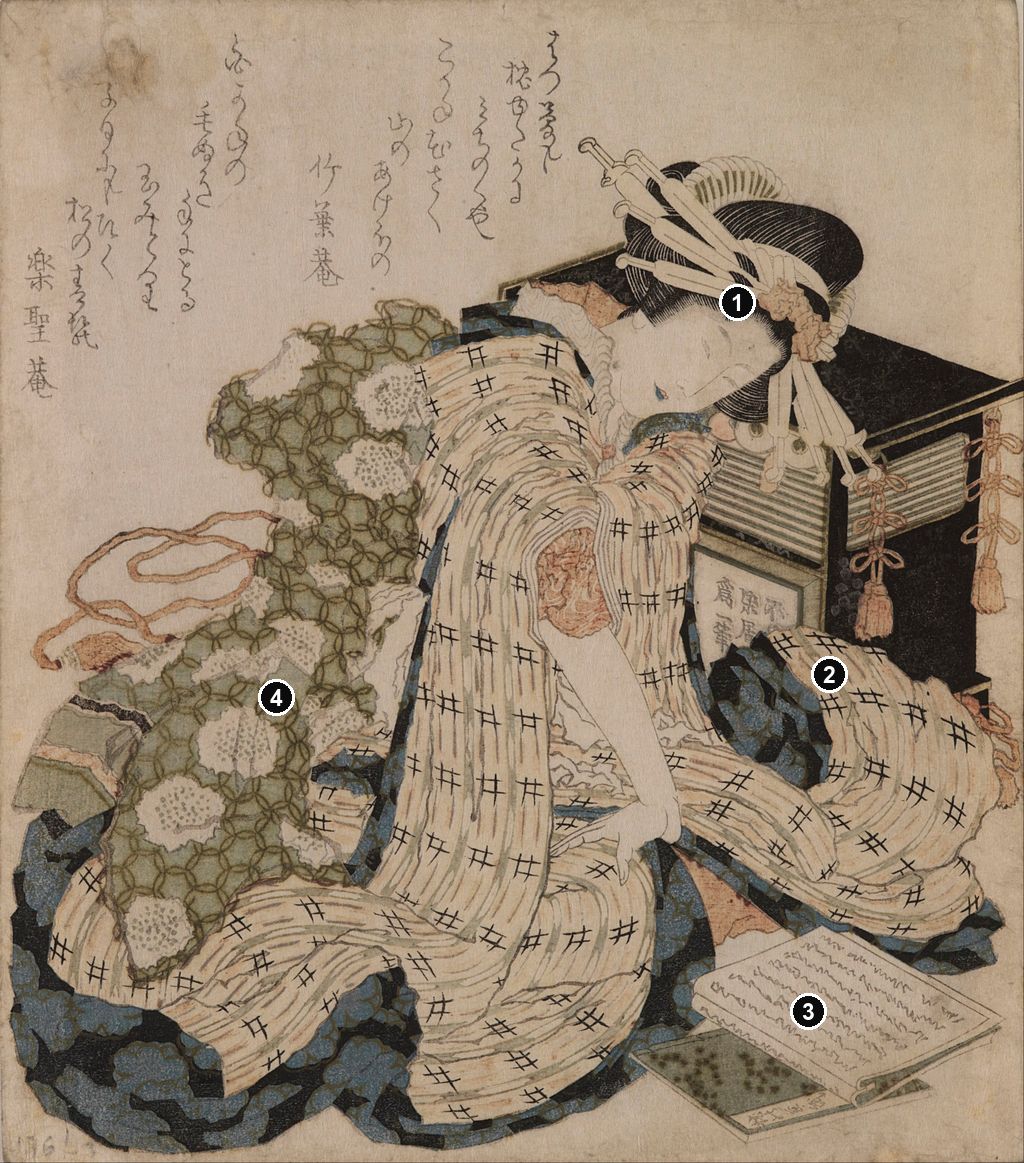
Annotated Details from Young Woman Reading The Pillow Book
Bilbao Museoa, 82/758. [1]
Details from YOUNG WOMAN READING THE PILLOW BOOK
Select a detail to look closely.
The reader bends towards the book
The head tilts down, and the lines of the folded cloth carry that small movement into the larger shape of the body. [1]
Sleeve and support overlap
Lines in the striped sleeve reverse as the fabric folds. The dark straight edges behind it give the sleeve’s changes of direction a fixed point. [1]
The open book near the bottom edge
The book’s two leaves are seen from above. Its narrow rows of writing form a smaller pattern against the stripes of the reader’s clothing. [1]
Uneven fields of pattern
Rounded motifs, stripes and empty paper help distinguish one fold or surface from another. The areas of pattern give shape to the sitting figure. [1]
Explore Hokusai’s works
Discussion
Look again at the images and ideas explored in Young Woman Reading The Pillow Book. These editorial prompts invite your observations.
Reader Insights
Where does the artist direct your attention to the open book?
How do the garment patterns make the reader’s pose easier to follow?
Join the Conversation
Share a detail, comparison or question about Young Woman Reading The Pillow Book below.
References
- Bilbao Fine Arts Museum, via Google Arts & Culture, Woman Reading, object deposit with photograph, date and Palacio collection provenance. View source.
- Sumida Hokusai Museum, The Courtly Hokusai: Heian Literature in Edo, exhibition press material, p. 2, with full impression, book detail and curatorial notes. View source.
- Sumida Hokusai Museum, The Lineage of Hokusai’s Beauties, exhibition catalogue, no. 124, Young Woman Reading Makura no Sōshi (The Pillow Book), dimensions, form and date. View source.
- National Diet Library, via Japan Search, The Pillow Book (枕草子), collection overview and survey of chapter forms. View source.
- National Archives of Japan, Kitamura Kigin’s Shunshoshō (春曙抄), catalogued printed edition. View source.
- National Institute of Japanese Literature, Makura no Sōshi Shunshoshō (枕草子春曙抄), bibliography of variant editions and holdings. View source.
- RISD Museum, Cuckoo and Azaleas, 34.486.2, image, verse transcription and interpretation. View source.
- Rijksmuseum, Surimono, collection catalogue introduction. View source.
- Bilbao Fine Arts Museum, Japanese Art, exhibition page listing the work as Courtier sleeping. View source.