 by Tom Gurney
Tom Gurney BSc (Hons) is an art history expert with over 20 years experience
Published on June 19, 2020 / Updated on November 20, 2026
Email: tomgurney1@gmail.com / Phone: +44 7429 011000
Fishing by Torchlight in Kai Province
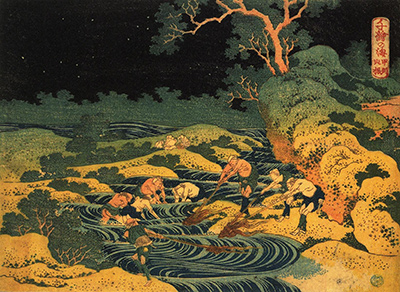
In Katsushika Hokusai’s Fishing by Torchlight in Kai Province, fishermen wade into a river at night and hold burning torches close to the current. One man leans from a rock at the right, extending his arms towards the water. Across the stream, pale backs and shoulders interrupt its dark ribbons. The warm colour around the group reaches up the embankment and catches the branches of a tree against a black sky. A handful of tiny stars gives the eye a way into that darkness. The river is visible at several distances, but it is down among the people that the curves of the water come most sharply into focus. [1] [2] [3]
The Japanese title is Kōshū hiburi, and the print belongs to Chie no umi, which the Art Institute of Chicago calls One Thousand Pictures of the Ocean. Chicago dates its sheet, accession 1983.581, to about 1833–34, while the Shimane Art Museum assigns its impression to the early Tenpō era, about 1830–33. The Tokyo National Museum holds another impression, A-10569-643, registered as a horizontal chūban colour woodblock print. The Chicago sheet measures 18.8 × 26 centimetres, a scale that makes the busiest part of the scene small enough to take in at once. Look closer and the individual postures, small changes of colour and alternating bands of water begin to separate. [1] [2] [3]
At a Glance
- ArtistKatsushika Hokusai
- DateEarly 1830s
- MediumColour woodblock print
- SeriesOne Thousand Pictures of the Ocean
Contents
How the fishermen use the light
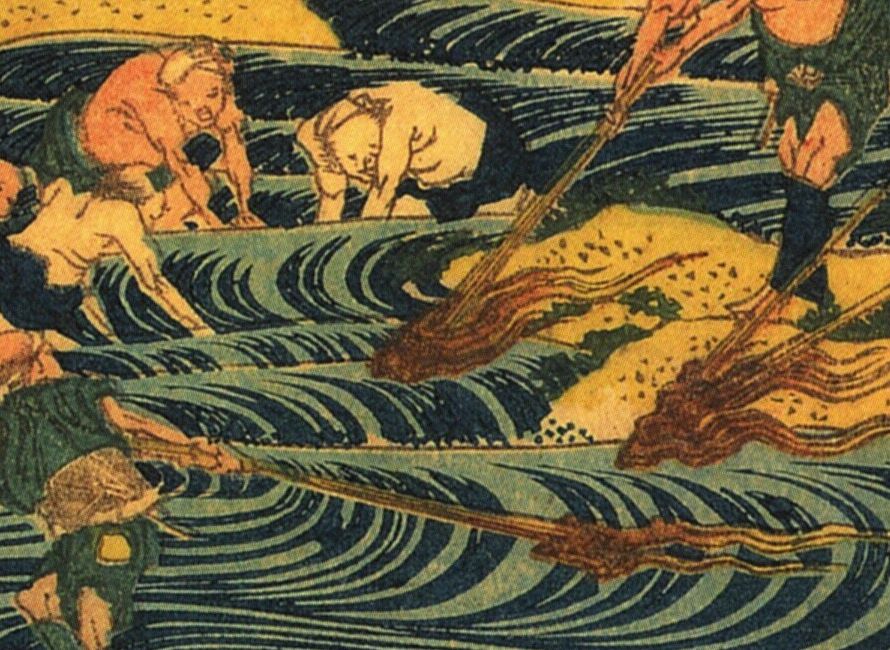
The Shimane Art Museum describes hiburi as a way of fishing late at night by directing firelight onto the water. In his study of the Chicago impression, curator James T. Ulak explains that some fishermen hold torches to attract the fish while others reach into the water to catch them. Those roles help make sense of the figures’ positions. Several men bend low over the current, close enough for the water to break up the outlines of their bodies. One of the most visible figures braces himself above them, with his arms and the shaft of his torch forming a long diagonal down to the centre. At the foreground bend a figure holds a long implement across the stream, following the line of the water for some distance before the current curves away. [1] [2]
The bank gives some of the fishermen a place to stand, but only in narrow patches. Their bare arms and bent legs are picked out against alternating pale stones and darker cover. Two figures are particularly easy to see because their light upper bodies almost meet in the middle of a dark run of water. Farther back, pale, much smaller figures come into view on a low rise. Their distance is measured against the same river and its banks, so the main group’s prominence owes as much to the direction of light as it does to their size. [1] [2] [3]
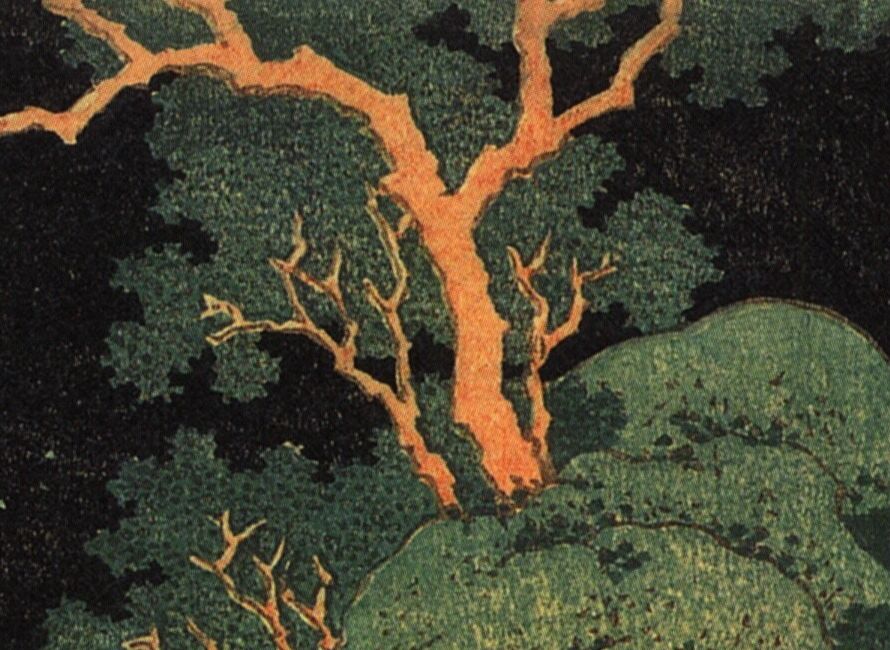
Across the lower half, the burning ends make low, irregular shapes. Ulak reads the yellow-orange of the nearby embankment and foliage as a suggestion of torchlight. In the picture, warm colour can appear on both sides of a band of blue without a sharp edge marking where the light stops. As the land recedes, cooler green and blue-green take over. The lighter rock face on the right catches the eye first, and the darker vegetation set into it breaks up the warm colour. The orange or pinkish branches at the upper right carry a related colour into the sky, even though most of the canopy remains hard to distinguish from the dark around it. [1] [2] [3]
The current and the sky
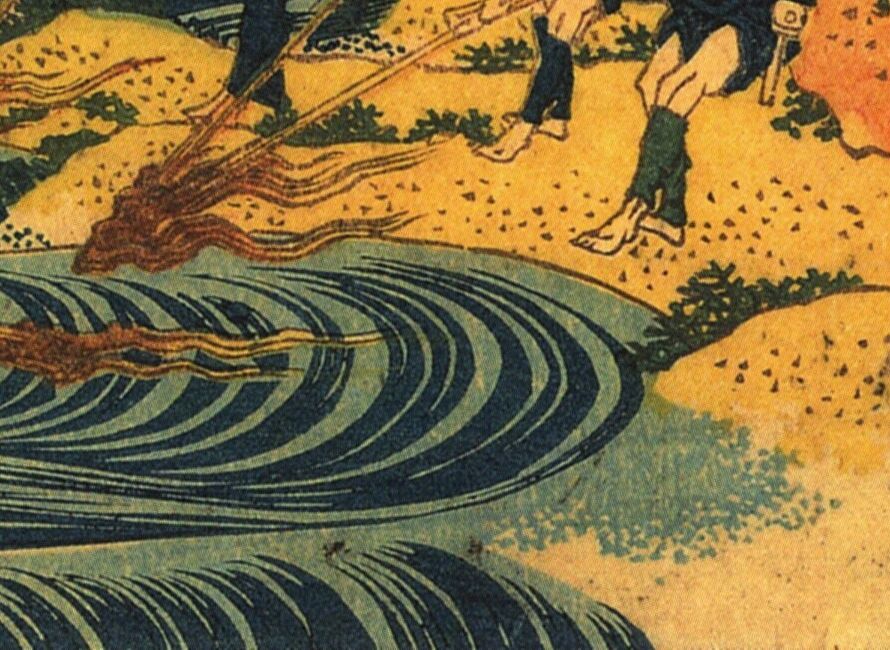
Hokusai gives the river a long approach. The water first shows itself as relatively level streaks in the distance, beyond the low land and trees. Follow it towards the fishermen and the streaks turn with the bank and broaden into curves. In front of the group, the outer lines sweep almost all the way from left to right before bending back. Inside that broad sweep, several smaller ribbons make tighter turns. The warm tips of the torches sit across these bands and help the eye return to the place where the men are working. Ulak describes the direction of the current turning almost at right angles from mid-distance into the rapids. The change of direction lets Hokusai show several reaches of the same stream in the shallow space between the middle of the sheet and its lower edge. [1] [2] [3]
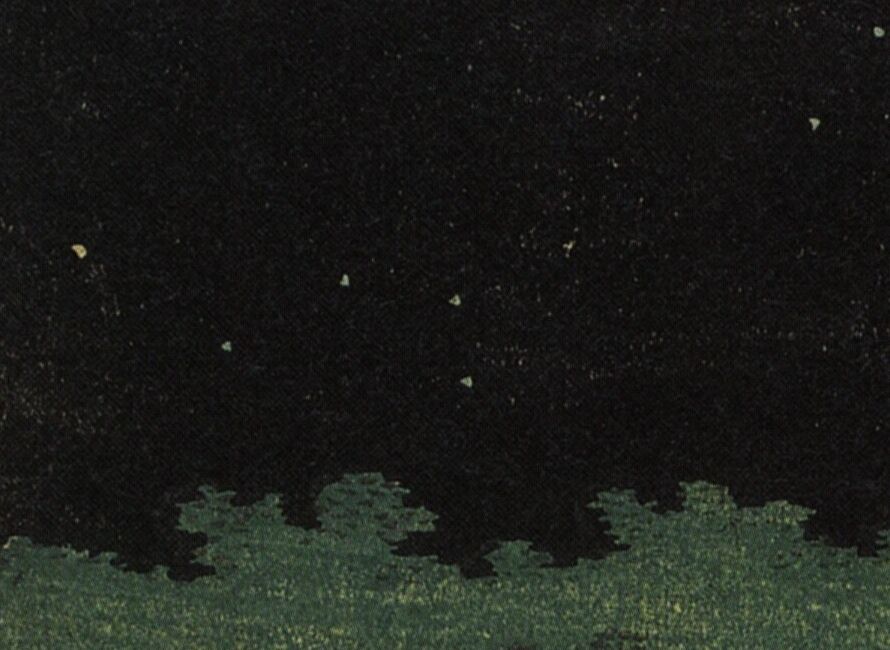
The print makes room for two quite different kinds of pale mark. In the water, the pale lines run beside deeper blue and carry the eye around the curves. Ulak identifies Prussian blue in the Chicago impression and draws attention to the passage from deeper blue in the distance to lighter and darker ribbons closer to the front. In the sky, tiny points of paper left unprinted provide the stars, the technique the Shimane catalogue identifies as white reserve against solid black ink. There is a great deal of room between the points. The water has many close lines to keep the eye moving, while a single star can hold the eye in an otherwise nearly empty stretch of sky. [1] [2]
The tree at the right gives the eye another way across that divide. Its trunk straddles the edge of the rock and then forks into the open space above. Some of the branches can be followed only in fragments as the dark foliage crosses them. To the left, the dark trees along the far bank approach the black of the sky while leaving a narrow, cooler stretch of water in view. The bank, stars and branches offer separate clues to depth at an hour when the outlines of distant things would be difficult to distinguish. [1] [2] [3]
What changes between impressions
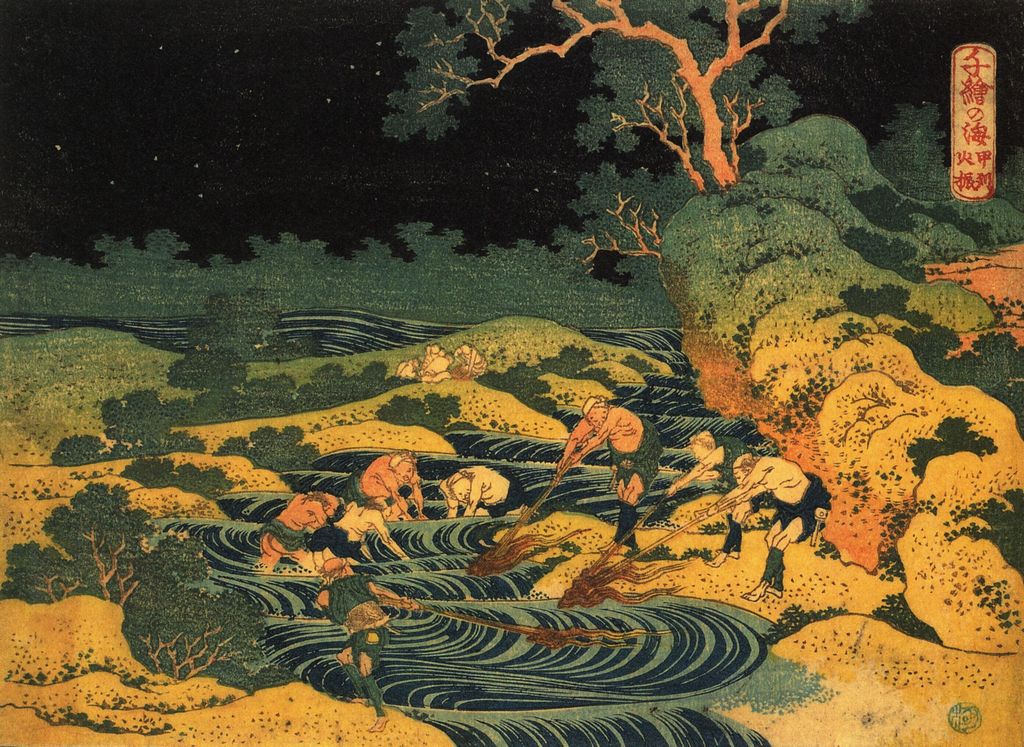
The stars, forked tree, vertical title panel and looping bands of the foreground river occupy the same places in the Shimane and Tokyo photographs and in the Wikimedia Commons reproduction shown with this article. The Commons file reproduces the same design, and its catalogue entry leaves the holding institution and particular impression unidentified. Colour changes the order in which these details catch the eye. The Commons reproduction makes the tree and much of the bank strongly orange and ochre. The Shimane image makes the ground look creamier and the title panel comparatively subdued. In the Tokyo photograph the banks are pale yellow and the lower river a cooler blue, with the figures easier to pick out where their pale outlines border dark water. The amount of warmth in the landscape varies across these reproductions, while the division between the open sky and the active lower half remains clear. Differences in paper, printing, preservation and photography can all affect what the images show. [1] [2] [3] [7]
The physical sheets give further clues about how the pictures circulated. Ulak argues that the torchlight scene and Whaling off the Gotō Islands appear to have been printed together on a larger ōban sheet and then cut apart. He describes a tiny trace of a treetop along the bottom of some torchlight impressions and a corresponding trimmed area on the whaling design. He also considers the distribution of signatures and seals across the series in making the case for printing two designs on one sheet. Such clues sit at the edge of the print, outside the parts most readily recognised as Hokusai’s picture. A reproduction cropped to the design gives a clear view of the work while making this kind of evidence harder to recover. [2]
Kai and Chōshi in One Thousand Pictures of the Ocean
The Shimane Art Museum identifies Moriya Jihei as publisher of the series. Ten finished designs are known. Suntory Museum of Art describes proofs for Kazusa-ura and Shinagawa that help show how its plans extended beyond those ten. The title covers many ways of working in and around water. In 1983 the Art Institute acquired its torchlight sheet together with Whaling off the Gotō Islands and Fishing Boats at Chōshi in Shimōsa, three prints formerly in the same set. Those subjects range from people hunting off the coast and handling boats in rough seas to fishermen wading a river in inland Kai. [1] [2] [4] [5]
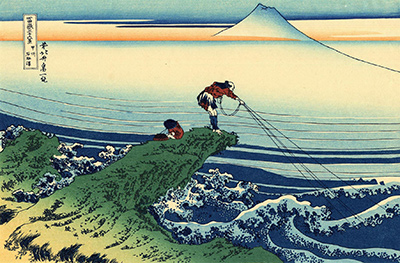
At Chōshi, the sea takes up so much of the sheet that the boats seem to appear between folds of water. The pale bands carry the eye across the field and out towards a second vessel. In Kai the bands describe the turn towards the front of a confined channel, and the scene keeps bringing the eye back to the space between the people holding the torches and those reaching into the water. Hokusai also set a fishing scene in the same province in Kajikazawa in Kai Province, part of Thirty-six Views of Mount Fuji. There the taut fishing lines repeat the triangular form of the distant mountain. In Fishing by Torchlight, the circle of light, the curve of the bank and the nearly closed loop of the lower rapids give the men’s work a shape of its own. [1] [2] [5] [6]
Image comparison
Where this work sits in Hokusai’s career
Annotated Details from Fishing by Torchlight in Kai Province
Wikimedia Commons reproduction, holding unidentified. Public Domain Mark 1.0. [7]
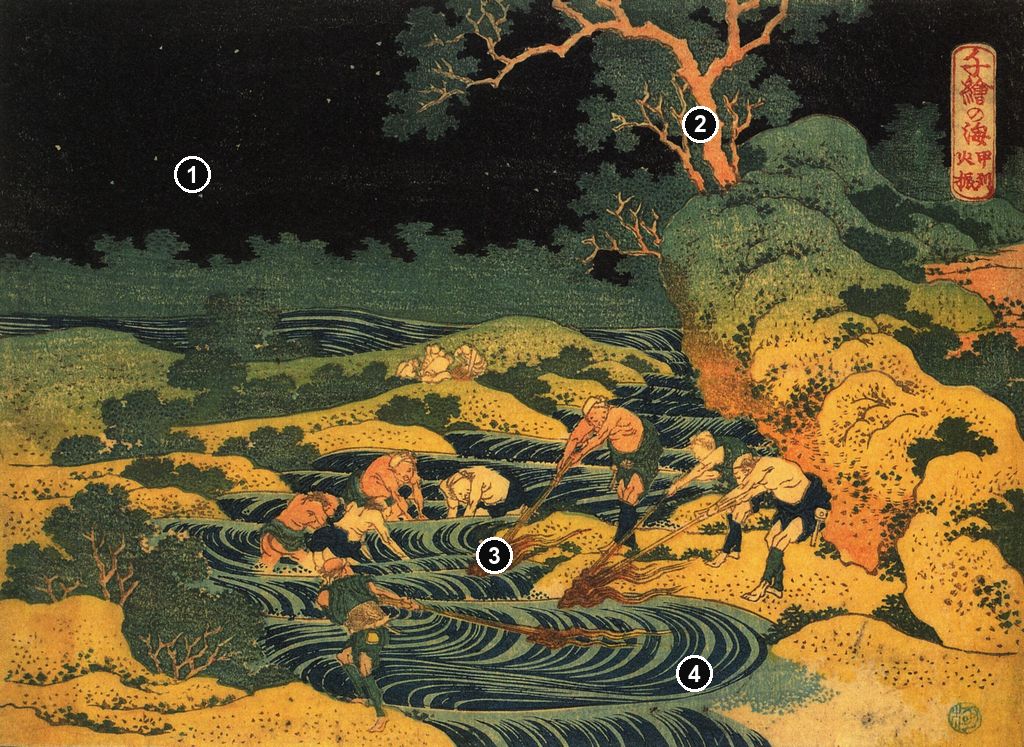
Details from FISHING BY TORCHLIGHT IN KAI PROVINCE
Select a detail to look closely.
A pale star shows against the sky
Small points of light are visible away from the warmer area around the fishermen. [7]
The tree divides above the bank
The forked silhouette helps distinguish the dark land from the sky. [7]
A torch lights the fishing party
The strongest warm colour gathers around a compact group near the centre of the action. [7]
The current turns through a broad loop
Long light lines bend around the darker water in the foreground. [7]
Explore Hokusai’s works
Discussion
Look again at the images and ideas explored in Fishing by Torchlight in Kai Province. These editorial prompts invite your observations.
Reader Insights
How does the torch light the nearby figures?
Where do the curves of the current change direction?
Join the Conversation
Share a detail, comparison or question about Fishing by Torchlight in Kai Province below.
References
- Shimane Art Museum, Kōshū hiburi, Nagata Seiji Collection, bilingual object entry on the work, the technique of night fishing and the publication of the series. View source.
- Art Institute of Chicago, Fishing by Torch in Kai Province, accession 1983.581, collection data. James T. Ulak, “The Art Institute of Chicago’s Clarence Buckingham Collection of Japanese Prints: A New Acquisition,” colour plate 3, fig. 7 and discussion on pp. 182–85. Museum acquisition study View source 1. View source 2.
- Tokyo National Museum, Chie no umi: Kōshū hiburi, accession A-10569-643, museum photograph C0083921 and Art Platform Japan object record. View source 1. View source 2.
- Suntory Museum of Art, A Wonderland of Japanese Art 2016, exhibition section on Hokusai’s landscape prints and preparatory material for the series. View source.
- The Museum of Kyoto, Hokusai and Hiroshige, exhibition checklist, section V, items v-2 and v-5. View source.
- The Metropolitan Museum of Art, Kajikazawa in Kai Province, accession JP2986. View source.
- Wikimedia Commons, Fishing by Torchlight in Kai Province, digital reproduction of the design with impression and holding institution unrecorded. View source.