 by Tom Gurney
Tom Gurney BSc (Hons) is an art history expert with over 20 years experience
Published on June 19, 2020 / Updated on October 30, 2026
Email: tomgurney1@gmail.com / Phone: +44 7429 011000
Lucifer: Introduction
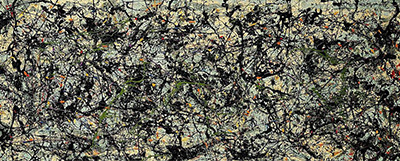
Jackson Pollock painted Lucifer in 1947. Its long canvas belongs to the Anderson Collection at Stanford University, whose record identifies oil and enamel and gives its dimensions as 41 3/16 × 105 1/2 inches. The painting extends more than eight feet across. [1]
Where does a painting like this begin? Asked in 1998 to identify Pollock’s first great drip painting, curator Kirk Varnedoe resisted choosing a single breakthrough. He placed Lucifer alongside Cathedral among the 1947 pictures in which pouring had become fundamental to the whole conception. That distinction helps explain why the work matters: a way of distributing liquid paint could now sustain an entire painting. His account invites attention to what a particular canvas makes possible, beyond the novelty of spilling or dripping colour. It also allows several paintings to share a decisive moment without making them interchangeable demonstrations of one discovery. [2]
At a Glance
This work across Jackson Pollock’s career
The Flame
c.1934–38The She-Wolf
1943Mural
1943Alchemy
1947Number 1A, 1948
1948Blue Poles
1952The Deep
1953White Light
1954Contents
The last green
Conservator James Coddington reconstructs a succession of different actions. Pollock first brushed in two greys, one pale and cool, the other darker. He squeezed bright oil colours from tubes, then poured black enamel, guided by a brush or stick. Coddington describes small holes in the tubes and forceful squeezing that sent yellow, blue and orange into extended lines. The black roughly echoed forms already established by the darker grey brushwork. Green came last. Its downward movement shows that the canvas stood vertically during or immediately after its application, before becoming the horizontal picture we know. The green encountered the raised strands of squeezed colour as it travelled. Whether it was already stretched remains uncertain. Those sideways trails therefore preserve an earlier orientation within the finished work. [3]
Pollock’s own account of working gives this sequence a useful setting. In “My Painting,” published in winter 1947–48, he described fastening canvas to a hard wall or floor and valued the resistance beneath it. Working on the floor let him approach from four sides. He also described a period of becoming acquainted with a developing picture, during which he could change or destroy an image. This is a statement about his practice, rather than an eyewitness record of Lucifer. It makes room for the combination of involvement and reconsideration that his finished surfaces demand. The floor gave him access; it did not oblige him to keep a canvas horizontal throughout its making. His words leave the painting open to decisions taken as it developed, with the eventual result emerging through his continuing response to it. [4]
Drawing with colour
A strand of paint can be both a line and a material deposit. Bernice Rose’s account of Pollock’s drawing and painting helps explain that double character. She argued that the drip line brought together two concerns that had long pulled against each other in his work: linear description and the physical presence of painted colour. A line could remain distinct while contributing to a painted surface. This offers a useful way of attending to Lucifer without requiring every mark to outline an object. Following a strand means noticing its course, but also its part in the fabric surrounding it. A painted line can catch the eye through its movement before it becomes a boundary around anything. Rose’s argument concerns the relationship between drawing and painting across Pollock’s work; it offers a framework for looking here, rather than a catalogue of hidden figures in this particular canvas. [5]
Varnedoe’s later comparison with Enchanted Forest emphasises their differences within the same year: Lucifer’s expansive drift contrasts with the other painting’s heavier, watery movement. Pouring offered a range of pictorial possibilities. [3]
That variety also complicates the familiar image of Pollock completing a picture in one uninterrupted performance. In his 1998 catalogue, Varnedoe described differences in paint thickness, drying, gloss and the interaction of successive applications across the poured paintings. He also stressed the place of reflection and selection within improvisation. Some surfaces suggest wet paint meeting wet paint; elsewhere layers could dry before further work, with a possible move from floor to wall for study. This broader argument should not be mistaken for a timed account of Lucifer’s making. Its value is to keep the viewer alert to choices that the word “drip” can conceal. The term identifies something about application while leaving many questions unanswered: how much paint, with what consistency, at what stage, and in relation to which earlier marks? Understanding the work involves holding those questions together. The apparent immediacy of a surface can coexist with a history of adjustments, and a recognisable technique can support markedly different results from one painting to another. [6]
Watch: Jackson Pollock
Choose a film about Pollock’s paintings and ways of working.
Energy under dispute
Lucifer appeared among seventeen paintings in Pollock’s Betty Parsons Gallery exhibition of 5–23 January 1948. Robert M. Coates’s New Yorker review of 17 January called it one of the “unorganized explosions of random energy” in the show; he grouped it with Reflection of the Big Dipper and Cathedral. His response was selective. He liked Full Fathom Five and Sea Change, and found poetic suggestion in Enchanted Forest. He could respond to some of Pollock’s new paintings while remaining unconvinced by others. The distinction makes the disagreement more revealing than a simple story of critics rejecting everything unfamiliar. For Coates, energy alone did not establish a successful connection with the spectator. Clement Greenberg’s favourable review of the exhibition followed on 24 January, presenting Pollock’s development as a challenge to existing judgment. That support concerned the show and Pollock’s direction; it should not become an invented individual endorsement of Lucifer. The exhibition brought competing judgments into contact with the same body of work. [7]
The title provides another route into the painting. In the Anderson Collection’s commentary, Sidney Simon connects Lucifer with the morning star and the fallen angel, proposing a descent into pictorial and psychological depths. This is a critic’s reading, not a surviving explanation by Pollock. It can suggest an experience of the picture without fixing its subject. Simon also records that Pollock gave it to chemist Grant Mark as payment for treatment of his alcoholism; their consultations began in 1952. The object record preserves this history alongside its accession number, 2014.1.019, but does not supply a complete sequence of dates for every change of ownership. [1]
A painting lived with
Its later domestic life became part of the story told at Stanford. In the 2024–25 exhibition An Expanded Lens, Lucifer was reunited with Peter Alexander’s Untitled of 1971 and a sideboard from the Anderson family’s dining room, where the three had once coexisted. The painting had hung above that piece of furniture. Curator Dejan Vasic used the grouping to consider how moving objects from a home into a museum alters their interpretation. A sideboard gives an abstraction a place within everyday life; placed in a gallery, the furniture itself becomes something to consider. The arrangement recalled a history of living with the picture, rather than reconstructing Pollock’s intentions when he painted it. The exhibition was scheduled through 17 August 2025. Stanford’s collection thus preserves more than an isolated encounter between painter and canvas: later owners, rooms and displays also form part of the work’s public history. The recorded gift is from Harry W. and Mary Margaret Anderson and Mary Patricia Anderson Pence. [8]
Pollock artworks directory
Explore the distinct works discussed in these guides. This selection is not a complete catalogue. Green Silver and Untitled, 1949 are two guides to the same painting.
Discussion
Look again at the images and ideas explored in Lucifer. These editorial prompts invite your observations.
Reader Insights
Which detail in “The last green” changes how you understand this work?
What comparison comes to mind after “Drawing with colour”?
What would you like to discuss about “Energy under dispute”?
Join the Conversation
Share a detail, comparison or question about Lucifer below.
References
- Anderson Collection at Stanford University, “Lucifer, 1947”, accession 2014.1.019; object record and commentary by Sidney Simon. View source.
- Kirk Varnedoe, interviewed by Terry Gross, “The Revolutionary Work of Painter Jackson Pollock”, Fresh Air, WHYY, 16 November 1998, transcript, discussion of the 1947 breakthrough paintings. View source.
- James Coddington, “No Chaos Damn It,” pp. 101–102, and Kirk Varnedoe, “Open-Ended Conclusions about Jackson Pollock,” p. 241, in Jackson Pollock: New Approaches, edited by Varnedoe and Pepe Karmel. New York: Museum of Modern Art, 1999. View source.
- Jackson Pollock, “My Painting,” Possibilities 1 (winter 1947–48), pp. 78–83; reprinted in Pepe Karmel, ed., Jackson Pollock: Interviews, Articles, and Reviews. New York: Museum of Modern Art, 1999, pp. 17–18. View source.
- Bernice Rose, Jackson Pollock: Drawing into Painting. New York: Museum of Modern Art, 1980, pp. 8–10. View source.
- Kirk Varnedoe, with Pepe Karmel, Jackson Pollock. New York: Museum of Modern Art, 1998, p. 51. View source.
- Francis V. O’Connor, Jackson Pollock. New York: Museum of Modern Art, 1967, pp. 42–43, exhibition record and excerpts from Coates and Greenberg. View source.
- Robin Wander, “The Anderson Collection celebrates 10 years”, Stanford Report, 26 September 2024. View source.