


 by Tom Gurney
Tom Gurney BSc (Hons) is an art history expert with over 20 years experience
Published on June 19, 2020 / Updated on August 9, 2026
Email: tomgurney1@gmail.com / Phone: +44 7429 011000
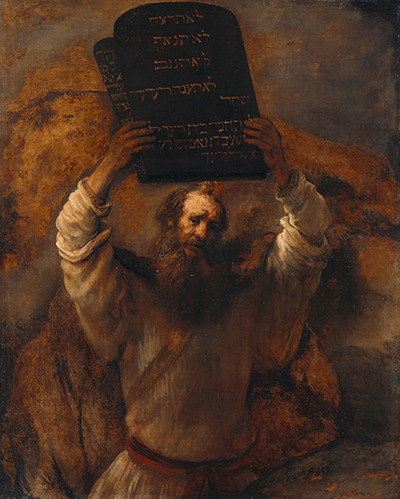
Moses with the Ten Commandments is Rembrandt's 1659 Berlin painting of anger, law and revelation
The precise date given by most reliable sources place this artwork at 1659 and it is generally considered to have been left incomplete by the time of the artist's passing. Despite this, the original painting is still worth appreciating in person and can normally be found at the Gemaldegalerie Berlin, Germany.
Moses lifts up the tables as he descends the holy mountain. This scene features him holding them aloft, displaying a supreme prize, whilst at the same time threatening to destroy when he believes i God's own work. Such powerful tales are frequent throughout religious scripture and help to strengthen believer's commitment to the cause.
The decision my Moses to smash the tablets is due to his followers' decision to worship the Golden Calf, a choice made whilst he was away on the holy mountain. The text found on the tablets is in Hebrew, but how would Rembrandt be able to produce such an accurate depiction of this foreign language? That is certainly one of the issues that has caused so much discussion around this particular painting.
The other question raised by the Corpus survey of his life's work is whether this is another cropped painting, originally featuring a full length portrait of Moses. Their theory is that it was intended for the new Amsterdam Town Hall. This latter discussion has been successfully concluded through x-rays which confirm it is in its original form, but the use of hebrew is best explained by Rembrandt's connections within Amsterdam at that time.
Object Notes and Research Context
The Berlin Gemaldegalerie painting is normally dated 1659 and shows Moses lifting the tablets at the charged moment before or during their destruction. Google Arts and Culture's Berlin partner record gives the dimensions as 168.5 by 136.5 cm and stresses the figure's monumental presence at the front edge of the picture.
The subject is not simply a scene of rage. Rembrandt combines Exodus references: Moses' anger at the golden calf and the shining face associated with his return from speaking with God. The Hebrew inscription on the tablets and the intense downward gaze make the law feel both physical and psychological, as if the stone tablets have become an extension of Moses' inner turmoil.
Technical material from the Berlin Rembrandt research project adds another useful angle. The mantle's colour has altered through pigment change, especially involving smalt, so the present brown-grey effect is partly a history of materials as well as a painterly decision. That material history connects the painting to Rembrandt's style and technique, to conservation language, and to Jacob Wrestling with the Angel as a possible Berlin late-work comparison.
Moses is a good place to introduce iconography without slowing the article. The tablets identify the law, the lifted arms suggest destructive force, and the illuminated head recalls the biblical tradition of Moses' shining face after speaking with God. Rembrandt compresses these details so the viewer sees prophet, judge and wounded leader at once.
The conservation angle should be specific rather than decorative. Berlin research on altered pigments helps readers understand that the colours now visible are not always identical to seventeenth-century intention. That is particularly important for Rembrandt, whose late works depend on warm browns, dark grounds and thick highlights; material change can intensify or distort the drama modern viewers admire.
The title should also acknowledge common variants. Many museum and search routes call the painting Moses with the Ten Commandments, while older wording stresses the smashing of the tablets. Using both forms helps readers connect the page with Berlin records and with the familiar biblical episode.
For a reader-focused page, the best final section would compare Moses' raised tablets with Rembrandt's wider interest in old, burdened authority figures. Moses is monumental, but the painting's intensity comes from strain, age and inward conflict as much as from scale.
Further Rembrandt Context
This shorter legacy page remains part of the Rembrandt archive. For fuller context, use the refreshed Rembrandt pages below, which explain the artist's biography, media, technique, attribution issues and major works in greater depth.
For secure object data, attribution and collection history, compare Moses Smashes the Stone Tablets with the Covenant with the relevant museum or catalogue record before treating older page text as final.
 Rembrandt.jpg)
Discussion
What feels most useful when looking at Moses Smashes the Stone Tablets with the Covenant: the subject, the handling of light, the medium, the attribution history, or its place within Rembrandt's wider painting output?
Reader Insights
Set this page beside the refreshed Rembrandt hubs before relying on older summaries alone.
Rembrandt pages often need museum records, catalogue history and attribution caution, especially where older sources use broader labels.
Which detail would you most want clarified next: date, medium, collection, attribution, subject, condition or comparison with another Rembrandt work?
Join the Conversation
Have a thought or observation about Moses Smashes the Stone Tablets with the Covenant? Share it below. Thoughtful responses may be added as the Rembrandt archive continues to be reviewed.