


 by Tom Gurney
Tom Gurney BSc (Hons) is an art history expert with over 20 years experience
Published on June 19, 2020 / Updated on August 9, 2026
Email: tomgurney1@gmail.com / Phone: +44 7429 011000
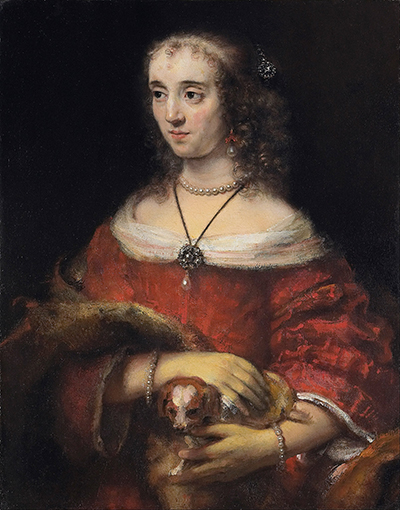
Portrait of a Woman with a Lap Dog is a late Rembrandt portrait at the Art Gallery of Ontario
There has been some discussion of who the lady found here is, but the general concensus today is with Magdalena. It is also highly unlikely that any further light will be cast on this painting, with so many centuries having past since the artist passed away.
Whilst the style is typical of Rembrandt's late work, there are some elements to this painting which slightly differ from the norm. For example, animals were very rarely seen within his career, perhaps meaning that in this case the model had a strong bond with her pet dog that she wished to be communicated in the painting.
The amount of light used is also significantly more in this artwork, when normally the artist may just bring out the facial features and leave the torso still relatively dark. This may have been the request of whoever commissioned the piece, or perhaps Rembrandt himself wished to draw particular attention to the attractive figure of his model.
The background to this scene remains neutral and bland, with the artist ensuring that no element of it took one's attention. The young lady herself looks pensively across, perhaps suggesting that she had not stood for the artist before. Perhaps she was not comfortable in such grand clothing, or was intimidated by the master's artistic reputation.
This painting from 1665 can be found at the Art Gallery of Ontario in Canada.
Object Notes and Research Context
The Art Gallery of Ontario records the work as Portrait of a Woman with a Lap Dog, c. 1665, oil on canvas, 81.3 by 64.1 cm, bequeathed by Frank P. Wood in 1955. The sitter is not conclusively identified. Older and popular accounts have suggested Magdalena van Loo, Rembrandt's daughter-in-law, but that possibility is best treated as a suggestion rather than a settled fact.
The lap dog makes the picture especially memorable within Rembrandt's late portraiture. Animals are not common in his mature portraits, so the dog encourages questions about intimacy, domestic status and sitterly self-presentation. At the same time, the dark background and introspective gaze keep the painting closer to Rembrandt's late psychological mode than to a fashionable society portrait.
AGO conservation material notes that the painting has been part of research and treatment involving Rembrandt specialists. That gives the page a useful technical route if expanded further later, especially around late paint handling, changes beneath the surface and how modern conservation supports attribution and interpretation.
The AGO object record gives useful factual limits: date, medium, dimensions, acquisition and sitter uncertainty. That uncertainty should shape the prose. Magdalena van Loo matters historically as a suggested identification, but the portrait has not been securely identified as Rembrandt's daughter-in-law.
The dog also deserves more careful treatment than a passing caption. In portraiture, lapdogs can signal affection, domestic refinement, loyalty or social ease, but Rembrandt's dark late handling complicates any simple emblem. The animal softens the sitter's presentation while the face remains reserved and inward. That tension is the page's best interpretive route.
The sitter's social presentation also matters. Even without a secure identity, the clothing, pose and animal companion suggest a woman of status. Rembrandt's late portrait mode then complicates that status by making the surface subdued, personal and psychologically reserved.
The page can also include a small provenance and collection note from AGO data. Collection anchoring matters for lesser-known portrait pages because it gives users a reliable path beyond repeated image-search captions and uncertain sitter identifications.
That combination makes the picture a useful late-portrait support page, even without a secure sitter name.
AGO's accession and object record should remain the anchor for any future image, provenance or sitter-identity updates.
Further Rembrandt Context
This shorter legacy page remains part of the Rembrandt archive. For fuller context, use the refreshed Rembrandt pages below, which explain the artist's biography, media, technique, attribution issues and major works in greater depth.
For secure object data, attribution and collection history, compare Portrait of a Woman with a Lapdog with the relevant museum or catalogue record before treating older page text as final.
 Rembrandt.jpg)
Discussion
What feels most useful when looking at Portrait of a Woman with a Lapdog: the subject, the handling of light, the medium, the attribution history, or its place within Rembrandt's wider painting output?
Reader Insights
Set this page beside the refreshed Rembrandt hubs before relying on older summaries alone.
Rembrandt pages often need museum records, catalogue history and attribution caution, especially where older sources use broader labels.
Which detail would you most want clarified next: date, medium, collection, attribution, subject, condition or comparison with another Rembrandt work?
Join the Conversation
Have a thought or observation about Portrait of a Woman with a Lapdog? Share it below. Thoughtful responses may be added as the Rembrandt archive continues to be reviewed.