


 by Tom Gurney
Tom Gurney BSc (Hons) is an art history expert with over 20 years experience
Published on June 19, 2020 / Updated on August 9, 2026
Email: tomgurney1@gmail.com / Phone: +44 7429 011000
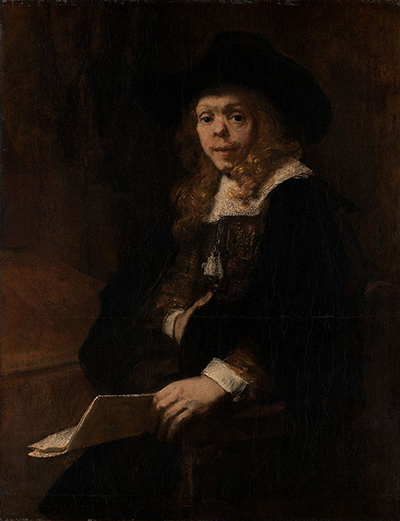
Portrait of Gerard de Lairesse is Rembrandt's late image of a younger artist and later critic
At the time of this painting Gerard would have been around his mid-twenties, with most of his career achievements still ahead of him (this certainly matches up with his youthful features in this painting). It was his loss of sight from congenital syphilis that forced him to pursue theorism, having initially succeeded as a painter and etcher.
The disease is clearly evident in this painting, no attempt is made to disguise the health problems already been experienced by Gerard. The pleasing element to this is that despite his poor health, this creative man was able to somehow live on for many years to come, only passing away as late as 1711.
The painting itself picks up swollen elements to the face that fits with the disease he was experiencing. Despite never hiding away from the facial issues of his subject, Rembrandt van Rijn still managed to achieve a certain level of sympathy within his depiction.
This important artwork can now be found in the Metropolitan Museum of Art, having been gifted to them by Robert Lehman. This high profile art institution holds one of the finest art collections in the world and is amongst the most visited of all the world's galleries. It is impossible to list all of their artists here, but some of the highlights include paintings by Paul Klee, René Magritte (The Empire of Light), Pablo Picasso (Les Demoiselles d'Avignon), Claude Monet (Water Lilies triptych) and Salvador Dalí (The Persistence of Memory).
Object Notes and Research Context
The Metropolitan Museum of Art dates Portrait of Gerard de Lairesse to 1665-67 and records it as an oil on canvas in the Robert Lehman Collection. De Lairesse was himself a painter, etcher and art theorist, which makes the portrait more than a medical or biographical curiosity. It is an encounter between Rembrandt's late naturalism and a younger artist who would later favour a smoother classical ideal.
The Met notes that de Lairesse suffered from congenital syphilis and that its effects are visible in the face Rembrandt painted. The important point is Rembrandt's treatment: he does not flatter the sitter into conventional beauty, but neither does he reduce him to illness. The broad brushwork, dark tonality and dignified pose make vulnerability and intellectual status coexist.
The portrait connects naturally to Rembrandt's late years, style and reception. De Lairesse later criticised Rembrandt's rough manner, so the portrait offers a compact way to discuss how taste shifted against Rembrandt during and after his final years.
The portrait has a strong afterlife because de Lairesse later became one of the voices of classicising taste. His theoretical preferences make him almost an opposite number to Rembrandt's late style: smoother, more ideal, more rule-bound. That contrast means the painting can serve both as a portrait page and as a reception page about why Rembrandt's roughness was not always admired.
The medical context needs careful language. De Lairesse's facial features have often been connected with congenital syphilis, and the Met discusses the sitter's condition, but the disease is not the whole story. Rembrandt's achievement is to paint the younger artist as intelligent, poised and professionally significant while refusing conventional prettification.
For internal linking, this portrait is one of the best bridges to Rembrandt's later reputation. De Lairesse's later criticism helps explain how quickly taste could move away from the qualities modern viewers often prize in Rembrandt: rough handling, deep shadow and unidealised truthfulness.
De Lairesse's own career also needs to remain visible. He was not merely a subject painted by Rembrandt; he became an artist and theorist whose later preferences help explain changing seventeenth-century taste. That makes the portrait a useful historical crossroads.
It is therefore one of the clearest links between portraiture, biography and later criticism.
Further Rembrandt Context
This shorter legacy page remains part of the Rembrandt archive. For fuller context, use the refreshed Rembrandt pages below, which explain the artist's biography, media, technique, attribution issues and major works in greater depth.
For secure object data, attribution and collection history, compare Portrait of Gerard de Lairesse with the relevant museum or catalogue record before treating older page text as final.
 Rembrandt.jpg)
Discussion
What feels most useful when looking at Portrait of Gerard de Lairesse: the subject, the handling of light, the medium, the attribution history, or its place within Rembrandt's wider painting output?
Reader Insights
Set this page beside the refreshed Rembrandt hubs before relying on older summaries alone.
Rembrandt pages often need museum records, catalogue history and attribution caution, especially where older sources use broader labels.
Which detail would you most want clarified next: date, medium, collection, attribution, subject, condition or comparison with another Rembrandt work?
Join the Conversation
Have a thought or observation about Portrait of Gerard de Lairesse? Share it below. Thoughtful responses may be added as the Rembrandt archive continues to be reviewed.