


 by Tom Gurney
Tom Gurney BSc (Hons) is an art history expert with over 20 years experience
Published on June 19, 2020 / Updated on August 9, 2026
Email: tomgurney1@gmail.com / Phone: +44 7429 011000
Portrait of Titus by Rembrandt: Introduction
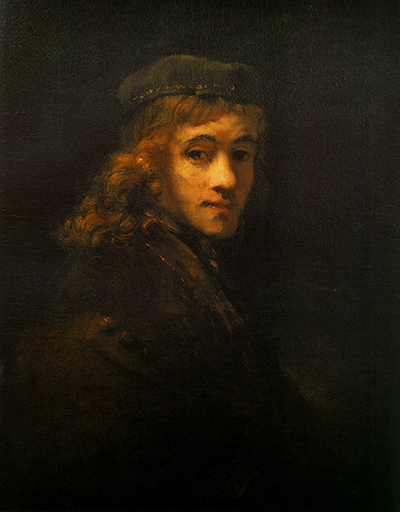
Rembrandt's Portrait of Titus is a small, intimate painting with a complicated authority behind its quiet surface. The work discussed here is the Louvre painting titled Portrait de Titus (1641-1668), fils de l'artiste, inventory RF 1948 34. The Louvre dates it to about 1662, records it as oil on canvas, and gives the dimensions as 0.72 by 0.56 metres. It is currently listed in the Louvre's Dutch painting rooms, in Salle 844.
The sitter is Titus van Rijn, Rembrandt's son with Saskia van Uylenburgh. That relationship makes the portrait attractive to modern viewers, but it also makes caution necessary. A portrait of an artist's child can easily become a sentimental document, as if paint gave direct access to private feeling. Rembrandt's painting does something more difficult. It gives us a young man close to the painter's household, formed out of light, dark, flesh, cloth and reserve.
This page focuses on the Louvre portrait. Rembrandt and his circle produced or inspired several images associated with Titus, and the Louvre itself compares this painting with other portraits of him. Those works matter for context, but they should not blur the object at hand. The Louvre painting is the subject here: a late Rembrandt portrait of Titus, powerful because it sits between family biography and painterly uncertainty.
Contents
- Introduction
- First Look at the Portrait
- Who Was Titus van Rijn?
- Sitter and Attribution Caution
- A Family Portrait Without Sentimentality
- Paint, Light and Late Rembrandt
- Place in the Rembrandt Story
- Why the Portrait Matters
First Look at the Portrait
The portrait is direct without feeling official. Titus is not shown as a grand public sitter, surrounded by emblems of rank, office or learned identity. The image is built around the head, the turn of the body, the weight of clothing and the dark field from which the figure emerges. The result is more inward than ceremonial.
The face draws attention first. Rembrandt gives the young sitter a presence that is alert but not theatrically expressive. The viewer is not asked to read a dramatic incident. Instead, the portrait depends on small pressures: the modelling of the cheeks, the shadowed depth around the eyes, the softness and weight of the hair, and the way the head seems to hold thought without announcing it.
The clothing matters too. The sitter's dress gives body and dignity to the image, but it does not turn Titus into a social type. Fabric and flesh are handled as parts of the same pictorial problem: how to make a living presence emerge from dark paint without polishing away the work of the brush. In that sense, the portrait belongs naturally beside Rembrandt's later portraits and self-portraits, where surface, age, nearness and human gravity often become inseparable.
Who Was Titus van Rijn?
Titus was the only child of Rembrandt and Saskia to survive childhood. That fact gives him a central place in the family story. When Saskia died in 1642, her will made Titus her heir, with Rembrandt managing his possessions. Later records around Titus's testament, the transfer of the Breestraat house, the household's financial arrangements and his marriage to Magdalena van Loo show how closely his life was tied to Rembrandt's domestic and legal world.
This context is important, but it should not make Titus seem like a set of documents rather than a person. The records survive because early modern families used churches, notaries, wills, testaments and property transfers to manage life. They reveal inheritance, obligations and social structure more clearly than emotion. The portrait gives another kind of evidence. It does not explain Titus's legal role, but it lets viewers encounter him as a figure in Rembrandt's visual world.
By about 1662, the date given by the Louvre, Titus was no longer a child. He belonged to the later household formed after Saskia's death, Rembrandt's financial crisis and the move away from the Breestraat house. In 1660, Hendrickje Stoffels and Titus formed a business arrangement that employed Rembrandt, a practical structure connected with the post-bankruptcy years. The portrait therefore sits near a period when Titus was both son and participant in the household's survival.
That background should not be forced into the face. The painting is not an illustration of bankruptcy, inheritance or filial duty. But those facts explain why Titus was not a minor biographical footnote. He was one of the people through whom Rembrandt's family, property, work and late life were joined.
Sitter and Attribution Caution
The Louvre record is especially useful because it preserves the portrait's uncertainties. It says the painting has been considered a portrait of Titus since Wilhelm von Bode in 1873. Before that, it long passed as a portrait of Rembrandt in his youth. That earlier title history matters because it reminds us that sitter identities can change over time, especially when family resemblance, youth, costume and later tradition are involved.
The Louvre also presents a careful attribution picture. It records the work under Rembrandt and says it has generally been recognised as an original by him, while noting that Christian Tumpel hypothetically suggested a school work. The same Louvre entry adds that, compared with uncontested portraits of Titus in Rotterdam, Vienna and Amsterdam, this painting has a certain heaviness and a relative lack of depth or subtlety that can justify some reserve.
That is not a reason to dismiss the portrait. It is a reason to write about it accurately. The safest public description is that the Louvre presents RF 1948 34 as a Rembrandt portrait of Titus, dated about 1662, while also recording historical caution around both the sitter's identification and the painting's quality in relation to other Titus portraits.
Such caution is normal in Rembrandt studies. The artist's workshop, later copies, old titles, family identifications and changing scholarly judgements often complicate apparently simple labels. A careful reading lets the viewer enjoy the painting while understanding that object records carry history, not just facts.
A Family Portrait Without Sentimentality
The temptation is to make the portrait a private confession: Rembrandt looking at his son, age looking at youth, loss looking at continuity. Some of that emotional force may be part of why viewers respond to the painting, but the evidence does not let us turn it into a diary.
What can be said is stronger because it is more exact. Titus had a unique place in Rembrandt's life. He was Saskia's surviving child, her heir, a member of the later household with Hendrickje and Cornelia, and eventually a participant in the business structure that helped Rembrandt continue working after financial collapse. A portrait of Titus made around 1662 therefore belongs to a deeply personal circle, even if it is not a document of a specific feeling.
Rembrandt's art often makes this distinction important. His portraits are intimate not because they give away everything, but because they hold something back. Faces emerge from darkness, hands and clothing carry life, and the viewer is invited to stay with uncertainty. In the Louvre Portrait of Titus, the family relationship sharpens that effect. We know enough to feel the nearness, but not enough to replace looking with biography.
That restraint protects Titus too. He should not be reduced to the role of beloved son, heir, helper or late-life consolation. He was a young man in a complex household, and the portrait's dignity lies partly in allowing him to remain more than a function in Rembrandt's story.
Paint, Light and Late Rembrandt
The Louvre dates the painting to about 1662, placing it in Rembrandt's later career. This was not the final year, but it belongs to the period after the bankruptcy and after the move into more constrained circumstances. Rembrandt's late art often turns away from polished finish toward heavier surfaces, selective detail and a searching use of light.
In a portrait like this, those qualities create intimacy. The dark background does not simply hide the setting. It gathers attention around the sitter. The face and clothing are not described with equal finish everywhere. Some passages feel more weighted, others more open. That unevenness can make the figure feel present rather than merely recorded.
Late Rembrandt is sometimes described as rough, but roughness is not enough. The better word is concentration. The painting reduces the problem of portraiture to essentials: a face, a body, a few signals of dress, and the pressure of paint making a person visible. It does not need a story around Titus to matter. The handling itself carries the emotional temperature.
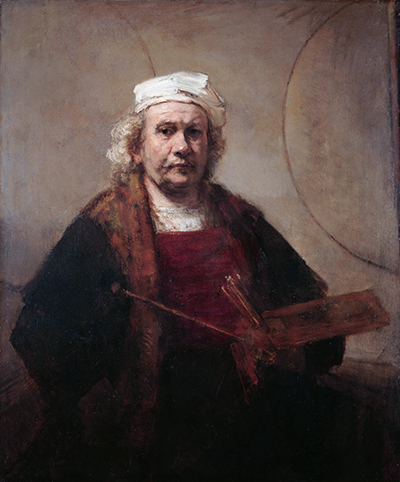
This is where the portrait links naturally to Rembrandt's self-portraits. In the self-portraits, the painter repeatedly tests how identity can be made through light, skin, costume, gesture and worked surface. A portrait of Titus raises a related question from the other side: how does Rembrandt's mature manner change when the sitter belongs to his own household?
The answer is not simple tenderness. The Louvre's own reservation about heaviness should stay in view. The painting may not have the subtlety of the most secure Titus portraits. Yet that very reserve makes the work interesting. It sits at the edge between likeness, family memory, studio practice and late Rembrandt handling.
Place in the Rembrandt Story
Portrait of Titus belongs beside the family-and-household story because Titus's life connects Saskia, inheritance, the Breestraat house, Hendrickje Stoffels, Cornelia, business arrangements, Magdalena van Loo and Titia. The painting cannot carry all that history, but it gives the history a face.
It also belongs beside the late-years story. Titus died in 1668, the year before Rembrandt. Records of his betrothal and marriage to Magdalena place Rembrandt beside him in 1668, and the baptism of Titus's daughter Titia in 1669 places Rembrandt as witness in the final year of his own life. Those later records should not be pushed back into a painting dated about 1662, but they deepen the reader's understanding of who Titus would become in the final family chronology.
The portrait also helps explain why Rembrandt's art resists the split between public work and private life. A son could be an heir, a business participant, a husband, a father and a sitter. A painting could be a likeness, a family image, an object with an attribution history and a study in late brushwork. The categories overlap because Rembrandt's household and artistic practice overlapped.
That is why the discussion stays focused. The Louvre portrait is not the whole Titus story. It is one concentrated point where the story becomes visible.
Why the Portrait Matters
The Louvre Portrait of Titus matters because it gives readers a way into Rembrandt's family without turning family into gossip. It shows Titus not through anecdote, but through the disciplined uncertainty of portraiture: a face, a dark field, a worked surface, and a sitter whose identity has been shaped by both scholarship and family memory.
It also matters because the painting carries caution inside its appeal. The Louvre record preserves earlier identification as a youthful Rembrandt, later identification as Titus, broad acceptance as Rembrandt, and a minority school suggestion. Those details make the portrait a useful example of how Rembrandt pages should be read: with pleasure, but also with attention to titles, evidence and changing scholarship.
Most of all, the painting matters because it keeps Titus present. In the documents, he appears as child, heir, testament-maker, property figure, business participant, bridegroom and father. In the portrait, he appears as a young man held in paint. The two kinds of evidence do not merge perfectly. They answer different needs.
That difference is the portrait's quiet strength. It does not solve Titus for us. It lets him remain near.
Frequently Asked Questions About Portrait of Titus
The painting discussed here is in the Louvre in Paris. Its inventory number is RF 1948 34, and the Louvre lists it in Salle 844.
The Louvre dates the painting to about 1662.
The Louvre records the work as oil on canvas, measuring 0.72 by 0.56 metres.
The Louvre presents the painting under Rembrandt and records that it has generally been recognised as an original by him, while also noting a hypothetical school suggestion by Christian Tumpel and some reservation when compared with uncontested portraits of Titus.
Titus was Rembrandt and Saskia's only child to survive childhood. He became Saskia's heir and later played an important role in Rembrandt's household and post-bankruptcy business arrangements.
Discussion
What feels most important in Portrait of Titus: Rembrandt's light, the figure's expression, the material surface, the historical source, or the way the work sits beside his other paintings and prints?
Reader Insights
Begin with one detail in Portrait of Titus, then move outward to light, gesture, surface and the surrounding space.
Connect the work to Rembrandt's biography, workshop, medium and the museum record rather than reading it as an isolated image.
Which detail changes the interpretation most once you know the date, subject, attribution history or present collection?
Join the Conversation
Have a thought or observation about Portrait of Titus? Share it below. Thoughtful responses may be added to this section as the Rembrandt pages develop.
References
- Louvre, Portrait de Titus (1641-1668), fils de l'artiste, RF 1948 34: https://collections.louvre.fr/en/ark%3A/53355/cl010061070
- Stadsarchief Amsterdam, Rembrandt en Saskia (in Dutch): https://www.amsterdam.nl/stadsarchief/stukken/beroemd/rembrandt-saskia/
- Stadsarchief Amsterdam, Saskia begraven (in Dutch): https://www.amsterdam.nl/stadsarchief/stukken/dood/saskia-begraven/
- Stadsarchief Amsterdam, De geldzaken van Rembrandt (in Dutch): https://www.amsterdam.nl/stadsarchief/nieuws/rembrandt-0/
- GeschiedenisLokaal Amsterdam, Testament van Titus (in Dutch): https://geschiedenislokaalamsterdam.nl/bronnen/testament-van-titus
- GeschiedenisLokaal Amsterdam, Rembrandt laat zijn huis aan Titus na (in Dutch): https://geschiedenislokaalamsterdam.nl/bronnen/rembrandt-laat-zijn-huis-aan-titus-na
- GeschiedenisLokaal Amsterdam, Ondertrouw Titus en Magdalena van Loo (in Dutch): https://geschiedenislokaalamsterdam.nl/bronnen/ondertrouw-titus-en-magdalena-van-loo
- GeschiedenisLokaal Amsterdam, De doop van kleindochter Titia (in Dutch): https://geschiedenislokaalamsterdam.nl/bronnen/de-doop-van-kleindochter-titia
- Stadsarchief Amsterdam, Rembrandt burial page (in Dutch): https://www.amsterdam.nl/stadsarchief/stukken/dood/rembrandt/
- National Gallery of Art, Washington, Rembrandt van Rijn artist biography: https://www.nga.gov/artists/1822-rembrandt-van-rijn
- National Gallery, London, Rembrandt artist biography: https://www.nationalgallery.org.uk/artists/rembrandt
- Museum Rembrandthuis, Meet Rembrandt: https://www.rembrandthuis.nl/en/find-out-more/meet-rembrandt/
 Rembrandt.jpg)