


 by Tom Gurney
Tom Gurney BSc (Hons) is an art history expert with over 20 years experience
Published on June 19, 2020 / Updated on August 9, 2026
Email: tomgurney1@gmail.com / Phone: +44 7429 011000
The Shipbuilder and His Wife by Rembrandt: Introduction
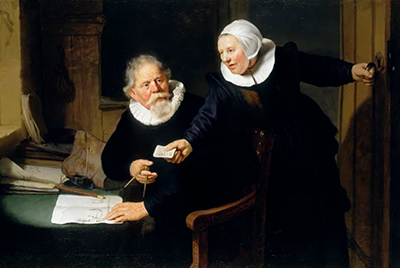
Rembrandt's The Shipbuilder and his Wife is one of his most vivid portraits of work interrupted. The Royal Collection Trust identifies the painting as "The Shipbuilder and his Wife": Jan Rijcksen (1560/2-1637) and his Wife, Griet Jans (before 1562-1652). It was painted by Rembrandt van Rijn in 1633 and is recorded in the Royal Collection as RCIN 405533.
The picture shows Jan Rijcksen, a shipbuilder, with his wife Griet Jans. The Royal Collection Trust identifies Rijcksen as a shareholder in the Dutch East India Company and, from 1620, its master shipbuilder. That fact gives the portrait a sharper social setting. This is not just a man at a table. It is a portrait of maritime work, paper, planning and reputation, set inside a marriage.
The painting is recorded as oil on canvas, measuring 113.8 x 169.8 cm. Its later collection history is also important: the Royal Collection notes that it was purchased for George IV in 1811. Yet the painting's force does not depend on royal ownership. It depends on the way Rembrandt makes two sitters meet in a moment of urgency.
Contents
- Introduction
- What the Painting Shows
- Who Were Jan Rijcksen and Griet Jans?
- A Different Kind of Double Portrait
- Work, Paper and Maritime Amsterdam
- Light, Age and Surface
- How to Look at the Painting
- Place in Rembrandt's Portraiture
What the Painting Shows
At first glance, the painting looks like a domestic scene. Jan Rijcksen sits with papers before him, turned toward the viewer and toward his wife. Griet Jans enters or leans in from the side, bringing a message or news that demands attention. Her body creates the painting's momentum. She is not simply placed beside her husband as a pendant figure. She interrupts the space.
That interruption is the key to the picture. Many seventeenth-century married couples were portrayed in separate companion portraits, each sitter occupying a matching but independent image. Rembrandt does something different here. He brings the husband and wife into one shared scene. Their bodies overlap. Their attention crosses. The portrait becomes an encounter.
This is why the picture feels unusually alive. Jan Rijcksen's work has been paused. Griet Jans seems to arrive with something that cannot wait. The painting lets the viewer imagine the second just before speech, or just after it begins. Rembrandt gives the couple status, but he does not freeze them into ceremony.
Who Were Jan Rijcksen and Griet Jans?
The Royal Collection Trust says the couple were identified in 1970 as Jan Rijcksen and Griet Jans. That identification matters because it anchors the picture in a specific social world. Rijcksen was connected to shipbuilding at a high level, and his association with the Dutch East India Company places him near one of the major commercial forces of the Dutch Republic.
The VOC context should be handled carefully. The painting is not a panoramic image of empire, trade routes or shipyards. It is a portrait. But Rijcksen's profession changes how the objects and papers feel. The documents before him are not generic props. They belong to a world of contracts, designs, instructions, schedules and decisions. Shipbuilding was practical, technical and commercial work, and the portrait lets that world enter domestic space.
Griet Jans should not be treated as a passive addition. Rembrandt gives her the action of the scene. She appears with urgency, making communication the central drama. At the same time, the painting does not by itself prove a formal business role for her. Its public meaning is subtler: marriage, household life and professional identity are shown as connected rather than sealed off from one another.
A Different Kind of Double Portrait
The painting is a double portrait, but it resists the stillness often associated with paired likenesses. Rembrandt had already learned how portraiture could carry social ambition in early Amsterdam. In the same decade he would paint large-scale portraits of Marten Soolmans and Oopjen Coppit, where husband and wife appear separately but on matching grand canvases. In The Shipbuilder and his Wife, he chooses a more compressed and narrative solution.
The difference is revealing. Marten and Oopjen are presented through full-length display, dress and scale. Jan Rijcksen and Griet Jans are presented through action. Their portrait does not separate masculine work from feminine presence. It makes the exchange between them the subject.
This gives the painting a social intelligence that is easy to miss if it is treated only as a likeness. Jan is not merely identified by face and clothing. He is identified through work. Griet is not merely identified as wife. She is identified through her role in the moment. The marriage becomes visible through interruption, attention and response.
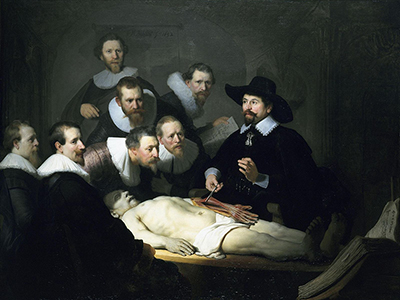
Rembrandt often found ways to make portraiture happen in time. In The Anatomy Lesson of Dr Nicolaes Tulp, a professional group becomes an event of looking and demonstration. In The Syndics of the Drapers' Guild, officials seem to pause as the viewer arrives. Here, a married couple creates the event. The room is smaller, but the principle is similar: portraiture becomes drama without ceasing to be portraiture.
Work, Paper and Maritime Amsterdam
Jan Rijcksen's shipbuilding identity gives the table and papers real weight. Shipbuilding in the Dutch Republic belonged to a culture of planning, measurement, material knowledge and commercial urgency. A ship was not an abstract symbol. It was an expensive, complicated object, tied to labour, trade, risk and profit.
Rembrandt does not need to show a shipyard to evoke that world. He brings the work indoors. The papers make the portrait think. They suggest tasks that can be interrupted and resumed: reading, writing, reviewing, deciding. Jan's identity is not shown through a distant emblem but through the practical surface in front of him.
That is part of the painting's modern appeal. It shows professional life not as a remote category but as something woven into daily exchange. A message arrives. A decision must be made. A spouse steps into the rhythm of work. The scene is specific to seventeenth-century Amsterdam, yet the human pattern is immediately understandable.
The painting also gives maritime commerce a household dimension. Dutch trade depended on ships, and ships depended on builders, documents and networks of decision-making. Rembrandt's portrait does not celebrate that world in grand allegorical terms. It lets us glimpse it through a room, a table, a man, a woman and a moment of communication.
Light, Age and Surface
The Royal Collection's Dutch Art story emphasizes Rembrandt's naturalism in this painting, especially his attention to textures, surfaces, age and light. That naturalism is essential. The sitters are not idealized into smooth types. Their age is visible. Their hair, skin and clothing carry the force of lived time.
Rembrandt's light helps organize the scene. It falls across forms at an angle, catching surfaces and making details readable. The effect is not a theatrical spotlight in the later Romantic sense. It feels tied to the room itself, as if daylight has entered with the same directness as Griet Jans.
The handling of age is especially important. Jan Rijcksen and Griet Jans are elderly sitters, and Rembrandt does not erase that. Their presence depends on the marks of time. The painting respects their age by making it part of their authority. These are not youthful figures posing for marital display. They are people with long experience, shown inside a working and domestic relationship.
Texture carries meaning here. Papers are different from fabric; skin is different from hair; the table is different from clothing. Rembrandt's close attention to surfaces makes the world believable, but it also helps define social identity. The materials of work and the materials of the body belong to the same painted reality.
How to Look at the Painting
Start with Griet Jans. Her movement gives the painting its first pulse. Notice how her body leans into the scene and how her presence changes Jan Rijcksen's attention. She is the force that prevents the portrait from settling into a quiet image of a man at work.
Then look at Jan. He is not shown as a heroic labourer with tools in hand, but as a person whose work involves papers, decisions and responsibility. His profession is intellectual and practical at once. Rembrandt makes that clear by placing him at a table rather than in a shipyard.
Next, look at the space between them. The painting's drama lives there. It is the space of message, interruption and response. The couple share a room, but they also share a task of attention. The viewer is invited into that charged interval.
Finally, look at the surfaces. The picture rewards close looking because its emotional truth is built from physical detail: aging faces, white hair, paper, fabric, light and shadow. Rembrandt turns portraiture into an experience of touch and time.
Place in Rembrandt's Portraiture
The Shipbuilder and his Wife belongs to Rembrandt's early Amsterdam period, when portraiture was central to his success. It shows a painter who could satisfy the need for likeness and status while also making a picture feel narratively alive.
It also broadens the idea of what a Rembrandt portrait can be. Some portraits emphasize elegance, like Portrait of Jan Six. Some emphasize full-length display, like the Soolmans and Coppit pair. Some turn professional groups into collective events. This painting does something more intimate. It makes marriage and work meet in one glance.
That is why the picture remains memorable. It does not need a dramatic biblical subject or a large civic stage. Its drama is ordinary and precise: a woman arrives with urgent news; a man at work turns toward her; papers lie before them; a life of trade, marriage and decision briefly becomes visible.
Rembrandt's achievement is to make that moment durable. The interruption passes, but the painting holds it. Jan Rijcksen and Griet Jans are remembered not as isolated sitters but as people in relation, caught inside the small social theatre of work and marriage.
Frequently Asked Questions About The Shipbuilder and His Wife
The Royal Collection Trust identifies them as Jan Rijcksen and his wife Griet Jans. The couple were identified in 1970.
The Royal Collection Trust identifies Jan Rijcksen as a shareholder in the Dutch East India Company and, from 1620, its master shipbuilder.
The painting is in the Royal Collection. Its Royal Collection inventory number is RCIN 405533.
It is unusual because the married couple appear together in one interactive scene. Rather than two separate portraits, Rembrandt shows husband and wife overlapping, communicating and interrupting one another's space.
Discussion
What feels most important in The Shipbuilder and His Wife: Rembrandt's light, the figure's expression, the material surface, the historical source, or the way the work sits beside his other paintings and prints?
Reader Insights
Begin with one detail in The Shipbuilder and His Wife, then move outward to light, gesture, surface and the surrounding space.
Connect the work to Rembrandt's biography, workshop, medium and the museum record rather than reading it as an isolated image.
Which detail changes the interpretation most once you know the date, subject, attribution history or present collection?
Join the Conversation
Have a thought or observation about The Shipbuilder and His Wife? Share it below. Thoughtful responses may be added to this section as the Rembrandt pages develop.
References
- Royal Collection Trust, "The Shipbuilder and his Wife": Jan Rijcksen (1560/2-1637) and his Wife, Griet Jans: https://www.rct.uk/collection/405533/the-shipbuilder-and-his-wife-jan-rijcksen-15602-1637-and-his-wife-griet-jans
- Royal Collection Trust Dutch Art story page for the same object: https://www.rct.uk/collection/stories/dutch-art/the-shipbuilder-and-his-wife-jan-rijcksen-1560/2-1637-and-his-wife-griet-jans-before-1562-1652
- Wikimedia Commons metadata lead for medium, dimensions and source-chain checking: https://commons.wikimedia.org/wiki/File:Rembrandt_van_Rijn_(Leiden_1606-Amsterdam_1669)_-_%22The_Shipbuilder_and_his_Wife%22,_Jan_Rijcksen_(1560-2-1637)_and_his_Wife,_Griet_Jans_-_RCIN_405533_-_Royal_Collection.jpg
- Rembrandt Database, mission and scope: https://rembrandtdatabase.org/about/mission-and-scope.html
 Rembrandt.jpg)