


 by Tom Gurney
Tom Gurney BSc (Hons) is an art history expert with over 20 years experience
Published on June 19, 2020 / Updated on August 9, 2026
Email: tomgurney1@gmail.com / Phone: +44 7429 011000
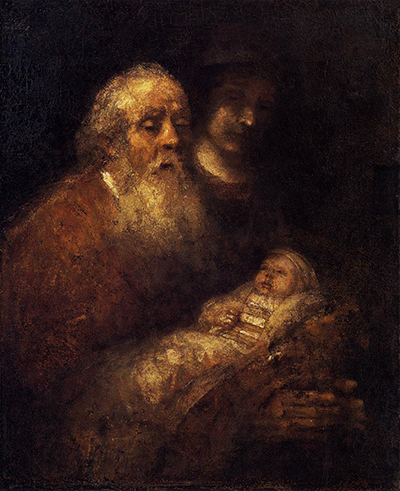
Rembrandt van Rijn's late three figured painting entitled Simeon's Song of Praise is inspired by a biblical story from Luke 2:25
The work is dated at 1669 which is the year of Rembrandt's passing. It is likely to have been his final painting, marking it out as a highly significant addition to the famous master's extensive career. It is a crying shame that this particular item was not well looked after in the early years after the artist's death, causing damage that could never be reversed centuries later.
Christian tales had inspired Rembrandt right throughout his career, just as they had earlier through the various stages of the Renaissance when religious themes dominated the content of sculpture, painting and architecture. Indeed, on just this theme alone the famous master produced two paintings and several other drawings.
Within this painting Simeon believes he is holding the future Messiah. Whilst damaged, there is still enough of the painting left to understand Rembrandt's thinking behind this piece. There is also some documentation from previous centuries that provides additional information from a time when perhaps the painting was in better condition. The baby was brought to the old man to be blessed, perhaps knowing that the elderly man was already in his final days. The story tells of how the Holy Spririt influenced Simeon in making the visit to this temple.
This important painting is owned by the Nationalmuseum, found in Stockholm, Sweden. Their collection includes several other original Rembrandt van Rijn paintings plus also many other great names such as Rubens, Goya, Renoir, Degas and Gauguin. There is also, as you would expect, an excellent collection of the finest native artists to have come from the Swedish region all the way back to the Middle Ages.
Object Notes and Research Context
Nationalmuseum records the late painting as Simeon in the Temple, made c.1669, oil on canvas, 98.5 by 79.5 cm, inventory NM 4567. It is widely treated as Rembrandt's last painting and was left unfinished at his death, a fact that gives the page much stronger value than the old short text suggests.
The subject is Luke 2: Simeon has been promised that he will see the Saviour before death, and recognises the infant Jesus in the temple. Rembrandt strips the scene down to a few figures in darkness. The aged Simeon holds the child with closed or half-closed eyes, and the unfinished surface makes the moment feel suspended between revelation and mortality.
The late painting belongs beside the 1631 Mauritshuis Simeon's Song of Praise and the Simeon's Hymn of Praise etching, showing that Rembrandt returned to the subject across his entire career.
The late painting should also be separated from the earlier Mauritshuis Simeon subject in plain language. Both concern Simeon's recognition of Christ, but the Nationalmuseum canvas is a final, unfinished work from around 1669. That late status changes the emotional register: the scene reads through old age, near-death and completion rather than youthful narrative drama.
Its unfinished state can be useful for readers if handled carefully. It does not make the painting incomplete in a simple negative sense; it lets modern viewers see Rembrandt's late process, with some areas carried further than others. That unfinished surface connects directly to Rembrandt's late style, technique and final years.
This painting should be routed to both biography and technique. As a late, unfinished work it belongs to the story of Rembrandt's final months, but its visible surface also helps readers understand how late Rembrandt could suggest form with selective completion and warm, shadowed paint.
The etching titled Simeon's Hymn of Praise is an important comparison. That route helps readers see the subject across media and across decades, from a dark printed temple scene to the unfinished late painting often associated with Rembrandt's final year.
Further Rembrandt Context
This shorter legacy page remains part of the Rembrandt archive. For fuller context, use the refreshed Rembrandt pages below, which explain the artist's biography, media, technique, attribution issues and major works in greater depth.
For secure object data, attribution and collection history, compare Simeon's Song of Praise with the relevant museum or catalogue record before treating older page text as final.
 Rembrandt.jpg)
Discussion
What feels most useful when looking at Simeon's Song of Praise: the subject, the handling of light, the medium, the attribution history, or its place within Rembrandt's wider painting output?
Reader Insights
Set this page beside the refreshed Rembrandt hubs before relying on older summaries alone.
Rembrandt pages often need museum records, catalogue history and attribution caution, especially where older sources use broader labels.
Which detail would you most want clarified next: date, medium, collection, attribution, subject, condition or comparison with another Rembrandt work?
Join the Conversation
Have a thought or observation about Simeon's Song of Praise? Share it below. Thoughtful responses may be added as the Rembrandt archive continues to be reviewed.