


 by Tom Gurney
Tom Gurney BSc (Hons) is an art history expert with over 20 years experience
Published on December 6, 2025 / Updated on December 6, 2025
Email: tomgurney1@gmail.com / Phone: +44 7429 011000
Weaning the Calves by Rosa Bonheur - A Detailed Study
Weaning the Calves, from 1879, is regarded as one of artist Bonheur's finest works. In this unique piece, she addresses emotion, rather than solely tackling physical strength and toil.
We learn more about the artist herself through this painting, and it also underlines her creative flexibility. The specific content which draws in this emotion is the moment at which calves and separated from their mother - something we can all connect with, though rarely see within art.
Bonheur studied animal behaviour for decades, and went far beyond just understanding the physical aspects of her subjects - time spent in rural France enabled the artist to capture their characters within her work, be it horses, dogs, cows or anything else.
Historical Background
The painting arrived whilst Rosa was in her late fifties, by which time much of her artistic development had already been completed. She had also enjoyed commercial success for around a decade, both domestically and abroad. She was at her most confident, and therefore willing to try alternative types of compositions and atmospheres.
Whilst animals had been featured in art history for centuries, it was rare to find their own emotions considered. Typically they would provide aesthetic interest, as supporting elements, but their own feelings were not considered important enough - Bonheur felt differently, thanks to her carefully-fostered compassion towards many different animals species.
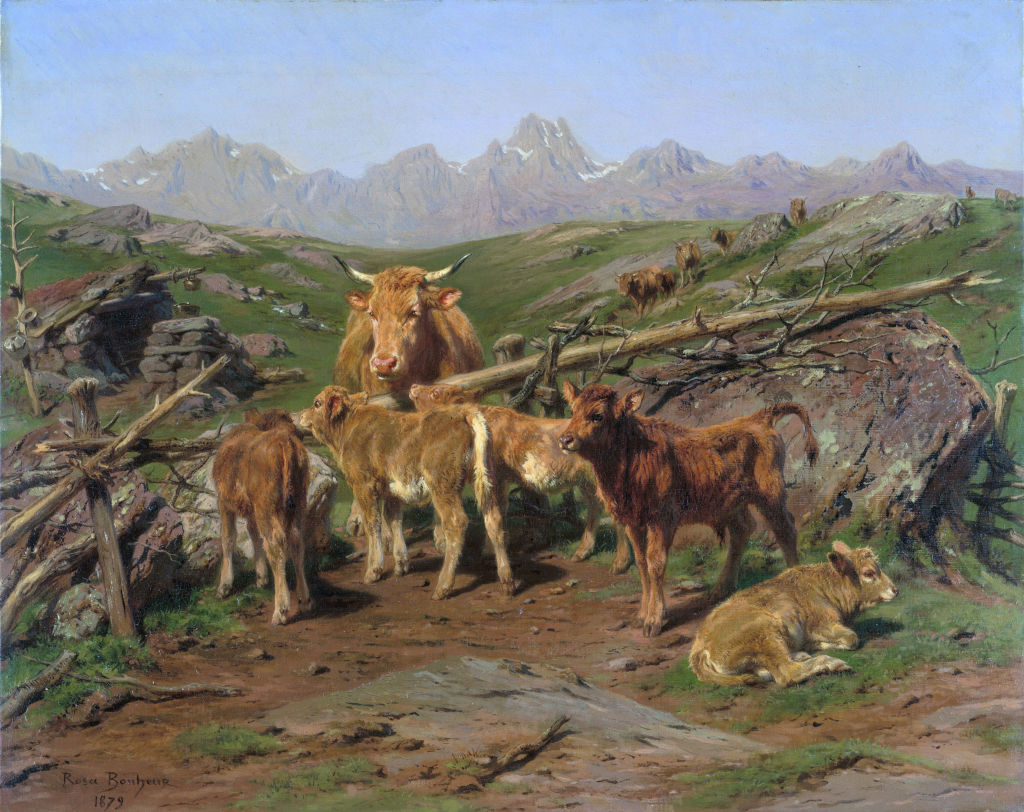
Weaning the Calves by Rosa Bonheur, 1879
Painting Description and Meaning
Weaning is a necessary, but difficult agricultural task where emotions are stretched to the limit. This point of conflict as cows and calves protest is perhaps content for an artist seeking to display deep emotions on canvas. She would have seen, and studied, this type of situation many times before in order to best prepare for this piece.
The painting helps us to understand the feelings of the animals during the weaning process. They clearly understand this process, or at least are aware of the potential danger. It shows a connection between the animals as a matter of instinct. It must also be noted that the workers are portrayed as patient and caring, perhaps reflecting how the artist would behave in the same situation.
Rosa Bonheur attempts to mark her contributions to the French Realism movement with honesty and accuracy, avoiding judgement of the animals or their accompanying workers. She tries to document rural life, but neither idealise it, nor judge those working within it.
Realism and its Interpretation of Rural Life
Bonheur avoids sentimentality, sticking as closely to reality as possible. There is no moral message within this painting, it merely presents and documents, leaving us to make up our own minds. That said, there is empathy, and plenty of emotion as we quickly connect with the animals and their difficulties.
The artist understood rural life very well, and related to both the workers and their animals alike. She also understood how this weaning process was one of the hardest tasks found in the agricultural world, and perfect for her work. This is Realism, but with the added knowledge, experience and research carried out by this highly diligent artist.
Technique and Colour Palette
The artist chose familiar, rural tones for this work in order to best capture this location. We find, for example, earthy browns, warm creams, soft greys and atmospheric greens. She employed short, controlled brushstrokes in order to form the various elements, in line entirely with her normal artistic style. There is then a little variation across the scene, such as with the texture of rope and leather as well as the thicker, heavier coats of the cows.
It is specifically the part of Bonheur's career in which she worked in this manner - her highly successful "mature" period. She also often considered light as a means to portraying a particular time of the day - something people in rural communities are well aware of. There is also a consideration of weight and balance amongst the different animals, something Bonheur had already mastered through study, practice and output in recent decades.
Composition and Structure
Bonheur makes some clever choices when composing this piece. We find contrast in many aspects, such as between the foreground and background content, as well as the mood between different animals in the painting. Eye contact is used to help trigger emotion in the viewer, by playing on the relationships here.
Lower heads also adds to the feeling of sadness, with a large physical barrier between mother and calves helping to really play on this feeling of separation and anxiety. One can access this piece easily, with everything composed so intelligently. It is likely, based on Bonheur's other paintings, that she would have completed a number of sketches of this composition prior to commencing this final piece in oil.
A diagonal direction is also added to help lead the eye and explain the meaning of the painting to us. This direction merges the collective pain together, as the calves strain toward their mothers.
Reception and Legacy
Weaning the Calves is a painting which represents an artist, Rosa Bonheur, at the peak of her powers. After decades of practice and study, she is now commercially successful in a number of different territories and feels confident in tackling new types of compositions. Here she focuses on emotion, whilst retaining her impressive qualities in capturing animal anatomy.
It remains an important work for this reason - a reminder of her gentler, more compassionate side which lay at the foundation of her love for all animals.