by
Tom Gurney
Tom Gurney BSc (Hons) is an art history expert with over 20 years experience
Published on June 19, 2020 / Updated on October 22, 2026
Email:
tomgurney1@gmail.com
/ Phone:
+44 7429 011000
Dürer’s Adoration of the Magi, 1504: Introduction
An elderly king bends so close to the infant Christ that the space between them almost disappears. Behind him, a man with long curls holds an elaborate golden vessel, while a young Black king waits on the right, his blue mantle opening above red hose. Albrecht Dürer gives these three visitors distinct bodies, clothes and ways of attending to the encounter. Their arrival has brought the treasures of a court to a place of broken masonry and rough timber. Yet the painting’s centre of attention is a small, naked child on his mother’s lap.
Dürer’s 1504 Adoration of the Magi is an oil panel at the Uffizi in Florence since 1793, 99 × 113.5 centimetres, inventory 1890 n. 1434. His AD monogram and date occupy a foreground stone. [1]
At a Glance
This work across Albrecht Dürer’s career
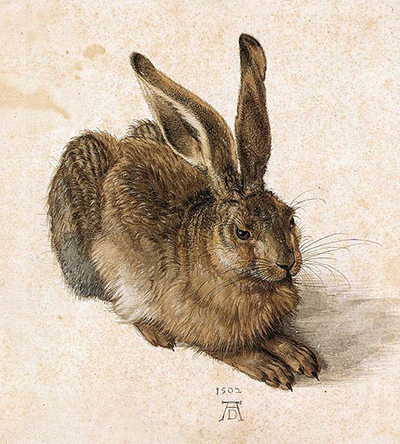
Young Hare
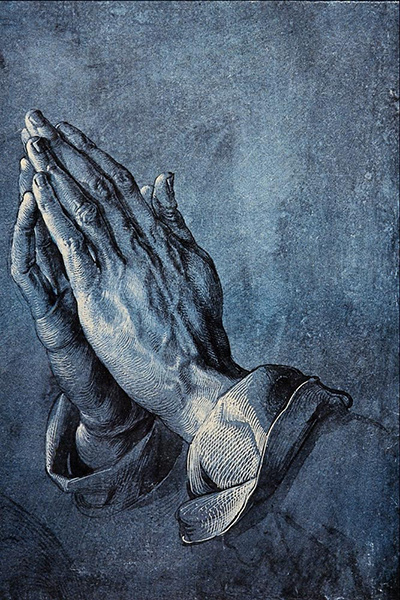
1502Praying Hands
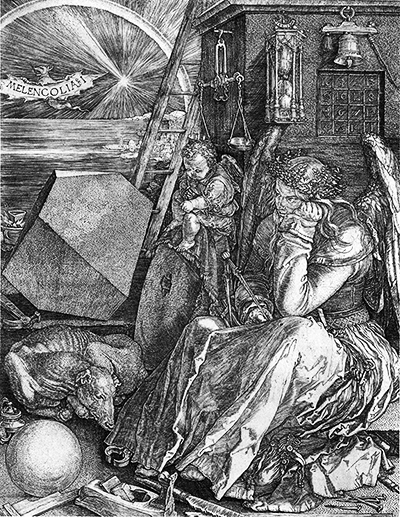
1508Melencolia I
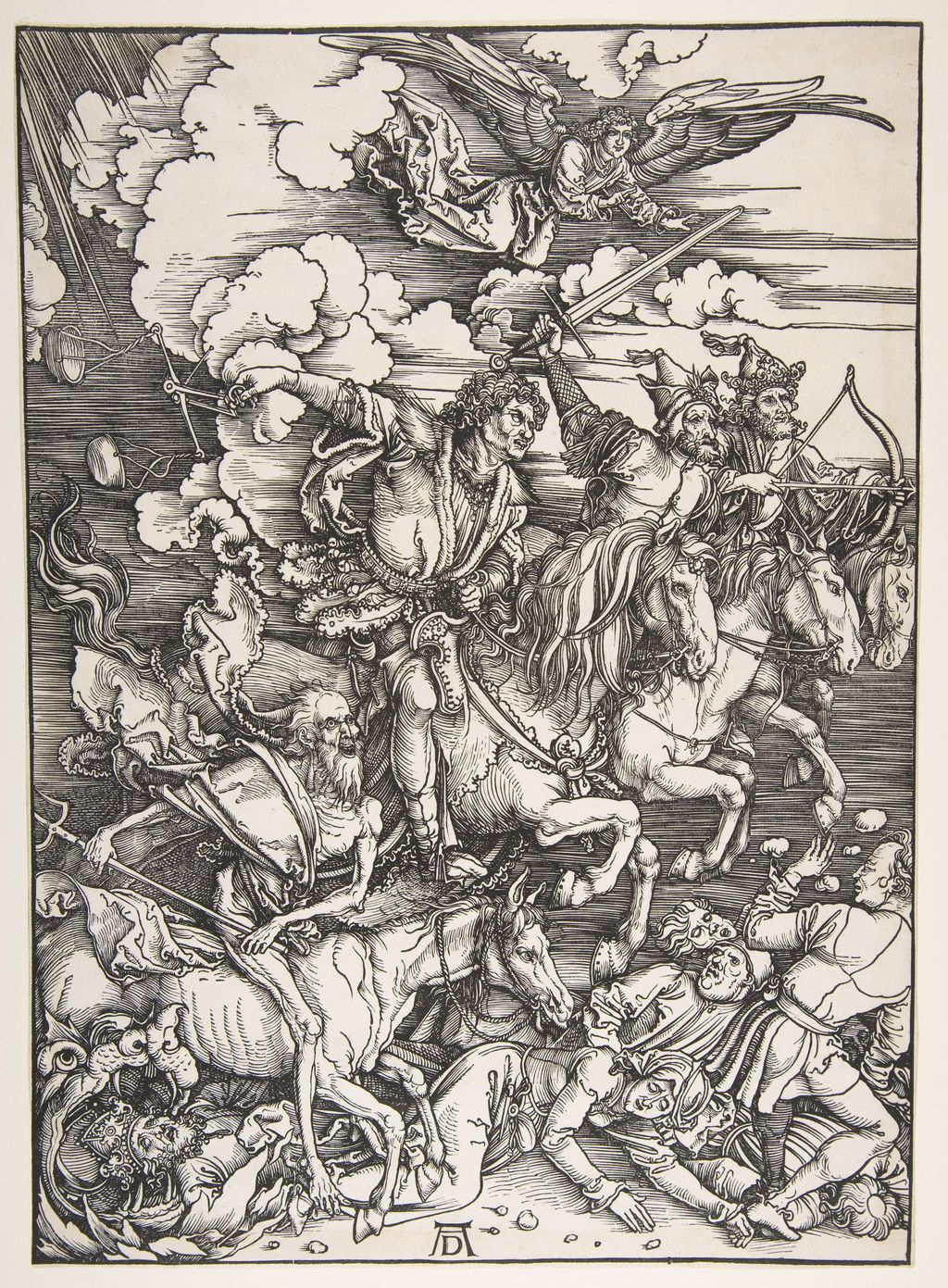
1514Four Apostles
1526Contents
- The meeting at the left
- What Matthew tells, and what painters added
- Gifts and the hands that made them
- The African king and the attendant
- Stone, timber and distance
- A possible self-image and travelling forms
- From Wittenberg to Florence
- Frequently Asked Questions
The meeting at the left
Mary sits low in the picture, her dark blue dress spreading towards the lower edge. Her white head covering makes a sharp, bright shape against the shadow behind her. She supports the Child across her lap and presents him towards the kneeling visitor. This is a very physical introduction: the infant’s small limbs stretch into the interval between the adults, bringing the scene within reach of touch.
The old king has lowered his head and body. His bald crown catches the light, while his beard falls towards the Child. The rich red fabric and fur of his clothing gather around a posture of submission. He is still recognisably a person of wealth and authority, but his bodily position gives those qualities a new direction. The act of kneeling brings his face to the infant’s level. Dürer makes reverence legible through the adjustment of one body to another.
The small casket at this meeting point is surrounded by hands, cloth and flesh. The infant reaches towards it while the visitor draws close to his face. The box has become a support for their encounter: its firm horizontal edges lie beneath the Child’s soft arms, and the king’s fingers rise along its side. A precious object helps bring two bodies together. Mary steadies her son, keeping the energetic movement securely within her lap.
The two standing kings extend this movement upwards. The central figure’s curls, beard, patterned mantle and green sleeves occupy the space before the tall wall. His head turns towards his younger companion. The young king in turn angles his face into the group, holding a round golden container in front of his body. Their relationship gives the scene a social rhythm: one visitor has already knelt, another stands close behind, and the third is still approaching his own moment of homage.
This arrangement also controls how we enter the painting. The seated mother and kneeling man form a compact group at lower left; the two standing figures carry the eye across and up. Their different heights leave the principal gestures visible. Dürer has room for the visitors’ clothing and gifts without burying the infant beneath a crowd. At the same time, the courtly company remains connected to people and horses farther away.
What Matthew tells, and what painters added
The biblical account begins with an inquiry. In Matthew 2:1–12, wise men arrive from the east after observing a star and ask in Jerusalem for the newborn king of the Jews. Herod is troubled. He consults the chief priests and scribes, learns that the expected birthplace is Bethlehem, and sends the visitors there, asking them to report back so that he too can worship the Child. The reader enters a story in which an apparently courteous request carries danger. [17]
The star then leads the travellers to the Child. They enter a house, find him with Mary, fall down in worship and open their treasures: gold, frankincense and myrrh. A warning dream prevents their return to Herod, and they depart by another route. Matthew specifies three gifts, but supplies neither the visitors’ number nor their names, ages or royal titles. [17]
Paul Kaplan describes the medieval elaboration into three kings of different ages and lands; Dürer’s group belongs to that expanded tradition. [18]
Dürer chooses the interval in which the travellers have reached their destination and can give their attention to the Child. The consultation with Herod and the warning dream remain outside the picture. This choice gives the visible meeting a particular stillness. The riding company continues to assemble behind the kings, while the person who has already knelt seems wholly absorbed by the infant. Journey and arrival occupy different depths of the panel.
The surroundings enlarge Matthew’s brief description too. His visitors enter a house; Dürer sets Mary beside animals and a timber shelter embedded in a ruin. The painter makes the reception materially humble while allowing the travellers to retain their ceremonial dress. We can read the situation through possessions and gestures: the visitors have brought valuable things, and the Child receives their homage in a place whose very shelter has been improvised. [17]
Gifts and the hands that made them
The three kings offer Dürer an opportunity to paint different kinds of splendour. The central vessel rises in a succession of foot, narrow stem, swelling body and decorated cover. Its elaborate silhouette competes with the patterned clothing behind it. The younger king’s rounded container makes a more compact shape, held out clearly against his mantle. These are objects with weight, handles, edges and reflective surfaces, made convincing through their relationship to the hands that support them.
The gifts had acquired meanings beyond their price long before Dürer painted them. In Against Heresies III.9.2, Irenaeus reads myrrh in relation to Christ’s death and burial, gold to his kingship, and frankincense to his divinity. His argument draws together prophetic and Gospel testimony about the same Christ: the gifts disclose who is being worshipped. This is an early witness to a Christian interpretive tradition, rather than evidence for a particular book on Dürer’s desk. [19]
That interpretation lets the scene of infancy contain a longer history. The young body on Mary’s lap belongs to someone whose death lies ahead; the worshipper kneels before a king whose authority has no visible palace. The painted containers keep their contents hidden, so their full significance depends on a viewer’s knowledge of the story. Their beauty remains immediately available, however. The picture allows the gifts to work at both speeds: a reflective edge catches the eye before an inherited explanation unfolds. [19]
The Uffizi identifies the metalwork with Nuremberg goldsmiths. [1]
Dürer’s own recollection brings the craft closer. In the family account he assembled in 1524, he explains that his father took him from school and taught him goldsmith’s work. Once the boy preferred painting, he asked to change trades. His father was displeased at the prospect of losing the time already spent training him, but eventually agreed. Dürer dates the beginning of his three-year apprenticeship to Michael Wolgemut to St Andrew’s Day, 1486. [20]
It is a revealing memory to bring to these painted vessels. The artist remembered a decision between two kinds of making, with an investment of family labour behind it. Here he represents objects that would have required another craftsman’s work, then makes their contours, ornament and shining surfaces serve his own medium. The early training does not identify a particular cup or its maker. It does give the attention paid to such things a basis in the artist’s account of his own education. [20]
Clothing offers another set of problems and pleasures. The old king’s red robe hangs in broad, heavy folds beneath the fur. The central visitor’s green sleeves appear fuller and more angular. The young king’s blue mantle spreads over his chest in a large, sloping plane, with a gold border tracing its edge. Below it, the close fit of his red hose reveals the position of his legs. Each costume helps us understand a body while also displaying a different fabric. At his side, the young king holds a red headdress whose pale feather sweeps down beside the dark mantle; the ornament continues below the hand, tracing a loose curve against the stone.
Mary’s clothing works at a quieter pitch. Her blue dress contains deep shadows, but the light finds raised folds across her knees. The white cloth beneath and around the Child makes his uncovered skin more prominent. Beside the kings’ ornament, these simpler areas give the eye a place to rest. The distinction is made through the handling of surfaces: embroidery and metal catch attention in small points, while Mary’s dress gathers its colour into a broad mass.
The containers also caught the eye of a seventeenth-century reader. In his Teutsche Academie of 1675, Joachim von Sandrart lists the three wise men under the year 1504 and distinguishes them by their offerings: a golden cup, something resembling a globe, and a golden little chest. The compact notice follows one object after another, identifying the picture through the variety of things carried by its figures. [21]
Sandrart’s globe-like object is especially suggestive beside the young king’s spherical vessel, with its encircling bands and small ring above. His language records a visual resemblance; it does not establish that Dürer intended a literal model of the world. Reading the notice beside the painting restores the practical pleasure of recognising shapes before assigning them meanings. The tall cup, round container and rectangular casket also give the hands three different tasks: supporting a narrow foot, balancing an ornamented base and steadying a box close to a child. [21]
We can enjoy this abundance and still see its devotional purpose. Every vessel has been carried towards the infant; every splendid costume belongs to a person who has travelled to acknowledge him. The objects retain their fascination after they have entered the story. That tension gives the painting much of its vitality. It asks us to look closely at valuable things while watching the people who surrender them.
The African king and the attendant
Kaplan draws attention to the darker complexion and European courtly dress of the young Black king, contrasted with the lighter-skinned, turbaned attendant beside the luggage. He sees an unusual arrangement of rank and complexion within Renaissance imagery, while also identifying conventional features in the king’s representation. The distinction involves what each figure is allowed to do: one presents a treasure, the other attends to the journey’s equipment. These are constructed roles within a European Christian image; neither figure has a securely identified sitter. The king’s prominence invites attention, but cannot establish the social conditions of African people outside the painted story. [18]
Stone, timber and distance
Behind the people, Dürer builds a setting from several kinds of structure. The shelter at the left has exposed timber and a steep sloping roof. Farther back, rounded masonry arches and a tall, broken wall suggest something more ambitious and durable. Plants and trees have established themselves above and around the stonework. These materials appear to have accumulated over time: a usable refuge occupies the remains of a larger building.
The principal wall is especially effective because its irregular upper edge rises behind the central king. His decorated clothing is set against blocks, mortar and patches of worn surface. The architecture supplies height and solidity without becoming an intact palace. On the right, an isolated arch frames a different portion of the scene, opening towards the mounted company. Dürer repeatedly uses masonry to separate spaces while allowing sight through them.
The foreground provides another kind of boundary. Large stones, changes of level and the corner of the platform establish a place on which the visitors can stand. The young king’s feet make its scale tangible. The attendant occupies a lower area beside it. These shifts in height clarify the approach to Mary and the Child, turning the event into something we can imagine entering through a sequence of steps and passages.
The shelter’s large diagonal board is particularly abrupt. It descends towards the animals’ heads and cuts across the smaller upright and horizontal timbers beneath it. A stone arch continues behind this wooden assembly; another great masonry fragment rises almost to the top edge. Dürer lets us see construction, damage and adaptation together. The spaces remain usable, even though the building has ceased to form a complete enclosure.
The stonework changes character as the eye moves across it. Behind the central king, closely laid small blocks lie beneath surviving patches of pale plaster; at the right, the isolated arch has larger, cleaner divisions. Its open centre contains more people and a glimpse of the route beyond. A wall that could have closed the picture instead becomes another opening, letting the procession approach through the architecture.
Beyond that arch the company changes into small patches of movement: a horse seen from behind, another turning, riders and people on foot. Above them, buildings climb a steep rocky height. The visitor can follow a succession of occupied places, from the nearest platform through the arch and onwards to the settlement. The main figures are large enough to examine at leisure, while the diminished people ask us to imagine activity we can only partly resolve.
Small living things bring us back towards the surface. Plants grow at the edges of the stonework and close to the foreground. Behind Mary, the ox thrusts its broad muzzle over the wooden barrier, with the donkey’s head partly concealed below. The animals occupy a dark enclosure, yet the ox’s face receives enough light to make it startlingly near. The lower edge offers another change of scale: stems rise beside cut stones, close to the place where the painter has left his mark.
These details reward a different pace of looking from the distant procession. A rider can be understood in a glance as part of an arriving group; a narrow stalk or an irregular patch of plaster asks for closer inspection. Dürer places both kinds of demand in one image. We move between the event as a whole and the things that make its setting feel inhabitable, finding no neat border between ceremonial splendour and ordinary material life.
A possible self-image and travelling forms
The Uffizi suggests that the curly-haired king resembles Dürer’s Prado self-portrait of 1498. If so, the painter appears as an offerer within the sacred gathering; that devotional possibility depends on an unproven identification. The Uffizi proposes Bouts and Gerard David for the ruins, Leonardo for the bending king, and Nuremberg’s trade in portable Italian art as a route of exchange. The panel predates Dürer’s second Italian journey of 1505–07; the earlier itinerary remains disputed. [1] [22]
From Wittenberg to Florence
The painting’s association with Frederick the Wise and Wittenberg’s castle church remains a probable commission. Christina Posselt’s scholarly annotation records that qualification, together with Christian II of Saxony’s gift of the panel to Emperor Rudolf II in 1603. The gift establishes a collecting relationship; it does not by itself date a transfer to Vienna. [23]
In 1792–93, fifty-five paintings changed hands in an exchange between the courts of Vienna and Florence. Debora J. Meijers places Dürer’s panel among those sent to Florence; Fra Bartolomeo’s Presentation of Christ in the Temple went the other way within the larger transaction. Her study connects the selections with an ambition to represent schools and major artists more fully. The panel acquired a place in a comparative history of painting, alongside its devotional identity; this was a broad gallery exchange, not an isolated barter of two pictures. [24]
Frequently Asked Questions
Artworks directory
These 187 records include individual works, reverse sides, detail views, paired panels and reconstructed arrangements. Three additional catalogue images repeat works already listed. Related views are not counted as separate originals; qualified attributions and published dating are retained.
Discussion
Look again at the images and ideas explored in Dürer’s Adoration of the Magi, 1504. These editorial prompts invite your observations.
Reader Insights
Which detail or idea in Dürer’s Adoration of the Magi, 1504 most changed your reading, and why?
How does the discussion of “The meeting at the left” affect your understanding?
What comparison would you bring to the discussion of “From Wittenberg to Florence”?
Join the Conversation
Share a detail, comparison or question about Dürer’s Adoration of the Magi, 1504 below.
References
- Uffizi Galleries , Adoration of the Magi , object record (English; Italian); museum-label transcription, Virtual Museum of Nuremberg Art; Prado, Self-portrait , 1498 (English). View source 1 . View source 2 . View source 3 . View source 4 .
- Charles Ephrussi, Albert Dürer et ses dessins (Paris: A. Quantin, 1882), selected pp.2,14–16,20,78–80,107,109,120,153,178,188,298,302; index pp.399,403,405–406,409–410. Original French edition. View source.
- Moriz Thausing, Albert Dürer: His Life and Works, translated from German, edited by Fred. A. Eaton, vol. II (London: John Murray, 1882), pp. 16–18. Original English edition. View source.
- S. R. Koehler, A Chronological Catalogue of the Engravings, Dry-Points and Etchings of Albert Dürer (New York: Grolier Club, 1897). Original English edition Selected pp. 5, 14, 17–18, 32, 37, 42, 44, 51, 58, 60, 63, 81. View source.
- Albrecht Dürer, family chronicle and father’s death accounts, in William Martin Conway, Literary Remains of Albrecht Dürer (Cambridge University Press, 1889), pp. 34–35, 37, 40–41. Historical English translation; manuscript transcripts and notes by Lina Eckenstein. View source.
- ALBERTINA, Selbstbildnis als Dreizehnjähriger, inv. 4839 (German). Heinz Widauer, entry no.1, in Klaus Albrecht Schröder and Maria Luise Sternath, eds., Albrecht Dürer (Ostfildern-Ruit: Hatje Cantz, 2003), p.116. View source.
- Metropolitan Museum, Four Horsemen from The Apocalypse, 19.73.209 (English). Associated publication: Suzanne Boorsch and Nadine M.Orenstein, The Print in the North: The Age of Albrecht Dürer and Lucas van Leyden, The Metropolitan Museum of Art Bulletin 54/4 (Spring1997). View source.
- Bayerische Staatsgemäldesammlungen, Selbstbildnis im Pelzrock, inv. 537 (German). View source.
- ALBERTINA, Feldhase, inv. 3073 (German). View source.
- ALBERTINA, Das große Rasenstück, inv. 3075 (German). View source.
- Metropolitan Museum, Adam and Eve, 19.73.1 (English). View source.
- Uffizi Galleries, Adoration of the Magi, Albrecht Dürer, 1504, inventory 1890 n. 1434 (English). View source.
- ALBERTINA, Betende Hände, inv. 3113 (German). Heinz Widauer, in Klaus Albrecht Schröder, ed., Die großen Meister der Albertina (Petersberg: Imhof, 2008), no.10. View source.
- Metropolitan Museum, Knight, Death, and the Devil, 43.106.2 (English). View source.
- Metropolitan Museum, Melencolia I, 43.106.1 (English). View source.
- Bayerische Staatsgemäldesammlungen – Alte Pinakothek München, Vier Apostel: Hll. Johannes Ev. und Petrus, 1526, inv. 545 (German). View source.
- Matthew 2:1–12, The Cambridge Paragraph Bible of the Authorized English Version, edited by F. H. Scrivener (Cambridge University Press, 1873), New Testament pp. 1–2. Historical English Authorized Version. View source.
- Paul Kaplan, “Albrecht Dürer: Adorazione dei Magi,” sections 4–6, in On Being Present, vol. I: La figura africana nelle collezioni delle Gallerie degli Uffizi (Uffizi Galleries, 20 February 2020). Italian. View source.
- Irenaeus, Against Heresies III.9.2, in Alexander Roberts and James Donaldson, eds., The Ante-Nicene Fathers: Translations of the Writings of the Fathers down to A.D. 325, vol. I, revised by A. Cleveland Coxe (Buffalo: Christian Literature Publishing Company, 1887), pp. 422–423. Historical English translation. View source.
- Albrecht Dürer, family chronicle of 1524, in William Martin Conway, Literary Remains of Albrecht Dürer, with Transcripts from the British Museum Manuscripts, and Notes upon Them, by Lina Eckenstein (Cambridge University Press, 1889), pp. 34–37. Historical English translation. View source.
- Joachim von Sandrart, L’Academia Todesca della Architectura, Scultura & Pittura: oder Teutsche Academie der Edlen Bau- Bild- und Mahlerey-Künste (Nuremberg, 1675), II, book 3, p. 224. Original German edition; facsimile and transcription. View source 1. View source 2.
- ALBERTINA , Albrecht Dürer , exhibition press dossier, 2019, chronology, PDF p. 17 (German); Château de Chantilly, Albrecht Dürer: Print and Renaissance , 2022 press dossier, “Dürer, a Prince in Venice,” PDF p. 16 (English). View source 1 . View source 2 .
- Christina Posselt , Anbetung der Könige , annotation, 6 January 2009, Sandrart.net (German). View source .
- Debora J. Meijers , “An Exchange of Paintings between the Courts of Vienna and Florence in 1792–1793: A Logical Step Taken at the Right Moment”, translated by Donald Gardner, Journal of the History of Collections 26, no. 1 (2014), pp. 45–61. View source .
- Campbell Dodgson, Catalogue of Early German and Flemish Woodcuts Preserved in the Department of Prints and Drawings in the British Museum, vol. 1 (London: British Museum, 1903). Original English edition Selected pp. 246, 260, 262, 272, 274, 288, 290, 294–296, 299–300, 302, 307. View source.
- Heinrich Wölfflin, Die Kunst Albrecht Dürers, second enlarged edition (Munich: F. Bruckmann, 1908), pp. 110, 298. Original German edition. View source.
- Burlington Fine Arts Club, Exhibition of Early German Art (London: Burlington Fine Arts Club, 1906). Original English catalogue P.24, no.38. View source.
- Joseph Heller, Das Leben und die Werke Albrecht Dürer's, vol. II, part 1 (Bamberg: C. F. Kunz, 1827), p. 118, no. 138; pp. 160–162, Florence entry 13; pp. 196–197, Munich entry 17. Original German edition. View source.
- Johann Carl Sigmund Kiefhaber, ed., Nachrichten zur ältern und neuern Geschichte der freyen Reichsstadt Nürnberg: ein Beytrag zur Geschichte der Reichsstädte in Teutschland, vol.1 (Nuremberg: Lechner, 1803), first quarter, pp.6–9,14–16. Original German historical edition of correspondence and inventory. View source.
- Maud Cruttwell, Andrea Mantegna, London: George Bell and Sons, 1901, pp. 110–112. View source.
- Moriz Thausing, Dürer: Geschichte seines Lebens und seiner Kunst (Leipzig: E. A. Seemann, 1876). Original German edition Selected pp.303, 306, 308–309. View source.
- T. Sturge Moore, Albert Dürer (London: Duckworth and Co.; New York: Charles Scribner’s Sons, 1905), part III, portrait discussion and caption of the 1500 Munich self-portrait. Original English edition. View source.
- Hans W. Singer, Drawings of Albrecht Dürer (London: G. Newnes; New York: C. Scribner’s Sons, 1906), p. 8; Little Owl (Schönbrunner and Meder no. 829). Original English edition. View source.
- Germanisches Nationalmuseum, Katalog der im Germanischen Museum befindlichen Gemälde (Nürnberg: Verlag des Germanischen Museums, 1893), pp.34–35, nos.206–209. Original German catalogue. View source.
- Germanisches Nationalmuseum, Barbara Dürer (German and English). View source.
- Web Gallery of Art, Tucher–Rieter reverse (English). View source.
- National Gallery of Art, Portrait of a Clergyman (English). Associated catalogue: John Oliver Hand, with Sally E.Mansfield, German Paintings of the Fifteenth through Seventeenth Centuries (Washington: National Gallery of Art,1993). View source.
- Dürer Art, Portrait of a Man (English). View source.
- Hessen Kassel Heritage, Elsbeth Tucher (German). View source.
- Web Gallery of Art, Hans Tucher (English). View source.
- Germanisches Nationalmuseum, Emperor Maximilian I (German and English). View source.
- National Gallery of Art, Lot and His Daughters, reverse (English). View source.
- Bayerische Staatsgemäldesammlungen, Glim Lamentation (German). View source.
- Museo Nacional del Prado, Portrait of a Man (Spanish). View source.
- Bayerische Staatsgemäldesammlungen, Madonna of the Carnation (German). View source.
- Städel Museum, Job on the Dungheap (German). View source.
- Wallraf-Richartz-Museum, Piper and Drummer (German). View source.
- Italian Ministry of Culture / Uffizi, Head of Saint James (Italian). View source.
- Klassik Stiftung Weimar, Dresden Altarpiece (German). View source.
- Staatliche Museen zu Berlin, Girl with a Red Beret (German and English). View source.
- Dresden State Art Museums / Roland Enke, Bernhard von Reesen (German). View source.
- Royal Collection Trust, Burkhard von Speyer (English). View source.
- Dresden State Art Museums, Seven Sorrows of the Virgin (English). View source.
- Bayerische Staatsgemäldesammlungen, Mater Dolorosa (German). View source.
- Bayerische Staatsgemäldesammlungen, Lucretia (German). View source.
- Städel Museum, Young Woman with Her Hair Down (English). View source.
- ALBERTINA, Portrait of a Young Man (German). View source.