


 by
Tom Gurney
Tom Gurney BSc (Hons) is an art history expert with over 20 years experience
Published on June 19, 2020 / Updated on October 22, 2026
Email:
tomgurney1@gmail.com
/ Phone:
+44 7429 011000
Adoration of the Wise Men (1524 drawing): Introduction
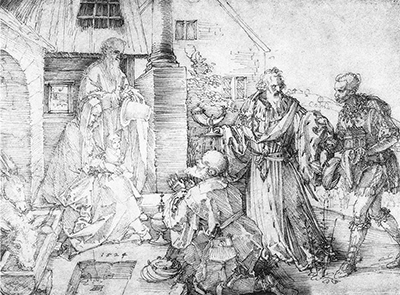
The meeting takes place at a threshold. On the left, Mary sits with the infant Christ beneath a steep roof, Joseph standing behind her. From the right come three richly dressed visitors, one already on his knees. A column rises between these two groups, making the approach to the child feel both intimate and ceremonious. Albrecht Dürer's Adoration of the Wise Men is a pen drawing of 1524 in Vienna's ALBERTINA, inventory 4837. Measuring 21.3 × 29.2 centimetres, it is drawn in grey and black ink. It is a different work from his 1504 painting in the Uffizi. [1]
Within that small horizontal sheet, Dürer gives each visitor a distinct moment in the act of arrival. The kneeling king has put his headgear on the ground and lifted his hands together. His broad back faces us; the turn of his head directs attention towards the child. Behind him, the long-robed king carries an elaborate vessel while reaching back to the youngest visitor. That final figure advances with one knee bent and a covered treasure held before him. The story moves through bowed head, outstretched arm and forward step. We see an encounter still unfolding.
At a Glance
This work across Albrecht Dürer’s career
Young Hare
1502Praying Hands
1508Melencolia I
1514Four Apostles
1526Contents
A closer look
Its biblical source is Matthew 2:1–12. The visitors follow a star, ask Herod about the newborn king, and reach the child with Mary. They bow and offer gold, frankincense and myrrh, then leave by another route after a warning in a dream. Matthew does not specify three visitors or give them names; three kinds of gift are named. The description of them as kings belongs to the later interpretation of the story, associated with Old Testament passages about rulers bringing tribute. Dürer's costumes translate the gifts into visible wealth, but his principal subject is the visitors' response to the child. [12]
Mary's posture establishes the still centre of that response. Her head inclines beneath a veil, and the folds around her body spread down over the raised ground. The little face beside her is much more exposed. Joseph, with his long beard and hat held before his chest, looks down towards the meeting. His upright body continues the vertical movement of the building behind him. The family occupies less space than the visitors' unfolding draperies and extended limbs, yet the direction of the kneeling king's face makes its quiet corner the destination of the whole composition.
The other two kings complicate a straightforward procession. The middle figure turns his head away from Mary to address his companion, his body stretched between the two directions. His raised gift balances the gesture of the arm reaching behind him. Scherbaum identifies the curved incense vessel as a Greifenklaue , or griffin's claw. Its elaborate silhouette projects across the heavy column base, keeping the gift conspicuous against the architecture. The younger king answers with his own inclined head and moving body. There is a small pause within the approach: one visitor brings another forward while the first has already arrived. Dürer gives the spectators time to notice the exchange of attention between the men, as well as their common purpose. [1]
The Black king at the right is particularly sharply characterised, with a close profile, an earring, a prominent necklace and an elaborate headdress. A possible connection with Dürer's earlier black-chalk portrait of an African man has been discussed in scholarship. The ALBERTINA dates that separate portrait, inventory 3122, to 1508. The man's identity and the place where Dürer encountered him are unknown; the museum discusses the drawing's possible later usefulness for images of the Magus. A remembered or adapted head type cannot supply the name or biography of the person represented here. In this scene, the king's role is conveyed most directly by the treasure he carries and the invitation he receives. [13] [14]
The architecture supplies another, slower way into the picture. At the far left, animal heads emerge from the shadow of an arch. Beside them, a diagonal timber leads the eye upwards towards Mary's skirts. Behind Joseph are rough horizontal boards, above him the long sloping roof. Against these uneven surfaces stands the column, with its smooth shaft and emphatic squared base. Farther back, a gabled house with small windows appears above foliage. The space combines domestic shelter, a substantial architectural fragment and a glimpse of a settlement beyond.
There is even a second story within the building. Cowen identifies the tiny scene framed by the window behind Mary as the Annunciation to the Shepherds. Its figures are minute beside the foreground gathering. The window gives the shelter an unexpected opening into another place and event, allowing the birth narrative to extend beyond the kings' arrival. [14]
Dürer makes those different distances legible through changes in the weight of his drawing. The foreground garments are full of folds, fastenings, borders and short shadows. The house behind is more lightly indicated, its wall made from broken strokes with plenty of paper between them. At the upper right, the open sky gives the young king's head a clear silhouette. The dense passages do not spread evenly across the sheet. They collect where a sleeve turns, cloth bunches, a vessel curves or the ground falls away.
That last feature is especially arresting. Immediately below Mary is a rectangular opening in the paving, drawn at an angle towards the viewer. Its dark interior interrupts the broad pale foreground. The kneeling man's headgear lies close by, so that the eye passes from a recognisable personal possession to a recess whose purpose is less obvious. Astrid Scherbaum has interpreted the opening as a suggestion of Christ's future tomb. Cowen similarly reads the column as an anticipation of the Flagellation. These interpretations bring Christ's later suffering into the scene of his infancy. Even before that meaning is considered, the hole gives the foreground an unexpected depth: the gathering seems to stand beside an exposed space beneath its feet. [1] [14]
The penwork rewards the same close attention as the figures. Long, nearly parallel strokes model much of the drapery, following a fold before changing direction at its edge. Shorter lines gather around faces, fingers and small ornaments. The column's base has a regular horizontal rhythm; the thatch is more scattered and broken. We can follow the artist's separate decisions about stone, cloth, hair and timber without losing the coherence of the setting. The varying density of the lines produces volume while keeping the movement of the pen visible.
There is a conspicuous difference in tone between the pale family group and the more emphatic visitors. The catalogue identifies grey and black inks; faint yellow on the gifts is probably a later addition. Colour therefore needs to be distinguished from the original organisation of the drawing. Its lights often come from spaces between strokes. Mary's veil can remain luminous even where its folds are minutely described, while the patterned clothes at the right accumulate dark accents. The contrast lets the viewer move quickly from the visitors' conspicuous finery to the comparatively quiet forms around the child. [1]
The date and Dürer's monogram appear low on the left, placed on the foreground surface near the rectangular opening. This brings the act of signing into the little world he has constructed. The numerals sit among paving edges, the discarded headgear and the margins of drapery. They also mark how much the drawing depends on its foreground: this is where bodies acquire weight, the approaching figures meet the family's raised platform, and the spectator finds a point of entry.
The date links the sheet with Dürer's late investigations of sacred narrative in a horizontal format. The Städel Museum's Christ on the Mount of Olives , also dated 1524, measures 21.2 × 29.1 centimetres and is executed in grey pen with a black framing line. Its near-identical size provides a concrete comparison. Such relationships have encouraged attempts to reconstruct a larger undertaking. Scherbaum proposed that the Adoration might have introduced a planned Passion sequence. The ALBERTINA's current account also considers a Childhood of Christ series, while emphasising compositional experiment and the gathering of workshop motifs. [15] [1]
These possibilities give the drawing different kinds of future. Scherbaum points to its largely parallel hatching, with little crosshatching, as a feature that would facilitate translation into woodcut. A workshop model could furnish figures or arrangements for later use. Dana E. Cowen instead argues that the related Oblong Passion drawings can be understood as independent works, with the Adoration as a complementary meditation on Christ's life. The sheet's finish makes that argument worth considering. Its minor details sustain attention long after the principal figures have been identified, and the broad arrangement remains intelligible without another image beside it. A planned cycle has not been established as a documented commission. [1] [14]
The horizontal arrangement also opens a useful comparison with Netherlandish art. Cowen connects the interaction of the standing kings with Lucas van Leyden's Adoration of the Magi of 1513. Lucas's engraving survives, for example, in the National Gallery of Art's Rosenwald Collection. Looking at it beside Dürer's drawing reveals both a similar leftward approach and a striking change of scale within the crowd. Lucas fills the background with faces and elaborate headgear; Dürer's three visitors have room to act as individuals. In Lucas's foreground, a backward-reaching arm links the central king with an attendant holding a hat. Dürer's corresponding exchange makes contact between two kings central to the unfolding story. [14] [16]
The comparison helps explain how a crowded religious subject could become so concentrated. Dürer retains luxury in the vessels and clothes, while giving the spaces around the figures more of the narrative work. Each gesture can be followed through to its recipient.
Cowen also proposes a relationship with contemporary religious reform, interpreting the visitors' faith and the anticipations of the Passion through Luther's teaching. She explicitly notes that Dürer's ownership of Luther's 1522 Church Postil is unknown. Luther's Epiphany sermon offers a revealing contemporary comparison: in sections 100–101, the visitors recognise a king despite the humble woman, child and dwelling before them. Their faith overcomes the lack of outward royal splendour. The parallel gives historical depth to Dürer's meeting of rich visitors and a modest family. It remains an interpretation of their relationship, rather than proof that the drawing illustrates the sermon. [14] [17]
The drawing's later history leads from imperial collecting to Vienna. The ALBERTINA records probable ownership by Rudolf II, followed by the imperial treasury, the court library from 1783 and transfer to Duke Albert of Saxe-Teschen in 1796. On the sheet itself, the tiny child receives an approach whose movement occupies almost the entire width of the paper. [1]
Frequently Asked Questions
Artworks directory
These 187 records include individual works, reverse sides, detail views, paired panels and reconstructed arrangements. Three additional catalogue images repeat works already listed. Related views are not counted as separate originals; qualified attributions and published dating are retained.
Discussion
Look again at the images and ideas explored in Adoration of the Wise Men (1524 drawing). These editorial prompts invite your observations.
Reader Insights
Which detail or idea in Adoration of the Wise Men (1524 drawing) most changed your reading, and why?
How does the discussion of “A closer look” affect your understanding?
What comparison would you bring to the discussion of “A closer look”?
Join the Conversation
Share a detail, comparison or question about Adoration of the Wise Men (1524 drawing) below.
References
- ALBERTINA , Die Anbetung der Könige , inventory 4837, current object record and introductory text; Astrid Scherbaum, catalogue essay, 2003, no. 184, p. 520, reproduced in the record. German; English introductory text. View source .
- ALBERTINA, Selbstbildnis als Dreizehnjähriger, inv. 4839 (German). View source.
- Metropolitan Museum, Four Horsemen from The Apocalypse, 19.73.209 (English). View source.
- Bayerische Staatsgemäldesammlungen, Selbstbildnis im Pelzrock, inv. 537 (German). View source.
- ALBERTINA, Feldhase, inv. 3073 (German). View source.
- ALBERTINA, Das große Rasenstück, inv. 3075 (German). View source.
- Metropolitan Museum, Adam and Eve, 19.73.1 (English). View source.
- ALBERTINA, Betende Hände, inv. 3113 (German). View source.
- Metropolitan Museum, Knight, Death, and the Devil, 43.106.2 (English). View source.
- Metropolitan Museum, Melencolia I, 43.106.1 (English). View source.
- Bayerische Staatsgemäldesammlungen, inventory 545: current collection record (German; descriptive citation). View source.
- Matthew 2:1–12 and accompanying notes , New American Bible, Revised Edition , United States Conference of Catholic Bishops. English translation. View source .
- ALBERTINA , Bildnis eines jungen Mannes , inventory 3122, current object record and reproduced catalogue text, Dürer–Cranach–Holbein , 2011, p. 98, no. 48. German; English introductory text. View source .
- Dana E. Cowen , Albrecht Dürer's “Oblong Passion”: The Impact of the Reformation and Netherlandish Art on the Artist's Late Drawings , PhD dissertation, Case Western Reserve University, January 2014, abstract and appendix 2, pp. 209–218, especially pp. 212, 215–218. English. View source .
- Städel Museum , Christus am Ölberg , 1524, inventory 694, current object record. German. View source .
- National Gallery of Art , Lucas van Leyden, The Adoration of the Magi , 1513, accession 1943.3.5620, object record and image. English. View source .
- Martin Luther , Epiphany sermon, Church Postil , 1522, sections 100–101; English text in the John Nicholas Lenker translation tradition, Church Postil: Advent, Christmas and Epiphany , vol. 1. English translation. View source .
- Germanisches Nationalmuseum, Barbara Dürer (German and English). View source.
- Web Gallery of Art, Tucher–Rieter reverse (English). View source.
- National Gallery of Art, Portrait of a Clergyman (English). View source.
- Dürer Art, Portrait of a Man (English). View source.
- Hessen Kassel Heritage, Elsbeth Tucher (German). View source.
- Web Gallery of Art, Hans Tucher (English). View source.
- Germanisches Nationalmuseum, Emperor Maximilian I (German and English). View source.
- National Gallery of Art, Lot and His Daughters, reverse (English). View source.
- Bayerische Staatsgemäldesammlungen, Glim Lamentation (German). View source.
- Museo Nacional del Prado, Portrait of a Man (Spanish). View source.
- Bayerische Staatsgemäldesammlungen, Madonna of the Carnation (German). View source.
- Städel Museum, Job on the Dungheap (German). View source.
- Wallraf-Richartz-Museum, Piper and Drummer (German). View source.
- Italian Ministry of Culture / Uffizi, Head of Saint James (Italian). View source.
- Klassik Stiftung Weimar, Dresden Altarpiece (German). View source.
- Staatliche Museen zu Berlin, Girl with a Red Beret (German and English). View source.
- Dresden State Art Museums / Roland Enke, Bernhard von Reesen (German). View source.
- Royal Collection Trust, Burkhard von Speyer (English). View source.
- Dresden State Art Museums, Seven Sorrows of the Virgin (English). View source.
- Bayerische Staatsgemäldesammlungen, Mater Dolorosa (German). View source.
- Bayerische Staatsgemäldesammlungen, Lucretia (German). View source.
- Städel Museum, Young Woman with Her Hair Down (English). View source.







