by
Tom Gurney
Tom Gurney BSc (Hons) is an art history expert with over 20 years experience
Published on June 19, 2020 / Updated on October 22, 2026
Email:
tomgurney1@gmail.com
/ Phone:
+44 7429 011000
Angel Appearing to Joachim by Albrecht Dürer: Introduction
An angel hovers among the trees while an elderly man kneels on the uneven ground below. Their meeting fills the foreground of Albrecht Dürer's Angel Appearing to Joachim , also known as Joachim and the Angel . Designed around 1504, this woodcut belongs to The Life of the Virgin . Its promise concerns a child who has yet to enter the picture: Mary, the future mother of Christ. The National Gallery of Art in Washington catalogues the design as Meder 190; the equally familiar Bartsch number is 78. [1]
The encounter unfolds at the edge of a thick wood, with shepherds, sheep and a resting dog nearby. Joachim's great mantle spreads across the bottom of the image, while the angel's wings and fluttering clothing reach into the upper left. Beyond them, the view opens towards a distant settlement. The sudden depth makes the woodland meeting feel both sheltered and connected to a much larger world. Dürer gives the promise of Mary's birth a tangible setting of rough bark, bent knees, grazing animals and working people.
At a Glance
This work across Albrecht Dürer’s career
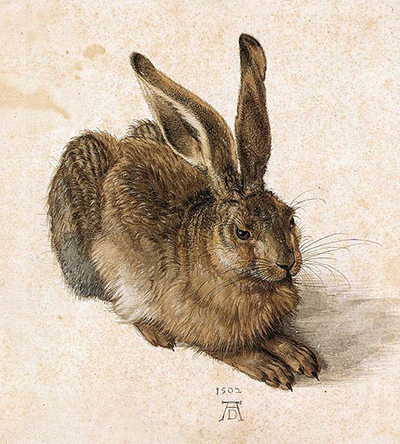
Young Hare
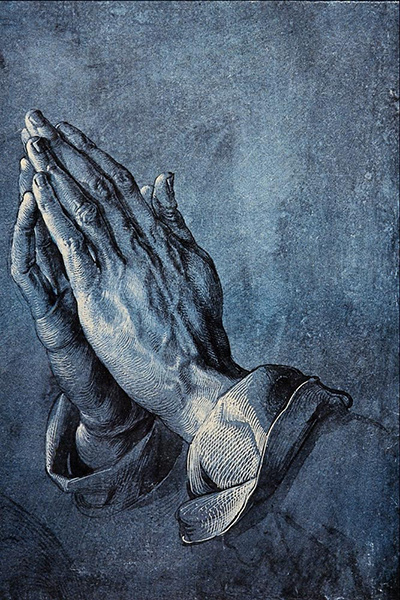
1502Praying Hands
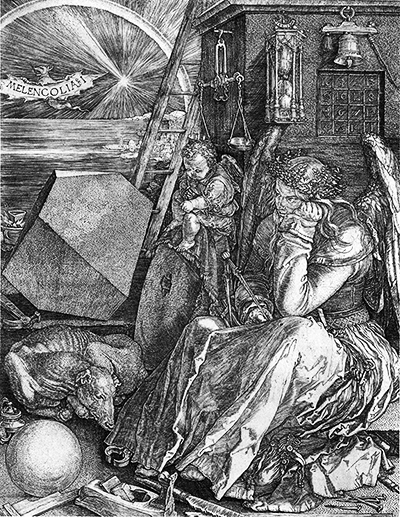
1508Melencolia I
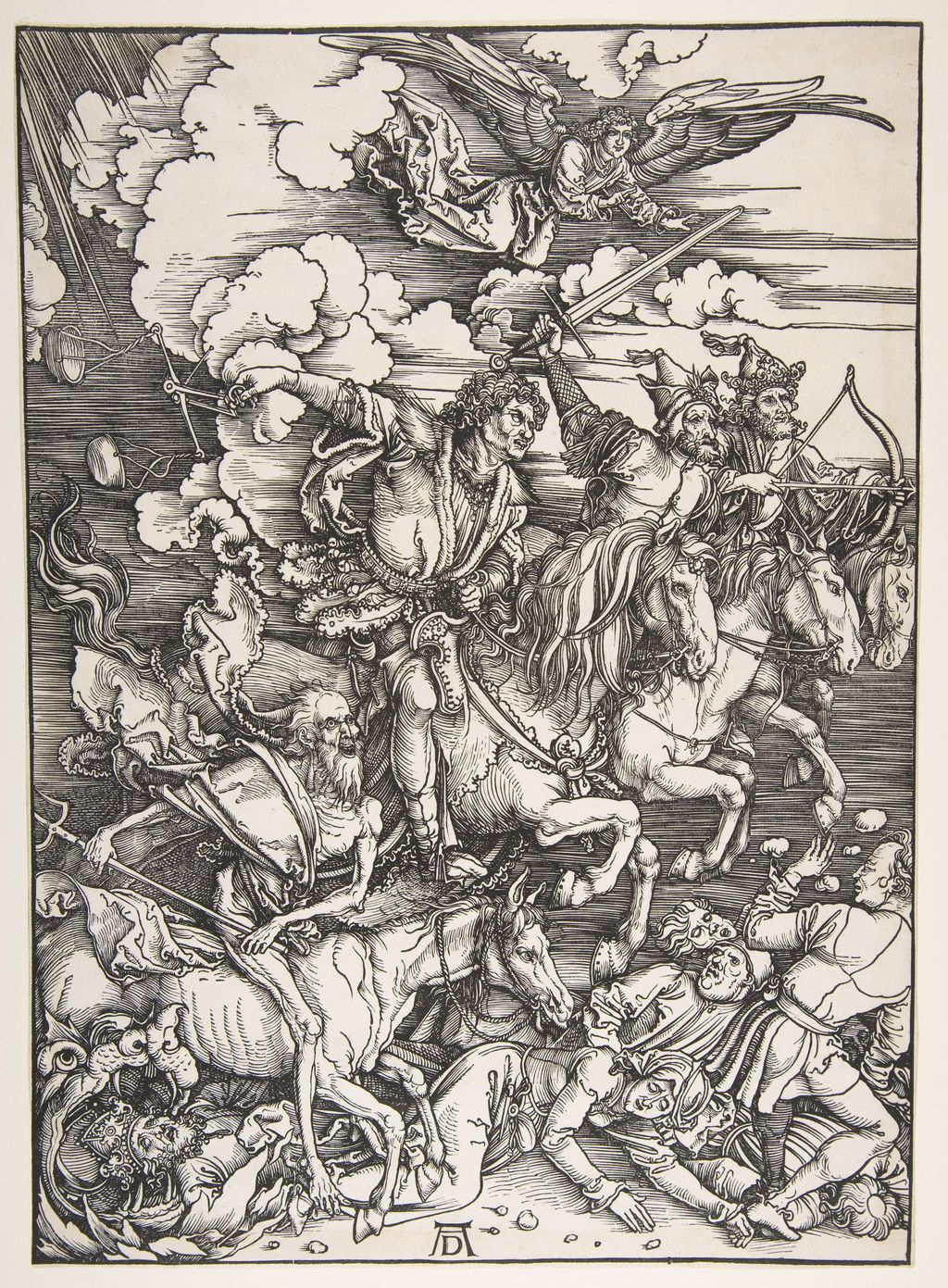
1514Four Apostles
1526Contents
- The promise to Mary's father
- An apparition in a working landscape
- How the woodcut makes light
- A separate print and a page in a book
- The histories carried by individual sheets
- Frequently Asked Questions
The promise to Mary's father
Joachim's story comes from the apocryphal and legendary traditions surrounding Mary's parents, Joachim and Anne. In the Golden Legend , Jacobus de Voragine recounts how the childless Joachim is humiliated when a priest rejects his offering at the Temple. Ashamed to return home, he stays with his herdsmen. An angel reassures him that childlessness is no proof of sin, then announces that Anne will bear a daughter named Mary. As a sign, Joachim will meet his wife at Jerusalem's Golden Gate. The angel also visits Anne, bringing the separated couple towards their reunion. [12]
That reassurance changes the meaning of Joachim's isolation. His removal from the city begins in public disgrace; the countryside becomes the place where the judgment against him is overturned. The Golden Legend places the promised birth beside earlier stories of Sarah, Rachel and other women who bear exceptional children after a long wait. In the woodcut, the broad landscape and ordinary flock surround a conversation whose consequences extend far beyond the people who witness it. [12]
An earlier version appears in the Protoevangelium of James . There, Joachim withdraws into the wilderness for forty days and nights of fasting after being reproached for having no offspring. Anne mourns separately at home. Chapter four reports the angel's message to Joachim through messengers speaking to Anne: her husband has been told to return because she will conceive. Joachim then calls his shepherds and prepares offerings before coming home with his flocks. These details give the sheep and herdsmen a firm place in the narrative tradition. [13]
The versions differ in their arrangement and emphasis. Reading them helps explain Dürer's choice of a rural annunciation without turning every visible detail into an illustration of one sentence. The Allen Memorial Art Museum at Oberlin identifies the visitor as Gabriel and associates the subject with the Golden Legend . The passages in the two narratives cited here call Joachim's visitor an angel of the Lord without naming him. The image itself makes his function unmistakable: he brings a message, and Joachim receives it in prayer. [12] [13] [14]
This is the second narrative woodcut in the published sequence, following the rejection of Joachim's offering and preceding the reunion at the Golden Gate. Counting the book's title image makes it the third illustration. The position gives the kneeling figure a recent past and an immediate future: he has suffered rejection, and he is about to return to Anne. Mary is absent because the story has reached the moment when her birth is promised. [15]
An apparition in a working landscape
Dürer places the angel against the darkest part of the wood. Feathers fan out in long, overlapping rows; one wing rises beside the trunk while the other curves behind the figure. Bands of fabric circle the body and stream out towards the left edge. The movement seems to have been arrested just long enough for a conversation. A curling scroll hangs between angel and man, giving the spoken message a visible shape. Its pale surface stands clear of the crowded foliage behind it.
Joachim answers with joined hands. His profile turns upward, but most of his body is seen from behind and to the side. The large hood and broken folds around his shoulders conceal much of his neck and torso. Below, the mantle falls in broad planes, gathers around the kneeling leg and trails towards the lower edge. The contrast of poses is particularly expressive: the angel's body is suspended amid flying cloth, while Joachim's weight settles into the earth. Their inclined heads and hands establish an intimate exchange across that difference.
The surrounding people offer less concentrated responses. Beneath the angel, a shepherd spreads his arms beside the trees, his smaller figure framed by the trunks. Another man stands near the right edge with a staff. His position keeps him close to the flock while leaving Joachim's silhouette open. The raised arms introduce a sudden, expansive gesture beside Joachim's close, joined hands. Dürer allows several forms of attention to coexist around the same event.
At the lower left, the dog lies near a patch of bare ground. Its low, extended shape anchors a corner otherwise full of upright trunks and descending drapery. Farther back, sheep collect along the irregular hillside. Their rounded backs and small heads form a busy passage between the large kneeling figure and the miniature buildings beyond. The flock carries the eye into depth by a series of small, recognisable bodies.
The trees organise that journey. Massive, deeply scored trunks crowd the left, while a slimmer tree rises near the centre and sends comparatively bare branches across the open sky. Tufts of foliage, dangling growth and scattered birds interrupt the white spaces. Close vegetation overlaps Joachim's robe at the right, tightening the foreground around him. Above it, the landscape becomes more spacious and the marks grow smaller. The image offers a route out of the dense wood even as the angel draws attention back into it.
These differences give the setting its force without requiring a separate symbolic explanation for each branch. The woodland contains roughness, age, growth and open air at once. Joachim kneels where several of those textures meet. The natural world is sufficiently particular to hold attention in its own right, yet its arrangement keeps returning the eye to the angel's message and the man's response.
How the woodcut makes light
The effect depends on a demanding reversal between design and manufacture. In relief printing, the lines that will carry ink remain standing on the wooden block; the surrounding wood is cut away. A narrow black stroke on the paper therefore represents a surviving ridge of wood. Suzanne Boorsch and Nadine M. Orenstein explain this process in their study of northern printmaking, while leaving Dürer's personal participation in cutting blocks an open question. The design can be credited to him without assigning every passage of carving to his hand. [16]
Here, the printable lines perform markedly different tasks. Short, curved marks roughen the bark. Tightly massed strokes make the interior of the wood dark. Longer lines follow the angel's feathers and articulate their layered surfaces. On Joachim's clothing, bands of hatching change direction as the cloth bends. Broad areas of white paper give the robe its light, interrupted by sharply enclosed folds. The paper is an active part of the image's illumination.
The contrast is especially clear around Joachim's back. An almost unbroken pale expanse separates the figure from the sheep and undergrowth beside him, while the darker folds at his knee fix his position on the ground. The angel is made luminous by a similar relationship to the surrounding trunks. Neither figure requires a painted glow: the density and spacing of the black marks make them stand out. Across a sheet roughly thirty centimetres high, the same vocabulary of lines can describe a wing, a weathered trunk and a distant roof.
A separate print and a page in a book
The date around 1504 concerns the design's creation. Its place in a book belongs to another stage in its history. Dürer published The Life of the Virgin in 1511 with Latin verses by the Benedictine poet Benedictus Chelidonius. The twenty illustrations comprise a title image, eighteen narrative scenes and a concluding image of Marian veneration. Anna Scherbaum's account, reproduced by the ALBERTINA, stresses that the order in which the designs were made differs from the order of the story. [17]
Scherbaum also connects the prominence of Mary's parents with the growth of devotion to Saint Anne and with contemporary disputes over Mary's conception. Her reading places the opening scenes within the religious concerns of Dürer's own period. For a viewer following the sequence, the effect begins with the family itself: Mary's life emerges from her parents' distress, their answered prayers and their eventual return to one another. [17]
The volume placed the appropriate text on the left of an opening and the full-page image on the right. The University Library of Regensburg describes the poems' centred setting in Antiqua type and their regular form of twelve elegiac couplets for each station. For this landscape, that arrangement offered a second rhythm of attention: the reader could move between a densely populated image and measured lines of Latin verse. [15]
Art historian Arwed Arnulf argues that Chelidonius's poems retell the episodes through classical poetic language while retaining independence from the adjacent images. His discussion is a useful warning against treating the verse as an explanation of every pictured gesture or object. In the Cleveland Museum of Art's 1959 portfolio, R. J. Schork's English translation of the heading for this scene says that an angel appears to Joachim in the country and advises him to meet his wife at the Golden Gate. That heading establishes the narrative destination; it is distinct from a translation of the complete poem. [18] [19]
An impression could also have a life before the Latin book. The National Gallery of Victoria identifies its Joachim and the Angel as printed before the 1511 text edition. Its image measures 30.1 × 21.2 centimetres on a slightly larger sheet. The wooded composition has a complete frame, a clear principal encounter and its own progression into distance. Seen separately, it offers a sustained encounter with Joachim's answered prayer; placed in sequence, it becomes the turning point between rejection and reunion. [20]
The histories carried by individual sheets
Surviving impressions preserve different physical histories. Washington's example is trimmed to the block and measures 29.8 × 21 centimetres; it entered the National Gallery of Art as W. G. Russell Allen's gift in 1941. Oberlin records its own impression at 29.9 × 21 centimetres, acquired through the R. T. Miller Jr. Fund. These are measurements and acquisitions of particular sheets, alongside the shared design. [1] [14]
The Melbourne impression carries a High Crown watermark, classified as Meder 20 and Briquet 4899. The NGV relates that mark to examples in documents dated 1501–03 in Bergamo. Such a comparison concerns the history of the paper and its manufacture; it cannot supply an automatic printing date. The museum's conservation study explains how the mould's wires leave laid lines, chain lines and watermark patterns in handmade paper, and recommends considering them together with other evidence. [20] [21]
Those physical distinctions sit behind the apparent familiarity of a reproduced image. The block could produce many impressions, but trimming, paper and collecting changed each sheet's later life. What continues across them is Dürer's carefully staged interruption: an angel held among the trees, an old man listening with his whole body, and shepherds and animals occupying the countryside around them. The promise has arrived before its fulfilment, and the landscape gives Joachim a place in which to receive it.
Frequently Asked Questions
Artworks directory
These 187 records include individual works, reverse sides, detail views, paired panels and reconstructed arrangements. Three additional catalogue images repeat works already listed. Related views are not counted as separate originals; qualified attributions and published dating are retained.
Discussion
Look again at the images and ideas explored in Angel Appearing to Joachim by Albrecht Dürer. These editorial prompts invite your observations.
Reader Insights
Which detail or idea in Angel Appearing to Joachim by Albrecht Dürer most changed your reading, and why?
How does the discussion of “The promise to Mary's father” affect your understanding?
What comparison would you bring to the discussion of “The histories carried by individual sheets”?
Join the Conversation
Share a detail, comparison or question about Angel Appearing to Joachim by Albrecht Dürer below.
References
- National Gallery of Art , Washington, Joachim and the Angel , c. 1504, 1941.1.29. English. Current collection metadata and provenance. View source .
- ALBERTINA, Selbstbildnis als Dreizehnjähriger, inv. 4839 (German). View source.
- Metropolitan Museum, Four Horsemen from The Apocalypse, 19.73.209 (English). View source.
- Bayerische Staatsgemäldesammlungen, Selbstbildnis im Pelzrock, inv. 537 (German). View source.
- ALBERTINA, Feldhase, inv. 3073 (German). View source.
- ALBERTINA, Das große Rasenstück, inv. 3075 (German). View source.
- Metropolitan Museum, Adam and Eve, 19.73.1 (English). View source.
- ALBERTINA, Betende Hände, inv. 3113 (German). View source.
- Metropolitan Museum, Knight, Death, and the Devil, 43.106.2 (English). View source.
- Metropolitan Museum, Melencolia I, 43.106.1 (English). View source.
- Bayerische Staatsgemäldesammlungen, inventory 545: current collection record (German; descriptive citation). View source.
- Jacobus de Voragine , “The Nativity of Our Blessed Lady,” The Golden Legend , chapter 131, translated by William Caxton, 1483; English text with editorial glosses. Parental story through the angel's messages and reunion. View source .
- The Protoevangelium of James , chapters 1–5, translated by Alexander Walker, in Ante-Nicene Fathers , vol. 8, 1886; revised electronic edition, New Advent. English translation of the Greek apocryphal text. View source .
- Allen Memorial Art Museum , Oberlin, Joachim and the Angel, from the Life of the Virgin , 1504, 1959.111. English. Collection record and curatorial interpretation. View source .
- University Library of Regensburg , “Die Buchgestaltung des Marienlebens”. German. Book layout and poetic form. View source .
- Suzanne Boorsch and Nadine M. Orenstein , The Print in the North: The Age of Albrecht Dürer and Lucas van Leyden , The Metropolitan Museum of Art Bulletin , 54, no. 4, Spring 1997, pp. 3–4, 25. English. View source .
- Anna Scherbaum , Marienleben discussion in Albrecht Dürer , ALBERTINA exhibition catalogue, 2003, pp. 284–294, reproduced in the ALBERTINA's Heimsuchung Mariae , drawing 3078, collection entry. German. View source .
- Arwed Arnulf , “Dürers Buchprojekte von 1511: Andachtsbücher für Humanisten”, Marburger Jahrbuch für Kunstwissenschaft , 31, 2004, pp. 145–174, especially pp. 152–154. German; author's uploaded article. View source .
- Cleveland Museum of Art , Albrecht Dürer: The Life of the Virgin , 1959, plate III and introductory note identifying R. J. Schork as translator of Chelidonius's headings. English. View source .
- National Gallery of Victoria , Joachim and the Angel , c. 1504, printed before the 1511 text edition, 3544.3-4. English. Impression metadata and watermark record. View source .
- National Gallery of Victoria , “Watermarks in the NGV's collection of prints by Albrecht Dürer”. English. Paper manufacture, watermark interpretation and measurement glossary. View source .
- Germanisches Nationalmuseum, Barbara Dürer (German and English). View source.
- Web Gallery of Art, Tucher–Rieter reverse (English). View source.
- National Gallery of Art, Portrait of a Clergyman (English). View source.
- Dürer Art, Portrait of a Man (English). View source.
- Hessen Kassel Heritage, Elsbeth Tucher (German). View source.
- Web Gallery of Art, Hans Tucher (English). View source.
- Germanisches Nationalmuseum, Emperor Maximilian I (German and English). View source.
- National Gallery of Art, Lot and His Daughters, reverse (English). View source.
- Bayerische Staatsgemäldesammlungen, Glim Lamentation (German). View source.
- Museo Nacional del Prado, Portrait of a Man (Spanish). View source.
- Bayerische Staatsgemäldesammlungen, Madonna of the Carnation (German). View source.
- Städel Museum, Job on the Dungheap (German). View source.
- Wallraf-Richartz-Museum, Piper and Drummer (German). View source.
- Italian Ministry of Culture / Uffizi, Head of Saint James (Italian). View source.
- Klassik Stiftung Weimar, Dresden Altarpiece (German). View source.
- Staatliche Museen zu Berlin, Girl with a Red Beret (German and English). View source.
- Dresden State Art Museums / Roland Enke, Bernhard von Reesen (German). View source.
- Royal Collection Trust, Burkhard von Speyer (English). View source.
- Dresden State Art Museums, Seven Sorrows of the Virgin (English). View source.
- Bayerische Staatsgemäldesammlungen, Mater Dolorosa (German). View source.
- Bayerische Staatsgemäldesammlungen, Lucretia (German). View source.
- Städel Museum, Young Woman with Her Hair Down (English). View source.
- ALBERTINA, Portrait of a Young Man (German). View source.