by
Tom Gurney
Tom Gurney BSc (Hons) is an art history expert with over 20 years experience
Published on June 19, 2020 / Updated on October 22, 2026
Email:
tomgurney1@gmail.com
/ Phone:
+44 7429 011000
Apollo and Diana: Introduction
Apollo fills almost the entire height of Albrecht Dürer’s Apollo and Diana . His feet meet the lower edge, his curling hair crowds the top, and his extended arms carry the eye towards a bow at the right. Beside this upright, muscular figure, Diana sits with a stag, holding vegetation in her lap and reaching towards the animal’s muzzle. The encounter occupies an engraving only about 11.6 centimetres high. Its small scale brings the gods within the range of intimate scrutiny: the turn of a shoulder, the pressure of a foot and the meeting of a hand with an animal become its principal events. [1]
The print is generally dated around 1503–04, the dating used by Princeton University Art Museum. The National Gallery of Art in Washington currently places its impression in 1504/1505. Since Dürer supplied no engraved year, these differing estimates deserve to remain visible. What the image does carry is his AD monogram, on the little slip of paper at the lower right. The signature belongs to the same compressed world as the bodies, stones and animal: a small, sharply legible object resting on the ground. [1] [2]
At a Glance
- Museum datings About 1503–04 at Princeton; 1504/1505 at the National Gallery of Art [1] [2]
- Process Engraving [1]
This work across Albrecht Dürer’s career
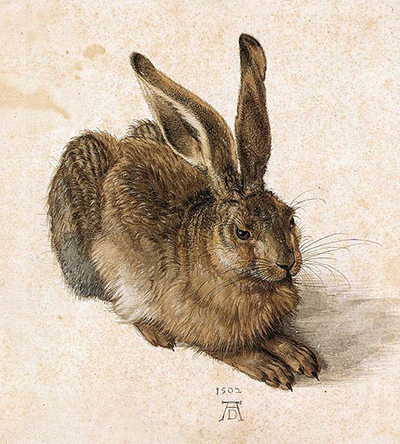
Young Hare
1502Apollo and Diana (current article)
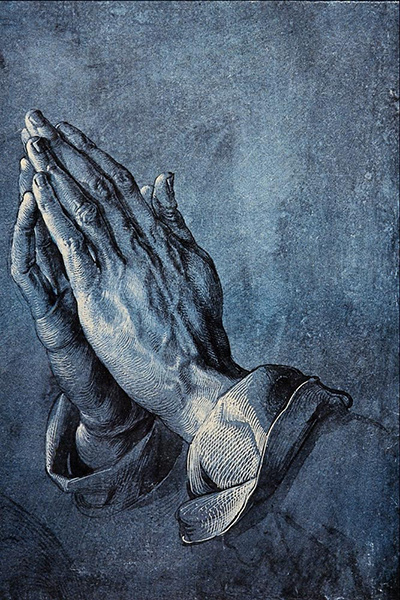
c. 1503–1505Praying Hands
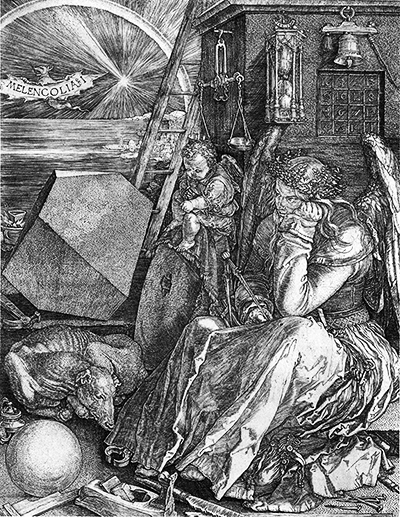
1508Melencolia I
1514Four Apostles
1526Contents
- Bodies at close quarters
- The gods and the stag
- A conversation with Italian prints
- Another Apollo, another experiment
- Lines, ink and individual impressions
- Frequently Asked Questions
Bodies at close quarters
The figures scarcely have room to separate. Apollo’s legs rise immediately in front of Diana’s extended legs, while the stag’s neck and head enter the narrow interval between them. Its antlers spread out at the left, giving the animal a larger presence than its partly concealed body initially suggests. Diana’s hand, the stag’s lifted muzzle and Apollo’s hip form a compact knot of contact near the centre. Elsewhere the design stretches emphatically outward: feet towards the bottom corners, hair towards the upper left and the bow towards the right edge.
Apollo’s pose lets Dürer show several aspects of the male body at once. The head turns into profile, the back and flank curve towards the viewer, and the arms extend across the sheet. The muscular shoulder opens into a long shaded side; below it, the buttock and thigh carry the figure down towards the planted feet. These changes of direction make the body feel substantial within a very shallow space. A strap and quiver interrupt its contours, while a loose strip of fabric curls around the waist. The rigid arrows in the quiver provide a small, straight-edged counterweight to the flowing hair and fabric.
Diana’s seated body develops a different sequence of shapes. Her raised head, shoulders, rounded abdomen and broad lap descend in stages towards the legs crossing the foreground. Fine shading follows the swell of her torso, while firmer darks collect under her arm and along the folds of the material behind her shoulder. Her gaze rises into the space beneath Apollo’s arms. It would be easy to turn that expression into a story about dependence, anxiety or affection, but the engraving leaves her thoughts open. The visible action is clearer: one hand tends the stag, and the other holds its food.
The setting gives this tangle of limbs surprising clarity. Above the low, dark ground is a large expanse of pale, almost empty background. At the bottom, short strokes and dense patches of shading gather around stones, vegetation and the animal’s body. Across the upper half, the light background releases the outlines of Apollo’s hair, back and arms. Dürer makes a few centimetres of paper carry both the weight of solid bodies and the openness around them.
The gods and the stag
The traditional title identifies the figures as the divine siblings Apollo and Diana, the Roman counterpart of the Greek Artemis. Bow, arrows and stag place the scene within their shared world of archery and hunting. Yet a weapon need not announce a particular episode. The arrow’s destination lies outside the frame. Apollo’s equipment gives his body a task; Diana’s handling of the stag gives hers another. [1]
Ancient poetry helps explain why the animal belongs beside her. In his Hymn to Artemis , Callimachus describes the goddess acquiring a bow and hunting dogs, capturing deer for her chariot, and receiving the services of nymphs who feed and water them. Near the end of this sequence, she takes her seat beside Apollo in their father’s house. The hymn presents hunting, care for deer and sibling companionship within the same divine life. It provides useful context for the engraving without establishing that Dürer illustrated its words. His little group has neither the chariot nor the heavenly household described by the poet. [13]
The stag also changes how the two nudes are encountered. Its muzzle approaches Diana’s fingers with the immediacy of an animal seeking food. That small transaction brings mythology down to an observable gesture. Apollo’s expansive posture and Diana’s concentrated movement can be read together without deciding that one must represent aggression and the other perfect calm. Their different activities keep the compact scene alive.
A conversation with Italian prints
Princeton relates the engraving to Dürer’s investigations of human proportion and to prints by the Venetian artist Jacopo de’ Barbari. Barbari’s own Apollo and Diana , dated around 1503–05 by the Metropolitan Museum of Art, makes the celestial identities explicit. Apollo stands on a great sphere, surrounded by rays; the museum interprets his arrows as the sun’s rays and Diana as night giving way to day. [1] [14]
The comparison is illuminating at the level of the figures as well as their attributes. In Barbari’s composition, the archer’s torso faces the viewer, one arm bends back across his face, and the other reaches towards the bow. Diana turns her back at the lower right. Dürer turns Apollo around, brings Diana’s face into view and settles both figures on ordinary ground. The broad sphere and radiating light disappear. His standing figure is larger in relation to the sheet, and the stag presses further into the shared space. A related subject has become a closer encounter with bodies, equipment and animal life.
The overlapping approximate dates leave the precise sequence of invention open. The resemblance supports an artistic relationship; it cannot by itself date a meeting between the artists or reconstruct what passed between them. Dürer’s later testimony adds something more specific. In a draft dedication for his work on human proportion, he recalled seeing male and female figures made by Jacopo according to measurements. He also said that Jacopo had not clearly explained his principles, prompting Dürer to pursue his own investigation and read Vitruvius. This is Dürer’s retrospective account of an intellectual stimulus. It supplies no record of a complete method being handed over for use in this engraving. [15]
Looking at Apollo and Diana , the interest in bodily construction is evident in the unusual demands placed on each pose. Apollo must remain balanced while his upper body turns and reaches; Diana’s torso must rise convincingly from her seated hips. Their contours carry these problems without exposing a diagram of their solution. The finished image gives no warrant for assigning a particular numerical formula to either figure. What it makes available is the result: bodies whose internal organisation can be followed through changes of direction, overlap and shading.
Another Apollo, another experiment
Dürer also explored the subject in a larger drawing now in the British Museum, Apollo , sometimes called Apollo with the Solar Disc . The museum dates this pen-and-ink sheet to about 1500–01 and records a size of 28.3 by 20.5 centimetres. It is a distinct composition. Apollo stands frontally, holding a radiant disc in one raised hand and a staff in the other. At the right, Diana sits with her back turned and raises an arm. Dark pen work across the upper sheet sets the central body against a turbulent sky. [16]
The change from that drawing to the engraving is therefore more substantial than a change of medium. The drawing presents the torso openly and makes Apollo’s light a visible force. The engraving twists his body away and clears the background. In the drawing Diana is a smaller, more rapidly indicated presence behind him; in the print her face and modelled torso command a much greater share of attention. Comparing them reveals several ways Dürer could organise the same divine pair, each placing a different demand on the human figure.
The British Museum interprets the drawing as preparation for an unexecuted print, perhaps initially of Apollo alone. That proposed purpose should not turn it into a literal preparatory design for the surviving Apollo and Diana . Its staff, solar disc, frontal body and surrounding pen work belong to a separate experiment. The shared subject connects the works, while their visible differences preserve the independence of each. [16]
Lines, ink and individual impressions
Engraving translates these bodies into grooves cut in a metal plate. Ink settles in the incisions; after the surface is wiped, damp paper is pressed against the plate to receive it. In Apollo and Diana , the succession from sparse marks to closely packed strokes makes skin turn from light into shadow. On Apollo’s flank, curved hatching follows the body’s surface. Around the stag and the feet, denser work joins several forms into a dark base. The bright areas between strokes remain active throughout, keeping even small anatomical transitions legible. [17]
Printing can modify that balance. In his 1897 catalogue, Sylvester Rosa Koehler described an exhibited impression with a slight veil of ink over the densely worked passages, especially the stag and ground. He compared impressions in several European collections and found differences in wiping: the Berlin example was cleaner, while the London impression resembled the one he exhibited. His account concerns particular sheets he examined. It shows why two impressions of this design can differ in depth and atmosphere even when their engraved outlines agree. The delicate bodily modelling emerges from the interaction of cut line, ink left on the plate and paper. The little signature also preserves a practical complication of working in reverse: Koehler noted that its D had been reversed and corrected. [18]
The surviving sheets also retain different margins and collecting histories. Princeton records a plate measuring 11.6 by 7.2 centimetres on a sheet measuring 12.7 by 8.4; Melbourne’s National Gallery of Victoria records the same plate dimensions on a sheet only 11.7 by 7.3 centimetres. Those figures describe the physical room around the image, not two differently scaled compositions. Washington’s sheet is trimmed to the plate mark and entered the National Gallery through Lessing J. Rosenwald’s gift in 1943. Melbourne acquired its impression through the Felton Bequest in 1956. [1] [19] [2]
The catalogue numbers provide continuity across these dispersed objects: Bartsch 68, Meder 64 and Schoch, Mende and Scherbaum 38 identify the design in the National Museum of Western Art’s record for its Tokyo impression. Paper can carry further evidence. The ALBERTINA in Vienna records an ox-head watermark with a rod, flower and triangle in its sheet, comparing it with related marks used over a period of years. Such a mark belongs to the paper of that impression. Its interpretation requires comparison, especially when the aim is to establish when a sheet was printed. [20] [21]
Each sheet has its own paper, edges, printing and subsequent history. That material variety suits an image which rewards close attention. A scene small enough to be taken in at a glance keeps drawing the eye back to the touches that hold it together: the stag at Diana’s hand, the curling fabric at Apollo’s waist and the fine lines through which both bodies acquire their weight.
Frequently Asked Questions
Artworks directory
These 187 records include individual works, reverse sides, detail views, paired panels and reconstructed arrangements. Three additional catalogue images repeat works already listed. Related views are not counted as separate originals; qualified attributions and published dating are retained.
Discussion
Look again at the images and ideas explored in Apollo and Diana. These editorial prompts invite your observations.
Reader Insights
Which detail or idea in Apollo and Diana most changed your reading, and why?
How does the discussion of “Bodies at close quarters” affect your understanding?
What comparison would you bring to the discussion of “Lines, ink and individual impressions”?
Join the Conversation
Share a detail, comparison or question about Apollo and Diana below.
References
- Princeton University Art Museum , Apollo and Diana , x1960-25, current collection essay and object record. View source .
- National Gallery of Art , Washington, Apollo and Diana , 1943.3.3486, current collection record. View source .
- ALBERTINA, Selbstbildnis als Dreizehnjähriger, inv. 4839 (German). View source.
- Metropolitan Museum, Four Horsemen from The Apocalypse, 19.73.209 (English). View source.
- Bayerische Staatsgemäldesammlungen, Selbstbildnis im Pelzrock, inv. 537 (German). View source.
- ALBERTINA, Feldhase, inv. 3073 (German). View source.
- ALBERTINA, Das große Rasenstück, inv. 3075 (German). View source.
- Metropolitan Museum, Adam and Eve, 19.73.1 (English). View source.
- ALBERTINA, Betende Hände, inv. 3113 (German). View source.
- Metropolitan Museum, Knight, Death, and the Devil, 43.106.2 (English). View source.
- Metropolitan Museum, Melencolia I, 43.106.1 (English). View source.
- Bayerische Staatsgemäldesammlungen, inventory 545: current collection record (German; descriptive citation). View source.
- Callimachus , Hymn III: To Artemis , especially lines 1–28, 80–109 and 162–169; translated by A. W. Mair, Callimachus: Hymns and Epigrams , Loeb Classical Library, 1921. View source .
- Metropolitan Museum of Art , Jacopo de’ Barbari, Apollo and Diana , 20.92.2, current collection essay and record. View source .
- Albrecht Dürer , draft dedication to Willibald Pirckheimer, in William Martin Conway, Literary Remains of Albrecht Dürer , Cambridge University Press, 1889, English translation p. 165; German transcription pp. 253–54. English and German. View source .
- British Museum , Apollo , SL,5218.183, current collection record and curatorial commentary. View source .
- Pushkin State Museum of Fine Arts , Copperplate Engraving , technical account. View source .
- Sylvester Rosa Koehler , A Chronological Catalogue of the Engravings, Dry-Points and Etchings of Albert Dürer, as Exhibited at the Grolier Club , New York: Grolier Club, 1897, no. 36, pp. 42–43. View source .
- National Gallery of Victoria , Apollo and Diana , 3480-4, current collection record. View source .
- National Museum of Western Art , Tokyo, Apollo and Diana , G.2015-0003, collection record, updated 14 May 2025. View source .
- ALBERTINA , Vienna, Apollo und Diana , DG1930/1518, collection record, last edited 3 April 2023. German. View source .
- Germanisches Nationalmuseum, Barbara Dürer (German and English). View source.
- Web Gallery of Art, Tucher–Rieter reverse (English). View source.
- National Gallery of Art, Portrait of a Clergyman (English). View source.
- Dürer Art, Portrait of a Man (English). View source.
- Hessen Kassel Heritage, Elsbeth Tucher (German). View source.
- Web Gallery of Art, Hans Tucher (English). View source.
- Germanisches Nationalmuseum, Emperor Maximilian I (German and English). View source.
- National Gallery of Art, Lot and His Daughters, reverse (English). View source.
- Bayerische Staatsgemäldesammlungen, Glim Lamentation (German). View source.
- Museo Nacional del Prado, Portrait of a Man (Spanish). View source.
- Bayerische Staatsgemäldesammlungen, Madonna of the Carnation (German). View source.
- Städel Museum, Job on the Dungheap (German). View source.
- Wallraf-Richartz-Museum, Piper and Drummer (German). View source.
- Italian Ministry of Culture / Uffizi, Head of Saint James (Italian). View source.
- Klassik Stiftung Weimar, Dresden Altarpiece (German). View source.
- Staatliche Museen zu Berlin, Girl with a Red Beret (German and English). View source.
- Dresden State Art Museums / Roland Enke, Bernhard von Reesen (German). View source.
- Royal Collection Trust, Burkhard von Speyer (English). View source.
- Dresden State Art Museums, Seven Sorrows of the Virgin (English). View source.
- Bayerische Staatsgemäldesammlungen, Mater Dolorosa (German). View source.
- Bayerische Staatsgemäldesammlungen, Lucretia (German). View source.
- Städel Museum, Young Woman with Her Hair Down (English). View source.
- ALBERTINA, Portrait of a Young Man (German). View source.