


 by
Tom Gurney
Tom Gurney BSc (Hons) is an art history expert with over 20 years experience
Published on June 19, 2020 / Updated on October 22, 2026
Email:
tomgurney1@gmail.com
/ Phone:
+44 7429 011000
Bacchanal with Silenus (after Mantegna): Introduction
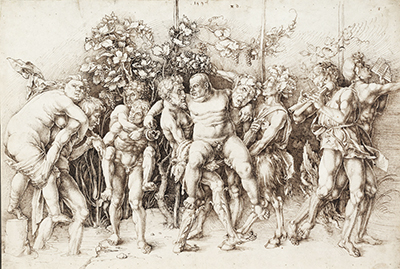
Silenus is having difficulty remaining upright. His arms stretch across the shoulders of his companions, his knees spread and his feet dangle above the ground. Around him, the business of carrying, supporting and entertaining continues with remarkable concentration. Albrecht Dürer drew this crowded assembly in 1494, working after an engraving by Andrea Mantegna. The sheet, now in Vienna’s ALBERTINA, measures 29.8 × 43.3 cm and is executed in brown pen. Its date and monogram appear above the revellers. [1]
The composition offered Dürer a demanding kind of exercise. Its figures share a narrow space, overlap almost continuously and carry one another’s weight. A misplaced shoulder or bent leg would disturb an entire group. Yet the drawing also leaves considerable freedom within those bodies: a darkened thigh, a tuft of hair or the folds across a stomach can be made in different ways. Dürer followed Mantegna closely enough for their images to invite comparison, while making hundreds of small decisions about how a pen should describe flesh.
At a Glance
- Date 1494 [1]
- Model After an engraving by Andrea Mantegna [1]
- Collection ALBERTINA, Vienna [1]
- TypeDrawing [1]
This work across Albrecht Dürer’s career
Young Hare
1502Praying Hands
1508Melencolia I
1514Four Apostles
1526Contents
- An Italian print within reach
- A procession of unequal burdens
- Why crown Silenus?
- What Dürer changes
- Close copying and material evidence
- Learning through another artist’s invention
- Frequently Asked Questions
An Italian print within reach
Mantegna’s Bacchanal with Silenus circulated as a print. The Metropolitan Museum of Art’s impression, accession 29.44.15, is catalogued as an engraving with drypoint, made before 1475; its sheet measures 30.5 × 43.8 cm. This is the design Dürer copied, with the supported Silenus in the centre and the musicians at the right. [12]
Museum Boijmans Van Beuningen connects Mantegna’s relief-like arrangement with his interest in classical sculpture. Looking across the engraving, the bodies seem assembled along a continuous frontage: shoulders turn sideways, heads appear over other heads and the central figure projects towards us. Dürer therefore encountered antiquity through an Italian artist’s organisation of it. The inherited arrangement gave him an opportunity to study how a row of interlocking figures could feel substantial on a flat sheet. [13]
The distinction between an engraving and a pen drawing matters here. Engraving involves cutting lines into a metal plate; those incisions carry the ink that produces the printed image. Dürer’s drawing deposits ink directly on paper. Suzanne Boorsch and Nadine Orenstein explain the metalworking origins of the engraved line in The Print in the North . When Dürer translated a printed passage into pen strokes, he had to recreate its effect through another tool, with a different relationship between pressure, movement and the surface. [14]
Prints also changed the distance over which an artist could study another artist’s work. As Wendy Thompson explains, Mantegna and other Renaissance artists used them to distribute inventions drawn from their engagement with ancient art and literature. The individual impression used by Dürer remains uncertain. The drawing records sustained attention to an image that could travel independently of its maker. The ALBERTINA allows that Dürer could have encountered and copied Mantegna’s widely circulating prints in Nuremberg. This sheet alone cannot establish that he made it in Venice. [15] [1]
A procession of unequal burdens
At the left, a heavy figure with a broad, exposed back twists its head towards us while clinging to a bearer. The supporting body bends beneath it. Beside them, an upright muscular man carries another reveller whose head drops close to his own. The arrangement makes looking surprisingly physical: following one person’s arm leads into another person’s chest, and tracing a hanging leg brings us back to the carrier’s effort. The separate figures become understandable through their dependence on one another.
Silenus occupies the widest and brightest patch near the centre. The folds across his abdomen are emphatic, but his face is turned sideways towards a companion. He receives attention without confronting the viewer. Behind his head, a raised arm extends through the leaves towards the crown. Below, the carriers’ legs open into an angular framework, and their feet find places on the narrow strip of ground. His suspended bulk makes their planted feet seem especially necessary.
The musicians at the right establish another rhythm. One blows into a pair of long pipes, while the figure behind turns partly away and lifts a set of shorter pipes. Their bent knees and angled legs carry the eye towards the edge. Above them, thin upright supports pass through trailing vines. These verticals steady a scene in which almost every body leans, turns or sags. The music has no visible sound, of course, but the repeated diagonals of instruments, limbs and drapery give it a persuasive visual equivalent.
Why crown Silenus?
Silenus belonged to the company of Bacchus and was traditionally associated with both intoxication and wisdom. The Metropolitan Museum identifies him here as Bacchus’s tutor and suggests that the act of crowning may acknowledge poetic gifts. It also stresses that the precise meaning of Mantegna’s bacchanals remains unsettled. That combination is useful when looking at Dürer’s drawing: the scene is comic, but its central honour need not be an empty joke. [12]
Virgil’s sixth Eclogue gives Silenus an unexpected authority. Two young companions find him asleep after drinking and bind him with his fallen garlands; the nymph Aegle joins them. On waking, he agrees to provide the song they have been trying to obtain. His performance makes fauns and wild animals dance and even draws a response from the trees. The song begins with the formation of the world and ranges through stories of transformation and desire. [16]
The drawing does not reproduce that episode literally. There is no sleeping figure in a cave, and the principal action is a coronation within a larger gathering. Virgil’s poem nevertheless helps explain why bodily excess and poetic distinction could coexist in the same character. Silenus’s unreliable legs do not necessarily cancel his powers. The attentiveness of the surrounding faces and the presence of the musicians allow a festive, knowing interpretation alongside the immediate spectacle of drunkenness. Whether Dürer himself read this passage is unknown; its relevance is to the tradition of Silenus, not a documented reading session in his workshop.
What Dürer changes
Set beside Mantegna’s engraving, the drawing initially looks remarkably faithful. The large back at the left, the central spread of Silenus’s thighs and the two musicians preserve the same broad relationships. Even small spaces between arms and torsos recur. The changes become clearer when the eye stops following the figures’ outlines and begins to follow the marks inside them. [1] [12]
In the Metropolitan Museum’s impression, long diagonal strokes sweep across the background and continue the prevailing direction of much of the shading. This produces an unusually consistent grain. Bodies emerge from a dark field that feels closely knit together. Dürer breaks that continuity. Look at the large figure at the far left: the shaded area beneath the shoulder gathers into shorter, more varied strokes, while a broad expanse of back remains open. The light seems to turn across a soft surface rather than stop at a single boundary.
The central group offers another comparison. Dürer keeps Silenus’s horizontal abdominal folds clear, then shades the lower belly and the adjoining limbs with changes in density. The bright upper torso seems almost to swell towards us. Beside it, the supporting companion’s beard forms a compact collection of curls, and the hairy leg farther right dissolves into longer, irregular strokes. These passages ask us to distinguish several surfaces in a very small area. The eye can move from rounded flesh to wiry hair without losing the structure of the supporting bodies.
The vegetation also receives a different emphasis. Above the left half of Dürer’s group, large leaves have crisp, uneven edges and broad light centres. Beneath them, bunches of grapes hang as clusters of small rounded forms. Towards the upper right, the vine thins and the surrounding paper opens out; loose curving strokes remain conspicuous. In Mantegna’s engraving, the diagonal background shading binds this region more firmly into the whole. Dürer’s mixture of dense foliage and lighter intervals gives the gathering a less uniformly enclosed setting.
At ground level, the drawing leaves pale stretches between the feet. Small stones, lines of shadow and scattered marks establish a surface without furnishing a distant view. These openings let us examine individual contacts: a heel raised, toes spread or a foot braced beneath a load. Although the figures remain crowded, the ground beneath them becomes available to the viewer’s eye. Much of the scene’s animation comes from that exchange between packed bodies and small, legible spaces.
Close copying and material evidence
The close agreement of scale and contours has encouraged the proposal that Dürer traced the engraving. The ALBERTINA’s short introduction favours that explanation, while Heinz Widauer’s longer catalogue essay says that technical evidence for tracing or transfer is lacking. The record also notes needle holes around the sheet’s edges. Those holes do not by themselves establish a transfer procedure. [1]
A different kind of technical evidence connects this drawing with Dürer’s other Vienna copy after Mantegna, The Battle of the Sea Gods . A research project conducted by the Bundesanstalt für Materialforschung und -prüfung and the Germanisches Nationalmuseum examined inks in about fifty early drawings. Using micro X-ray fluorescence analysis, the researchers compared the elemental compositions of drawing and writing materials. Their published project account reports homogeneous inks extending across the two ALBERTINA studies after Mantegna. [17]
That finding strengthens the material relationship between the sheets. It does not locate the artist’s desk or explain exactly how he established the contours. Nor does close transfer, if it occurred, settle the artistic character of the result. Copying an outline still leaves decisions about how to fill, interrupt and animate it. In this drawing, those decisions are particularly visible where a tightly controlled contour surrounds a lively accumulation of short pen strokes.
Learning through another artist’s invention
Recent scholarship has returned to the problem of what such copying meant. In his review of Anne-Sophie Pellé’s Aemulatio Italorum , Edward Wouk describes her account of these drawings as acts of cultural translation, shaped by Dürer’s own developing artistic manner. Wouk also observes that the possible role of tracing deserves attention within that discussion. The two questions belong together: a practical method of preserving a design and an ambitious response to that design can coexist. [18]
The sheet’s later history has left its own mark on the surface. The ALBERTINA records Duke Albert of Saxe-Teschen’s collector’s mark at the lower left. It lists probable ownership by Rudolf II, followed by the imperial treasury, the Court Library from 1783 and transfer to Duke Albert in 1796. These stages help explain the survival of a working encounter between two artists as a carefully preserved collection object. [1]
Dürer’s attention remains clearest in the demanding places: the carrier’s compressed shoulder, the fold beneath Silenus’s stomach, the small interval between a dangling foot and the legs supporting it. He gave time to the awkwardness of the company as well as its classical associations. The pleasure of the drawing lies partly in watching that awkwardness hold together, each unstable body made convincing by the patient activity of the pen.
Frequently Asked Questions
Artworks directory
These 187 records include individual works, reverse sides, detail views, paired panels and reconstructed arrangements. Three additional catalogue images repeat works already listed. Related views are not counted as separate originals; qualified attributions and published dating are retained.
Discussion
Look again at the images and ideas explored in Bacchanal with Silenus (after Mantegna). These editorial prompts invite your observations.
Reader Insights
Which detail or idea in Bacchanal with Silenus (after Mantegna) most changed your reading, and why?
How does the discussion of “An Italian print within reach” affect your understanding?
What comparison would you bring to the discussion of “Learning through another artist’s invention”?
Join the Conversation
Share a detail, comparison or question about Bacchanal with Silenus (after Mantegna) below.
References
- ALBERTINA , Bacchanal mit Silen (nach Mantegna) , inv. 3060; current collection record and Heinz Widauer’s essay from Albrecht Dürer , exhibition catalogue, edited by Klaus Albrecht Schröder and Maria Luise Sternath (Vienna, 2003), pp. 144–146. German, with an English introduction. View source .
- ALBERTINA, Selbstbildnis als Dreizehnjähriger, inv. 4839 (German). View source.
- Metropolitan Museum, Four Horsemen from The Apocalypse, 19.73.209 (English). View source.
- Bayerische Staatsgemäldesammlungen, Selbstbildnis im Pelzrock, inv. 537 (German). View source.
- ALBERTINA, Feldhase, inv. 3073 (German). View source.
- ALBERTINA, Das große Rasenstück, inv. 3075 (German). View source.
- Metropolitan Museum, Adam and Eve, 19.73.1 (English). View source.
- ALBERTINA, Betende Hände, inv. 3113 (German). View source.
- Metropolitan Museum, Knight, Death, and the Devil, 43.106.2 (English). View source.
- Metropolitan Museum, Melencolia I, 43.106.1 (English). View source.
- Bayerische Staatsgemäldesammlungen, inventory 545: current collection record (German; descriptive citation). View source.
- Metropolitan Museum of Art , Andrea Mantegna, Bacchanal with Silenus , before 1475, engraving with drypoint, accession 29.44.15. View source .
- Museum Boijmans Van Beuningen , Andrea Mantegna, Bacchanal with Silenus , circa 1470–1475, accession DN 650/212 (PK). View source .
- Suzanne Boorsch and Nadine M. Orenstein , The Print in the North: The Age of Albrecht Dürer and Lucas van Leyden , The Metropolitan Museum of Art Bulletin , 54, no. 4 (Spring 1997), pp. 3–4. View source .
- Wendy Thompson , “Poets, Lovers, and Heroes in Italian Mythological Prints”, Heilbrunn Timeline of Art History , Metropolitan Museum of Art, October 2004. View source .
- Virgil , Eclogues , VI, especially lines 13–40, translated by H. R. Fairclough, Loeb Classical Library (1916), reproduced by Theoi Classical Texts Library. Latin work, consulted in English translation. View source .
- Bundesanstalt für Materialforschung und -prüfung , “Albrecht Dürers frühe Federzeichnungen”, project account, 11 August 2016, especially “Methoden” and “Ergebnisse.” German. View source .
- Edward Wouk , review of Anne-Sophie Pellé, Aemulatio Italorum: La réception culturelle des gravures de Mantegna dans l’art germanique au temps d’Albrecht Dürer , Historians of Netherlandish Art Reviews , August 2024. English review of a French book. View source .
- Germanisches Nationalmuseum, Barbara Dürer (German and English). View source.
- Web Gallery of Art, Tucher–Rieter reverse (English). View source.
- National Gallery of Art, Portrait of a Clergyman (English). View source.
- Dürer Art, Portrait of a Man (English). View source.
- Hessen Kassel Heritage, Elsbeth Tucher (German). View source.
- Web Gallery of Art, Hans Tucher (English). View source.
- Germanisches Nationalmuseum, Emperor Maximilian I (German and English). View source.
- National Gallery of Art, Lot and His Daughters, reverse (English). View source.
- Bayerische Staatsgemäldesammlungen, Glim Lamentation (German). View source.
- Museo Nacional del Prado, Portrait of a Man (Spanish). View source.
- Bayerische Staatsgemäldesammlungen, Madonna of the Carnation (German). View source.
- Städel Museum, Job on the Dungheap (German). View source.
- Wallraf-Richartz-Museum, Piper and Drummer (German). View source.
- Italian Ministry of Culture / Uffizi, Head of Saint James (Italian). View source.
- Klassik Stiftung Weimar, Dresden Altarpiece (German). View source.
- Staatliche Museen zu Berlin, Girl with a Red Beret (German and English). View source.
- Dresden State Art Museums / Roland Enke, Bernhard von Reesen (German). View source.
- Royal Collection Trust, Burkhard von Speyer (English). View source.
- Dresden State Art Museums, Seven Sorrows of the Virgin (English). View source.
- Bayerische Staatsgemäldesammlungen, Mater Dolorosa (German). View source.
- Bayerische Staatsgemäldesammlungen, Lucretia (German). View source.
- Städel Museum, Young Woman with Her Hair Down (English). View source.
- ALBERTINA, Portrait of a Young Man (German). View source.







