


 by
Tom Gurney
Tom Gurney BSc (Hons) is an art history expert with over 20 years experience
Published on June 19, 2020 / Updated on October 22, 2026
Email:
tomgurney1@gmail.com
/ Phone:
+44 7429 011000
Bearded Saint in a Forest: Grünewald’s Proposed Moses: Introduction
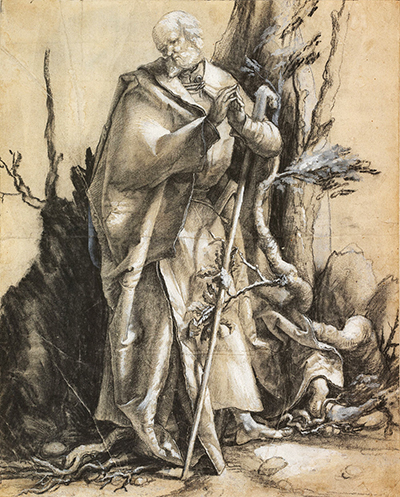
An elderly man stands beside a broken oak, his hands pressed together and his bare feet planted among its roots. Almost everything around him seems caught between darkness and a sudden illumination. This is Matthias Grünewald’s drawing, not Albrecht Dürer’s: the ALBERTINA’s Moses beneath the Burning Bush , dated about 1516, inventory 3047r. The change of name opens an intriguing question: what has this solitary figure encountered just beyond the edge of the drawing? [1]
The man's body offers several answers at once. His hands rise towards the right, while his head turns left and slightly down. The movement pulls his attention in opposing directions. He seems drawn towards something and reluctant to face it. Grünewald places that tension high in the composition, where the small, carefully articulated fingers meet the heavy sleeves. Below them, the long garments settle into a much slower rhythm. The figure's stillness is therefore active: the body holds a response which has not yet become a step.
At a Glance
- Artist Matthias Grünewald [1]
- Current title Moses beneath the Burning Bush [1]
- Date About 1516 [1]
- Collection ALBERTINA, Vienna; 3047r [1]
- TypeDrawing [1]
This work across Albrecht Dürer’s career
Young Hare
1502Praying Hands
1508Melencolia I
1514Four Apostles
1526Contents
- A figure made from light
- Charcoal and the finished drawing
- Why Moses?
- The other side and a related study
- A sheet preserved by collectors
- Frequently Asked Questions
A figure made from light
At first the cloak reads as one broad mass. Its outer edge descends from the shoulder almost to the ground, making the old man appear larger than his slight head and exposed feet would suggest. Looking longer, one discovers a sequence of pockets and shelves within the cloth. A deep fold below the joined hands cuts across the torso; a long bright ridge runs down towards the lower left; narrow dark creases gather and release along the hem. The clothing gives the upright figure much of its weight.
The tree is a second upright body. Its trunk rises close behind the man, then leaves the sheet at the top. Near the ground its spreading roots and broken limbs interrupt the cloak's descending lines. The two forms are tightly interlocked. Small spaces between cloth, staff and trunk let the pale ground show through, preventing this crowded arrangement from becoming a single dark block. Across the bottom, the roots curl horizontally, anchoring both the tree and the figure within a very shallow foreground.
Despite the familiar English title, the drawing gives little sense of a walk through an extensive forest. There is no inviting path into a distant view. A dark wedge presses against the man's left side, and the tree closes the space on the right. The sparse foliage is concentrated beside his upper body. Beyond these forms, the comparatively empty paper makes the encounter feel isolated. Grünewald has organised a setting around one person's response, leaving much of the surrounding world undescribed.
The museum identifies the medium as charcoal, partly rubbed and fixed, with brush-applied white heightening on yellow-grey washed paper; the sheet measures 36.2 × 29.2 centimetres. Its range of tones is especially clear at the shoulder. The wash provides an intermediate value, dark strokes establish the recesses, and touches of white lift the exposed cloth towards the light. Lower down, the illuminated fabric becomes a long, irregular ribbon. The highlights do not trace every edge with equal force: they select the passages which make the folds seem to turn. [1]
The light also joins otherwise separated parts of the picture. The old man's scalp, the front of his clothing and a pale patch of earth at lower right register as points within the same event. His feet remain close to the roots, but the bright ground beside them opens a small breathing space. Following these scattered accents brings the eye from his head to the earth and back again. Illumination supplies a connection that the dense tangle of outlines alone could not establish.
Charcoal and the finished drawing
Charcoal can produce both a sharp mark and a spread of tone. Here the distinction matters as much as the contrast between black and white. Some passages retain wiry contours, especially around the roots and small branches; elsewhere the dark material spreads into broad, soft shadows. A reproduction can make these differences look like changes in ink or paint, although the sheet's recorded materials describe a deliberately worked charcoal surface.
Georg Josef Dietz's technical account, published in 2009, explains how research changed the understanding of Grünewald's black drawing materials. In a Berlin–Stuttgart project associated with the 2008 Grünewald exhibition, examination at magnifications of 25 to 100 times distinguished charcoal from black chalk through the particles' forms and their distribution on the paper. The researchers also identified a fixing procedure: binder used to prepare the paper was reactivated after drawing, securing the charcoal. Dietz's short contribution does not identify 3047r as a tested sheet, so these findings provide context for Grünewald's practice rather than a laboratory report on this particular drawing. [12]
That context helps explain why a charcoal drawing need not be a fleeting first notation. On this sheet, darkness has been gathered into sustained masses and balanced against small, forceful lights. The head occupies very little space, yet the transition from its bright upper surface into the beard makes it conspicuously solid. The upper garment is developed with comparable care. Whatever practical purpose the sheet once served, its effect depends upon a patient adjustment of tonal relationships.
Why Moses?
Christof Metzger proposes Moses, following earlier suggestions of Joseph, Jerome or Peter; he also suggests a connection with the lost left wing associated with the Stuppach Madonna . Both proposals concern questions the drawing leaves open: the figure's identity and the work for which he may have been conceived. [1]
Exodus 3 gives the Moses reading a clear narrative framework. Moses is tending his father-in-law's flock when he sees a bush burning without being consumed. As he approaches, God calls to him and commands him to remove his shoes because he stands on holy ground. Moses then hides his face, afraid to look upon God. The encounter leads to his commission to bring the Israelites out of Egypt. Bare feet and an averted face consequently carry particular significance within this story, while the staff suits the shepherd's setting. [13]
The drawing nevertheless concentrates on a human response without supplying the whole episode. No unmistakable flames rise from the branches. The large tree occupies much of the sheet, but its presence alone cannot establish the burning bush of Exodus. Nor do the joined hands reproduce the text's action of covering the face. Read as Moses, the figure makes the moment legible through prayer, bodily hesitation and light. These correspondences make the proposal worth considering; they leave room for the uncertainty preserved in the work's older titles.
The sword at the man's side introduces another visual complication. Its angular shape sits among the straighter lines of the staff and garment, adding an object which is easier to recognise than to explain securely. A viewer can inspect it without turning it into a decisive clue. The whole pose matters more than any one accessory: the head withdrawing from the hands' direction, the exposed feet meeting the ground, and the constricted space around the body create an encounter whose unseen cause feels powerful.
The other side and a related study
Turning the sheet changes the experience completely. The reverse, catalogued as an unfinished study of Saint Peter and dated about 1516–1519, is viewed horizontally. A lightly drawn figure occupies the left portion. Much of the remaining surface carries the faint, reversed presence of forms from the front. Near the centre-right, the paper’s bull’s-head watermark, with its long cross and snake, is conspicuous. Across this open surface, the photograph brings two differently developed drawings into contact. [14]
The reverse figure's head, raised hand and long garment remain much more open than the front's dense modelling. Lines indicate where forms might settle; a few rubbed areas suggest volume without filling the surrounding space. Seeing both sides guards against treating the highly finished front as the only kind of drawing Grünewald made. It also reveals the practical reuse of one sheet. The two studies' physical conjunction does not establish that they belonged to the same painted composition.
A useful comparison is Grünewald's Study for the Stuppach Madonna , KdZ 12039 in Berlin. Michael Roth's catalogue entry, reproduced by the Kupferstichkabinett, relates it directly to the surviving painting and explains that major changes to figures and costume accompanied the move from drawing to panel, even while much of the drapery design remained binding. In the drawing itself, the seated Virgin's enormous skirt spreads across the foreground beside another tree. The cloth seems to wrap around the trunk at its base. As in the standing old man, fabric and wood occupy the space together, with folds and roots making a continuous sequence of turns. [15]
The comparison provides a concrete example of Grünewald working through a figure's relationship to a tree and to heavy clothing. It cannot, by itself, assign the old man to a particular altarpiece. Similar visual problems may recur across different subjects, and even an established preparatory drawing can differ substantially from its painted result.
The altarpiece's missing section further complicates reconstruction. Andreas Menrad's account of the Stuppach Madonna and its restoration explains that Heinrich Reitzmann's 1517 testament commissioned a painting of the Snow Miracle, now in Freiburg, for an enlarged ensemble. The frame bears the completion date 1519. Menrad stresses the absence of equivalent evidence for the lost left panel's subject and allows the possibility of a donor image. That documentary gap gives Metzger's proposed Moses a possible place, but no surviving agreement or panel confirms it. The drawing remains more securely understood as an image than as a recovered fragment of a lost programme. [16]
There is a historical reason why Moses at the bush could enter a Marian programme. The Latin antiphon Rubum quem viderat Moyses connects the unconsumed bush with Mary's preserved virginity and asks the Mother of God to intercede. Cantus records the chant in a fourteenth-century Einsiedeln antiphoner. This comparison shows how an Old Testament scene could carry Marian meaning. It establishes a relevant religious tradition, without proving that Grünewald illustrated the chant or conceived this figure for Reitzmann's altarpiece. [17]
A sheet preserved by collectors
The ALBERTINA traces the drawing from Gottfried Winckler to Duke Albert of Saxe-Teschen, with acquisition around or shortly before 1795 uncertain. Its earlier association with the Grimmers, Philipp Uffenbach and Abraham Schelckens is qualified as probable. An older written account helps explain why those names matter. [1]
In his Teutsche Academie of 1675, Joachim von Sandrart recalled visiting Uffenbach while attending school in Frankfurt. Uffenbach showed him a book of drawings attributed to Grünewald, praising their qualities as they looked through it. Sandrart described the collection's descent through Grimmer and its subsequent sale by Uffenbach's widow to the collector Abraham Schelckens. This is testimony to drawings being kept, studied and valued long before their arrival in a modern museum. It does not identify the present sheet individually, and Sandrart's compressed account of the Grimmer succession requires caution. [18]
His description of drawings made largely in black chalk also preserves the vocabulary of an earlier age of connoisseurship. Set beside modern technical investigation, it reminds us that the name of a material can change while admiration for the marks themselves persists. The old man still rewards the kind of concentrated looking that Sandrart remembered: first the arresting whole, then the small transitions through which cloth, skin, wood and light acquire their distinct presences.
Frequently Asked Questions
Artworks directory
These 187 records include individual works, reverse sides, detail views, paired panels and reconstructed arrangements. Three additional catalogue images repeat works already listed. Related views are not counted as separate originals; qualified attributions and published dating are retained.
Discussion
Look again at the images and ideas explored in Bearded Saint in a Forest: Grünewald’s Proposed Moses. These editorial prompts invite your observations.
Reader Insights
Which detail or idea in Bearded Saint in a Forest: Grünewald’s Proposed Moses most changed your reading, and why?
How does the discussion of “A figure made from light” affect your understanding?
What comparison would you bring to the discussion of “A sheet preserved by collectors”?
Join the Conversation
Share a detail, comparison or question about Bearded Saint in a Forest: Grünewald’s Proposed Moses below.
References
- ALBERTINA , Vienna, Moses unter dem brennenden Dornbusch , Matthias Grünewald, 3047r, object record, interpretive essay and provenance, last edited 13 October 2025. German. View source .
- ALBERTINA, Selbstbildnis als Dreizehnjähriger, inv. 4839 (German). View source.
- Metropolitan Museum, Four Horsemen from The Apocalypse, 19.73.209 (English). View source.
- Bayerische Staatsgemäldesammlungen, Selbstbildnis im Pelzrock, inv. 537 (German). View source.
- ALBERTINA, Feldhase, inv. 3073 (German). View source.
- ALBERTINA, Das große Rasenstück, inv. 3075 (German). View source.
- Metropolitan Museum, Adam and Eve, 19.73.1 (English). View source.
- ALBERTINA, Betende Hände, inv. 3113 (German). View source.
- Metropolitan Museum, Knight, Death, and the Devil, 43.106.2 (English). View source.
- Metropolitan Museum, Melencolia I, 43.106.1 (English). View source.
- Bayerische Staatsgemäldesammlungen, inventory 545: current collection record (German; descriptive citation). View source.
- Georg Josef Dietz , “Kunsttechnologische Forschung zur Zeichentechnik am Beispiel schwarz zeichnender Stifte der Renaissance,” in Wilhelm Krull and Bernhard Graf, eds., Was heißt und zu welchem Ende betreibt man Forschung in Museen? , Mitteilungen und Berichte aus dem Institut für Museumsforschung 48 (Berlin, 2009), pp. 95–97. German. View source .
- Exodus 3 , King James Version, especially verses 1–6. English translation. View source .
- ALBERTINA , Vienna, Unvollendete Studie des heiligen Petrus , Matthias Grünewald, 3047v, object record, last edited 13 October 2025. German. View source .
- Staatliche Museen zu Berlin , Kupferstichkabinett, Studie zur Stuppacher Madonna (Madonna dell' Umiltà) , KdZ 12039, including Michael Roth's entry from Matthias Grünewald. Die Zeichnungen (2008), pp. 65–66, cat. 23; record updated 9 October 2026. German. View source .
- Andreas Menrad , “Grünewalds Ikone im Landesamt für Denkmalpflege. Die Restaurierung der ‘Stuppacher Madonna’”, Denkmalpflege in Baden-Württemberg 42, no. 2 (2013), pp. 62–68, especially pp. 64–65. German. View source .
- Cantus Index , Rubum quem viderat Moyses , chant 004669, complete Latin text; Cantus Database, Einsiedeln, Stiftsbibliothek 611, fol. 34r, chant 2, manuscript and chant record. Latin primary liturgical text; English catalogue metadata. View source 1 . View source 2 .
- Joachim von Sandrart , Teutsche Academie , 1675, II, book 3, p. 236, passage on Grünewald's drawings and their collectors; digital scholarly edition, Sandrart.net. German, seventeenth century. View source .
- Germanisches Nationalmuseum, Barbara Dürer (German and English). View source.
- Web Gallery of Art, Tucher–Rieter reverse (English). View source.
- National Gallery of Art, Portrait of a Clergyman (English). View source.
- Dürer Art, Portrait of a Man (English). View source.
- Hessen Kassel Heritage, Elsbeth Tucher (German). View source.
- Web Gallery of Art, Hans Tucher (English). View source.
- Germanisches Nationalmuseum, Emperor Maximilian I (German and English). View source.
- National Gallery of Art, Lot and His Daughters, reverse (English). View source.
- Bayerische Staatsgemäldesammlungen, Glim Lamentation (German). View source.
- Museo Nacional del Prado, Portrait of a Man (Spanish). View source.
- Bayerische Staatsgemäldesammlungen, Madonna of the Carnation (German). View source.
- Städel Museum, Job on the Dungheap (German). View source.
- Wallraf-Richartz-Museum, Piper and Drummer (German). View source.
- Italian Ministry of Culture / Uffizi, Head of Saint James (Italian). View source.
- Klassik Stiftung Weimar, Dresden Altarpiece (German). View source.
- Staatliche Museen zu Berlin, Girl with a Red Beret (German and English). View source.
- Dresden State Art Museums / Roland Enke, Bernhard von Reesen (German). View source.
- Royal Collection Trust, Burkhard von Speyer (English). View source.
- Dresden State Art Museums, Seven Sorrows of the Virgin (English). View source.
- Bayerische Staatsgemäldesammlungen, Mater Dolorosa (German). View source.
- Bayerische Staatsgemäldesammlungen, Lucretia (German). View source.
- Städel Museum, Young Woman with Her Hair Down (English). View source.
- ALBERTINA, Portrait of a Young Man (German). View source.







