


 by
Tom Gurney
Tom Gurney BSc (Hons) is an art history expert with over 20 years experience
Published on June 19, 2020 / Updated on October 22, 2026
Email:
tomgurney1@gmail.com
/ Phone:
+44 7429 011000
Christ before Pilate (Small Passion): Introduction
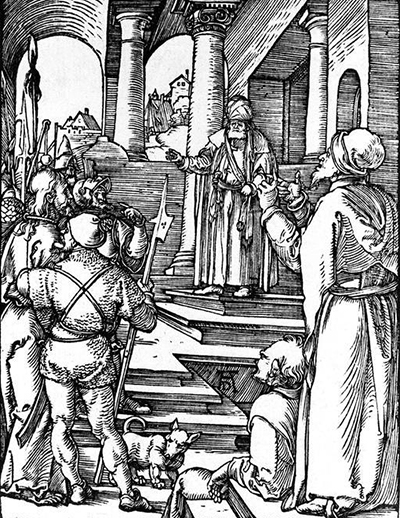
Pilate occupies the highest step, but the most insistent figure stands much closer to us. Seen from behind at the right, a man in a long robe raises his hands towards the governor. Across the open space, Christ stands under guard at the left. Albrecht Dürer makes the hearing a contest of positions: one man commands, another argues, and the prisoner waits while other people decide what will happen to him. The scene belongs to the woodcut Small Passion , designed around 1508–09 and published as a book in 1511. Its catalogue numbers, Bartsch 31 and Meder 140, distinguish this composition from Dürer’s separate engraved treatment of the subject. [1]
The small format sharpens the encounter. The Metropolitan Museum of Art’s impression measures only 12.8 by 9.8 centimetres, yet the image contains several levels of architecture, a crowded escort, the governor and his interlocutors, a dog and distant buildings. The museum dates its woodcut to about 1508; its sheet entered the collection through Junius Spencer Morgan’s gift in 1919. Seen enlarged, the composition can look like a scene designed for a much larger surface. At its printed scale, the broad gestures and clear divisions of light keep the argument readable. [2]
At a Glance
This work across Albrecht Dürer’s career
Young Hare
1502Praying Hands
1508Melencolia I
1514Four Apostles
1526Contents
- A court organised around distance
- The hearing within the Passion
- A design made to be printed again
- The composition in other hands
- Frequently Asked Questions
A court organised around distance
Christ is surprisingly easy to overlook. His head appears near the left border, beyond the shoulder of a soldier whose back faces us. The guard’s short, closely patterned garment, crossed straps and firmly planted legs occupy more foreground space than the prisoner. Christ’s long robe descends behind him. Their overlap gives confinement a physical form: the escort interrupts our view as well as controlling the prisoner’s movement.
The weapons continue that enclosure upwards. Spear shafts and pointed blades rise beside Christ into the bright opening of an arch. Their narrow verticals crowd together, while Pilate has room to extend an arm. The difference between them is immediately legible. Christ’s surrounding figures compress his space; the governor’s surroundings enlarge his.
Pilate stands near the centre, his long garment reaching the top of the stair. His head is wrapped, and a chain or cord with a large round ornament hangs across his chest. One hand remains near his waist while the other reaches out, palm exposed. The gesture is open enough to suggest questioning or response. Dürer leaves the precise spoken words to the story surrounding the image. What we can see is that Pilate addresses someone below him without leaving his elevated place.
The stairs are the composition’s most effective barrier. Their light treads and dark risers make a broken path up through the middle of the picture. We can follow that path with our eyes, although the bodies at either side make it difficult to imagine walking into the hearing. The foreground man’s broad back closes the right edge; the armed guard anchors the left. A lower, seated figure at the right adds another watching presence. The court feels occupied before we arrive.
Behind Pilate, columns and arches extend the space. The rounded openings admit bright sky and glimpses of steep roofs, while the building at the right presents a more closed, shadowed face. Curved strokes follow the barrel vault at the upper left; straight hatching gives weight to the columns and wall. These contrasts help the eye move between the crowded foreground and the more spacious setting above it. The distant buildings supply a world beyond the immediate confrontation, but the picture gives us no secure route out into it.
At the bottom, a small dog stands between the soldier’s legs and the seated observer. Its alert head introduces a different scale of attention. After following the raised arms and weapons, we notice an animal close to the floor, amid the human feet. The detail makes the gathering feel less abstract and more inhabited. It also keeps the lowest part of the image active: power is concentrated above, while life continues at ground level.
Art historian Sabine Siemer reads the three principal figures as a triangle whose unequal levels express their unequal power. She also proposes a theological meaning for the architecture: the bright arches associated with Christ and Pilate contrast with the dark opening behind the accuser. That interpretation links illumination with the recognition of Christ’s divinity. Siemer further notes the hostile collective accusation against Jews in Chelidonius’s accompanying poem. These readings bring the Christian polemical framework of the book into view. The image’s opposed figures and the poem’s accusations belong to that framework; they cannot serve as historical evidence for collective Jewish responsibility for Jesus’s death. [13]
The hearing within the Passion
Luke’s account supplies a particularly useful way to follow the legal movement around this scene. Jesus is accused before Pilate of political offences, including opposition to tribute and a claim to kingship. Pilate questions him about being king of the Jews and declares that he finds no fault. Learning of Jesus’s Galilean connection, he sends him to Herod. Herod’s questioning and mockery lead to a return to Pilate, who again states that he has found no offence deserving death. Eventually Pilate yields to the demand for crucifixion and releases Barabbas. [14]
Read against this sequence, the raised hand and divided groups suggest a decision still being contested. The viewer knows where the Passion will lead, but the image holds attention on the intervening exchange. Luke’s repeated declarations of innocence also create a tension between Pilate’s judgement and his eventual action. His elevated position gives him the capacity to decide; it does not guarantee that he will act justly. [14]
Dürer gives this encounter its own place between the Mocking of Christ and Christ before Herod. Bridwell Library’s presentation of its 1511 book preserves that sequence and identifies the following episode as Pilate’s referral to Herod. The ordering encourages the reader to experience successive changes of custody. A single leaf isolates the hearing; the book makes it another stage in a sustained passage through other people’s power. Luke’s account helps us follow the succession of hearings. The costumes, architecture and gestures give the encounter its distinctive form in Dürer’s image. [15]
The Small Passion contained thirty-six narrative woodcuts and a title image, with a colophon bringing the book to thirty-eight leaves. Benedictus Chelidonius supplied Latin verse, so a reader encountered the sequence through both pictures and poetry. The compact court scene belongs to this larger devotional experience. Turning onwards meant leaving one hearing for another, and eventually following Christ towards execution and beyond it. The repeated encounters gave small changes of posture and setting considerable narrative work to do. [16]
A design made to be printed again
The image’s alternating light and darkness depend on woodcut’s physical construction. In relief printing, the cutter removes the spaces around the intended lines, leaving the printable surface raised. Ink applied to that surface transfers the design to paper under pressure. Here, the white steps, sky and exposed portions of clothing are as necessary as the black contours. A narrow dark edge can separate two overlapping bodies; a cluster of short strokes can distinguish the guard’s patterned clothing from the long folds of Pilate’s robe. [17]
The architecture makes especially clear how economical this vocabulary can be. A column takes shape through parallel marks and a curved boundary, while an adjacent strip of untouched paper supplies its light. The vault is described by repeated arcs whose spacing changes as they recede. Nothing requires a coloured wash to explain the space. The same black ink produces the close texture of the soldier’s clothing, the softness of fur and the harder edges of steps. Their different arrangements make the materials appear different.
Once the block existed, further impressions could carry this arrangement to other readers. The 1511 publication date therefore describes one important moment in the design’s history. It cannot date every surviving sheet. Cornell’s Herbert F. Johnson Museum of Art holds an impression specifically catalogued as a later printing, about 1540–50, although its record also gives 1511 in the date field. Its object number is 63.044. Keeping those pieces of information together reveals the distinction: the earlier date identifies the book’s historical setting, while the title specifies a later printing of this particular impression. [18]
The date, size and ownership listed by a museum belong to its individual impression. In reproductions the composition can look identical from sheet to sheet, even though each piece of paper has its own printing and collecting history. [2] [18]
An unusually revealing survival is the Rijksmuseum’s uncut sheet RP-P-OB-1360. It holds four Small Passion scenes: Christ before Caiaphas at upper left, the Mocking at upper right, Christ before Pilate below left and Christ before Herod below right. The museum dates the group to 1508–09 and records a sheet measuring 35.2 by 25.2 centimetres, with each image approximately 12.7 by 9.7 centimetres. [19]
The wide blank intervals are striking. The images occupy the four corners of the larger sheet, separated by substantial expanses of paper. Pilate’s hearing, which seems so self-contained when closely cropped, becomes one of four distinct compartments. Looking from the lower left to the lower right also makes the transfer between rulers visible at a glance. Pilate stands in an open colonnaded setting; Herod sits within a more enclosed interior. The physical sheet preserves their proximity while each scene maintains its own border and organisation. It offers another way to encounter a sequence that readers generally meet one image at a time.
The composition in other hands
Later artists could reuse this arrangement through fresh work in other materials. In Klosterneuburg’s Codex 1159, a manuscript of Brother Berthold’s Zeitglöcklein des Lebens und Leidens Christi dated 1544, the miniature on folio 95 recto follows Dürer’s Pilate composition. The scholarly manuscript catalogue identifies extensive borrowing from the Small Passion throughout this volume. [20]
On that page, the governor still extends his arm from the highest steps. Christ and his guard remain at the left, and the standing accuser presents his back at the right. Colour changes the distribution of attention: the accuser wears a conspicuous orange robe with green sleeves, while blue appears in the governor’s sleeves and the clothing at the left. Brown columns rise behind Pilate. A gold frame encloses the whole encounter. The dog has disappeared, leaving a more open area of floor beneath the soldier. [21]
The miniature demonstrates how much of the scene could survive such changes. Its stairway, overlapping bodies and opposed gestures continue to organise the hearing, although brushwork and colour replace the woodcut’s dense network of black strokes. Repeated printing was only one means of extending the design’s life. A painter could select its essential relationships and fit them into a different devotional book.
Virgil Solis also recast the scene in a woodcut published by Valentin Geißler in Nuremberg in 1552. The Staatsbibliothek Bamberg’s example, I E 30ba, is described by Franziska Ehrl as a reversed copy with altered details, including the omission of the town view and a changed pose for the dog. German printed text on the reverse connects the surviving leaf with a book. This was a new carved version, distinct from later impressions of Dürer’s own design. Alongside the manuscript miniature, it shows the court scene remaining useful to makers of devotional images decades after its first publication. [22]
In Dürer’s woodcut, the central stairway retains its force. The eye can climb it easily; Christ remains below. Across that distance, gesture, rank and guarded silence make an argument whose outcome the reader already knows. The image asks us to spend time with the human arrangement through which that outcome is reached.
Frequently Asked Questions
Artworks directory
These 187 records include individual works, reverse sides, detail views, paired panels and reconstructed arrangements. Three additional catalogue images repeat works already listed. Related views are not counted as separate originals; qualified attributions and published dating are retained.
Discussion
Look again at the images and ideas explored in Christ before Pilate (Small Passion). These editorial prompts invite your observations.
Reader Insights
Which detail or idea in Christ before Pilate (Small Passion) most changed your reading, and why?
How does the discussion of “A court organised around distance” affect your understanding?
What comparison would you bring to the discussion of “The composition in other hands”?
Join the Conversation
Share a detail, comparison or question about Christ before Pilate (Small Passion) below.
References
- National Museum of Western Art , Tokyo, Christ before Pilate: The Small Passion 16, G.2024-0026, collection record updated 24 June 2026. Japanese and English. View source .
- Metropolitan Museum of Art , Christ before Pilate, from The Small Passion , 19.73.185. English. View source .
- ALBERTINA, Selbstbildnis als Dreizehnjähriger, inv. 4839 (German). View source.
- Metropolitan Museum, Four Horsemen from The Apocalypse, 19.73.209 (English). View source.
- Bayerische Staatsgemäldesammlungen, Selbstbildnis im Pelzrock, inv. 537 (German). View source.
- ALBERTINA, Feldhase, inv. 3073 (German). View source.
- ALBERTINA, Das große Rasenstück, inv. 3075 (German). View source.
- Metropolitan Museum, Adam and Eve, 19.73.1 (English). View source.
- ALBERTINA, Betende Hände, inv. 3113 (German). View source.
- Metropolitan Museum, Knight, Death, and the Devil, 43.106.2 (English). View source.
- Metropolitan Museum, Melencolia I, 43.106.1 (English). View source.
- Bayerische Staatsgemäldesammlungen, inventory 545: current collection record (German; descriptive citation). View source.
- Sabine Siemer , Die Passionsdarstellungen von Albrecht Dürer: Theologie und Rezeptionsästhetik , Heidelberg: arthistoricum.net, 2023, section 4.2.16, especially p. 146. German. Chapter PDF. View source 1 . View source 2 .
- Luke 23:1–25 , King James Version. English translation. View source .
- Bridwell Library , Southern Methodist University, Christ before Pontius Pilate , Books and Prints by Albrecht Dürer . English. View source .
- Bridwell Library , Southern Methodist University, The Small Passion , Books and Prints by Albrecht Dürer . English. View source .
- Bridwell Library , Southern Methodist University, Introduction to Woodcuts , Books and Prints by Albrecht Dürer . English. View source .
- Herbert F. Johnson Museum of Art , Cornell University, Christ before Pilate, from the Small Passion (later printing, c. 1540–50) , 63.044. English. View source .
- Rijksmuseum , Christus voor Kajafas, Bespotting, Christus voor Pilatus, Christus voor Herodes , RP-P-OB-1360. Dutch. View source .
- Regina Cermann and Isabel von Bredow-Klaus , Klosterneuburg, Stiftsbibliothek, Cod. 1159 , Katalog der deutschsprachigen illustrierten Handschriften des Mittelalters , entry published 20 November 2018. German. View source .
- Klosterneuburg , Augustiner-Chorherrenstift, Cod. 1159, fol. 95r, digital facsimile, Österreichische Akademie der Wissenschaften / manuscripta.at. German manuscript; visual source. View source .
- Staatsbibliothek Bamberg; Franziska Ehrl , Christus vor Pilatus , Virgil Solis after Dürer, 1552, I E 30ba, collection record in Graphikportal. German. View source .
- Germanisches Nationalmuseum, Barbara Dürer (German and English). View source.
- Web Gallery of Art, Tucher–Rieter reverse (English). View source.
- National Gallery of Art, Portrait of a Clergyman (English). View source.
- Dürer Art, Portrait of a Man (English). View source.
- Hessen Kassel Heritage, Elsbeth Tucher (German). View source.
- Web Gallery of Art, Hans Tucher (English). View source.
- Germanisches Nationalmuseum, Emperor Maximilian I (German and English). View source.
- National Gallery of Art, Lot and His Daughters, reverse (English). View source.
- Bayerische Staatsgemäldesammlungen, Glim Lamentation (German). View source.
- Museo Nacional del Prado, Portrait of a Man (Spanish). View source.
- Bayerische Staatsgemäldesammlungen, Madonna of the Carnation (German). View source.
- Städel Museum, Job on the Dungheap (German). View source.
- Wallraf-Richartz-Museum, Piper and Drummer (German). View source.
- Italian Ministry of Culture / Uffizi, Head of Saint James (Italian). View source.
- Klassik Stiftung Weimar, Dresden Altarpiece (German). View source.
- Staatliche Museen zu Berlin, Girl with a Red Beret (German and English). View source.
- Dresden State Art Museums / Roland Enke, Bernhard von Reesen (German). View source.
- Royal Collection Trust, Burkhard von Speyer (English). View source.
- Dresden State Art Museums, Seven Sorrows of the Virgin (English). View source.
- Bayerische Staatsgemäldesammlungen, Mater Dolorosa (German). View source.
- Bayerische Staatsgemäldesammlungen, Lucretia (German). View source.
- Städel Museum, Young Woman with Her Hair Down (English). View source.
- ALBERTINA, Portrait of a Young Man (German). View source.







