


 by
Tom Gurney
Tom Gurney BSc (Hons) is an art history expert with over 20 years experience
Published on June 19, 2020 / Updated on October 22, 2026
Email:
tomgurney1@gmail.com
/ Phone:
+44 7429 011000
Christ Being Nailed to the Cross (Small Passion): Introduction
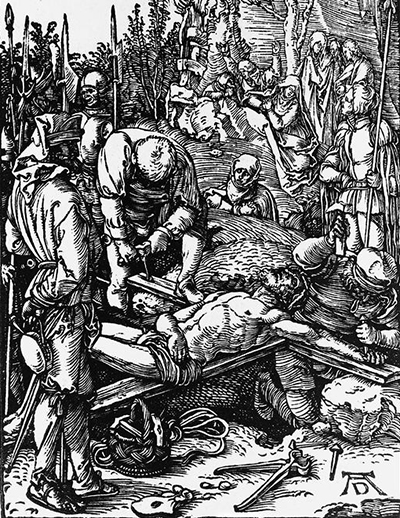
The cross is still on the ground. Christ lies across it while two men work over the timber and his outstretched hand; another stands close by, watching. In Albrecht Dürer’s Christ Being Nailed to the Cross , the crucifixion becomes a task carried out at arm’s length, among tools, discarded fabric and uneven earth. The Metropolitan Museum of Art dates this small woodcut to about 1509. Its impression, accession 19.73.193, measures only 12.7 × 9.8 centimetres. Within that narrow space, Dürer brings the preparations for an execution almost to the viewer’s feet. [1]
Christ’s head lies towards the right, his legs extending left. His torso crosses the lower part of the image on a rising diagonal, supported by beams whose squared edges remain plainly visible. One arm reaches along the crosspiece towards the right border, where a crouching executioner grips the hand and holds a hammer above it. The man’s own body is partly cut off by the frame. This crowded edge makes his concentration feel especially close: there is barely room for him, the hammer and the hand on which he is working.
Near the other end of the cross, a second man bends deeply at the waist. His hands hold the transverse handle of a boring tool, with its shaft directed into the timber. His bowed head conceals his expression. The position of his shoulders and the firm spread of his legs communicate effort without a theatrical gesture. Dürer gives the execution the practical movements of manual work. Boring the wood and driving a nail occupy the men as separate operations, while Christ’s exposed body joins those actions into a single ordeal.
The standing figure at the left is turned away from us. His feathered hat, belted clothing and sword establish a substantial barrier between the viewer and Christ’s feet. The pale sleeve and sharply folded clothes also balance the worker on the right. These large figures press the action down into the foreground, leaving the body stretched between them. We can see what is happening with painful clarity, but cannot approach it through an open, welcoming space.
At a Glance
- Design date About 1509 [1]
- Process Woodcut [1]
- Example impression Metropolitan Museum of Art, 19.73.193 [1]
This work across Albrecht Dürer’s career
Young Hare
1502Praying Hands
1508Melencolia I
1514Four Apostles
1526Contents
- Tools, bodies and witnesses
- A small image within a printed Passion
- The same design on different pages
- A composition carried into another language
- Frequently Asked Questions
Tools, bodies and witnesses
The ground contains more than incidental clutter. A pair of long-handled pincers lies diagonally near the bottom edge, beside loose nails. A bundled garment rests beneath the cross, and a woven basket stands under its right end. These objects give the violence a material vocabulary: metal, wood, cloth and flesh occupy the same small working area. The pincers repeat the oblique directions of the beams and limbs, carrying the eye back into the scene. Dürer places his AD monogram nearby, within the foreground rather than above the action.
Each surface receives a different arrangement of lines. The cross has long, straight edges; the basket is tightly interwoven; the garment bunches into curved folds. Short, bending strokes describe Christ’s ribs and abdomen. His chest is relatively light against the dense clothing and shaded ground surrounding it. The whiteness of the paper makes the skin vulnerable and conspicuous, while the body’s modelling prevents it from dissolving into an empty patch. The marks that give Christ physical weight also make his exposure difficult to overlook.
Beyond this immediate activity, the setting rises into a bank occupied by spectators and mourners. At the upper right, one figure lifts both hands while others cluster together among the trees. Lower down, a veiled woman holds out her hands towards the execution. Their gestures of distress interrupt the workmen’s absorbed movements, but the bank keeps them apart from the body. On the left, helmeted men and upright weapons create another kind of gathering. The spears form a stiff screen behind the foreground figure, answering the bare tree trunks across the image.
The separation matters emotionally. Dürer distributes different responses across the sheet: the men handling tools, the armed observers and the grieving group do not share one expression or one rhythm. Christ remains the still centre of their incompatible activities. His head turns towards the man beside his hand, bringing the sufferer’s face close to the executioner’s lowered head. The interaction is intimate in distance and brutal in purpose. Above it, the space between the trees offers little release; parallel strokes fill much of the sky.
The Gospel accounts provide the event’s foundation, but leave the artist considerable room to construct its physical details. John 19:17–18 tells of Christ going to Golgotha and being crucified between two others. The same chapter places his mother, other women and the beloved disciple beside the cross. It does not describe this arrangement of workmen, their tools or the cross lying across the foreground. Dürer expands a compressed narrative into a scene that can be examined action by action. [12]
The dark sky reinforces the gravity of the subject, although it cannot establish a precise biblical hour. In Luke 23:44–46, darkness extends from the sixth to the ninth hour, before Christ’s final words and death. The nailing belongs to an earlier stage of the execution. The sombre sky can gather the Passion’s gravity into the scene without fixing it to a single reported moment. [13]
A small image within a printed Passion
The force of the lines depends on the woodcut process. The marks that received ink stood above the areas cut away from the block; paper pressed against that raised surface received the image. Fine white intervals had to survive between the dark strokes, even where the design became crowded. This relief method allowed the composition to be printed repeatedly, while giving the close-packed clothes, foliage and shadows their strongly articulated texture. [14]
Its compactness suited the book for which it was made. The Small Passion appeared in Nuremberg in 1511 as a small quarto of 38 leaves, with a title page, 36 narrative woodcuts and a colophon. Benedictus Chelidonius supplied Latin verses. The date of that publication explains the frequent association of this scene with 1511, alongside the earlier dating of its design. The title distinguishes this woodcut sequence from Dürer’s larger Passion book and from his separate engraved Passion. [15]
Chelidonius’s verse gives the stillness of Christ a devotional meaning. In the Latin poem accompanying this scene, reproduced in an 1894 edition, he describes Christ as willingly extending his royal arms towards savage wolves. The contrast is between the victim’s voluntary offering and the executioners’ violence. Read with the image, the poem asks the Christian reader to understand Christ’s immobility as an act of will, even as the workmen exert force upon him. [16]
Within the sequence, Christ Being Nailed to the Cross comes after the presentation of Veronica’s cloth and before the Crucifixion . That placement makes the grounded cross a brief, necessary interval before the familiar upright image. Dürer gives attention to the handling of the body before its elevation, extending the reader’s encounter with the Passion beyond its most recognisable emblem. [15]
A surviving uncut sheet in the Rijksmuseum makes this relationship unusually tangible. It contains four compositions: the carrying of the cross and Veronica above, the nailing and crucifixion below. The museum identifies it as RP-P-OB-1362 and dates it to 1509–10; the whole sheet measures 35.2 × 25.2 centimetres. The nailing occupies the lower left, separated from the other images by broad areas of paper. Here an image often encountered as an isolated rectangle remains visible within a larger printed arrangement. [17]
Across that sheet, Christ’s body changes orientation. He bears the cross in the upper-left scene, lies across it below, then hangs from it at the lower right. Veronica’s cloth introduces another kind of bodily presence: a face retained as an image. Art historian Shira Brisman reads such acts of contact and transfer throughout the Small Passion in relation to printing itself. Her argument connects the divine body’s traces with the impressions made by a block upon paper. It offers a way to consider the nailing’s place within a sequence concerned with touching, supporting and injuring Christ, without turning every tool into a secret emblem. [18]
The same design on different pages
The survival of more than one impression also reveals how the composition could acquire a new setting. Alongside its small sheet dated about 1509, the Met owns an impression catalogued to the Venetian edition of 1612, accession 1986.1180.78. Its image measures 12.6 × 9.7 centimetres, while its sheet is substantially larger, at 20.5 × 14.7 centimetres. The extra dimensions belong to the paper around the design. They do not describe an enlarged cross or a newly expanded block. [19]
That distinction changes how we imagine encountering the work. In a closely trimmed impression, the execution presses against the edges of the surviving object. A wider sheet gives the same small composition more surrounding space. Neither measurement alone tells us how every example was bound, handled or displayed. It does show why the title of a print cannot stand for one universally sized physical object. The Met’s two sheets also have separate collecting histories: the impression dated about 1509 came through Junius Spencer Morgan’s gift in 1919; the 1612 example through Grace M. Pugh’s bequest. [1] [19]
The later date records a substantial afterlife for the printing material. The British Museum’s account of the surviving Small Passion blocks places them in Venice by 1612, when Daniel Bissuccio published an Italian edition. Its title page used an engraving based on a portrait medal of Dürer by Matthes Gebel. The museum acquired 35 of the cycle’s 37 blocks in 1839. The original frontispiece and Christ Taking Leave of His Mother are absent from that surviving group. These histories explain how an image devised in Dürer’s lifetime could continue in print long after it. [20]
The nineteenth century introduced a further distinction between an old design and a new printing surface. Austin Dobson’s introduction to the 1894 Little Passion explains that Henry Cole obtained permission in 1844 to make stereotype copies of the museum’s blocks. Damaged passages and borders were repaired in the copies, while Charles Thurston Thompson recut the two missing subjects. Dobson’s own edition reused that material. A later reproduction could therefore preserve Dürer’s composition through a repaired intermediary, with a different relationship to the original wood from the Venetian impressions. [16]
A composition carried into another language
A further journey involved remaking the image. Bridwell Library’s copy of the Arabic Gospels printed at Rome’s Typographia Medicea in 1591 displays a nailing scene designed by Antonio Tempesta. The library explicitly compares it with Dürer’s woodcut and proposes that the resemblance may have been an act of homage. Giovanni Battista Raimondi edited the volume. [21]
The opened book makes the connection immediately visible. Tempesta retains the cross and reclining body across the lower foreground, the deeply bent worker towards the left, the crouching man beside Christ’s hand and the standing figure along the left edge. Tools and bundled fabric again occupy the ground. The image becomes a wider rectangle above the Arabic text, with the mourning group compressed into its upper right. Individual figures and intervals have changed, while the organisation of the work remains recognisable. This is a new illustration in a new textual setting, demonstrating how portable the composition’s physical drama had become. [21]
Its reach extended beyond that Roman publication. In her study of nails and blacksmiths in Ethiopian art, Marcia Kupfer traces the Dürer composition through Tempesta’s Gospels to illustrations in an Ethiopian Gospel manuscript of 1664–65, now British Library Or. 510. Her wider argument also shows why the history cannot be reduced to admiration for a European master: imported Passion imagery could acquire local additions and participate in anti-Jewish polemic. Such later uses need their own historical explanation; they cannot be read back as a single programme governing Dürer’s sheet. [22]
The enduring element is the scene’s organisation around ordinary movements with terrible consequences. A man turns a tool, another holds a hammer, and the body remains exposed across the wood. Dürer makes those actions legible at a scale that could travel in a small book, survive on a later Venetian page and be adapted above Arabic type. The intensity begins in the narrow distance between a hand and a nail.
Frequently Asked Questions
Artworks directory
These 187 records include individual works, reverse sides, detail views, paired panels and reconstructed arrangements. Three additional catalogue images repeat works already listed. Related views are not counted as separate originals; qualified attributions and published dating are retained.
Discussion
Look again at the images and ideas explored in Christ Being Nailed to the Cross (Small Passion). These editorial prompts invite your observations.
Reader Insights
Which detail or idea in Christ Being Nailed to the Cross (Small Passion) most changed your reading, and why?
How does the discussion of “Tools, bodies and witnesses” affect your understanding?
What comparison would you bring to the discussion of “A composition carried into another language”?
Join the Conversation
Share a detail, comparison or question about Christ Being Nailed to the Cross (Small Passion) below.
References
- Metropolitan Museum of Art , Christ Nailed to the Cross, from The Small Passion , ca. 1509, 19.73.193. View source .
- ALBERTINA, Selbstbildnis als Dreizehnjähriger, inv. 4839 (German). View source.
- Metropolitan Museum, Four Horsemen from The Apocalypse, 19.73.209 (English). View source.
- Bayerische Staatsgemäldesammlungen, Selbstbildnis im Pelzrock, inv. 537 (German). View source.
- ALBERTINA, Feldhase, inv. 3073 (German). View source.
- ALBERTINA, Das große Rasenstück, inv. 3075 (German). View source.
- Metropolitan Museum, Adam and Eve, 19.73.1 (English). View source.
- ALBERTINA, Betende Hände, inv. 3113 (German). View source.
- Metropolitan Museum, Knight, Death, and the Devil, 43.106.2 (English). View source.
- Metropolitan Museum, Melencolia I, 43.106.1 (English). View source.
- Bayerische Staatsgemäldesammlungen, inventory 545: current collection record (German; descriptive citation). View source.
- John 19:17–30 , King James Version. View source .
- Luke 23:33–49 , King James Version. View source .
- Suzanne Boorsch and Nadine M. Orenstein , The Print in the North: The Age of Albrecht Dürer and Lucas van Leyden , The Metropolitan Museum of Art Bulletin 54, no. 4 (Spring 1997), pp. 3–4. View source .
- Bridwell Library Special Collections , Southern Methodist University, “The Small Passion,” Books and Prints by Albrecht Dürer . View source .
- Benedictus Chelidonius , ‘Christus crucifigitur,’ scene XXIV, and Austin Dobson, introduction, pp. 9–12, in The Little Passion of Albert Dürer (London: George Bell & Sons, 1894). Latin poem; English introduction. View source .
- Rijksmuseum , Kruisdraging, Veronica met de zweetdoek, Kruisoprichting, Kruisiging , 1509–10, RP-P-OB-1362. Dutch catalogue description; English metadata. View source .
- Shira Brisman , “A Touching Compassion: Dürer’s Haptic Theology”, Open Arts Journal 4 (Winter 2014–15), pp. 9–27, especially pp. 12–13 and 22–24, fig. 1.24. DOI: 10.5456/issn.2050-3679/2015w01. View source .
- Metropolitan Museum of Art , Christ Nailed to the Cross, from The Small Passion, edition Venice , 1612, 1986.1180.78. View source .
- British Museum , Small Passion: The Entombment of Christ , printing block, 1839,0608.3.44, collection record and curatorial account of the series’ blocks. View source .
- Bridwell Library Special Collections , Southern Methodist University, Arabic Gospels, Rome: Typographia Medicea, 1591, AER1214, with illustration after Antonio Tempesta. English catalogue; illustrated Arabic Gospel volume. View source .
- Marcia Kupfer , “Nails and Blacksmiths in Ethiopian Art (13th–19th Centuries)”, Codex Aqvilarensis 37 (2021), pp. 555–572, especially pp. 565–569. English article with Spanish abstract. View source .
- Germanisches Nationalmuseum, Barbara Dürer (German and English). View source.
- Web Gallery of Art, Tucher–Rieter reverse (English). View source.
- National Gallery of Art, Portrait of a Clergyman (English). View source.
- Dürer Art, Portrait of a Man (English). View source.
- Hessen Kassel Heritage, Elsbeth Tucher (German). View source.
- Web Gallery of Art, Hans Tucher (English). View source.
- Germanisches Nationalmuseum, Emperor Maximilian I (German and English). View source.
- National Gallery of Art, Lot and His Daughters, reverse (English). View source.
- Bayerische Staatsgemäldesammlungen, Glim Lamentation (German). View source.
- Museo Nacional del Prado, Portrait of a Man (Spanish). View source.
- Bayerische Staatsgemäldesammlungen, Madonna of the Carnation (German). View source.
- Städel Museum, Job on the Dungheap (German). View source.
- Wallraf-Richartz-Museum, Piper and Drummer (German). View source.
- Italian Ministry of Culture / Uffizi, Head of Saint James (Italian). View source.
- Klassik Stiftung Weimar, Dresden Altarpiece (German). View source.
- Staatliche Museen zu Berlin, Girl with a Red Beret (German and English). View source.
- Dresden State Art Museums / Roland Enke, Bernhard von Reesen (German). View source.
- Royal Collection Trust, Burkhard von Speyer (English). View source.
- Dresden State Art Museums, Seven Sorrows of the Virgin (English). View source.
- Bayerische Staatsgemäldesammlungen, Mater Dolorosa (German). View source.
- Bayerische Staatsgemäldesammlungen, Lucretia (German). View source.
- Städel Museum, Young Woman with Her Hair Down (English). View source.
- ALBERTINA, Portrait of a Young Man (German). View source.







