by
Tom Gurney
Tom Gurney BSc (Hons) is an art history expert with over 20 years experience
Published on June 19, 2020 / Updated on October 22, 2026
Email:
tomgurney1@gmail.com
/ Phone:
+44 7429 011000
City of Trento from the North by Albrecht Dürer: Introduction
The river opens out before the city does. Across the foreground of Albrecht Dürer’s City of Trento from the North, grey water curves around a wooded bank, carrying the eye towards pale buildings and then into a widening mountain valley. The Kunsthalle Bremen catalogues the sheet as Tryt, dates it to spring 1495, and records watercolour and bodycolour, measuring 23.8 × 35.6 cm. Within that small rectangle, Dürer gives the river, city, mountains and sky strikingly different kinds of presence. The date and circumstances of its making remain more complicated than the museum label alone can convey. [1] [2] [3]
At a Glance
- Museum date Spring 1495; chronology discussed in the article [1]
- Materials Watercolour and bodycolour [1]
- Collection Kunsthalle Bremen [1]
This work across Albrecht Dürer’s career
City of Trento from the North (current article)
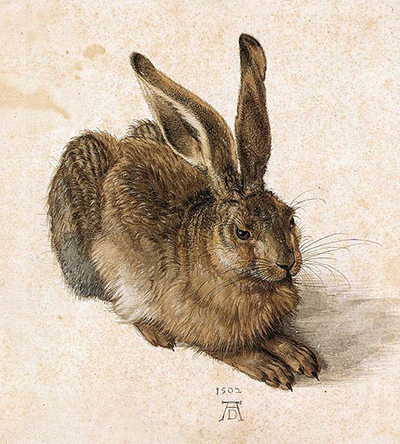
1495; date debatedYoung Hare
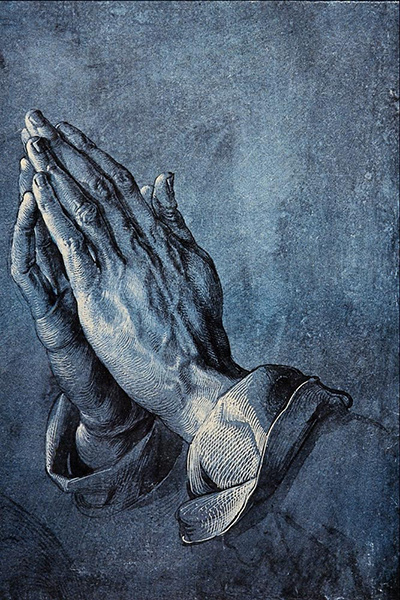
1502Praying Hands
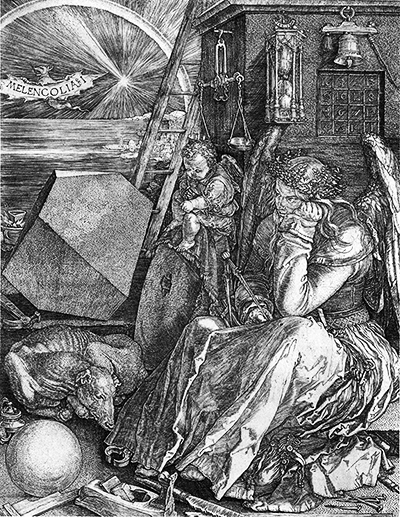
1508Melencolia I
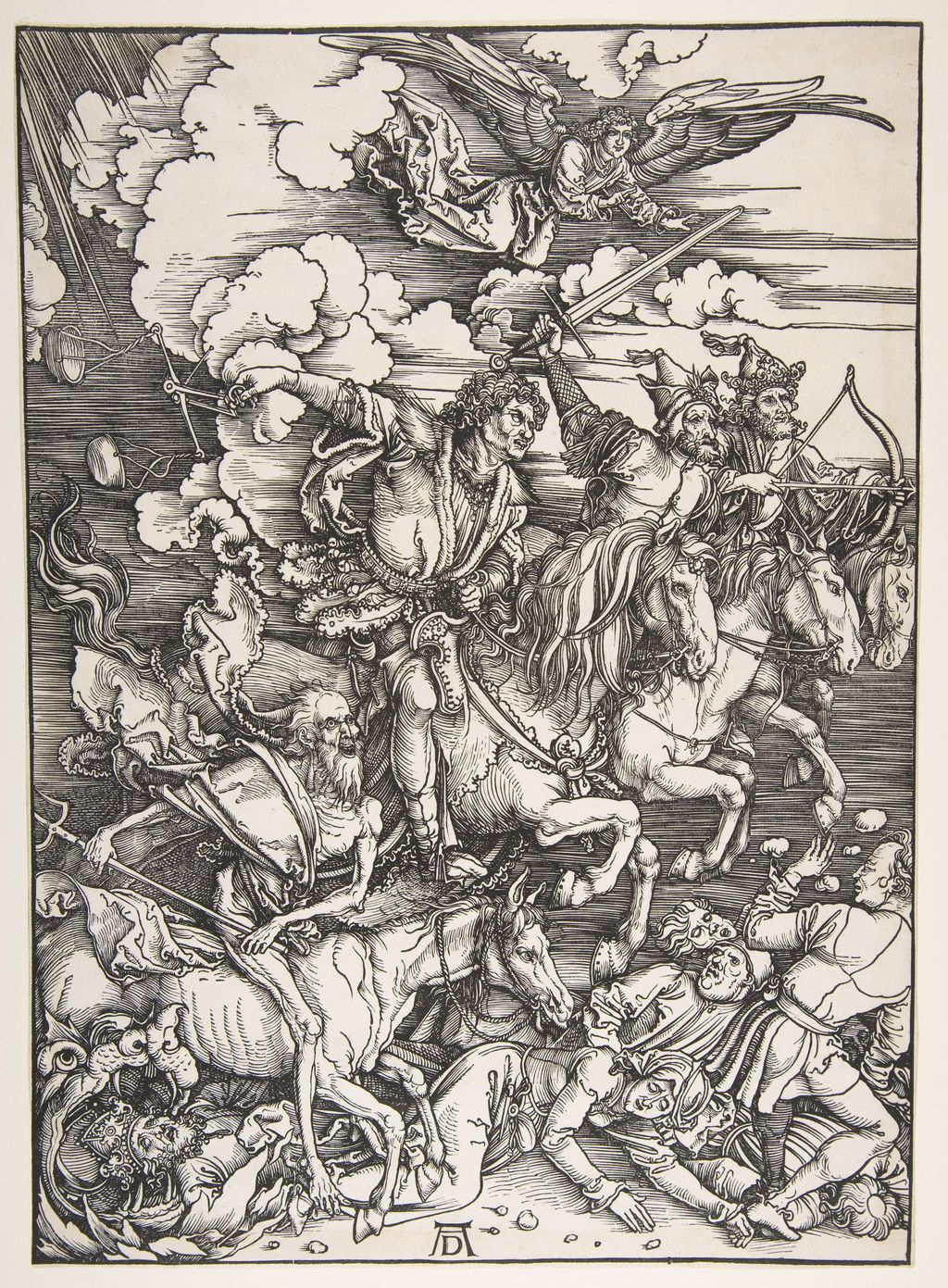
1514Four Apostles
1526Contents
- Following the river
- A city held between mountains
- Looking and making
- What the inscriptions and paper reveal
- The sheet in Bremen
- Frequently Asked Questions
Following the river
Start at the lower left, where a narrow ochre bank bends past a dark tree. This close strip of land gives the spectator somewhere to stand. Its curved edge also begins a movement that continues through the entire composition: from the near bank into the water, around the projecting trees opposite, and towards the buildings on the left. The eye follows a succession of turns before entering the distant valley. Dürer makes a broad prospect feel accessible through this very particular route into it.
A long pale shoal interrupts the foreground water. Its narrow point aims towards the left-hand cluster of buildings, while its broader end stretches back across the river. The shape adds another diagonal to an area otherwise built largely from horizontal marks. Without it, the water might read as a flat band underneath the landscape. With it, we become conscious of an expanse containing variations in the surface and exposed ground.
The water changes character from one side of the sheet to the other. Beneath the buildings at the left, dark vertical reflections descend into a sheltered-looking stretch. Across the lower right, closely spaced horizontal strokes break the surface into small ripples. Bright passages between these strokes keep the water from becoming a single heavy grey mass. The treatment makes us look both along the river and down onto its surface, two different experiences held within the same view.
Two small boats occupy the middle distance. One sits nearer the centre; another, to its right, has a long diagonal pole or oar rising above it. Their low, dark hulls nearly disappear against the river. At this scale, the people associated with them are marks rather than portraits. Yet the boats matter: they provide a measure of the breadth of the water and bring a modest human activity into a landscape whose larger forms would otherwise dominate everything. Their placement also helps bridge the gap between the empty foreground and the densely planted bank beyond.
The opposite bank is built from rounded masses of trees. Dark centres, irregular edges and lighter openings distinguish one group from the next. A pale clearing appears within the central cluster, so the wooded strip has an interior rather than presenting an unbroken wall of foliage. Buildings emerge behind it at intervals. The city extends further across the sheet than the conspicuous architecture at the left initially suggests; trees conceal part of its reach.
This is a view southwards into the Adige valley, with Trento’s northern entrance, the Deutsches Tor, included in the city prospect. The riverfront itself has since changed substantially. The Museo Diocesano Tridentino explains that the bend protecting the old city on its northern side was straightened between 1854 and 1858. That alteration matters when imagining Dürer’s position. A modern view can retain recognisable mountains and monuments while offering a very different arrangement of water and open ground. The sweeping river in the drawing belongs to the historical structure of the city. [4] [5] [2]
A city held between mountains
The buildings at the left are crowded with small distinctions: a crenellated wall, pointed roofs, pale façades, towers and dark apertures. Their closely spaced verticals arrest the movement of the river. Behind them, the mountains descend in long, slanting planes. Dürer sets these contrasting rhythms against one another so that the constructed city remains legible within a much larger terrain.
The skyline never competes in height with the mountains. Even the strongest towers occupy a relatively narrow zone near the river. This balance gives the picture its unusual spaciousness. We can examine individual structures, but the principal subject keeps expanding around them. A city name is attached to a view in which human occupation forms only one layer of the valley.
The mountains on the left are especially weighty. A jagged crest gives way to broad blue-grey faces, with darker folds descending towards the city. Nearer slopes overlap them in greener tones. These changes make the mountain range seem to possess thickness: its peaks occupy successive positions, and its lower reaches disappear behind other forms. On the right, a broad, pale slope receives more light and leads down to a thin band of distant settlement and vegetation.
Between the two sides lies an opening. The far mountains are weaker in contrast as well as smaller in apparent size; their contours soften into blue, grey and muted violet. The valley floor narrows towards them. Distance is therefore made through several cooperating effects: overlap, diminishing detail, reduced darkness and the gradual merging of land with sky. The brighter centre encourages the eye to travel beyond the visible city, towards a space that remains open.
The sky occupies a substantial part of the sheet. Its cloudy greys and blues gather more heavily near the upper edges and become lighter above the distant valley. The mountains cut into this changing field with very different profiles. Against the dark, sharply articulated left-hand ridge, the sky reads as a luminous background; above the middle distance, its softness seems continuous with the air between the mountains. The painting’s atmosphere comes from visible relationships, including the contrast between a bright horizon and the darker land and water closer to us.
Looking and making
At close range, the picture balances clear edges with passages that dissolve. A tower or roof can be defined by a few firm strokes, while a mountain face spreads across a much broader area of colour. Reflections extend architectural shapes downwards without reproducing every feature. Tree foliage gathers into dense patches, but the exposed bank beside it remains comparatively simple. Dürer varies the amount of information according to the role each part plays.
The near tree is an especially useful point of comparison. Its dark foliage overlaps the river and the architecture beyond, giving an immediate sense of separation between planes. Further away, trees become smaller, lighter and less individually described. These different degrees of visibility mean that the finely marked buildings can draw attention without every part of the sheet receiving the same precision.
Bodycolour describes a thicker, more opaque form of watercolour, distinct from the thin transparent washes often associated with the medium. Pale passages in the sky, distant slopes and river allow light to circulate through the composition. Stronger darks anchor the tree masses and sheltered water. The resulting prospect feels coherent even though its surfaces are handled with considerable variety. [6]
The GNM entry discusses Daniel Hess’s proposal that elaborate studio colouring followed a sketch made on the spot. The distinction allows room for both observation and sustained construction, with time between the encounter and the finished balance of colour. [4]
What the inscriptions and paper reveal
The owner identifies the place-name “Tryt” in carbon ink and the AD monogram as another hand’s addition in iron-gall ink. The lettering therefore has more than one history. Recognising Dürer’s famous initials is only the beginning of understanding how they arrived on this particular object. [1] [3]
The GNM researchers also found a watermark identical to one in a document dated Innsbruck, 1500. Their proposed paper-use ranges are 1496–1504 with four years’ tolerance, or 1498–1502 with two. A matching watermark on another Bremen drawing, KL9, also links the sheets through their paper. These findings complicate the traditional 1494–95 journey chronology; they do not establish an execution date of 1500. [4]
The broader dating debate reaches beyond Trento. The ALBERTINA still labels its Innsbruck from the North about 1495, while the extended catalogue text by Christof Metzger argues that the state of the Wappenturm points to observations made around 1496–97. It also discusses painting in successive stages. Those positions reveal why the Alpine watercolours cannot safely be placed along an exact itinerary simply by treating every finished sheet as a dated travel entry. For Trento, the museum’s spring 1495 label remains worth reporting. In 1899, Berthold Haendcke argued that the panorama predated 1500 because he believed its city walls reappeared in an allegorical drawing at Windsor. His reasoning depended on dating that comparison drawing to around 1500. [1] [7] [2] [8]
The sheet in Bremen
The collection history is firmer in the nineteenth century. Bremen’s catalogue records Joseph Grünling as an owner by 1821 and Hieronymus Klugkist’s acquisition in November 1827. Klugkist bequeathed it in 1851. Evacuated during the war in 1943, it was missing after 1945 and reacquired in 1980 with additional assistance from the Federal Republic of Germany. In a museum interview, curator Christien Melzer specifies that its return was mediated through the Berlin art trade. [1] [9] [2]
A sheet small enough to hold in the hands encompasses a city and a mountain corridor, while also carrying successive acts of naming, collecting, displacement and return. The airy opening between the mountains and the unhurried movement around the riverbank coexist with that much less tranquil history. [1] [2]
Frequently Asked Questions
Artworks directory
These 187 records include individual works, reverse sides, detail views, paired panels and reconstructed arrangements. Three additional catalogue images repeat works already listed. Related views are not counted as separate originals; qualified attributions and published dating are retained.
Discussion
Look again at the images and ideas explored in City of Trento from the North by Albrecht Dürer. These editorial prompts invite your observations.
Reader Insights
Which detail or idea in City of Trento from the North by Albrecht Dürer most changed your reading, and why?
How does the discussion of “Following the river” affect your understanding?
What comparison would you bring to the discussion of “The sheet in Bremen”?
Join the Conversation
Share a detail, comparison or question about City of Trento from the North by Albrecht Dürer below.
References
- Kunsthalle Bremen , Tryt , object 6862, inventory 1851/27 Z, current collection catalogue. German. View source .
- Giuseppe Alberti, La più antica veduta di Trento: acquarello di Alberto Dürer. Note e confronti con illustrazioni (Trento: Giovanni Zippel, 1898), pp. 3–10 (Italian original; selected pages). View source
- Albrecht Dürer, Deutsche Landschaften, introduction by Oswald Götz (Königstein im Taunus and Leipzig: Wilhelm Andermann, 1922), Trient plate (German original; selected plate and title). View source
- Germanisches Nationalmuseum , Trient von Norden, Bremen, KH KL10 , Dürer Tintenanalyse , last revised 7 March 2013. German and English. View source .
- Museo Diocesano Tridentino , L’immagine di Trento dal XVI al XX secolo , exhibition presentation, 2022. Italian. View source .
- Victoria and Albert Museum, What is watercolour?, updated 2 September 2026 (English; material definitions). View source
- ALBERTINA , Innsbruck von Norden , inventory 3056, current object record, including Christof Metzger’s text from Eva Michel and Maria Luise Sternath, eds., Kaiser Maximilian I. und die Kunst der Dürerzeit , 2012, pp. 140–141. German. View source .
- Berthold Haendcke, Die Chronologie der Landschaften Albrecht Dürer’s (Strassburg: J. H. Ed. Heitz, 1899), pp. 17–19 (German original; selected pages). View source
- Jasmin Mickein , “Nach knapp 70 Jahren heimgekehrt. Wie Kunstwerke verloren gehen und wieder in eine Sammlung zurück finden”, interview with Christien Melzer, Kunsthalle Bremen, 13 March 2014. German. View source .
- ALBERTINA, Selbstbildnis als Dreizehnjähriger, inv. 4839 (German). View source.
- Metropolitan Museum, Four Horsemen from The Apocalypse, 19.73.209 (English). View source.
- Bayerische Staatsgemäldesammlungen, Selbstbildnis im Pelzrock, inv. 537 (German). View source.
- ALBERTINA, Feldhase, inv. 3073 (German). View source.
- ALBERTINA, Das große Rasenstück, inv. 3075 (German). View source.
- Metropolitan Museum, Adam and Eve, 19.73.1 (English). View source.
- ALBERTINA, Betende Hände, inv. 3113 (German). View source.
- Metropolitan Museum, Knight, Death, and the Devil, 43.106.2 (English). View source.
- Metropolitan Museum, Melencolia I, 43.106.1 (English). View source.
- Bayerische Staatsgemäldesammlungen, online collection record for the left panel of Dürer’s 1526 pair, inventory 545 (German). View source
- Germanisches Nationalmuseum, Barbara Dürer (German and English). View source.
- Web Gallery of Art, Tucher–Rieter reverse (English). View source.
- National Gallery of Art, Portrait of a Clergyman (English). View source.
- Dürer Art, Portrait of a Man (English). View source.
- Hessen Kassel Heritage, Elsbeth Tucher (German). View source.
- Web Gallery of Art, Hans Tucher (English). View source.
- Germanisches Nationalmuseum, Emperor Maximilian I (German and English). View source.
- National Gallery of Art, Lot and His Daughters, reverse (English). View source.
- Bayerische Staatsgemäldesammlungen, Glim Lamentation (German). View source.
- Museo Nacional del Prado, Portrait of a Man (Spanish). View source.
- Bayerische Staatsgemäldesammlungen, Madonna of the Carnation (German). View source.
- Städel Museum, Job on the Dungheap (German). View source.
- Wallraf-Richartz-Museum, Piper and Drummer (German). View source.
- Italian Ministry of Culture / Uffizi, Head of Saint James (Italian). View source.
- Klassik Stiftung Weimar, Dresden Altarpiece (German). View source.
- Staatliche Museen zu Berlin, online collection record for the portrait of a girl, object 870760 (German and English). View source
- Dresden State Art Museums / Roland Enke, Bernhard von Reesen (German). View source.
- Royal Collection Trust, Burkhard von Speyer (English). View source.
- Dresden State Art Museums, Seven Sorrows of the Virgin (English). View source.
- Bayerische Staatsgemäldesammlungen, Mater Dolorosa (German). View source.
- Bayerische Staatsgemäldesammlungen, Lucretia (German). View source.
- Städel Museum, Young Woman with Her Hair Down (English). View source.
- ALBERTINA, Portrait of a Young Man (German). View source.
- Joseph Heller, Das Leben und die Werke Albrecht Dürer's, vol. II, part 1 (Bamberg: C. F. Kunz, 1827), p. 118, no. 138; pp. 160–162, Florence entry 13; pp. 196–197, Munich entry 17; additional selected pp. 230–231, no. 6 and p. 260, entry e. Original German edition. View source
- S. R. Koehler, A Chronological Catalogue of the Engravings, Dry-Points and Etchings of Albert Dürer, as Exhibited at the Grolier Club (New York: Grolier Club, 1897), nos. 16, 34 and 71, pp. 17–18, 37–39, 63. English. View source
- Campbell Dodgson, Catalogue of Early German and Flemish Woodcuts Preserved in the Department of Prints and Drawings in the British Museum, vol. 1 (London: British Museum, 1903). Original English edition Selected pp. 246, 260, 262, 272, 274, 288, 290, 294–296, 299–300, 302, 307. View source
- William Martin Conway, Literary Remains of Albrecht Dürer (Cambridge, 1889), pp. 34–38, 41, 44, 55–58, 60, 64–71, 76, 134–135, 246–249 (English/German). View source
- Charles Ephrussi, Albert Dürer et ses dessins (Paris: A. Quantin, 1882), selected pp.2,14–16,20,78–80,107,109,120,153,178,188,298,302; index pp.399,403,405–406,409–410; additional selected pp. 86, 111–112, 152, 158 (footnote 1) and 202. Original French edition. View source
- T. Sturge Moore, Albert Dürer (London: Duckworth and Co.; New York: Charles Scribner’s Sons, 1905), part III, portrait discussion and caption of the 1500 Munich self-portrait; additional selected Part III, II Portraits, subsection III, Hans Tucher paragraph. Original English edition. View source
- Hermann Knackfuß, Dürer, 12th edition (Bielefeld and Leipzig: Velhagen & Klasing, 1921), printed pp. 19–20, 24–26, 45–46, 58–60 and 138; plates 22, 30, 36 and 61. Original German edition. View source
- Heinrich Wölfflin, Die Kunst Albrecht Dürers, second enlarged edition (Munich: F. Bruckmann, 1908), pp. 110, 298. Original German edition. View source
- “Ein wiederaufgefundenes Gemälde von Albrecht Dürer”, Hamburgischer Correspondent, no. 473, Abend-Ausgabe (9 October 1900), p. 5, centre column (German). View source
- Albrecht Dürer, Records of Journeys to Venice and the Low Countries (Boston, 1913), translated Rudolph Tombo, diary pp. 31–32, 47–48, 59–60, 75, 83–87 (English). View source
- Maryan W. Ainsworth, Salvator Mundi, in Dürer and Beyond: Central European Drawings, 1400–1700, Metropolitan Museum, 2012, catalogue 8, pp. 19–22 (English). View source
- Moriz Thausing, Albert Dürer: His Life and Works, translated from German, edited by Fred. A. Eaton (London: John Murray, 1882), vol. I, pp. 119–120; vol. II, pp. 16–18 (English). View source View source
- Burlington Fine Arts Club, Exhibition of Early German Art (London: Burlington Fine Arts Club, 1906). Original English catalogue P.24, no.38. View source
- Johann Carl Sigmund Kiefhaber, ed., Nachrichten zur ältern und neuern Geschichte der freyen Reichsstadt Nürnberg: ein Beytrag zur Geschichte der Reichsstädte in Teutschland, vol.1 (Nuremberg: Lechner, 1803), first quarter, pp.6–9,14–16. Original German historical edition of correspondence and inventory. View source
- Maud Cruttwell, Andrea Mantegna, London: George Bell and Sons, 1901, pp. 110–112. View source
- Moriz Thausing, Dürer: Geschichte seines Lebens und seiner Kunst (Leipzig: E. A. Seemann, 1876). Original German edition Selected pp.303, 306, 308–309. View source
- Hans W. Singer, Drawings of Albrecht Dürer (London: G. Newnes; New York: C. Scribner’s Sons, 1906), p. 8; Little Owl (Schönbrunner and Meder no. 829). Original English edition. View source
- Germanisches Nationalmuseum, Katalog der im Germanischen Museum befindlichen Gemälde (Nürnberg: Verlag des Germanischen Museums, 1893), pp.34–35, nos.206–209. Original German catalogue. View source
- Joachim von Sandrart, L’Academia Todesca della Architectura, Scultura & Pittura: oder Teutsche Academie der Edlen Bau- Bild- und Mahlerey-Künste (Nuremberg, 1675), II, book 3, p. 224; facsimile and transcription. View source
- Albrecht Dürer and Benedictus Chelidonius, Epitome in Divae Parthenices Mariae Historiam ab Alberto Durero Norico per figuras digestam cum versibus annexis Chelidonii (Nuremberg: Albrecht Dürer, 1511); Vatican Library, Cicognara.IX.2022, scans 7–46, including all twenty designs, facing texts and final imprint. Latin. View source
- Friedrich Winkler, Die Zeichnungen Albrecht Dürers, II (Berlin: Deutscher Verein für Kunstwissenschaft, 1937), no. 357, pp. 73–74. German. View source
- National Gallery of Art, Annual Report 1974 (Washington: National Gallery of Art, 1975), p. 23; title and copyright pages. English. View source
- Heinrich Weizsäcker, Catalog der Gemälde-Gallerie des Städelschen Kunstinstituts in Frankfurt am Main, Erste Abtheilung: Die Werke der älteren Meister vom vierzehnten bis zum achtzehnten Jahrhundert (Frankfurt am Main: Druckerei von August Osterrieth, 1900), nos. 83 and 85, pp. 91–98. Original German edition. View source
- The Metropolitan Museum of Art, Handbook of the Benjamin Altman Collection, with painting descriptions by Bryson Burroughs, other object descriptions by Durr Friedley and William M. Milliken, and introduction by Edward Robinson (New York: The Metropolitan Museum of Art; printed by The Gilliss Press, November 1914), no. 32, pp. 50–52; staff credits, pp. xiv–xv. Original English edition. View source