


 by
Tom Gurney
Tom Gurney BSc (Hons) is an art history expert with over 20 years experience
Published on June 19, 2020 / Updated on October 22, 2026
Email:
tomgurney1@gmail.com
/ Phone:
+44 7429 011000
Design for a Goblet: Introduction
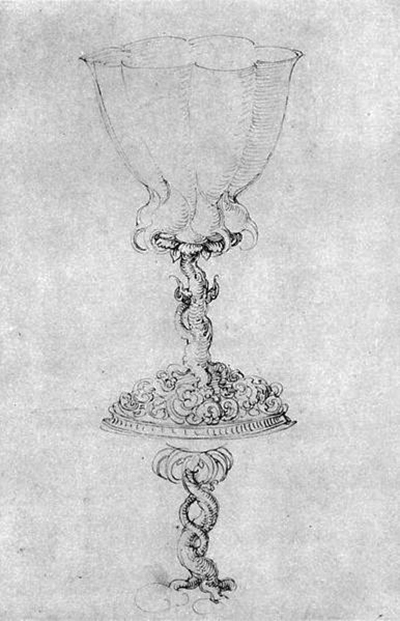
Albrecht Dürer's Design for a Goblet makes a drinking vessel seem to grow out of its own ornament. A broad, flowerlike cup rises above a narrow, twisting stem; beneath it, tightly curled foliage spreads across a low foot. Then, below the finished-looking silhouette, another stem appears, suspended on the otherwise empty paper. This small addition changes the character of the whole sheet. Dürer is offering a handsome object while continuing to think about how its parts might fit together. The British Museum, which owns the drawing, calls it Design for a Gothic cup and dates it to 1495–1500. Executed in pen and brown ink on paper, it measures 256 × 166 millimetres. [1]
At a Glance
This work across Albrecht Dürer’s career
Young Hare
1502Praying Hands
1508Melencolia I
1514Four Apostles
1526Contents
- A vessel built from curves
- The alternative below the foot
- A goldsmith's education
- More ways of making a goblet
- A new life in nineteenth-century silver
- Frequently Asked Questions
A vessel built from curves
The cup occupies most of the upper half of the design. Its opening has a scalloped outline, with rounded lobes continuing into the body below. The repeated curves create the impression of separate swelling sections gathered into a single vessel. Dürer gives the rim enough perspective to reveal the opening, allowing us to imagine looking down into it. At the same time, the drawing presents the goblet frontally enough for its height, width and ornamental divisions to be understood at a glance.
The transition from bowl to stem is especially lively. Long, leaflike forms turn outwards beneath the cup, their tips curling back towards the centre. They seem to release the smooth body into a much more restless world of hooks, loops and folds. These ornaments also give visual weight to the junction. The vessel's largest component appears to settle into a small cluster of supporting forms before the stem carries it down to the foot.
Below that junction, the stem twists irregularly, with projections that suggest clipped branches or curling shoots. It is an imagined piece of plant growth serving as a support. The foot answers it with a dense bed of scrolls. At the very bottom, however, a comparatively orderly band contains this exuberance. The shallow elliptical outline and its repeated little marks establish a firm edge on which the whole composition can rest. Decoration becomes more crowded towards the centre and more disciplined at the boundary.
The pen makes these changes of character legible. Short curved strokes turn around the cup's swelling surfaces, while denser marks collect at overlaps and recesses in the foliage. Much of the bowl remains relatively open. Its lightness depends on that restraint: the white paper can suggest a surface catching light without Dürer having to describe every part equally. The intricacy of the lower half then gives the broad cup an added sense of space and calm.
There is no coloured indication here of particular metals, gems or enamels. Brown ink establishes volume and a possible ornamental arrangement. Imagining a richly reflective metal surface is a reasonable response to the subject, but a precise scheme of gilding or colour would take us beyond what this drawing specifies.
The alternative below the foot
The separate study beneath the main goblet concentrates on the connection between foot and bowl. Two strands cross and open into elongated loops, then spread at the top into a small cluster of lobes. Compared with the stem in the complete design, this version makes the twisting structure easier to follow. The eye can move through its openings and see how one strand passes around another.
This is a useful way of presenting an alternative. The bowl does not need to be drawn again for the proposed change to become intelligible. We can mentally detach the stem above and insert the second idea. The sheet thus asks the viewer to participate in an act of assembly. It holds a complete silhouette and a possible revision together, preserving the relationship between them without making them compete for the same space.
The surviving drawing does not provide the information of a complete manufacturing specification. There are no dimensions for the proposed vessel, no sectional view explaining its interior and no written instructions on this face of the sheet. Its strongest evidence concerns the arrangement and appearance of the forms. Even the presence of an alternative cannot tell us whether Dürer was responding to a patron's request, preparing options for a craftsman or exploring a possibility for his own purposes.
The date has also required interpretation. In his 1936 catalogue, Friedrich Winkler placed this drawing among Dürer's decorative projects around 1500. He explained that its date had to be inferred from style, and thought the crowded, curling penwork belonged with the earlier group. His entry records disagreement among previous cataloguers, including proposals in the first years of the sixteenth century. The British Museum's present 1495–1500 range should therefore be understood as a catalogue judgement, rather than a year written by Dürer on the drawing. It places the sheet within the young artist's activity while leaving its precise occasion open. [12]
A goldsmith's education
Dürer's interest in such an object had a practical foundation. In the family chronicle he assembled in 1524, he recalled that his father took him out of school after he had learned to read and write and taught him the goldsmith's craft. He also stated that he could work neatly before his desire for painting became stronger. His father regretted the time already invested in the earlier training but agreed to the change; Dürer entered Michael Wolgemut's workshop in 1486. [13]
This recollection makes the goblet drawing easier to place within his career. The forms of a metal vessel were part of a trade he had encountered from within his own family. His later work on paper could draw upon that experience even though he had chosen another profession. The chronicle does not establish that he made this particular cup, nor does it reveal how far its design travelled towards execution.
Looking at the sheet with that background in mind brings its junctions into focus. How should a broad bowl meet a slender stem? How can the foot look both rich and stable? Where should ornament project, and where should the outer silhouette remain clear? Dürer's answers are visual, but the questions belong to an object that someone might hold, lift and set down. The changing density of decoration helps distinguish those parts before any workshop has resolved their construction.
More ways of making a goblet
A sheet of six vessels in the Dresden sketchbook gives a wider view of this inventive practice. Published in Robert Bruck's 1905 edition as plate 156, it brings together cups with markedly different proportions and combinations of ornament. One has a nearly spherical body and a handle. Others have lobed bowls, elaborate supports and upper sections capped by little footlike forms. Beside them, Dürer wrote that he would make more the next day. [14]
The comparison is revealing even without assigning the two sheets to the same moment. In the Dresden group, a twisted support appears beneath the vessel at the far right, while curled foliage gathers around several of the bases. We recognise ingredients also used in the British Museum design, distributed differently across a series of objects. Broad and narrow bodies, long and short stems, smooth curves and tightly folded leaves offer a vocabulary from which further combinations can be made.
In his accompanying discussion, Bruck singled out the goblet designs as particularly clear proposals for goldsmiths. He also distinguished them from nearby bottle studies whose intended material, glass or metal, he considered uncertain. His distinction draws attention to a useful feature of Dürer's work: a vessel's shape, its surface treatment and its possible material have to be considered together. The British Museum sheet offers a particularly concentrated instance of that process, making one design substantial enough to imagine while keeping another solution available underneath it. [14]
A new life in nineteenth-century silver
Winkler records the drawing as coming from Sloane's collection. In its later home at the British Museum, the sheet could serve as a resource for designers. Clive Wainwright identified it as the inspiration for the twisted stem of the so-called Coronation Cup , associated with the young Augustus Welby Northmore Pugin and made by the royal goldsmiths Rundell, Bridge & Rundell. The cup bears John Bridge's mark and the date letter for 1826–27. Wainwright places the work within Pugin's early experience of designing precious metalwork and learning from a major London workshop. [12] [15]
The surviving object, in the Royal Collection, is silver gilt with diamonds, sapphires, emeralds, rubies and enamel. The Royal Collection records its acquisition by George IV in 1827. Its familiar title is misleading: it arrived years after his coronation, and the collection suggests that the name may reflect later confusion about its purpose. [16]
Seen beside Dürer's sheet, the relationship is strongest in the lower structure. The royal cup has a spiralling stem that makes its support seem to twist as it rises. Above it, however, the bowl becomes a much more upright, densely decorated form. Pointed architectural divisions, coloured stones and small figures cover its surface. Dürer's great open lobes have given way to a different decorative programme. The two objects share a conspicuous idea without sharing an entire design.
That difference gives the nineteenth-century cup its value as a comparison. A designer could take the energy of Dürer's stem and put it to work in another setting, at another scale and with other kinds of ornament. The paper study remained useful because its forms invited adaptation. The alternative stem at the bottom of Dürer's own sheet already demonstrates that openness: even within one drawing, an object could retain its identity while one of its most expressive parts was reimagined.
Frequently Asked Questions
Artworks directory
These 187 records include individual works, reverse sides, detail views, paired panels and reconstructed arrangements. Three additional catalogue images repeat works already listed. Related views are not counted as separate originals; qualified attributions and published dating are retained.
Discussion
Look again at the images and ideas explored in Design for a Goblet. These editorial prompts invite your observations.
Reader Insights
Which detail or idea in Design for a Goblet most changed your reading, and why?
How does the discussion of “A vessel built from curves” affect your understanding?
What comparison would you bring to the discussion of “A new life in nineteenth-century silver”?
Join the Conversation
Share a detail, comparison or question about Design for a Goblet below.
References
- British Museum , Design for a Gothic cup , SL5218.78, current collection record. View source .
- ALBERTINA, Selbstbildnis als Dreizehnjähriger, inv. 4839 (German). View source.
- Metropolitan Museum, Four Horsemen from The Apocalypse, 19.73.209 (English). View source.
- Bayerische Staatsgemäldesammlungen, Selbstbildnis im Pelzrock, inv. 537 (German). View source.
- ALBERTINA, Feldhase, inv. 3073 (German). View source.
- ALBERTINA, Das große Rasenstück, inv. 3075 (German). View source.
- Metropolitan Museum, Adam and Eve, 19.73.1 (English). View source.
- ALBERTINA, Betende Hände, inv. 3113 (German). View source.
- Metropolitan Museum, Knight, Death, and the Devil, 43.106.2 (English). View source.
- Metropolitan Museum, Melencolia I, 43.106.1 (English). View source.
- Bayerische Staatsgemäldesammlungen, inventory 545: current collection record (German; descriptive citation). View source.
- Friedrich Winkler , Die Zeichnungen Albrecht Dürers , vol. I (Berlin, 1936), p. 164, no. 234. German. View source .
- Albrecht Dürer , Familienchronik (1524), family history and apprenticeship passage, electronic transcription, Bibliotheca Augustana. German. View source .
- Robert Bruck , ed., Das Skizzenbuch von Albrecht Dürer in der Königl. öffentl. Bibliothek zu Dresden (Strasbourg, 1905), pp. 39–40 and plate 156, digitised by the Saxon State and University Library Dresden. German. View source .
- Clive Wainwright , “A. W. N. Pugin and the Progress of Design as Applied to Manufacture”, in A.W.N. Pugin: Master of Gothic Revival , edited by Paul Atterbury (1995), pp. 161–75; online excerpt, Bard Graduate Center. View source .
- Royal Collection Trust , The Coronation Cup , RCIN 48358, current collection record. View source .
- Germanisches Nationalmuseum, Barbara Dürer (German and English). View source.
- Web Gallery of Art, Tucher–Rieter reverse (English). View source.
- National Gallery of Art, Portrait of a Clergyman (English). View source.
- Dürer Art, Portrait of a Man (English). View source.
- Hessen Kassel Heritage, Elsbeth Tucher (German). View source.
- Web Gallery of Art, Hans Tucher (English). View source.
- Germanisches Nationalmuseum, Emperor Maximilian I (German and English). View source.
- National Gallery of Art, Lot and His Daughters, reverse (English). View source.
- Bayerische Staatsgemäldesammlungen, Glim Lamentation (German). View source.
- Museo Nacional del Prado, Portrait of a Man (Spanish). View source.
- Bayerische Staatsgemäldesammlungen, Madonna of the Carnation (German). View source.
- Städel Museum, Job on the Dungheap (German). View source.
- Wallraf-Richartz-Museum, Piper and Drummer (German). View source.
- Italian Ministry of Culture / Uffizi, Head of Saint James (Italian). View source.
- Klassik Stiftung Weimar, Dresden Altarpiece (German). View source.
- Staatliche Museen zu Berlin, Girl with a Red Beret (German and English). View source.
- Dresden State Art Museums / Roland Enke, Bernhard von Reesen (German). View source.
- Royal Collection Trust, Burkhard von Speyer (English). View source.
- Dresden State Art Museums, Seven Sorrows of the Virgin (English). View source.
- Bayerische Staatsgemäldesammlungen, Mater Dolorosa (German). View source.
- Bayerische Staatsgemäldesammlungen, Lucretia (German). View source.
- Städel Museum, Young Woman with Her Hair Down (English). View source.
- ALBERTINA, Portrait of a Young Man (German). View source.







