


 by
Tom Gurney
Tom Gurney BSc (Hons) is an art history expert with over 20 years experience
Published on June 19, 2020 / Updated on October 22, 2026
Email:
tomgurney1@gmail.com
/ Phone:
+44 7429 011000
Expulsion from Paradise (Small Passion): Introduction
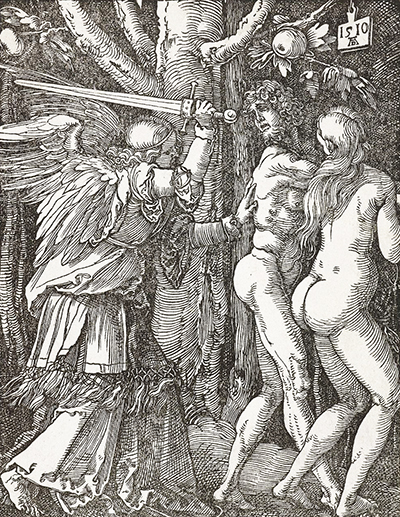
The angel's hand makes the sentence physical. Reaching across a tree trunk, it presses against Adam's side while a raised sword closes off the space above. Adam moves away but turns his face back; Eve, farther to the right, presents her back to us. Their legs overlap in an uneasy passage out of the picture. In Albrecht Dürer's Expulsion from Paradise , the loss of Eden happens within touching distance. There is scarcely room for the three figures, much less for an escape from the angel's reach.
Dated 1510 on the tablet at the upper right, this woodcut belongs near the beginning of the Small Passion . One impression in the National Gallery of Art, Washington, is printed on laid paper and trimmed to the block, measuring just 12.6 × 9.8 centimetres. Its small scale makes the crowded encounter particularly concentrated: a story of consequences for all humanity is carried by three bodies and a handful of forceful gestures. [1]
At a Glance
This work across Albrecht Dürer’s career
Young Hare
1502Praying Hands
1508Melencolia I
1514Four Apostles
1526Contents
- A departure that looks backwards
- What Genesis says
- The second scene in a longer history
- A familiar composition made newly immediate
- The body and the block
- Frequently Asked Questions
A departure that looks backwards
The angel fills the left side with wings, sleeves and a long patterned robe. One arm rises to hold the sword; the other extends almost horizontally towards Adam. These two actions enclose him between threat and pressure. The sword's long, pale blade runs across the dark trees above the angel, giving a clean edge to an otherwise intricately worked surface. It remains lifted. The immediate work of driving the couple onwards is done by the outstretched hand.
Adam's body answers that hand in several directions. His torso is exposed towards the viewer, his legs are already stepping away and his head turns towards the angel. The separation between movement and attention gives the scene its hesitation. His face can suggest an appeal, but the picture supplies no words for it. The turn itself is clearer than any precise emotion we might assign to him: his body is leaving a place to which his attention remains attached.
Eve's position makes the departure harder to read as a straightforward procession. Her long hair falls down her back, her body curves beside Adam's and her crossing legs complicate their shared movement. We can see the surface of her back and the twist of her neck, but cannot inspect her expression. This difference between the two figures matters. Adam's face offers something to read; Eve's averted head withholds it. Their proximity establishes that they leave together, without telling us exactly what either is thinking about the other.
The vegetation presses close behind them. A thick trunk occupies the centre, while branching limbs and dark leaves close the upper field. Fruit remains visible overhead, beside the signed tablet. Below, the rough ground gives the bare feet a narrow strip to cross. Dürer provides no expansive view of the world awaiting them. The urgent subject is the passage out, with the garden still surrounding their bodies and the right edge already cutting off their way forward.
What Genesis says
Genesis 3 moves from eating to concealment, accusation and judgment before it reaches expulsion. The serpent promises that eating will open the couple's eyes; after they eat, their awareness of nakedness leads them to sew fig leaves together. Adam subsequently explains that he hid because he was afraid and naked. These successive moments give bodily exposure and turning away their place in the story. [12]
The final verses introduce a further distinction. God clothes Adam and Eve in skins before sending Adam out to cultivate the ground. The stated concern is that humanity might also eat from the tree of life and live for ever. Cherubim and a turning, flaming sword are stationed to guard access to that tree. The forbidden fruit eaten earlier and the fruit whose future consumption is prevented therefore belong to different trees in the narrative. [12]
Dürer concentrates this sequence into a nude couple and a single active, sword-bearing angel. The skins described in verse 21 are absent. The visible fruit recalls the garden's abundance, but the image alone cannot settle the botanical identity or narrative function of every tree. Nor does Genesis name the forbidden fruit as an apple. Reading the text alongside the woodcut brings the artist's selection into focus: clothing, work and the guarding of immortality give way to the immediate vulnerability of bodies being pushed from their home. [12]
That selection also changes the pace. The chapter contains conversations and pronouncements extending over many verses. The woodcut brings its force into one instant of contact. The angel's robe and wings have a substantial presence beside the couple's unprotected skin. Against Adam's turning head, the straight reach of the angel's arm is uncompromising. A distant command has become an encounter that can be seen and almost felt.
The second scene in a longer history
The Expulsion follows the Fall of Man as the second narrative woodcut in the Small Passion . Published in Nuremberg in 1511, the book contained a title page, thirty-six narrative woodcuts and a colophon across thirty-eight leaves. Benedictus Chelidonius supplied Latin verses. Bridwell Library describes the resulting small-quarto volume as a portable devotional book. Its scale invited the reader to follow these encounters at close range, turning from one compact scene to the next. [13]
The accompanying Fall is the woodcut now dated probably about 1509–10, rather than Dürer's separate 1504 engraving of Adam and Eve. Looking at the two woodcuts together reveals a persistent arrangement: Eve is nearest the viewer and turns towards Adam, leaving her face concealed. In the Fall , arms and hands gather around the fruit and the two bodies remain closely joined beneath the trees. In the Expulsion , the angel inserts a new force into that intimate arrangement. The fruit remains above, while the joined couple is driven sideways. The repeated bodily relationship makes the change of circumstances readily visible. [14]
Art historian Shira Brisman gives this concealment a particular interpretation. She argues that Eve's averted face shifts attention towards shame and the viewer's prior knowledge of the story, and connects the presentation of front and back with the reversal inherent in printing. More broadly, she reads the cycle's contacts and bodily traces as a theological language especially suited to prints. Her account offers a way of connecting the figures' turns to their medium; it remains a critical interpretation, rather than a recorded explanation by Dürer. [15]
The next scenes are the Annunciation and Nativity, and the sequence eventually reaches Christ's Resurrection and the Last Judgment. Expulsion establishes the loss to which the book responds. Adam's backward glance belongs to the opening of a Christian history of salvation, with much still to come. [13]
A familiar composition made newly immediate
Dürer's arrangement also has a history within Nuremberg book illustration. Bridwell Library connects it, in reverse, with the Expulsion design associated with Michael Wolgemut in Hartmann Schedel's Nuremberg Chronicle of 1493. In the earlier book's illustrated opening, the expulsion shares a single large image with the temptation: the couple appears inside the garden and again outside, where an angel drives them towards the left. A wall and gateway make the boundary explicit. [16]
Dürer separates the two episodes into successive woodcuts and brings the act of expulsion much closer. The wall, gate and broad setting disappear from his scene; trunks, limbs and bodies occupy the space. The direction changes, yet the combination of a raised sword and an extended driving arm remains recognisable. The comparison shows how an established narrative arrangement could become a more compressed bodily encounter. Eden's boundary is now experienced through the pressure between figures.
A later treatment makes another useful comparison. Albrecht Altdorfer's Expulsion from Paradise , about 1513, belongs to his Fall and Redemption of Man . The National Gallery records a block size of only 7.2 × 4.8 centimetres. Its fleeing pair is more sharply pitched into motion, with a bright opening ahead and clouds above. Eve's face appears between the angel and Adam, while Adam turns his back towards us. Brisman reads Altdorfer's exchange of the figures' visibility as an engaged response to Dürer. Seen together, the two designs make the allocation of faces and backs especially conspicuous: a change in bodily orientation changes whose response the viewer can see. [17] [15]
The body and the block
The tonal richness of Dürer's scene comes from a relief process. In a woodcut, the printable lines remain standing on the block while surrounding material is cut away. Ink transfers from those raised surfaces to the paper. Engraving works through incised lines in metal. Here the densely worked bark and foliage build a dark enclosure, while more open passages articulate Eve's back, Adam's torso and the angel's robe. Curving strokes allow skin, feathers, fabric and timber to remain distinct within the same small field. [18]
Eve's back even became a point of revision in the printing matrix. Writing in 1861, the collector Bernhard Hausmann described ten small transverse hatch marks along her spine in the earliest impressions. He reported that these were subsequently cut away and the spinal line adjusted before the 1511 text edition; some impressions preceding that edition already showed the alteration. His historical observation concerns a specific change to the design, rather than a difference in the darkness of the ink. With raised lines, removing a little more wood could remove a mark from subsequent prints. [19]
Current institutional catalogues distinguish impressions preceding the text edition: the ALBERTINA lists DG1934/204 as Meder 127, before-text I, while the Rijksmuseum identifies RP-P-OB-1322 as the second of two before-text states. A date incorporated into the image therefore gives only part of a sheet's history. The Washington impression, for example, also passed through nineteenth- and twentieth-century collections before Lessing J. Rosenwald bought it in 1940 and gave it to the National Gallery in 1943. [20] [21] [1]
The image's small differences repay the same attention as its broad gestures. Hatching gives a back its curve; a turn makes a face available or hidden; a hand supplies the force that a sword holds in reserve. The Expulsion gathers these decisions into a crowded threshold, where departure has begun and the people leaving still turn towards what they have lost.
Frequently Asked Questions
Artworks directory
These 187 records include individual works, reverse sides, detail views, paired panels and reconstructed arrangements. Three additional catalogue images repeat works already listed. Related views are not counted as separate originals; qualified attributions and published dating are retained.
Discussion
Look again at the images and ideas explored in Expulsion from Paradise (Small Passion). These editorial prompts invite your observations.
Reader Insights
Which detail or idea in Expulsion from Paradise (Small Passion) most changed your reading, and why?
How does the discussion of “A departure that looks backwards” affect your understanding?
What comparison would you bring to the discussion of “The body and the block”?
Join the Conversation
Share a detail, comparison or question about Expulsion from Paradise (Small Passion) below.
References
- National Gallery of Art , Washington, The Expulsion from Paradise , 1510, Rosenwald Collection, 1943.3.3634. View source .
- ALBERTINA, Selbstbildnis als Dreizehnjähriger, inv. 4839 (German). View source.
- Metropolitan Museum, Four Horsemen from The Apocalypse, 19.73.209 (English). View source.
- Bayerische Staatsgemäldesammlungen, Selbstbildnis im Pelzrock, inv. 537 (German). View source.
- ALBERTINA, Feldhase, inv. 3073 (German). View source.
- ALBERTINA, Das große Rasenstück, inv. 3075 (German). View source.
- Metropolitan Museum, Adam and Eve, 19.73.1 (English). View source.
- ALBERTINA, Betende Hände, inv. 3113 (German). View source.
- Metropolitan Museum, Knight, Death, and the Devil, 43.106.2 (English). View source.
- Metropolitan Museum, Melencolia I, 43.106.1 (English). View source.
- Bayerische Staatsgemäldesammlungen, inventory 545: current collection record (German; descriptive citation). View source.
- Genesis 3 , King James Version, especially verses 5–10 and 21–24. Historical English translation. View source .
- Bridwell Library , Southern Methodist University, “The Small Passion”, Books and Prints by Albrecht Dürer . View source .
- National Gallery of Art , Washington, The Fall of Man , probably c. 1509/1510, Rosenwald Collection, 1943.3.3669. View source .
- Shira Brisman , “A Touching Compassion: Dürer's Haptic Theology”, Open Arts Journal , no. 4, Winter 2014–15, pp. 9–27, especially pp. 17–19. DOI: 10.5456/issn.2050-3679/2015w01. View source .
- Bridwell Library , Southern Methodist University, “Expulsion of Adam and Eve” and “World Chronicle”, Books and Prints by Albrecht Dürer ; the latter illustrates the 1493 German edition. View source 1 . View source 2 .
- National Gallery of Art , Washington, Albrecht Altdorfer, Expulsion from Paradise , c. 1513, 1941.1.110. View source .
- Suzanne Boorsch and Nadine M. Orenstein , The Print in the North: The Age of Albrecht Dürer and Lucas van Leyden , The Metropolitan Museum of Art Bulletin , vol. 54, no. 4, Spring 1997, pp. 3–4. View source .
- Bernhard Hausmann , Albrecht Dürer's Kupferstiche, Radirungen, Holzschnitte und Zeichnungen, unter besonderer Berücksichtigung der dazu verwandten Papiere und deren Wasserzeichen , Hannover: Hahn, 1861, “Die kleine Passion,” pp. 62–63. German. View source .
- ALBERTINA , Vienna, Die Vertreibung aus dem Paradies (Kleine Passion, 3) , DG1934/204, record updated 12 April 2023. German. View source .
- Rijksmuseum , Amsterdam, Adam en Eva verdreven uit het paradijs , RP-P-OB-1322. Dutch description with English catalogue fields. View source .
- Germanisches Nationalmuseum, Barbara Dürer (German and English). View source.
- Web Gallery of Art, Tucher–Rieter reverse (English). View source.
- National Gallery of Art, Portrait of a Clergyman (English). View source.
- Dürer Art, Portrait of a Man (English). View source.
- Hessen Kassel Heritage, Elsbeth Tucher (German). View source.
- Web Gallery of Art, Hans Tucher (English). View source.
- Germanisches Nationalmuseum, Emperor Maximilian I (German and English). View source.
- National Gallery of Art, Lot and His Daughters, reverse (English). View source.
- Bayerische Staatsgemäldesammlungen, Glim Lamentation (German). View source.
- Museo Nacional del Prado, Portrait of a Man (Spanish). View source.
- Bayerische Staatsgemäldesammlungen, Madonna of the Carnation (German). View source.
- Städel Museum, Job on the Dungheap (German). View source.
- Wallraf-Richartz-Museum, Piper and Drummer (German). View source.
- Italian Ministry of Culture / Uffizi, Head of Saint James (Italian). View source.
- Klassik Stiftung Weimar, Dresden Altarpiece (German). View source.
- Staatliche Museen zu Berlin, Girl with a Red Beret (German and English). View source.
- Dresden State Art Museums / Roland Enke, Bernhard von Reesen (German). View source.
- Royal Collection Trust, Burkhard von Speyer (English). View source.
- Dresden State Art Museums, Seven Sorrows of the Virgin (English). View source.
- Bayerische Staatsgemäldesammlungen, Mater Dolorosa (German). View source.
- Bayerische Staatsgemäldesammlungen, Lucretia (German). View source.
- Städel Museum, Young Woman with Her Hair Down (English). View source.
- ALBERTINA, Portrait of a Young Man (German). View source.







