by
Tom Gurney
Tom Gurney BSc (Hons) is an art history expert with over 20 years experience
Published on June 19, 2020 / Updated on October 22, 2026
Email:
tomgurney1@gmail.com
/ Phone:
+44 7429 011000
Heron (Garza) by Albrecht Dürer: Introduction
Albrecht Dürer’s Heron brings two ways of looking at a bird together on one sheet. At the right, the feathered body spreads into a broad grey mass beneath a slender neck and sharply pointed bill. At the left, an isolated leg receives its own, more concentrated examination. Berlin’s Kupferstichkabinett exhibited the work as Reiher , dated 1515, in its 2023 exhibition Dürer für Berlin . The watercolour is painted on parchment mounted on paper and measures 26.7 × 34.8 cm; its inventory number is KdZ 17654. [1]
The alternative name Garza is simply Spanish for heron. The picture’s distinctive arrangement makes it easy to recognise across languages: an orange-brown leg beside a pale-necked bird facing right. Its interest lies partly in the difference between those two elements. The body invites us to follow the overlapping softness of feathers, while the leg makes us attend to joints, angles and the grip of individual toes. They share a surface without pretending to occupy one continuous scene.
At a Glance
- Date 1515 [1]
- Medium Watercolour on parchment mounted on paper [1]
- Collection Kupferstichkabinett, Berlin; KdZ 17654 [1]
This work across Albrecht Dürer’s career
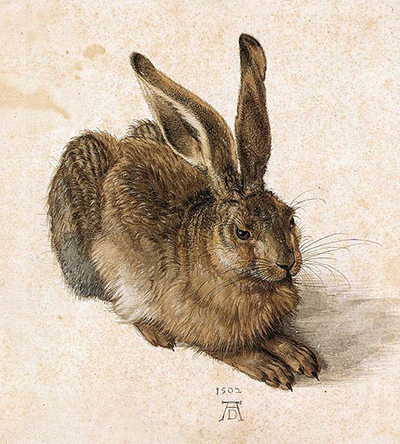
Young Hare
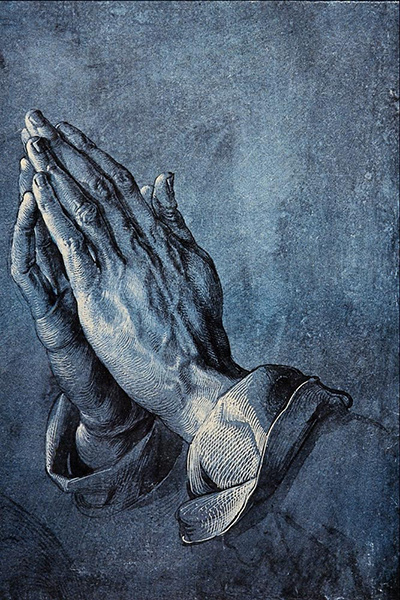
1502Praying Hands
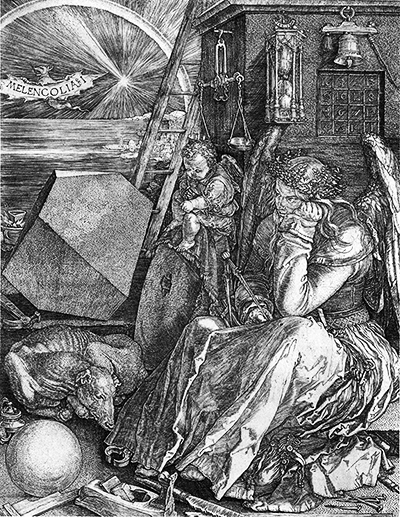
1508Melencolia I
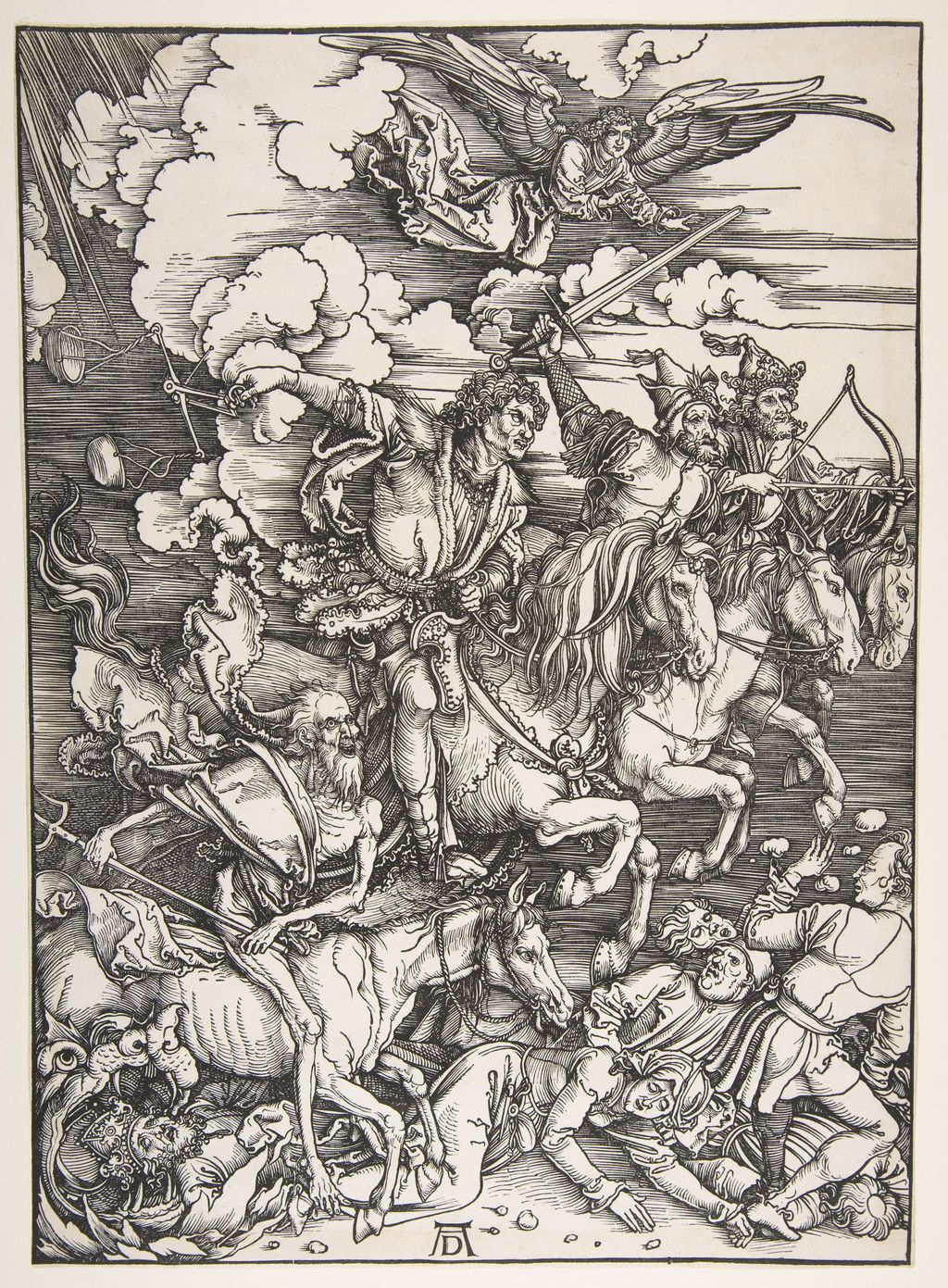
1514Four Apostles
1526Contents
- The weight of feathers
- Why the leg stands apart
- Parchment, paint and the date
- A body and a detail
- From private collection to Berlin
- Frequently Asked Questions
The weight of feathers
The heron’s head gives the composition its most decisive horizontal line. The long bill projects into the empty space at the upper right, its narrow orange shape standing out against the light background. Behind it, dark feathers sweep backwards over the crown. Their loose points give the head an irregular silhouette, while the bill holds its almost ruler-straight direction. The transition from this dark cap to the pale throat makes the head legible without enclosing every part in an equally strong outline.
Below, the neck changes direction as it descends towards the breast. Its narrowness makes the body seem particularly substantial. The back rises into a rounded shoulder and then slopes towards the right edge, where longer, darker feathers carry the eye downwards. Across the middle, paler strokes curve over the wing. Their direction matters as much as their colour: they suggest how the feathers lie over the volume beneath them, allowing the bird’s flank to feel rounded even though the setting supplies no depth.
Dürer varies the density of his description. The black cap, the dark patch at the shoulder and the outer wing feathers give the eye firm points of attachment. The breast and lower neck are much more lightly stated. At the bottom, delicate descending lines leave parts of the bird’s outline open. These differences prevent the plumage from becoming an evenly patterned covering. Softness emerges through a mixture of clear edges, layered strokes and areas where the description almost disappears into the support.
The grey body is also more varied than its overall colour first suggests. Pale bands pass between darker passages, and the wing’s lower edge gathers into a much heavier shadow. Against this restrained range, the warm bill and the separate leg are conspicuous. Colour helps connect the two studies across the blank interval between them. The leg has none of the body’s feathery breadth, but its orange-brown tone answers the small, concentrated warmth of the face.
Why the leg stands apart
The leg at the left begins near the top edge and runs down through a pronounced bend before reaching the foot. Its narrow form changes direction abruptly, creating an angular counterpart to the bird’s flowing neck. The toes spread and curl below, with dark tips making their ends particularly distinct. Because the limb is shown apart from the body, its construction can be followed without the breast or wing obscuring it. The arrangement offers a second route into understanding the animal.
This separation also changes how we read the sheet. A heron placed in reeds or shallow water would invite a story about its habitat or activity. Here there is no bank, pool or horizon. The two studies occupy available space according to what each needs to show. The elongated leg uses the height of the left side; the broad body uses the width of the right. Their different proportions make the sheet feel responsive to the subject rather than governed by a single enclosing outline.
We can recognise the observational purpose of the arrangement without reconstructing an undocumented session in Dürer’s workshop. The isolated limb does not establish whether the bird was alive, dead or preserved when studied. Nor does the lifelike head establish that the entire picture was completed before a living specimen. What survives is the artist’s selection of views. The body and leg allow complementary features to remain visible, and the gap between them makes that selection unusually apparent.
Parchment, paint and the date
The support belongs to this picture’s identity. Berlin specifies parchment with a paper backing. The pale field visible around the bird therefore forms part of a layered physical object. The empty areas are visually active: they separate the leg from the body, let the bill project clearly and give the lightly painted neck room to turn. The absence of a landscape focuses attention on the changing boundaries between paint and bare surface. [1]
The visible difference between broad grey passages and finer feather marks is easy to appreciate, but it does not provide a complete recipe for the work. The checklist names watercolour but provides no pigment analysis. The crisp dark points and softer pale areas show the range of effects achieved within the image. They do not, by themselves, identify particular pigments or prove how the parchment was prepared. [1]
The date has a scholarly history. In Albrecht Dürer: Aquarelle , published in 1971 with an afterword by Werner Timm, the Heron appears as a work of about 1503. Its catalogue entry describes the monogram and the date 1515 as additions by another hand. Berlin’s 2023 checklist nevertheless labels the sheet 1515 and attributes it to Dürer. The recent museum label provides the principal identification here, while the older entry explains why the inscribed year should be treated with care. It cannot establish an Italian location or an episode of travel. [12] [1]
A body and a detail
The combination of an animal with a separately examined part has a useful parallel in Dürer’s two roller studies at the Albertina in Vienna. Its Wing of a Blue Roller , inventory 4840, and Dead Blue Roller , inventory 3133, are both currently dated about 1500 and painted on fine parchment. The museum treats the “1512” inscriptions on those sheets as later additions whose authority is uncertain. Their dating history offers another reason to distinguish the making of a nature study from a date subsequently written on it. [13] [14]
Looking at the images makes the comparison more specific. The roller’s wing opens into a fan of blue and green feathers, giving a detached body part the visual presence of a complete subject. The full roller presents its breast and underside, with the wings falling to either side. In the Heron, the leg’s sparseness sets off the feathered body within a single horizontal arrangement. Each solution makes an anatomical detail independently readable, but the balance between part and whole changes.
These comparisons do not establish that the Heron belonged to a planned series. They help explain why an isolated leg can command attention beside a more fully described bird. Margaret Doyle’s National Gallery of Art brochure makes the broader point that Dürer’s nature drawings were not necessarily preparations for other compositions. A study could sustain interest through the subject it explored. Here the two views give us enough to examine without requiring a lost painting or print to explain their existence. [15]
From private collection to Berlin
A likely early reference to the Heron appears in Moriz Thausing’s book of 1882. He describes a heron on parchment dated 1515 in the possession of Herr Hasse of Göttingen, formerly in the Grünling collection in Vienna. The description agrees with the Berlin study’s subject, support and inscribed date. The notice supplies neither an illustration nor the complete chain of transfers into the museum, so the connection remains provisional. [16]
Berlin’s 2023 exhibition texts place the Heron among acquisitions financed by sales of duplicate works in the 1930s. Its arrival belongs to an active process of reshaping the collection: the museum relinquished some works to strengthen its holdings elsewhere. [17]
Frequently Asked Questions
Artworks directory
These 187 records include individual works, reverse sides, detail views, paired panels and reconstructed arrangements. Three additional catalogue images repeat works already listed. Related views are not counted as separate originals; qualified attributions and published dating are retained.
Discussion
Look again at the images and ideas explored in Heron (Garza) by Albrecht Dürer. These editorial prompts invite your observations.
Reader Insights
Which detail or idea in Heron (Garza) by Albrecht Dürer most changed your reading, and why?
How does the discussion of “The weight of feathers” affect your understanding?
What comparison would you bring to the discussion of “From private collection to Berlin”?
Join the Conversation
Share a detail, comparison or question about Heron (Garza) by Albrecht Dürer below.
References
- Staatliche Museen zu Berlin , Kupferstichkabinett, Dürer für Berlin: Werkliste , 2023, p. 17, no. 115, Reiher , KdZ 17654. German. View source .
- ALBERTINA, Selbstbildnis als Dreizehnjähriger, inv. 4839 (German). View source.
- Metropolitan Museum, Four Horsemen from The Apocalypse, 19.73.209 (English). View source.
- Bayerische Staatsgemäldesammlungen, Selbstbildnis im Pelzrock, inv. 537 (German). View source.
- ALBERTINA, Feldhase, inv. 3073 (German). View source.
- ALBERTINA, Das große Rasenstück, inv. 3075 (German). View source.
- Metropolitan Museum, Adam and Eve, 19.73.1 (English). View source.
- ALBERTINA, Betende Hände, inv. 3113 (German). View source.
- Metropolitan Museum, Knight, Death, and the Devil, 43.106.2 (English). View source.
- Metropolitan Museum, Melencolia I, 43.106.1 (English). View source.
- Bayerische Staatsgemäldesammlungen, inventory 545: current collection record (German; descriptive citation). View source.
- Albrecht Dürer: Aquarelle , with an afterword by Werner Timm (Berlin: Union Verlag, 1971), list of plates, p. 74, no. 19, Reiher . German. View source .
- ALBERTINA , Der Flügel einer Blauracke , inventory 4840, collection record and catalogue text by Heinz Widauer, 2008. German and English. View source .
- ALBERTINA , Tote Blauracke , inventory 3133, collection record and catalogue text by Heinz Widauer, 2003. German and English. View source .
- Margaret Doyle , Albrecht Dürer: Master Drawings, Watercolors, and Prints from the Albertina , National Gallery of Art exhibition brochure, 2013, pp. 14–15, “Capturing Details of Nature.” View source .
- Moriz Thausing , Albert Dürer: His Life and Works , translated from German, edited by Fred. A. Eaton (London: John Murray, 1882), vol. II, pp. 53–54. View source .
- Staatliche Museen zu Berlin , Dürer für Berlin: Ausstellungstexte , 11 May 2023, pp. 6–7, “Dürer bis heute.” German. View source .
- Germanisches Nationalmuseum, Barbara Dürer (German and English). View source.
- Web Gallery of Art, Tucher–Rieter reverse (English). View source.
- National Gallery of Art, Portrait of a Clergyman (English). View source.
- Dürer Art, Portrait of a Man (English). View source.
- Hessen Kassel Heritage, Elsbeth Tucher (German). View source.
- Web Gallery of Art, Hans Tucher (English). View source.
- Germanisches Nationalmuseum, Emperor Maximilian I (German and English). View source.
- National Gallery of Art, Lot and His Daughters, reverse (English). View source.
- Bayerische Staatsgemäldesammlungen, Glim Lamentation (German). View source.
- Museo Nacional del Prado, Portrait of a Man (Spanish). View source.
- Bayerische Staatsgemäldesammlungen, Madonna of the Carnation (German). View source.
- Städel Museum, Job on the Dungheap (German). View source.
- Wallraf-Richartz-Museum, Piper and Drummer (German). View source.
- Italian Ministry of Culture / Uffizi, Head of Saint James (Italian). View source.
- Klassik Stiftung Weimar, Dresden Altarpiece (German). View source.
- Staatliche Museen zu Berlin, Girl with a Red Beret (German and English). View source.
- Dresden State Art Museums / Roland Enke, Bernhard von Reesen (German). View source.
- Royal Collection Trust, Burkhard von Speyer (English). View source.
- Dresden State Art Museums, Seven Sorrows of the Virgin (English). View source.
- Bayerische Staatsgemäldesammlungen, Mater Dolorosa (German). View source.
- Bayerische Staatsgemäldesammlungen, Lucretia (German). View source.
- Städel Museum, Young Woman with Her Hair Down (English). View source.
- ALBERTINA, Portrait of a Young Man (German). View source.