by
Tom Gurney
Tom Gurney BSc (Hons) is an art history expert with over 20 years experience
Published on June 19, 2020 / Updated on October 22, 2026
Email:
tomgurney1@gmail.com
/ Phone:
+44 7429 011000
Head of an Apostle Looking Downward: Introduction
The forehead catches the light before the face comes into view. Beneath its broad, rounded surface, the brows contract, the eyes turn down and a long beard spreads into loose, tapering strands. Dürer's Head of an Apostle Looking Downward asks us to look closely at someone who seems absorbed in looking elsewhere. The head feels remarkably substantial, although there is no body beneath it and little surrounding space to explain its position.
This drawing, dated 1508, belongs to the ALBERTINA in Vienna, inventory 4836. It measures 31.6 × 22.9 centimetres. Dürer used grey and black brushwork, grey wash and opaque white on paper prepared with green over a pink ground. The coloured surface participates in almost every part of the image. Around the face it becomes atmosphere; within the head it becomes the quiet tone between illumination and shadow. [1]
At a Glance
- Date 1508 [1]
- Materials Grey and black brushwork, wash and opaque white on prepared paper [1]
- Collection ALBERTINA, Vienna; 4836 [1]
This work across Albrecht Dürer’s career
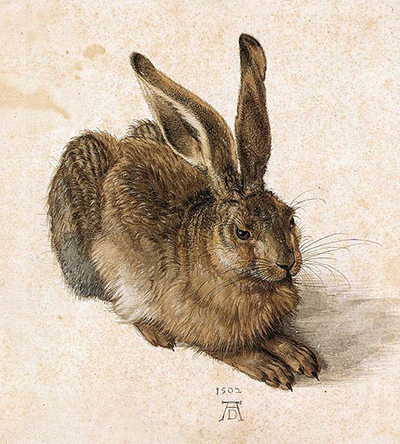
Young Hare
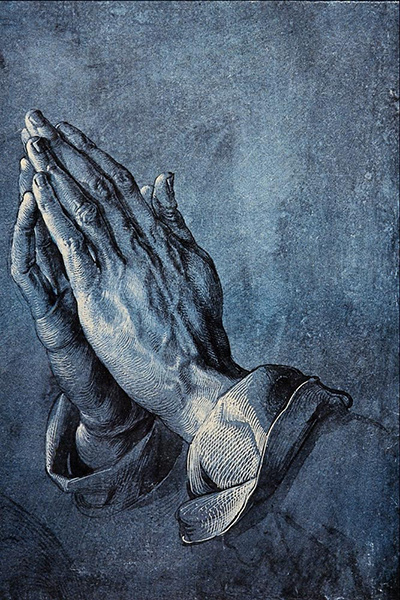
1502Praying Hands
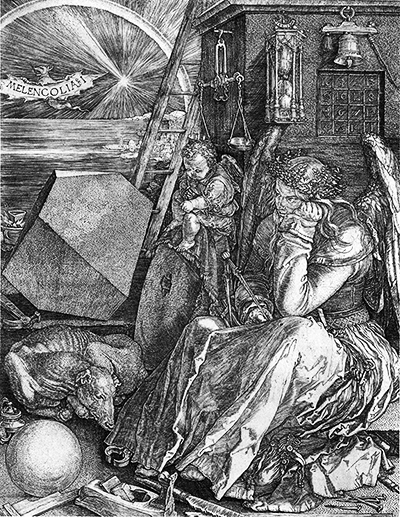
1508Melencolia I
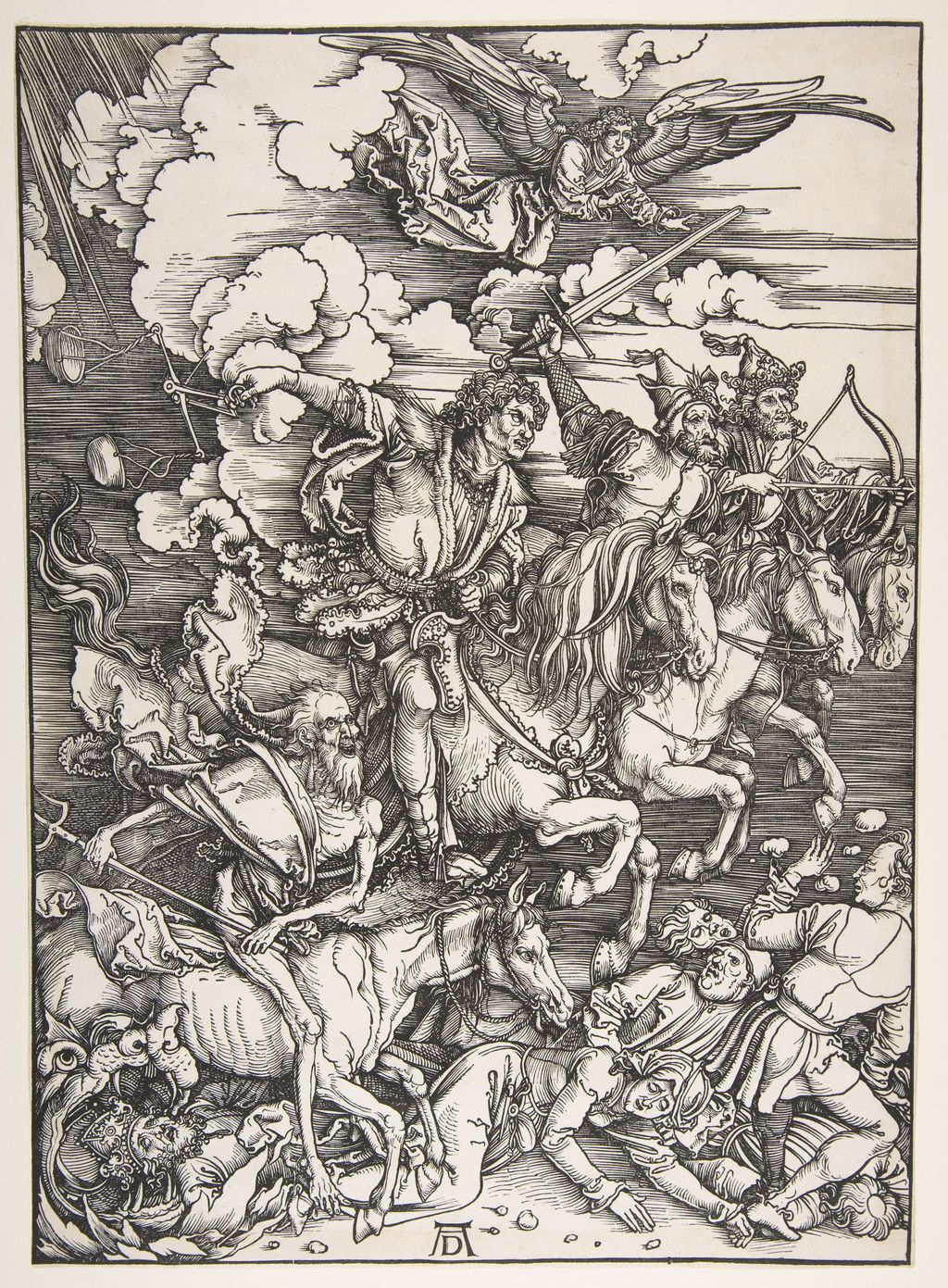
1514Four Apostles
1526Contents
- A face built from changing lines
- Working between light and dark
- The other half of the sheet
- Finding the head in the Heller Altarpiece
- How much care could a face receive?
- A drawing with its own afterlife
- Frequently Asked Questions
A face built from changing lines
The crown of the head looks smooth from a distance. Closer inspection reveals a field of extremely fine, curving strokes. Their direction changes as they pass over the skull. Near the temple the marks become tighter and darker; over the forehead they spread and intersect with pale lines. Dürer gives the impression of a rounded surface by making the drawing move around it. A bright patch above the brow pulls the front of the skull towards us, while the shadow at the side lets it turn away.
The features below are much more compressed. The eyebrows project over the eyes like small shelves, and their individual hairs break the edge of the shadow. A deep crease crosses the forehead immediately above them. The nose descends sharply into the pale moustache, with a dark recess at its side. Its strong outline is one of the easiest parts of the face to follow, yet the cheek beside it depends on small changes of tone. The mouth almost disappears into hair. These differences give the face its particular rhythm: broad forehead, crowded features, then a long release into the beard.
That beard rewards more than a glance. At the left it divides into heavy, irregular locks, some edged with light and others falling into deep shadow. Across the front, finer hairs descend in long curves, opening into a lighter, more transparent mass. Near the bottom, individual strands seem to wander away from the main shape. The drawing alternates between describing hair as a solid volume and letting us see it as separate filaments. The same white medium can mark a sharp ridge, a shining hair or a thin veil over a darker passage.
The visible ear offers another small change of pace. Its pale outer rim turns into the darker hollow inside, while the hair behind it sweeps backwards before curling down. This backward motion balances the beard's descent. The head is lowered, but its forms do not all collapse in one direction. Dürer distributes movement through the hair, the brow and the cheek, so that a still pose remains full of activity.
Working between light and dark
A coloured ground gives an artist a middle value from the outset. Dark marks deepen it into shadow; white marks lift it towards light. The ALBERTINA's 2025 exhibition, curated by Achim Gnann and Christof Metzger, distinguishes Dürer's carefully prepared grounds from the blue paper coloured during manufacture that he used in Venice. The catalogue identifies the layers; their order cannot be established from the present colour alone. [12]
The method is especially clear where the scalp meets the surrounding ground. Much of the apparent flesh consists of a surface that remains close in tone to the background, crossed by dark and pale strokes. There is no need to fill the entire head with a separate flesh colour. At the cheek, pale accents make the prominent bone project; below it, a dark hollow gives the lower face its sunken appearance. Light establishes both the shape of the face and the condition of its surface.
The unusually narrow range of colours makes these changes easier to follow. One can move from the brilliant accents above the eyes to the softer light in the beard, then into the deepest recesses beside the nose. Each area receives a different balance of strokes and wash. Dürer sustains the illusion of skin, hair and bone while allowing the marks that create it to remain visible.
The other half of the sheet
Originally, the head shared a sheet with the hanging arm now catalogued as ALBERTINA 3114: head on the right, arm on the left. Reuniting them in the imagination changes the apparent purpose of this solitary head. The page once brought a face and a hanging arm into the same field of attention. [1] [13]
In the arm drawing, the hand drops below a folded cuff. Its fingers hang at slightly different angles, and white strokes run over the knuckles and along their lengths. The sleeve is articulated by larger folds, but these too are built with fine dark and light marks. Where the fabric turns back at the cuff, closely spaced lines follow the curve. Beside the apostle's beard, this would have offered a second demonstration of how repeated strokes could distinguish one substance from another.
The two fragments also preserve different kinds of weight. The head bears down through its gaze and beard; the hand hangs from the wrist, with the broad sleeve rising above it. Their separation encourages us to treat one as a portrait and the other as an anatomical or costume study. Their original coexistence makes the shared investigation of light and surface more apparent.
In the altarpiece, these details belonged to different apostles: the head at the far left and the arm to the foreground Peter. The sheet could accommodate details needed in different parts of a composition. Its arrangement was more flexible than a diagram of an assembled figure. [1] [13]
Finding the head in the Heller Altarpiece
The central painting for which these studies were made no longer survives. Jobst Harrich's replacement, commissioned in 1614 when Maximilian of Bavaria acquired Dürer's panel, is now in the Historisches Museum Frankfurt. It measures 189 × 138 centimetres and is painted in mixed technique on limewood. The copy preserves the composition through which this separate head can be placed among the apostles. [14]
In Harrich's picture, the men gather around a tomb below the Virgin's ascent and coronation. The lower scene is crowded with bodies turning, kneeling and looking in different directions. The long-bearded head near the far left is much smaller within this whole. Seen there, a lowered gaze contributes to a group response: attention can be directed towards the tomb as well as towards the figures above. The isolated drawing lets us dwell on distinctions that become subordinate within the larger religious event.
The copy is valuable evidence for that arrangement, but its broad view cannot tell us exactly how Dürer's finest drawn hairs became paint. Nor does the drawing record the final colour of the apostle's face. The two images answer different questions. One shows the figure's place in the scene; the other makes a sustained encounter with the construction of a head possible.
How much care could a face receive?
Dürer's letters to Jakob Heller make the investment of time unusually tangible. On 24 August 1508, the year written on this drawing, he explained that he had carefully outlined the central panel and laid in two good colours. He proposed repeated further applications and promised to paint it himself. In William Martin Conway's 1889 English translation, the letter also conveys his pleasure in the undertaking, alongside his concern about its cost and the approaching short winter days. [15]
The correspondence becomes particularly revealing when Heller's expectations turn towards the greatest possible care. On 4 November 1508, Dürer objected that such an unlimited promise would be impossible to fulfil. With care pushed to that extreme, he wrote, “I can hardly finish a face in half a year”. He then asked what use that degree of elaboration would be on an altarpiece where nobody could see it. The argument bears directly on our experience of this head: we can examine it from a closeness that a church painting would seldom allow. [15]
The remark is part of a disagreement over work and payment. It gives no timetable for drawing this particular face, and the head's extraordinary finish does not establish how many sittings it required. What it does reveal is Dürer's awareness that precision had practical limits, depending on the size, position and audience of a work.
By 21 March 1509, he reported that the lower part of the painting was complete apart from varnishing, while cherubs still required painting above. On 24 July, with delivery under discussion, he returned to the difference between the simpler work initially envisaged and the prolonged labour he had actually invested. Cristina Neagu's modern translation of that letter is based on Friedrich Campe's 1828 edition; the autograph is lost. The exchange lets us follow a changing negotiation, rather than a neat plan executed without interruption. [15] [16]
Anja Grebe's study of Dürer's pricing draws attention to the additional value he claimed for artistic distinction and the judgement of other painters. That context helps explain why sheer finish could matter beyond the immediate needs of a commission. The 2025 ALBERTINA exhibition interprets such elaborate drawings as demonstrations retained within a workshop archive, questioning their usefulness as direct preparatory aids. Their relationship to paintings remains clear; their degree of finish opens a further question about whom they were intended to impress. [17] [12]
A drawing with its own afterlife
The ALBERTINA's catalogue essay relates the head's emphatic features to Dürer's Italian experience, particularly impressions of Leonardo. The individual appearance of the face does not supply a name, occupation or personal history. Its expressive force can be appreciated without attaching an invented biography to the face. [1]
The museum's provenance lists probable ownership by Rudolf II, then the imperial treasury, the court library from 1783 and Duke Albert of Saxe-Teschen in 1796. Its present independence is part of that long collecting history, although the record does not identify who divided the original sheet or when. The surviving fragments retain enough common purpose to invite us to look across that division. [1]
At close range, the head can still seem to alternate between a human presence and a network of marks. The white hairs across the mouth resolve into an aged face; a moment later, they become delicate strokes again. That movement between the subject and its making gives this fragment a particular intimacy. The apostle belongs within a distant, crowded altarpiece, while the drawing brings the act of looking close enough for us to follow it line by line.
Frequently Asked Questions
Artworks directory
These 187 records include individual works, reverse sides, detail views, paired panels and reconstructed arrangements. Three additional catalogue images repeat works already listed. Related views are not counted as separate originals; qualified attributions and published dating are retained.
Discussion
Look again at the images and ideas explored in Head of an Apostle Looking Downward. These editorial prompts invite your observations.
Reader Insights
Which detail or idea in Head of an Apostle Looking Downward most changed your reading, and why?
How does the discussion of “A face built from changing lines” affect your understanding?
What comparison would you bring to the discussion of “A drawing with its own afterlife”?
Join the Conversation
Share a detail, comparison or question about Head of an Apostle Looking Downward below.
References
- ALBERTINA , Kopf eines Apostels (Detail aus dem “Heller-Altar”) , inventory 4836. German. Current object record and Heinz Widauer's catalogue text, Albrecht Dürer (Vienna, 2003), no. 114, p. 363, reproduced in the record. View source .
- ALBERTINA, Selbstbildnis als Dreizehnjähriger, inv. 4839 (German). View source.
- Metropolitan Museum, Four Horsemen from The Apocalypse, 19.73.209 (English). View source.
- Bayerische Staatsgemäldesammlungen, Selbstbildnis im Pelzrock, inv. 537 (German). View source.
- ALBERTINA, Feldhase, inv. 3073 (German). View source.
- ALBERTINA, Das große Rasenstück, inv. 3075 (German). View source.
- Metropolitan Museum, Adam and Eve, 19.73.1 (English). View source.
- ALBERTINA, Betende Hände, inv. 3113 (German). View source.
- Metropolitan Museum, Knight, Death, and the Devil, 43.106.2 (English). View source.
- Metropolitan Museum, Melencolia I, 43.106.1 (English). View source.
- Bayerische Staatsgemäldesammlungen, inventory 545: current collection record (German; descriptive citation). View source.
- ALBERTINA , Leonardo–Dürer: Renaissance Master Drawings on Colored Ground , press dossier, 2025. English; exhibition curated by Achim Gnann and Christof Metzger, especially pp. 6–10. View source .
- ALBERTINA , Linke Hand eines Apostels (Detail aus dem “Heller-Altar”) , inventory 3114. German. Current record and Heinz Widauer's catalogue text, Albrecht Dürer (Vienna, 2003), no. 113, p. 363, reproduced in the record. View source .
- Städel Museum , Zeitreise, Jobst Harrich, Ascension and Coronation of the Virgin , B 265. English/German. Record of the 1614 replacement, owned by the Historisches Museum Frankfurt. View source .
- Albrecht Dürer , letters to Jakob Heller, in William Martin Conway, Literary Remains of Albrecht Dürer (Cambridge, 1889). English translation: 24 August 1508, p. 65; 4 November 1508, pp. 65–67 (quoted passage p. 66); 21 March 1509, p. 67; 24 July 1509, pp. 68–69. View source .
- Albrecht Dürer to Jakob Heller , 24 July 1509, p. 1, translated by Cristina Neagu, hosted by Early Modern Letters Online, Bodleian Libraries. English. Based on Friedrich Campe, Reliquien von Albrecht Dürer (1828), pp. 45–47. View source .
- Anja Grebe , “Marketing favours: Formal and informal criteria for pricing Albrecht Dürer's works between 1500 and 1650”, Journal for Art Market Studies 1, no. 1 (8 February 2017), DOI 10.23690/jams.v1i1.3. English; especially the opening discussion of the Heller correspondence. View source .
- Germanisches Nationalmuseum, Barbara Dürer (German and English). View source.
- Web Gallery of Art, Tucher–Rieter reverse (English). View source.
- National Gallery of Art, Portrait of a Clergyman (English). View source.
- Dürer Art, Portrait of a Man (English). View source.
- Hessen Kassel Heritage, Elsbeth Tucher (German). View source.
- Web Gallery of Art, Hans Tucher (English). View source.
- Germanisches Nationalmuseum, Emperor Maximilian I (German and English). View source.
- National Gallery of Art, Lot and His Daughters, reverse (English). View source.
- Bayerische Staatsgemäldesammlungen, Glim Lamentation (German). View source.
- Museo Nacional del Prado, Portrait of a Man (Spanish). View source.
- Bayerische Staatsgemäldesammlungen, Madonna of the Carnation (German). View source.
- Städel Museum, Job on the Dungheap (German). View source.
- Wallraf-Richartz-Museum, Piper and Drummer (German). View source.
- Italian Ministry of Culture / Uffizi, Head of Saint James (Italian). View source.
- Klassik Stiftung Weimar, Dresden Altarpiece (German). View source.
- Staatliche Museen zu Berlin, Girl with a Red Beret (German and English). View source.
- Dresden State Art Museums / Roland Enke, Bernhard von Reesen (German). View source.
- Royal Collection Trust, Burkhard von Speyer (English). View source.
- Dresden State Art Museums, Seven Sorrows of the Virgin (English). View source.
- Bayerische Staatsgemäldesammlungen, Mater Dolorosa (German). View source.
- Bayerische Staatsgemäldesammlungen, Lucretia (German). View source.
- Städel Museum, Young Woman with Her Hair Down (English). View source.
- ALBERTINA, Portrait of a Young Man (German). View source.